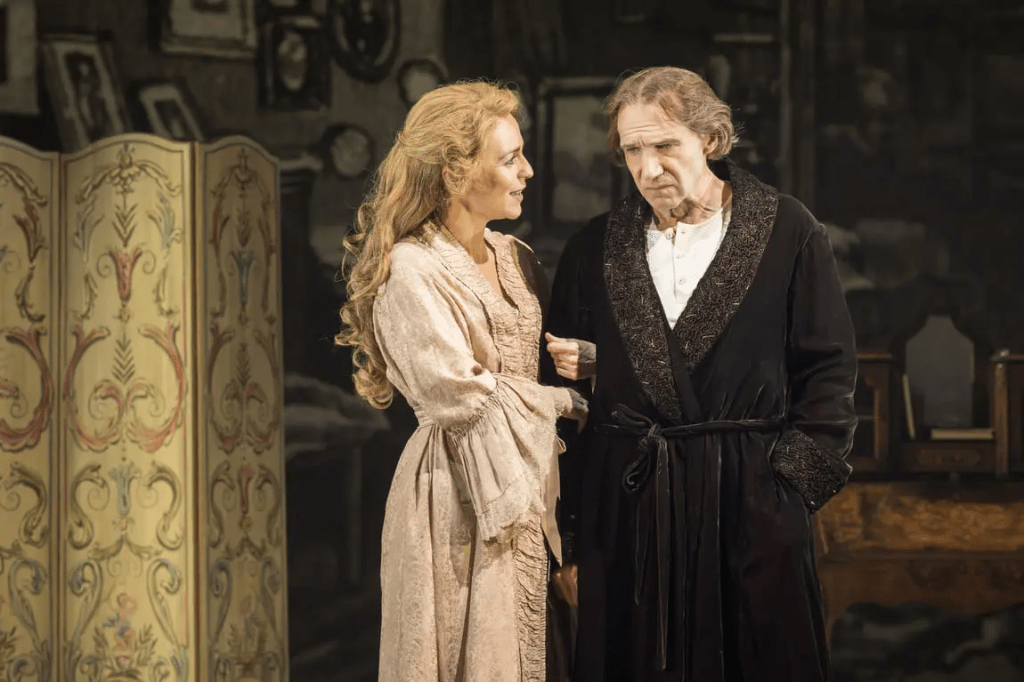
Grace Pervades at Theatre Royal Haymarket is by people who love theatre about people who love theatre for people who love theatre. The play explores the relationship between two of the most influential actors in England’s history, starring Miranda Raison as Ellen Terry and Ralph Fiennes as Henry Irving. Their story is about love and compromise and passion. When Raison and Fiennes are on-stage, they are captivating. They are so natural as their characters and have such beautiful chemistry together. The entire show, I just wanted to know more about them and their relationship. However, instead we had too many scenes about Ellen Terry’s children and their boring lives. Although I was interested in her daughters lesbian throuple and her son’s affair, these aspects were never discussed during the play. I understand the playwright’s intent was to show Terry and Irving’s influence and inspiration, but it fell flat because of how incredibly boring these plotlines were. If these scenes of the Terry siblings were replaced with more of Fiennes and Raison, every minute of this play would have enthralled me. This being said, I did enjoy the narration from the children and I think that would have been enough to show how their mother and Irving influenced them and their lives. What I think added to some of my boredom throughout the play, was the pace of the show. Much of the play moved at a very slow, careful pace and had very little times when this changed. I think moments where the pace slows can be beautiful, but when the entire show moves that slow, it is hard to appreciate those moments. Overall, I thought the acting, the costumes, and the lighting were beautiful, I would just have preferred the story to be structured differently. Also the Royal Haymarket desperately needs to invest in new seats as soon as possible.
Even if I could not quite see their faces all the way up in the highest stalls, I still felt the zeal in every word, action, and nod to the audience, who were exuding the same passion from their seats as the performers on the stage. This was not just a show about iconic historical theatre professionals—but rather an examination of how theatre changes, influences, and drives the people engaged in it.
I will not deny my initial tedium toward the beginning of the play, questioning who these people were and why they are significant. (After some research, I now know!) But I did find aspects of it deeply intriguing, such as the banter between Irving and Terry, and seeing how they gained each other’s respect by speaking authentically. I thought that Irving’s sincerity when recruiting her to his theatre company was admirable and real, as he explained how Terry’s presence brings joy. Joy is necessary in the theatre, no matter what story or what ending, the audience should find at least an ounce of hope or happiness by the end of it, otherwise what was the point? I specifically enjoyed the scene where Terry spoke out against Irving’s unintentional ignorance toward her, as well as correcting him on some of his acting choices. As well as when she tested him by wearing black and posing certain changes of their Hamlet production. This kind of conversation is essential in the theatre, as if one feels no need for improvement or diversity, the flow of impact may go stagnant. I enjoyed seeing them “argue,” and felt it represented how the arts are so subjective.
Irving seemed to embody an opinion of theatre that will always remain, one rooted in tradition, discipline, spectacle, and reputation. This is shown through his production of only Shakespeare plays, his costume stringency, and his occasional outbursts in devotion. Meanwhile, Terry challenged him with her progressiveness and instinctively emotional beliefs within theatre.
Speaking to the differences again with Terry and Irving, I found the interpolations of their family life with their dedication to the arts was compelling. Irving learned that his son had attempted suicide just ten minutes before he was set to go onstage, yet he still performed without missing a beat. This moment raises a question: what do we lose when we give ourselves entirely to a passion, and what do we gain in return? As Irving suggests, performing became a kind of “distraction,” perhaps even a refuge from the pain that comes with real life. I thought this scene was a commentary on the cost of commitment. He was one of the greatest of all time, but his entire life was spent on the stage. I believe at one point he mentioned 700 roles, and when he added that he felt uncomfortable talking to women, it made me want to ask, does performing that many different characters make you lose a sense of your own? Not only did it feel like a love letter to theatre, but it also felt like a reflection on theatre’s power… how it shapes the people who devote themselves to it, how it influences culture, and how those same people help determine its lasting relevance.
One thing I wish the play had explored more deeply was the connection to Terry’s children. There did not seem to be much discussion of Irving and Terry’s impact on them beyond the opening idea that their mother’s life onstage made her daughter long to be ordinary, while her son wanted to revolutionize theatre in the same way Terry had transformed acting. While this was a strong starting point, it felt a bit underdeveloped. For a play so centered on Irving and Terry’s relationship and artistic legacy, I expected the children’s lives and stories to be more closely intertwined with that central relationship. Overall though, I still understood that message and meaning well enough, so that deeper exploration could just be a personal preference!
Grace Pervades, written by David Hare, was a play written for actors and artists. It was so beautifully performed, with Ralph Fiennes stealing the show with his portrayal of real-life actor Henry Irving.
I loved what this show had to say about artists and our art and asking the question of “how much do we put into our art? How much of ourselves and our lives do we give up for our art?” The show tackles this concept by showing the dynamic of Ellen Terry and Henry Irving, as well as the lasting effect it had on Terry’s two children, Edith and Edward.
Henry Irivng devoted his whole life to his art, to acting, to telling a story for others to watch because that’s what people need. I know I’ll butcher it if I tried, but Irving’s line of people watching dramas because they don’t understand life and comedies because they do was extremely impactful. It showed that he viewed his work as a gift for others, not for himself. He spent his whole life in it, something that stayed with him until the very end of his life. His line of saying that Terry had lived the role he promised her, but her frustration that she didn’t want to live it, she wanted to play it, showed their different viewpoints in their art. His relationship with Terry shows how hard it is to watch someone give their all to their art, losing others in the process. Of course, they loved each other, but Irving would not rest, could not stop, not until the very end.
Also, I loved seeing the differences in Edith and Edward’s views on art and how we shape our life around it. Edith didn’t follow her mother’s career as an actor, but instead worked to build a theatre for other actors to perform their art. She focused on the future of acting and the art, while her brother did not do the same. He was focused on direction, on making acting the art that can’t change, on perfecting something that he will never believe is perfect.
I loved the questions it raised about our art and what we put into it. It was a love letter to artists and especially actors, anyone who wants to pursue any career in theatre.
I am, though, surprised that Voldemort didn’t kill anyone in this one.
Grace Pervades was a beautiful love letter written to theatre and the people that love theatre so much! After having more of a talk about it with Shawn, I was able to appreciate it more because he told me more of the history about it and the fact that the play was about real people.This is definitely a play that you should educate yourself about the history beforehand to understand it a little better, my bad. The acting, the wittiness, the lighting, and the set were absolutely beautiful, I was blown away!
The play shows the relationship between Henry Irving and Ellen Terry showing the history of theatre, sacrifice, and obsession with the arts. Ellen was definitely the character that stood most out to me, her loyalty to Henry I just couldn’t understand, but maybe I just wasn’t paying attention to the right things. Sure, Henry was an amazing actor and owned the theatre but he would leave her behind, ignore her, and he had a wife. She stayed by his side and in total support of him, just wanting his admiration and opinion that was so hard to get out of him. Now that I’m thinking about it, maybe that was the obsession all along was the need of his approval.
Through out the play I also couldn’t quite form an opinion on the fact if she was humble or she was insecure. Even though she was an amazing actor, loved by many, she kept saying she wasn’t the amazing actor in the family, her sister was. Part of me thought she just didn’t want to take the compliments but the other part me thought, OMG HOW YOU CAN YOU SAY THAT YOU’RE BASICALLY A HOUSEHOLD NAME!!!
The dancing in the play was so beautiful and free and I actually thought it was extremely pretty. The set was so beautifully put together bringing you back in time, helping you understand when places in scenes changed, and just visually very pretty and intense. All the actors played their characters extremely well! Our seats thoughhh, those were rough and so uncomfortable, but you can’t have everything!!
I will admit it’s hard for me to describe Grace Pervades. With that being said, I loved it. The story follows Ellen Terry and Henry Irving as her mentor and friend. The narration is told from the point of view of Terry’s two children. The best way I can describe it is as a love letter to theater. The story is based on real people, which I was unaware of until getting in the theater.
I was very excited to see this show based on the fact Ralph Fiennes was playing Henry Irving. I love the work that I seen Fiennes do in the past, so I was very excited to see his performance in Grace Pervades. I was not dissapointed. The acting across the board was very refreshing, as I didn’t feel myself watching actors but watching humans. Mirando Raison, who played Ellen Terry, also did a phenomenal job in my opinion. She was able to characterize light on stage and I found myself admiring her character throughout the show.
I can’t fully comment on plot or subject because I will admit the show was not very exciting. It was a slow moving piece that didn’t evoke many strong emotions in me. Instead, I found myself feeling calm and appreciating what was in front of me. For example, I really loved the set design. We didn’t have the best view as I was in the very back row of the theater for the second act, but I was able to appreciate the artistic choices even from there. The screen in the background that tended to show a continuation of the setting really helped draw me into the story and feel like I was watching something real.
It was a very simple show that was more a retelling of events rather than a plot line, but I believed it to be very effective. I found myself very emotion at the end of the show, due to a beautiful moment of silence between Ellen Terry and her daughter, Edith.
Speaking of Edith, I believe the discussion of female independence was very well addressed in this play. The story bounced back and forth between Ellen’s lifeline and the life line of her children, and we were able to see Edith’s independence with two other women by her side.
Overall, I believe the show was very well put together, the acting was wonderful, and it truly showed beauty and pain that comes with a career in theater.
A review of Grace Pervades at Theatre Royal Haymarket, where to begin… Oh! I know, we had the best seats in the house, and let me tell you about it. Sitting in the nose bleeds with the most uncomfortable seats in the world was something I’ll never forget. Okay, but on a more serious note, I am thankful to Shawn Irish for giving me a premise of what the play was supposed to be about, because as a non-theatre major, I was very confused after the first act. After the brief analysis of what I had just witnessed, all the puzzle pieces of missing information made the second act much more enjoyable.
The acting in this play was phenomenal compared to the other plays we have seen, not to dim their light of course. Lord Voldemort, I mean Henry Irving, as one of the most famous stage actors, was one to be remembered. I was fangirling over his performance in person. His reenactment of Irving’s life and relationship with Ellen Terry was interesting to analyze with their chemistry and shared obsession with theatre. Irving’s love and obsession for the theatre was greater than his love for anything, his life was consumed by it. Taking a look into how he lived as one of the great’s of the 19th century was awesome.
Looking into the costumes that the play had for their actors, their dresses, suits, and various outfits that they wore were so intricate and looked as if they were actually from this timeline. I did enjoy this play after I knew the premise, thanks Shawn, but I did believe it to be slower paced and harder to keep up with if you were not informed of the history beforehand. Overall, I had a great time at this play, besides the seats. End scene and special thanks to Lord Voldemort, I mean, Henry Irving played by Ralph Fiennes.
After an eventful day of delicious food at Borough Market and shopping until my feet throbbed at London’s largest vintage market, we made our way to Piccadilly Circus to see Grace Pervades.
The inside of the Theatre Royal Haymarket itself was absolutely stunning! I’ll be honest and admit that I was a bit worried when I saw our seats in this gorgeous theatre, but it honestly turned out to be just fine. I could see the actors and hear (pretty much) everything they said. Were they the most comfortable seats in the theatre? Absolutely not. Was I squirming, trying to get comfortable every 30 seconds? Of course. However, I can’t let comfort dictate my opinion of the show itself.
Overall, I thought the show was fine. It didn’t have any “wow” moments or elements that jumped out at me, and I wished the show had more uniqueness about it. Because I view the script as unique, I would’ve liked to see some different design choices, such as set or lighting, that would’ve made the performance slightly more engaging. Despite this, I do believe that the acting was incredible. The comedic moments were perfectly timed, and I felt as though I truly knew each character- why they did certain things and how they would react to other characters doing certain things. I didn’t mind the acting choices; each character had their own quirks, but it wasn’t too forced or in your face- it was natural. I have to state the obvious here and say that Ralph Fiennes was magnificent. I was excited to see how he would perform on stage, since, of course, I’ve only ever seen him on screen, and I can confidently say that his acting was everything I could’ve wished for and more. That was pretty much the only great thing about the show. The rest was meh.
When I learned that we would have the privilege of seeing Ralph Fiennes in a stage play, I was intrigued and thoroughly excited. I’ve seen his work in a few films–The Menu, Schindler’s List, The English Patient, and of course the Harry Potter series—and I always thought he seemed exceptionally talented. After watching him in the theatre, my opinion was not only confirmed but amplified; he’s incredible!
The command that he has over the audience is truly something else. It’s easy for me to imagine why he has played so many Shakespearean roles; I think it is true of him, as of his character, that certain actors aren’t as suited to “smaller” roles depicting everyday life. Some actors must be kings, martyrs, poets, all the greatly heroic and tragic figures of performance. The timbre of his voice just penetrates the air, capturing attention and imbuing each word with a certain gravity. I also enjoyed the Teddy character; I think everyone, within theatre or outside of it, knows someone who believes faithfully and arrogantly in their own genius, more than anyone else’s. The actor played it well, I think, and humorously at that.
I found the lighting very interesting as well. They used the front of stage frequently for monologuing, with a spotlight on the speaker and the rest of the stage often in darkness. It proved effective both at isolating attention on the speaker and hiding the rearranging that was happening at the back of the stage. It was difficult to understand all the nuances of the lighting design, however, because our seats were . . . less than optimal when it comes to having a clear view of the stage. Much of the lighting was top down as well, which was no help. I definitely gained an appreciation for the seats we had at The Mousetrap! The degree of proximity to the stage you need for enjoyment also depends on what’s happening on stage. At War Horse, we also had balcony seats, which were far from the stage but it didn’t matter because everything on stage was big, colorful, bright, explosive. War Horse is a very visually theatrical production, so you can enjoy Grace Pervades, however, was incredibly interpersonal, mostly dialogue and less action, so reading the actors’ expressions and body language was more important. Being 100 feet above the stage with the ceiling obscuring the top of the stage made this rather difficult.
Nevertheless, it was a very interesting play, and I’m grateful to have seen it. I think if I were more immersed in the theatrical world, I would’ve found it even more engaging, but that just means there was more for me to learn about the craft and production of theatre. It had a similar theme to Whiplash in highlighting the complete personal sacrifice required to achieve artistic greatness. Henry Irving dedicated his life to elevating the theatre, building his own company and shaping modern theory about the art itself. As a result, he was an absent father, absent husband, and absent adulterer. Miranda Raison’s character foils him in a way, questioning whether that degree of devotion is necessary; after all, Ellen Terry maintained a relationship with her two children, lectured on Shakespeare, and engaged in external projects while remaining the most successful actress of the Victorian age. It was also interesting how the four main characters—Ellen, Henry, Edie, and Teddy—each kind of embodied a different school of thought for theatre. Whether it was experimental, realism, classical, or otherwise, they all seemed to represent a theory of performance. Overall, exploring a lot thematically, and very academically engaging!
Gracefully,
Reese
P.S. I watched a YouTube advertisement for Grace Pervades, which included stage-level shots of their performances, and man! It was like a different show altogether! Seeing their faces was a gamechanger. Food for thought!
At the Theatre Royal Haymarket, Grace Pervades felt like both a history lesson and a love letter to theatre itself. As a person who grew up in the arts, I could appreciate every aspect of that play. They had comedic theatrical references, a dancer, painters, beautiful lighting/staging, and so much more. This play is by theatre lovers for theatre lovers. What stood out most to me was how the play celebrated the power of theatre while also revealing the personal sacrifices behind artistic success. The performance of Ralph Fiennes was a standout for me. The way he portrayed such an awkward yet complex character was beautiful to me. He was great at adding layers to the character of Henry, more specifically, the small details. Miranda Raison’s character of Ellen Terry balanced him perfectly with warmth and energy, making their relationship feel believable and emotionally layered. Her character was also very humorous and theatrical, which I thoroughly enjoyed. They had great chemistry. It felt very relaxed in understanding, in love, instead of anxiety-ridden waiting for something to happen. Visually, the production was gorgeous. The backlit lighting in the first scene, with the smoke as all of the characters walked out, made me audibly gasp. It was stunning. The costumes immediately transported the audience into the Victorian era. The pleating of the skirts and the dark jewel-toned colors really made the costumes stand out for me. I did think some of the pacing in the beginning was a little slow. I do enjoy an action-packed play, so this did move a little slowly for my personal taste, but once it picked up, I was invested in the plot and was waiting to see what would happen next. Overall, Grace Pervades was a beautifully acted production. It celebrates theatre history while also exploring the humanity of the artists behind it.
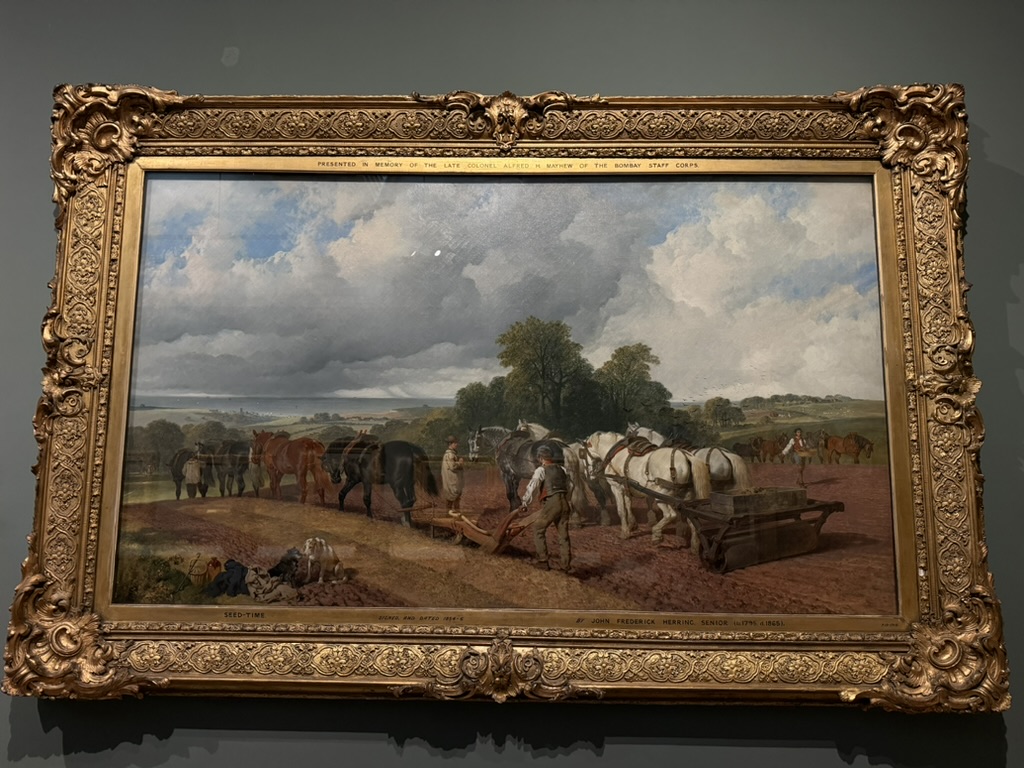
My image is about the play War Horse. This play stuck out to me because of the emotion I felt while watching it. The image I chose directly reflects the two main horses, Joey and Topthorn. This painting is a beautiful reflection of the two of them and how they both had to put aside their differences to work together. They carried soldiers, transported supplies, and worked in extremely dangerous conditions. Seeing a painting like this in a museum really made me think about how important horses are in our history. They were around helping more times than not. The image also reflects the connection between humans and animals in War Horse, exemplifying one of the play’s major themes: the connection between humans and animals. In War Horse, Albert and Joey form a special bond. Throughout the first act, their bond continues to grow even during hardships. The two get separated, and Joey has one other figure to rely on, Topthorn. They go through many challenges together, and they only have each other for a few years. The two horses in the museum image reminded me of the companionship and trust shown between Joey and Topthorn as they survive the hardships of war together. Finally, the object connects to the visual style of the play itself. The play War Horse is famous for its larger-than-life production with their humungous yet realistic puppets. The puppets showcase lifelike movement, but also captivating emotions. Both the play and the image of the horses capture their strength and endurance, but also the moody and emotional aspect of the story. The museum painting helped me think more deeply about how horses were viewed both historically and artistically, which enriches the meaning of the play. War Horse was one of my favorite plays so far, and the museum was my favorite excursion. It was so fun to find a connection between the two of them.