I knew from the moment I saw her face, peeking around the corner, that my feet would be glued to the floor in front of this portrait. My icon, my inspiration, Princess Diana. (And now, seeing others felt the same! Didn’t see Diana was mentioned here before I wrote this on the train to Paris with no service lol, but finished it then and just now seeing that so here is your double dose of Lady Di!) Ever since my mother gave me a book about her when I was the ripe age of six, explaining in a whimsical, almost exclamatory tone that she was a “real princess,” I have been completely enthralled by her. Over the years, that fascination only grew. After watching her portrayed in films and shows such as Spencer and, most memorably, The Crown, and after being gifted several more books about her by friends and family, my admiration for Diana deepened into something even more personal.
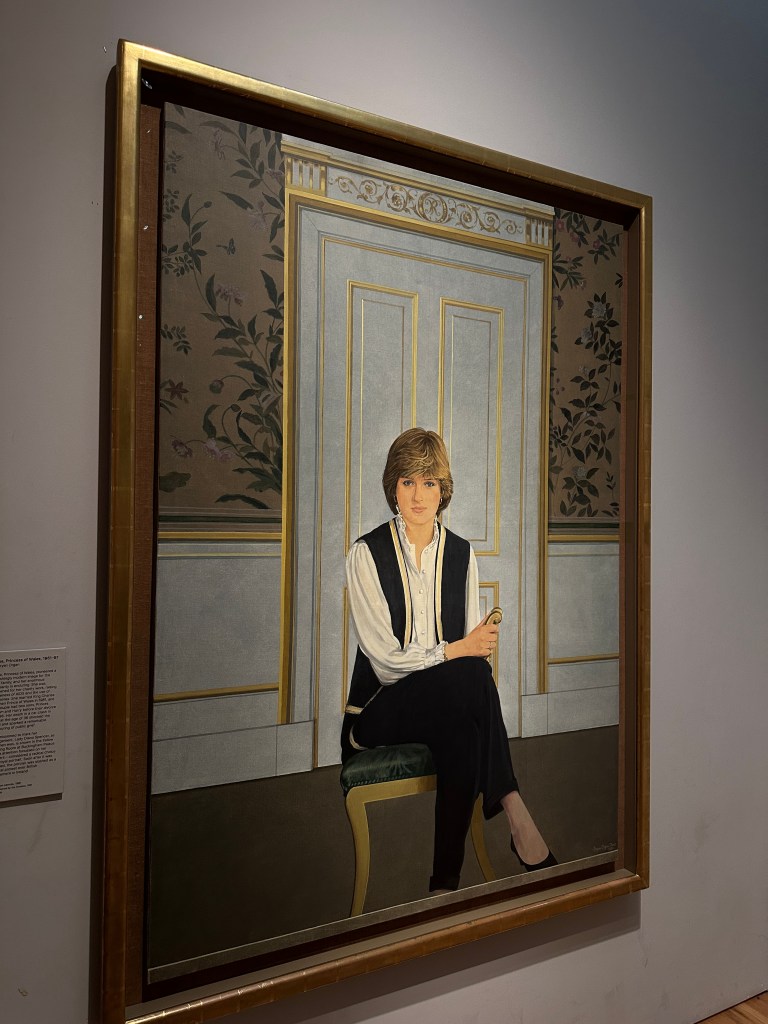
So, standing in front of this image that I had seen and revered before on Google and Pinterest, was quite surreal. I found myself lingering there for several minutes, studying her expression and looking closely into her eyes. Seeing the painting in person was moving not only because it is so beautiful, but also it captures a specific version of Diana… young, hopeful, and newly positioned inside the palace she believed would be her happy home and future.
This is a painting by Bryan Organ and was commissioned shortly after her engagement to Prince Charles. Here she sits in the drawing room of Buckingham Palace, dressed in trousers and seated sideways in a chair. She is the focal point of the image, placed directly in the center. And there is a gentle brightness coming from her, making her the source of light and attention. For a setting as grand as Buckingham Palace, the artist makes an interesting choice keeping the background relatively simple. Rather than overwhelming the viewer with elaborate royal detail, the room is reduced to a subtle gold lining, a simple floral wall pattern, and a calm almost flat backdrop. The contrast between her figure and the doorway draws the viewer’s eyes directly toward her face, her posture, and expression. The glamour of royalty is not found in the grandeur, but rather the simplicity and presence of this new addition to the royal family.
There are also several choices in the rose that feel intentional. Her crossed legs, her sideways position in the chair, and her soft smile all create an impression that feels different from the traditional royal image. She isn’t stiff, smiling broadly, or overly formal. This portrait feels more authentic and intimate. It gives the impression that Diana might be more comfortable sitting down and having a real conversation than performing the distant fantasy of royalty.
Diana would later become widely known as an “unconventional” royal, someone who pushed boundaries and challenged expectations. She did not necessarily cross lines carelessly, but rather redrew them. Through her advocacy for AIDS awareness and landmine victims, her devotion to children, and her warmth and authenticity when interacting with the public, Diana redefined what it meant to be royal. She brought humanity into a role often defined by distance, tradition, and image.
I think that this portrait does a fantastic job at foreshadowing this, and was way ahead of its time. I think if I was to step inside this painting, I would not be met with the typical fluff and fancy of a royal. Instead, I imagine I would encounter someone down-to-earth, gentle, and real. Of course I very much wish I could step into it!
I think the artist did an incredible job capturing Diana’s humanity. This portrait doesn’t present her as a princess or royal figure, but truly as a person. It humanizes her, and by that begins the humanizing of the royal family.
Best,
Siena
 Theatre in London U of A