I’ve been posting in the wrong place 😑
I adore Gothic architecture, so it was wonderful seeing one of the most important Gothic buildings in the country. A historic, royal church. It has the highest Gothic vault in Britain! It’s always an incredible feeling looking up at the ceiling of a European church as well as looking at their stained glass windows. My favorite is the rose windows, the most telling characteristic of Gothic churches.
Poet’s Corner – 📖
John Keble
English priest & poet, not buried at Westminster Abbey but has a dedicated memorial.
He was the key leader of the 19th century Oxford Movement, a 19th century religious revival within the Church of England that sought to restore the church’s ancient, Catholic roots and establish its independence from state control. I found it fascinating how he sparked a historic revolution in how the Anglican Church understood its sacraments and authority. He argued that the state had no right to interfere with the church and Keble’s aim was to go backwards and restore the past, he believed that the church had turned spiritually lazy.
He did this by popularizing Theology through poetry and translating the Church Fathers.
What I found very interesting was how he profoundly loved nature and how this influenced his writings which directly correlates to the English Romantic Movement. Keble loved William Wordsworth and viewed him as a prophet!!!! (Woah)
He believed God intentionally designed the natural world to communicate invisible spiritual truths to mankind (Sacramental veil). His poetry is devotional and his love of nature was explicitly Christian.
This guy is very interesting 🧐
“The loveliest flowers the closest cling to earth, And they first feel the sun: So violets blue; So the soft star-like primrose – drenched in dew – The happiest of Spring’s happy, fragrant birth.” – Spring Flowers
A religious allegory, he uses the low growing nature of early blooms to praise the virtue of Christian humility.
John Dryden
English poet & playwright of the 17th century. He was buried at Westminster Abbey. He’s known as the Father of English Criticism and England’s first official poet laureate. After Shakespeare, he wrote the greatest tragedy of the Restoration (The Conquest of Granada).
He adapted a few stories from The Canterbury Tales by Geoffrey Chaucer into verse stories. A great quote from one of these stories:
“love is not in our choice but in our fate”.
Dryden was a master of political satire and standardizing the Heroic Couplet. He perfected the rhyming iambic pentameter couplet which gave it musicality and natural speech rhythms.
I love love this quote from the poem, Happy the Man,
“Not Heav’n itself upon the past has power,
But what has been, has been, and I have had my hour.”
Absolutely beautiful!
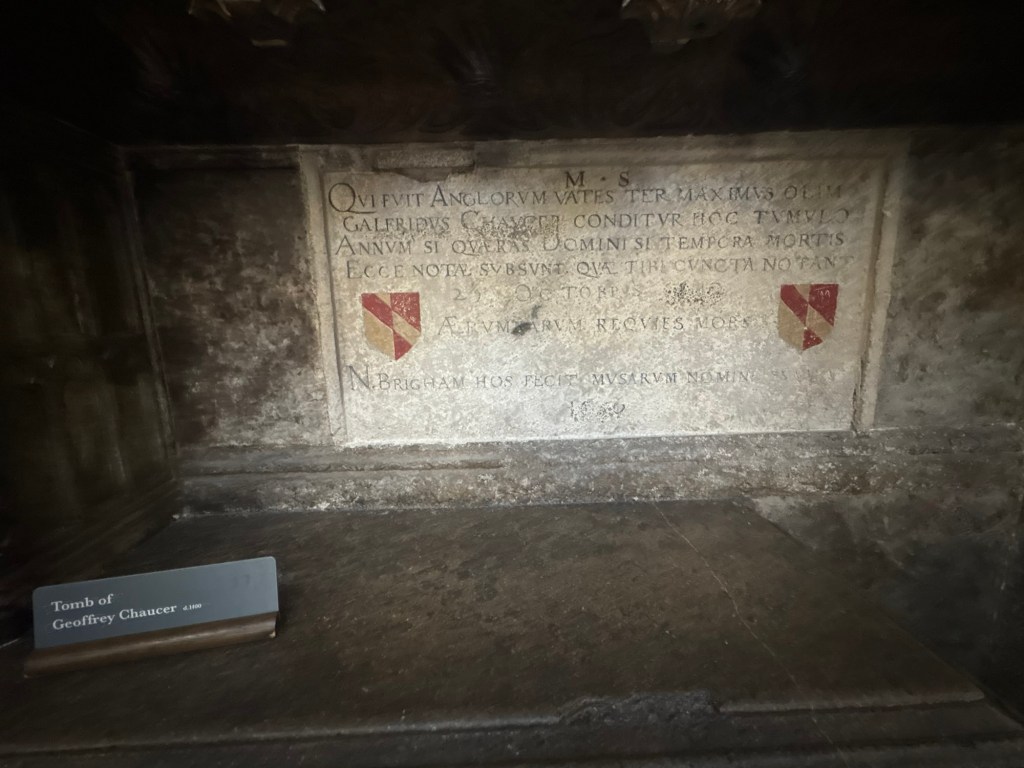
Geoffrey Chaucer
Born around 1342 & was laid to rest in Westminster Abbey on October 1400.
Father of English literature! Chaucer is known as the first English author. His most famous work is The Canterbury Tales, which is unfortunately unfinished. He came from a prosperous family of wine merchants and vintners.
Before Chaucer, serious European literature was written in Latin or French. Latin (the language of religion & science) & French (the language of royal court).
English was considered a crude language for commoners. Chaucer changed this by writing in Middle English and was the first writer to elevate English into a language of high art. So cool!
This shifted the literary tradition away from Latin & French.
“For thogh we slepe, or wake, or rome, or ryde, / Ay fleeth the tyme; it nyl no man abyde.”
Translation: “For though we sleep, or wake, or roam, or ride, / Always time flees; it will wait for no man.” – The Clerk’s Tale in The Canterbury Tales.
🇬🇧💫📖 – Ashley

