A Doll’s Room

As we recover from jet lag and settle into our British lives, we made our way to our second show; a modern take on Ibsen’s A Doll’s House. The set was designed to resemble a very modern, clean, and empty house. This led to a lot of blocking taking place on the carpeted floor. I quite liked this aspect and the humanity it brought to the conversations being held. I find myself laid out on a carpeted floor frequently and often find very good conversation down there. The lack of a changing set brought in the title in a similar way to original adaptations. The stationary setting creates that feeling of being stuck, especially for Nora, as she is present the most in this unchanging space. The act 1 finale captures this sense of helplessness as well. A woman turning to sexualizing herself with her own husband in her own house in order to get something was very powerful. It created discomfort in an intentional way. The use of the skylight-like lighting brought the “cage” to completion by offering the visual of a hypothetical outside world while keeping Nora as well as the audience stuck inside. I had a fear that the modernization of the story would lower the stakes of the loan that Nora took out. I was pleasantly surprised by how anxious I was about the the sum of money and scandal behind it. I do think it took away the commentary on gender in the conflict. The stakes were high but they no longer had to do with what a woman was and wasn’t allowed to do in a society.

This production was not what I was anticipating, especially for my first time seeing the show done; however, I thoroughly enjoyed it. I thought it carried the story and stakes well. There was a loss of the original discussion on gender roles. However, I do think there was an interesting new conversation on the more current gender roles in this production. Overall, I very much enjoyed this take on A Doll’s House.

A Doll’s House? Why isn’t There a Doll?

A modern version of a Doll’s House by Henrique Ibsen. I don’t have a lot of experience with the original, so you could say this was my first full experience with it. It was very interesting. It was definitely for a certain audience. After intermission, an elderly couple got up and left. I thought that it did do an excellent job of bringing the original play to a modern time and modern situation. 

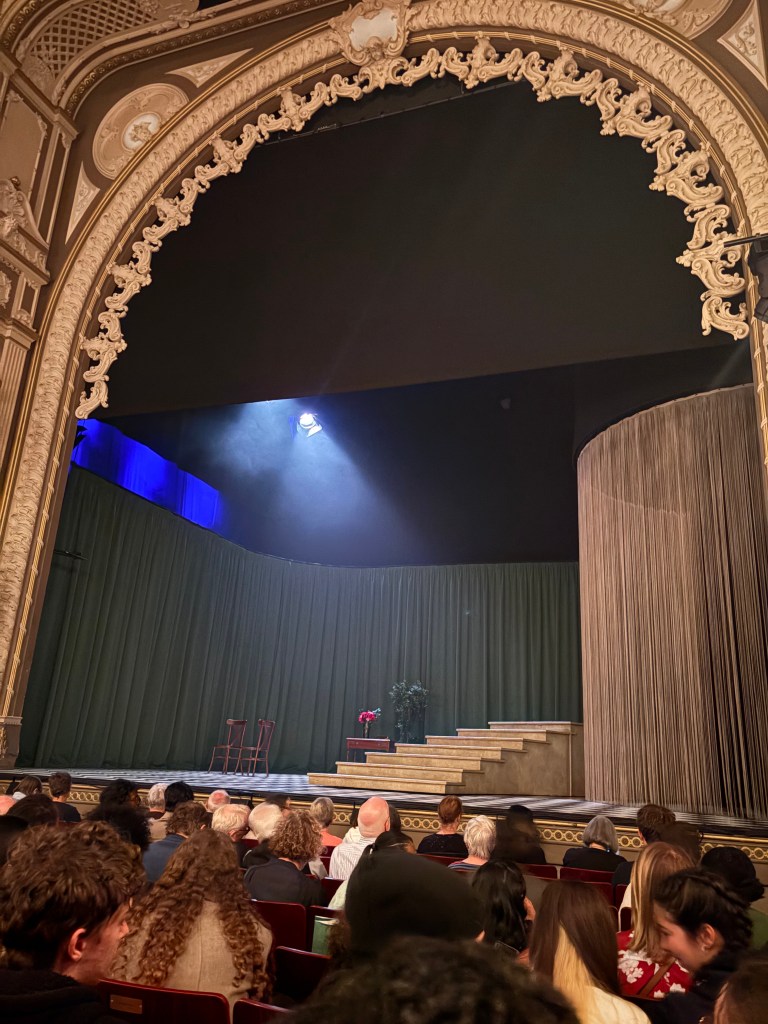
The set, however, was very lack luster and didn’t allow for a lot of blocking. The actors spent most of the time on the carpeted stage floor. But any furniture in the space would make it feel crowded and busy. So I don’t know what could have been done to change that. I was very intrigued by the lighting design. There was this really big “sky light” on the ceiling as the source. It changed colors and dimness to show passing of time and to set the mood. 

There were also a lot of uncomfortable moments on stage that left the audience feeling uncomfortable. 

I do think that the director did a good job at conveying the “caged bird” aspect of the character, Nora. She remained in this one room and almost never left unless it was with her husband or if her husband was aware. It felt like she was confined to this space. She didn’t even leave it to check on her children. 

Overall, I would not see this production again. It was as if they were trying to say that this adaptation was for “adults”. They added anything they could shove in to make it that way. There was a lot of sex, drugs, stripping, and crude language. It made it feel unauthentic to me in that aspect. But the acting was very very natural. The conversations felt real. And the arguments too. Much praise to the actors. The show was just not my speed. I appreciate the effect of the uncomfortable feeling and why they did it. They wanted you to feel how uncomfortable the situation is. I also appreciate the modern adaptation and how they did it. I would recommend it for other people if they are a fan of the Doll’s House and want to see the story if it was set in modern time.

Below is the picture of the stage:

Wife or Caged Bird? TBD

The creativity and depth of A Dolls House is one to not make assumptions about. The director and designer of this play that was put on by Almeida Theatre, was deep and required the viewers to look deeper than the surface of someone’s personality and life.

Nora, the main character in this play, is portrayed as a lonely housewife who hides her insecurities and expectations by money and materialistic items. The director puts Nora into a narrative that many women feel under their husband as well as the pressures and expectations of society. For example, she purchases Christmas gifts the family cannot afford, though she knows her family is in debt and cannot afford these things until the deal goes through in January. However, she uses her Amex to purchase the children Christmas gifts putting her and her family further into debt without the blink of an eye.

Nora’s coverup personality is to hide her anxieties about her husband’s drug addiction and her performance she puts on for Torvald. She does this due to her feelings of pressures from other people and societies norms. Her entire personality is not genuine and Nora is only living for others for status and likability.

Status is the front that she puts up to accommodate from the pressures of the modern world. She is trapped under this false reality and act that she puts on for others to please their idea of her. Each person she interacts with during the play gets a different side and version of Nora. Thus giving her the persona of a “caged bird”. She cannot escape the pressures of the outside world and the expectations set for her. Her performative personality ends up being the thing that breaks her and leads to her troubles.

The design of how the play was also conducted in was fantastic. The set appeared to be cold and empty, only to be filled with materialistic items which furthered her characters depth. The costume choices such as the skimpy nurse outfit Nora wears is part of the performative side of her. You can feel how the theatre is uncomfortable with this seen as is Nora as a character. Yet, she is still dancing for her husband as to please him which is another action she takes for others not herself.

The “caged bird” in this play is Nora. She is put into this cage by social norms, pressures, and expectations of others. These outside factors push her into this cage where she performs for others, thus filling a false reality for herself and those around her.

I MET DAISY RIDLEY (NOT CLICKBAIT)

We went and saw A Doll’s House, written by Henrik Ibsen and directed by Joe Hill-Gibbins, at Almedia Theatre! 

This is the first “version” of A Doll’s House I’ve seen and am not super familiar with the play itself, so I was going in completely open to the ideas of the director. One of the first things that I noticed about the set when walking in was the fully carpeted floor. There was no furniture, making the only place the actors could sit be either the floor or the also-carpeted bench lining the upstage wall of the set. At first it threw me off, but as the show went on, watching the actors, especially Nora, walk around the set in socks, it reminded me of those white padded rooms you see people in. Each footstep was silent, which made the noises other than the characters speaking way more noticeable. I do wish that there was furniture, but it wasn’t an awful thing that there wasn’t. I remember thinking “but this is her house, she has kids, why would she be raising kids in a house with no furniture?” but maybe it added to her disconnect from her life and how she doesn’t want it.

The “dance break.” It was uncomfortable and it made me feel trapped and awkward, which at the start of it made it a very jarring thing to see, but then I realized that’s how Nora feels, in life, her relationship, her situation. It definitely wasn’t my favorite part, but it’s the part that sticks with you, which to me means the director did their job. Also, the song being Man in Finance paralleling Nora’s search for the solution to her financial problem in title alone but also her wanting for something outside of everything that she already has was so funny and clever. 

Also, completely unrelated to the play, we sat behind Daisy Ridley and it was the coolest thing ever. Not a word was said but it was cool nonetheless.

Looking for a Man in Finance . . . Or Is She?

So . . . not quite what I expected. Club music, a reference to the ongoing Iran conflict, and WhatsApp. I think it’s safe to say even Ibsen, progressive as he was, would not have predicted this sort of interpretation. 

The costumery well conveyed the strictures of the status quo for Nora, but also the rest of the characters. From the start, several characters were monochrome—gray here, beige there, maybe a brown. Initially, each one plays a discreet role, adhering neatly to their stereotypes (the widow, the housewife, etc.) As the story progresses, though, and especially by the second act, it seems that the character’s true complexities are revealed, in both dress and behavior. For example, Krogstad wears a neon yellow jacket when he and Kristine turn a new leaf, and of course Nora emerges in boldly mismatched top and bottom in the end as a part of her revelation. I may not be spot on, but there seem to be deliberate wardrobe changes around moments of transformative character development.  

Nora’s nurse dress also serves as a cage of sorts. She wears it because her husband, Torvald, asks her to, because it pleases him. This in itself doesn’t necessarily indicate that she is constricted by Torvald, but when considering the nature of their relationship (Torvald’s expressions of adoration to her are almost always sexual, he has complete control of their finances), it is rather indicative of her dependency on him for validation and meaning. This is juxtaposed with her and Dr. Rank’s relationship; there is a sexual element, but he is the person she “likes to be with,” whereas Torvald is the person she “builds her life around.” She is diminished by him in a way, seen as childish and silly. I would say it’s a security thing, but the drug addiction and financial struggle may rule out her staying. 

I liked the use of the music as well; both times, it seemed to come at a time when Nora felt particularly out of control, particularly panicked. I think it was especially effective because there were few other sound effects or music throughout the show. As for the lighting, it was simple, but naturalistic, and we could actually see their faces (sorry, Mousetrap). And there may have been some color theory involved, something with purple, orange, blue (I’m not educated enough to understand the symbolism there).  

She seems less of a caged bird, however, when she’s confronted by Krogstad and blames him largely for her plight. It is understandable that she was in a difficult position with her husband’s addiction and rehabilitation (and I think this is actually a more plausible explanation for the expensive travel abroad), but not disclosing it to Torvald and digging the hole deeper makes her slightly less sympathetic. She also hesitates to acknowledge her hand in creating the debt and has a relentless sense of helplessness, but it is often those feelings that prompt and stem from borrowing more than you can return. It’s a very sticky situation to say the least. 

However, the ending most powerfully conveys a trapped feeling, I think. She finally awakens as an individual, only to realize that she doesn’t really exist as one; she has obligations to her children, the pressures of marriage, friendship, and society weighing on her. It kind of turns the original message on its head, questioning the feasibility and morality of defying social norms as if you live in a vacuum. I kind of like this ending better; it reflects the true, practical conflict of embracing one’s individuality at all costs at a later stage in life. Although the original ending likely made sense for Ibsen’s time; he was introducing a possibility to an audience that probably couldn’t imagine such rebellion. It was quite interesting to see Ibsen’s work in conversation with the modern world.  

Overall, I . . . liked it? Maybe works better as a reimagining than an adaptation or interpretation? Great theater, too!  

Cheers, 
Reese 

The Tower!

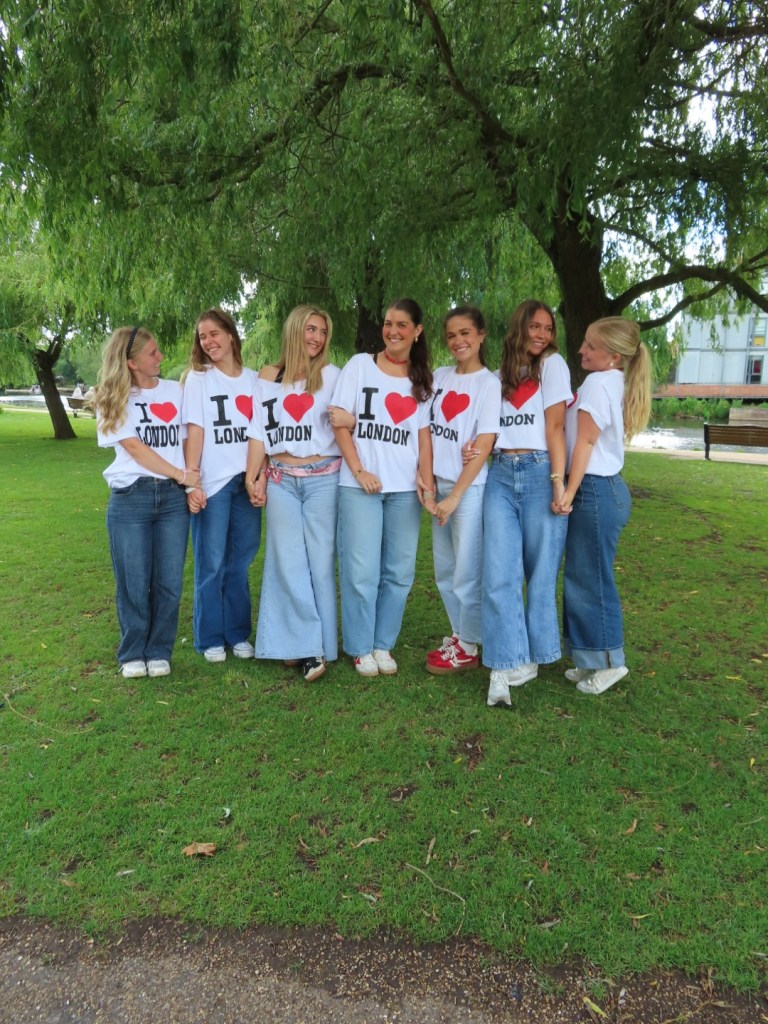
The Tower! What a dream come true! An absolute surreal experience. On our first full day in London, we eagerly arrived at the Tower (a seven minute walk from our apartment – btw!), took a group photo, then straight to get in line for the Crown Jewels – probably my most favorite part of the campus. I had a hard time wrapping my head around the fact that these priceless articles are a genuine and crucial part of the royalty’s traditional wear. To have seen these crowns, robes, swords, etc. on T.V. laying on the most influential people in the world, handed down from the previous most influential people in the world, was so hard to fathom. What was especially surreal was talking with the security guards and tour guides, and hearing that a lot of the things we saw were not in the exhibit the day before, like the  Imperial State Crown and the Robe of State, because King Charles the III had them on the day before. It was so moving to see these incredibly detailed articles that are hundreds of years old, being worn in my lifetime. So neat and definitely my favorite of the day. I learned different varieties of British culture and lasting history, from royal traditions and drama (thank you Bridgerton and The Crown for making sense now! 😉), to beheadings and affairs (Anne Boleyn’s feminist attributes and her de-head location! 😬), but I was most intrigued and surprised to learn about the British history of torture culture. Maybe because I have always had a light stomach, but hearing The Tower actors act out scenes of hanging, de-heading, stretching and crushing devices, and the stories of The Bloody Tower (Edward IV died, his two sons disappeared, and their uncle became Richard III, then in 1674, two children’s skeletons found in the Tower were believed to be the princes), I was taken back by how biblical, religious, and “holy” the court and city were, but closed and eye and ear when it came to torture. My shock was doubled when I read that the last de-heading was in 1941, less than one hundred years ago. My goodness! Speaking of de-heading, seeing Anne Boleyn’s death site and her genuine last view before she died was incredibly touching. Anne Boleyn, Henry VIII’s second wife, was imprisoned in the Tower of London in 1536 after being accused of treason by her husband. Henry got her executed there for standing up for herself and demanding loyalty from her husband to be his only wife. #girlboss! To avoid ending this post with an execution story, the Tower was a great introduction to the city with hundreds of years of stories to tell, and walking the same cobblestone as so many infamous people has been one of the highlights of the trip thus far!

Blog post 2: Tower of London

I loved getting to visit the Tower of London because everything felt so surreal to me. I’ve never experienced a place or history like this before, so to see this stuff in real life was extremely beneficial. My favorite parts were definitely the Crown Jewels and the prisons. These are vastly different, but they were both so impactful to me. Looking at all of the pieces in the crown jewels was crazy to me because when I think of that stuff, it just seems like a fantasy. Especially because the day before we went, some of the things were taken out and worn. It’s so impressive how it’s all lasted so long and still looks so fresh. Which are obviously preserved inside of safe doors and are only used for coronations and similar events. The prisons were fascinating to me because I had no clue how many people were imprisoned and killed. Also, how the spaces were used to become prisons, like the Bloody Tower. That space wasn’t made to be a prison but, actually, a grand room. The two princes that died and were found many years later really hit me, and I carried it with me throughout the whole tour. Our group found it shocking that the last beheading was in 1941. On the topic of beheadings, Anne Boleyn’s story really stuck with me. She was the first queen to be beheaded, which is what started kings thinking they could behead their queens. I love how all of the people’s names that were beheaded in the same spot are honored there. I enjoyed this so much, and I’m so glad I got to go explore this and learn about it with my friends!

Blog 2: Tower of London

The Tower of London was extremely fascinating. This is my second time going to The Tower of London, and I noticed a lot more than I did before. A fact that struck me the most is that the last beheading was in 1941. I pictured the last beheading to be around the 1600s or 1700s, so I was very shocked to find out when the most recent beheading actually was. I learned a lot about the British monarchy. I was very interested in their torture tactics and the way they treated their citizens who weren’t of the higher class. I also really enjoyed seeing the crown jewels. I did not get to see all of the jewels the last time I was there because some of them were missing, so it was really fascinating to see them all in their places. The piece that stuck out to me the most was the king’s golden robe that he would wear during his coronation. I am so infatuated with how they have kept his robe so intact over the century. A site that I did not get to see the last time I was there was Anne Boleyn’s beheading site. I thought the glass pillow was a beautiful representation of not only Anne Boleyn, but also all of the other individuals who were executed there. I also found it so infatuating that Anne was the first queen to be beheaded. The culture and environment were my favorite parts. I loved just walking around and taking in the architecture and the different styles of buildings. Overall, the tower shows how society used to be very hierarchical. Nobles, royals, and commoners were treated very differently, especially in imprisonment and punishment. The tower not only survived wars but also political issues and bomb damage during World War II. It has become a symbol of continuity in British culture. 

The Tower of Beasts, Beauty, and Betrayal

The treacherous journey to London left us all in need of an adventure. This lead us to the Tower of London. The famous monument of British artifacts, culture, and beautiful architecture. Despite the pull of the jet lag, the Tower of London certainly did not disappoint. The royal family famously had their band of Royal Beasts kept around for entertainment. The exhibition revealed that many (if not all) of these animals were poorly kept due to a lack of knowledge on what they required. Polar bears were released (on long ropes) into the Thames in order to catch fish. Many animals were left to roam freely resulting in many deaths. One of my favorite exhibitions was the Giant and the Dwarf in theWhite Tower. Two sets of armor for an unusually large man and an unusually small man. It was later rumored that the small suit of armor was in fact for a young 5 year old boy. As for the large suit, what could possibly explain it other than a real life giant? Many scandals were going on within the London Tower including the imprisonment of many members of the royal family. Princess Elizabeth was held prisoner in the Tower of London before her reign as Elizabeth 1. She was poorly treated by her step and half family for most of her life and eventually put up for execution. Her claimed devotion to the throne saved her and lead to her eventual ruling.

Aside from the riveting family history and quarrels, the Tower of London was simply full of beautiful pieces. The crowned jewels were beyond impressive, the architectural style was brilliant, and the guards of the British monarchy; the ravens, were captivating. I have never seen such wickedly beautiful birds in my life, they were certainly my favorite part of the Tower. Their story of upholding the monarchy and clipped wings were incredibly interesting. They are also, when you think about it, the last standing royal beasts in the Tower of London. Roaming about the grounds, potentially biting patrons as lions used to.

I look forward to more beasts, armor, and torture chambers. As we scratch the surface of London, I am eager to dig and keep exploring.

Meeting the past and the present in London!

What I’ve known to always be true about London, since I first set foot in it, is that it doesn’t try to impress. It doesn’t need to–it holds your attention by merely existing. Time does not wither its beauty but indeed enriches it, and I found that firsthand in the Tower of London this time around! 

After a hop, skip, and 24 hours of traveling in a metal box, we hit the ground running, well–dragging at first if I’m honest. It is hard to sit still in a city that has been bustling for thousands of years. What I always notice first upon landing in London is the balance between the past and the present, often shoulder to shoulder like friends, in the form of buildings. Glass skyscrapers that mirror the sun and rotted brick right beside each other–it creates a juxtaposition that proves how much these streets have seen. And now, they bear witness to you. 

There is old history in the air here, and something that stirs up all that you have been and all that you want to be, mixing them together and offering it to you to chew and relish. The Tower of London has always left a bittersweet taste in my mouth, but I’d take it again and again. When I went there for the first time two years ago with my family, we had the pleasure of a tour guide (known as the Yeoman Warders, I’m told). Walking through the tower felt almost like a treasure hunt, as we’d stop and unpack a profound new piece of backstory about every fifteen steps! Mainly, how a place could hold so many identities at once: a royal palace, a fortress, a prison, an execution site, an armory, a treasury, and now one of London’s most famous landmarks. And it’s interesting how most of that information had been buried in my brain, until I stepped foot inside the grounds again and found it at the forefront! I assumed a position as a sort of mediocre guide to my friends here (definitely needed some fact checks! lol), but being able to share the history that once stirred my heart was a pleasure and a prize. As well as recognizing how much my love for history, specifically British history, has only grown since my last time here.

My first time at the Tower of London in 2024!

I found myself enthralled by the onlookers of the setting, the opulence of the jewels, and the weight of the amount of last days lived out here, especially with such pillars of history. What I love about the Tower of London is how it brings history out of pages and sets it right in front of you, to walk through, to interact with, to see–in a sense, through the eyes of some of the most influential people in history. Anne Boleyn is the story I continue coming back to (my version of a “Roman Empire”). To think that she entered this place as a queen and then returned as a prisoner is harrowing and a daunting reminder of the cracks in London’s previous monarchy. She arrived there in 1533 to stay overnight and prepare for her coronation. I imagine her anticipating this new era in her life, not a clue it would be her last. Only three years later, in 1536, she was brought back, where she stayed for seventeen days before being executed on presumably false and forged convictions. I stood there, right behind that glass sculpture where it happened, and looked onto the green grass and the houses in the back, taking in this sight that was Anne’s very last. History has a way of humbling you, and I felt quite small standing there, in comparison to her circumstances. But it is a feeling that should be carried all throughout any traveling excursion, to remind oneself that the roads you trot have been carved by many feet and different paths, all intersecting here. It makes one feel quite connected to humanity indeed! 

Excited for what more is to come, and thankful my path led me here!