So . . . not quite what I expected. Club music, a reference to the ongoing Iran conflict, and WhatsApp. I think it’s safe to say even Ibsen, progressive as he was, would not have predicted this sort of interpretation.
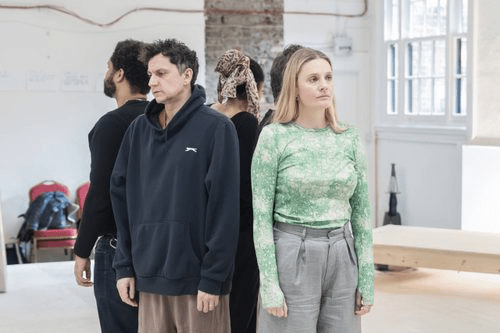
The costumery well conveyed the strictures of the status quo for Nora, but also the rest of the characters. From the start, several characters were monochrome—gray here, beige there, maybe a brown. Initially, each one plays a discreet role, adhering neatly to their stereotypes (the widow, the housewife, etc.) As the story progresses, though, and especially by the second act, it seems that the character’s true complexities are revealed, in both dress and behavior. For example, Krogstad wears a neon yellow jacket when he and Kristine turn a new leaf, and of course Nora emerges in boldly mismatched top and bottom in the end as a part of her revelation. I may not be spot on, but there seem to be deliberate wardrobe changes around moments of transformative character development.
Nora’s nurse dress also serves as a cage of sorts. She wears it because her husband, Torvald, asks her to, because it pleases him. This in itself doesn’t necessarily indicate that she is constricted by Torvald, but when considering the nature of their relationship (Torvald’s expressions of adoration to her are almost always sexual, he has complete control of their finances), it is rather indicative of her dependency on him for validation and meaning. This is juxtaposed with her and Dr. Rank’s relationship; there is a sexual element, but he is the person she “likes to be with,” whereas Torvald is the person she “builds her life around.” She is diminished by him in a way, seen as childish and silly. I would say it’s a security thing, but the drug addiction and financial struggle may rule out her staying.
I liked the use of the music as well; both times, it seemed to come at a time when Nora felt particularly out of control, particularly panicked. I think it was especially effective because there were few other sound effects or music throughout the show. As for the lighting, it was simple, but naturalistic, and we could actually see their faces (sorry, Mousetrap). And there may have been some color theory involved, something with purple, orange, blue (I’m not educated enough to understand the symbolism there).
She seems less of a caged bird, however, when she’s confronted by Krogstad and blames him largely for her plight. It is understandable that she was in a difficult position with her husband’s addiction and rehabilitation (and I think this is actually a more plausible explanation for the expensive travel abroad), but not disclosing it to Torvald and digging the hole deeper makes her slightly less sympathetic. She also hesitates to acknowledge her hand in creating the debt and has a relentless sense of helplessness, but it is often those feelings that prompt and stem from borrowing more than you can return. It’s a very sticky situation to say the least.
However, the ending most powerfully conveys a trapped feeling, I think. She finally awakens as an individual, only to realize that she doesn’t really exist as one; she has obligations to her children, the pressures of marriage, friendship, and society weighing on her. It kind of turns the original message on its head, questioning the feasibility and morality of defying social norms as if you live in a vacuum. I kind of like this ending better; it reflects the true, practical conflict of embracing one’s individuality at all costs at a later stage in life. Although the original ending likely made sense for Ibsen’s time; he was introducing a possibility to an audience that probably couldn’t imagine such rebellion. It was quite interesting to see Ibsen’s work in conversation with the modern world.
Overall, I . . . liked it? Maybe works better as a reimagining than an adaptation or interpretation? Great theater, too!
Cheers,
Reese

