Stratford-upon-Avon, a great way to end the trip! This place was beautiful town that was much smaller than London, it actual felt smaller than Fayetteville. I found myself at multiple times just slowly wondering around later in the afternoon, only passing a few people here and there. The town was had similarities to London like it age and the large history found in town. This is the town were William Shakespeare lived and is put to rest, being able to walk and visit the places that he lived was a very unique experience. This was an amazing way to end the trip, it was very calming and beautiful location and a good way to wind down. I like Stratford more because it reminded of my home town where I grew up, only a few cars on the road, you can walk anywhere in town, and the calmness. London is a very busy city, buss always about people everywhere and always a sense of directional flow. I did enjoy the flow of London and how navigating the tubes was a large part of the transportation but there always seemed to be a little sense of unease. With the thought of missing a tube, using the wrong tube, getting lost, or just trying to navigate always seemed like it was something you had to think about in London. But in Stratford I was able to just pick a direction and mindlessly wonder with very little fear of getting lost or stuck somewhere. This trip was amazing and hopefully it has left a lasting impression on me, I loved nearly every part of the trip and I am looking forward to the next time I travel to a new location. I took 1000s of photos during this trip and will be creating a video compilation of the trip, keep an eye out for that in the next week or two I will make another post here with the link to it. I did not get to the photos from Strafford-upon-Avon yet, but they will be included in the video. I hope everyone enjoyed the photos that I took! I very much enjoyed the company of everyone that was a part of this experience and thanks everyone for making it so AMAZING!!!
The Victoria and Albert Museum
Like many of the museums that we visited, the Vitoria and Albert Museum was packed full of some amazing things. There was a specific section that was dedicated just to theater, dance, and performance. It was interesting to a full section just on these topics because in included items that were related to Harry Potter, Star Wars, and many other movies and show. I was not expecting to see things that were produced after I was born like harry potter. It was cool to see and be reminded that history is being created at every moment in time, maybe one day I will add a section to the museum one way or another. One of the pieces that I came was the puppet from the live production of War Hoarse. After watching The Life of Pie, I found this piece similar in many ways to those puppets used in that show. How it took sever performers to bring one puppet alive astonished me on how well they worked together. The fact that they are all coordinated in their movements and timing was insane to watch on stage. Even with the fact that you could clearly see the puppeteers your mind did not focus on them, you focused on all the small and intentional movements of the puppet itself. Things like a simple flip of the tale of the lion in The Life of Pie do so much to explain the emotions of the puppet. I recall reading about animation and how secondary actions, or movement that are small and not noticeable are key elements to making something feel real. Another major part of animation is using curved in animations compared to straight lines, recalling the performance I see both of those elements in the performance of Life of Pie. I am very interested in explore the complexity it takes to make a puppet and performance aspect of the design and may be exploring it in the near future. The theater, performance, and dance section in the Vitoria and Albet Museum is my favorite part of any museum that I have been to so far. It shows so many different elements that go into producing production. It amazing to see some of the technology used to create special effects. One item that I really enjoyed is equipment that produced real sparks during a sword duel. This was achieved by running a wire from the sword to the bottom of the show with a metal plate in the stage floor to transfer the electricity through the floor to the swords creating sparks on contact between the sword. I was not able to get through many of the photos before posting, look for them in the final trip video that will be posted in about a week or two.
Borough Market and Food
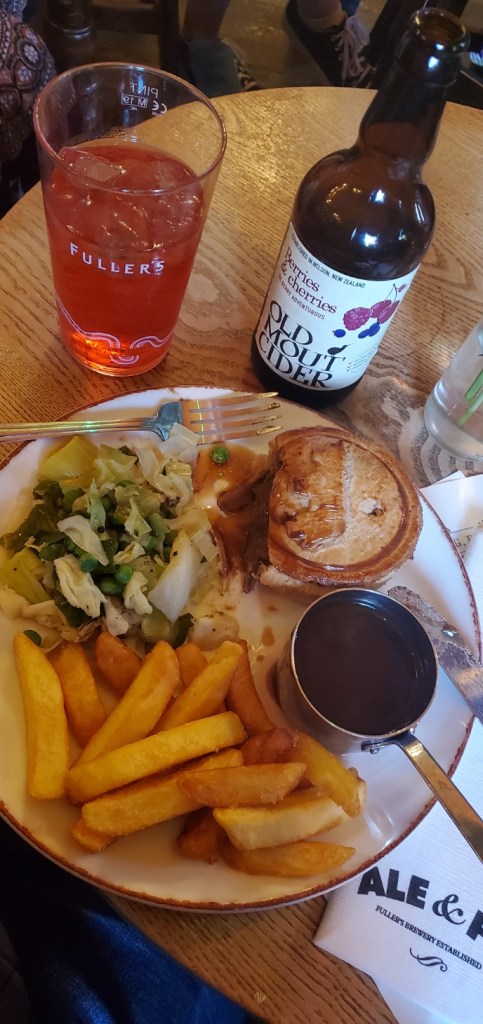
Food in London is different, this does not mean it was bad or good, I found food that was on both side of the spectrum. I visited many of the markets around London and each was filled with so many different types of food it was very hard to choose what to eat every time I visited. Something that I found craving while traveling in London was pretzels, a snack that is well known in the US is a not very common food in the UK. Through my light looking through the markets I only found on place that sold soft pretzels. It was a dissert stand and visited multiple times for both the pretzels and disserts that were on sale. Through my experience in London, I also found a pizza place that had one of the best pizzas I have ever had in my life, I went back almost more than I visited any market. The pizza was made with sourdough something I have not had the opportunity to try beforehand. Like many people I also had to try the fish and chip at a pub, it was a surprise to me how big the proportions were. I was fond of it because I have grown up eating thing very similar and it reminded me of those times. However, the fish and chip I think is the dish that was the most closely related to the food that I am used to. I came across the normal burger meals but they all just tasted different than what I am used to. While on my food journey through London I tried several types of burgers, including a lamb burger and venison burger. Both topped with sauces that complimented the flavors, both amazing. The things that stood out the most was the disserts, everything was so amazing. I don’t mean that likely I tried so many disserts and found that it was one of my favorite things about London, the meals for the most part were good, but the disserts stood out from everything. Something that I didn’t think I was going to enjoy is how much people drink alcohol in London, I do not like beer but I found out I greatly enjoy ciders. And started exploring the many flavors and brands that were commonly sold at pubs and restaurants. The two that I came familiar with was Bulmers’ a crushed red berries and lime cider, and Old Mout Cider’s Berries and Cherries cider. I have to give London credit with their vast variety of food, ciders, and dissert it has become one of the best places for food exploration!


Stratford-Upon-Avon
I was kind of disappointed by the lack of theater we’ve gotten to see at the end of this trip. I was really looking forward to seeing real British Shakespearean theater and I saw none. Nonetheless, I’ve gotten to see at least half a dozen monuments to the Bard while in England. I like how he’s usually in a casual, lounging position. Every statue indicates what an intelligent man he was with a keen sense of humor and culture.
If you didn’t know who Shakespeare was, you would know that he was very important because of the way people have taken care of his former homes. His birthplace and “new house” both have lavish gardens that are kept in shape. His actual houses looked much as you would imagine. He was born into moderate wealth so his family always had decent beds which were very expensive at the time. His house also contained a “buttery.” This is not a room to make butter, but a kind of pantry.
I adore the closeness and quietness of Stratford. This town is likely millenia old, yet it has a third the population of Fayetteville and can be circumnavigated on foot in just a couple hours. The streets are full of tourists and talented street performers. I even saw a man posing as a bust of Shakespeare in the street yesterday. Pretty creepy.
The best person we met in Stratford was Sylvia. She was our little guest house manager who had lived in the city since the seventies. She was very cute and quaint with a great sense of humor and arranged us breakfast every morning. The guest house itself was wonderful. It wasn’t as spacious as the one in The Mousetrap but that’s alright. The inside was painted with pretty pastels and hung with beautiful landscapes. There was even a map of the royal lineage that I stared at for a good fifteen minutes. I loved asking the Brits what they thought of the queen and I always received different answers. Our tour guide Molly said on more than one occasion that the queen has “never put a toe our of line.” Meanwhile, others do not really care or think the crown is just a drain on the economy.
But I’m digressing. Back to Stratford. The city itself was very beautiful. At this time of year, the sun set at about 10:30 and rose at 4. I got some great sunset pictures of the swans on the river and the lights of Stratford at dusk. It felt like the golden hour stretched on for two because of the time of year and how far north we were.
We got to see Holy Trinity Church where Shakespeare is laid to rest. Inscribed on his grave are the words, “Good friend, for Jesus’ sake forbear, to dig the dust enclosed here. Blessed be the man that spares these stones, And cursed be he that moves my bones.” This is largely the reason he’s not buried at Westminster Abbey. He wanted to be buried in his hometown so badly that he laid a curse on his grave, if you believe in that thing. British authorities seem to believe it.
Nothing on the London trip compared to the company I had the whole time. I’ve learned so much about acting and poetry and comedy and architecture and food and trees? I appreciate my fellow students’ specialty and willingness to share what they know and love.
Last Day :(:
The last leg of our trip brought us to Shakespeare’s hometown, Stratford Upon Avon. Every day of this program had been spent exploring and experiencing incredibly significant things around England. When you are surrounded by that many incredible things sometimes it can be hard to even process that it’s in front of you. We spent the first half of the day seeing Shakespeare’s birthplace, home, and grave. I couldn’t believe that I was in the presence of this person who is so much bigger than life, yet there was his gravestone, buried at a church, like so many other people.
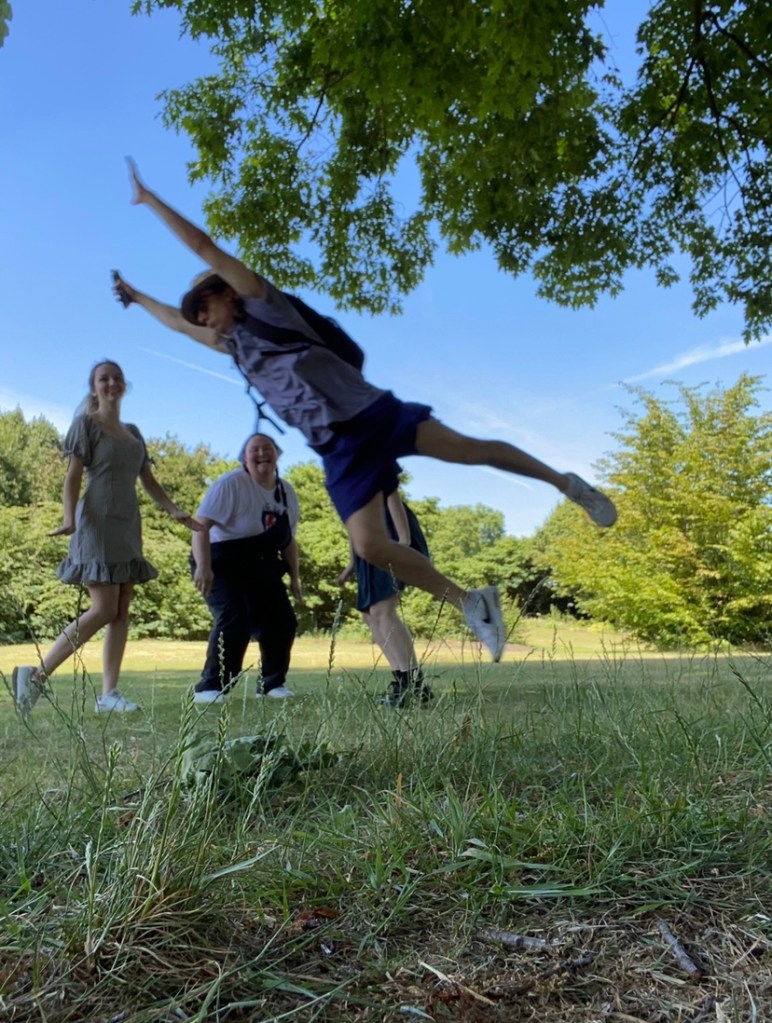
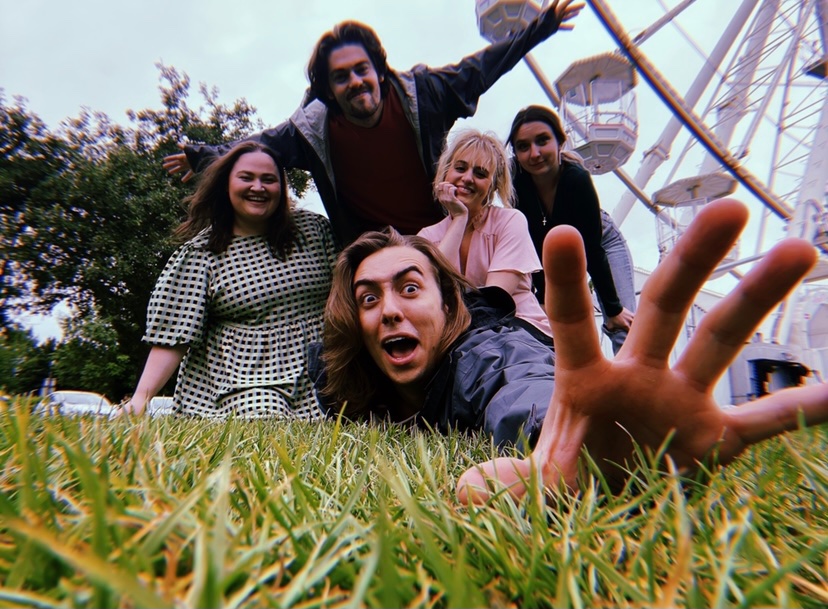
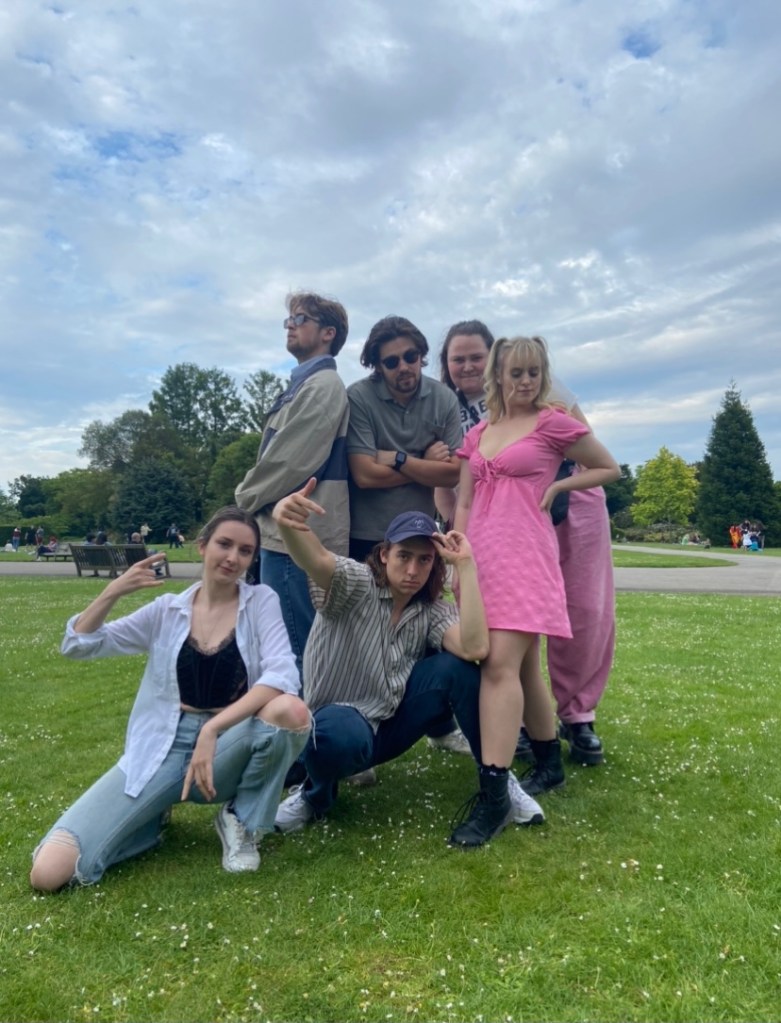
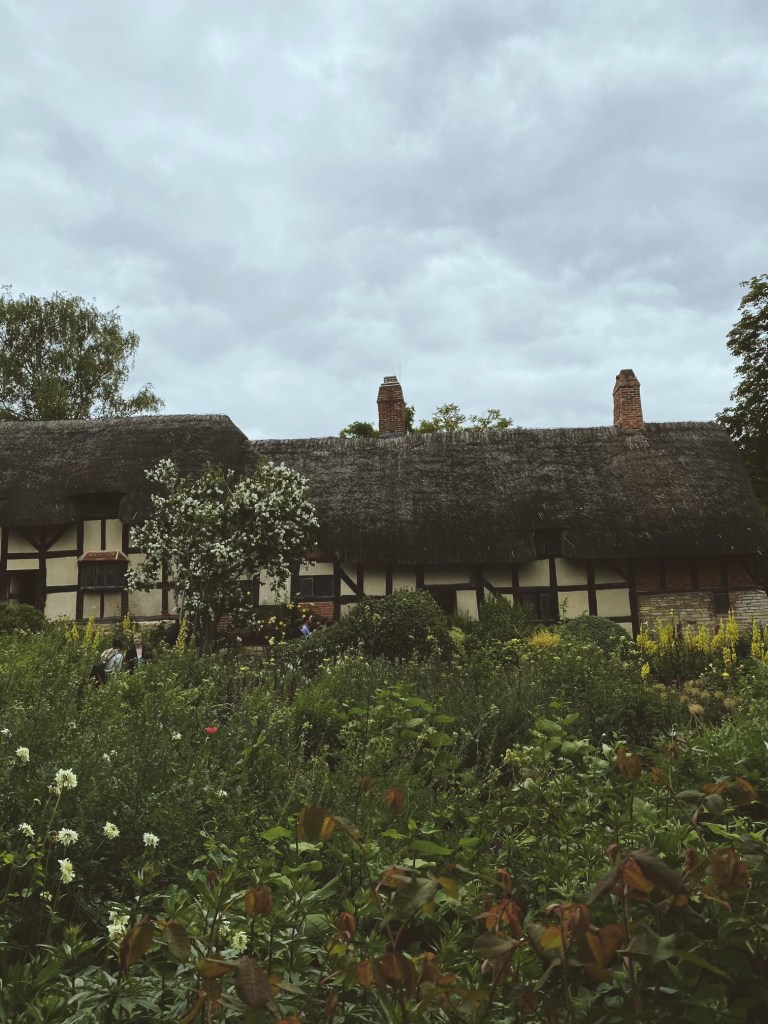
As the study abroad program neared the end, I found myself cherishing my time with the friends I had made more than ever. We went to Anne Hathaway’s cottage, and stood in the same rooms where Shakespeare once stood, but what I’ll remember most about that day is the time I spent exploring the gardens, dancing, taking pictures, and talking with my friends. We went on a haunted ghost tour that was spooky and hilarious, but the highlight of that night was playing drinking games with all my fellow students at the bar across the street. We went to a butterfly sanctuary where we were surrounded by the most vibrantly colorful plants and insects I’d ever seen. But what was most special about it was seeing Dru, who had told me of how her passed family members visit her as butterflies, smile and laugh.
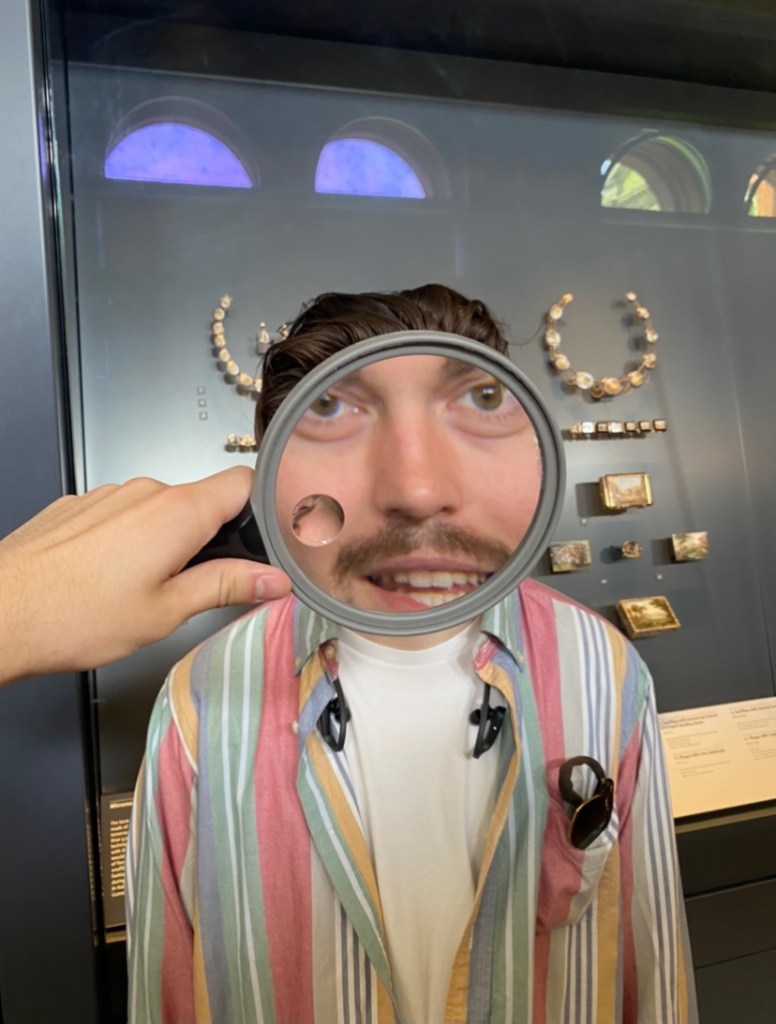
I had expected a lot out of this trip; history, theatre, emersion in a culture. I got all of those things and for that I am so grateful. But what I got out of this trip more than anything was something I hadn’t expected, lifelong friends and some of the happiest memories I’ve ever made. As the trip comes to an end so does my college career, and fittingly I am left typing this blog post, my final assignment. I don’t have the words to express how much I have loved this trip but I have met my word count so I think I’ll stop here and just show you with pictures.

#14 Stratford and the Melancholy Art of Saying Goodbye
Stratford-upon-Avon is small…like really small compared to London. Sirens, though present, are fewer and farther between, the air is a little softer and less full of drifting conversations, and everywhere you go is Shakespeare and the smell of rose petals. It was absolutely lovely getting a chance to be out in the country for our last few days in England. Sometimes it’s difficult to remember that the authors you read are or were real people, but seeing the glove-maker’s workshop with tanning hides and the kitchens stocked with what one tour guide called “real imitation, genuine fake” food inside Shakespeare’s family home finally made it a reality: Shakespeare was a real, living, breathing person who worked within a small community, had a storied family, and spent his life with someone that he loved. Sidenote: I had no idea that Anne Hathaway was twenty-six and Shakespeare was eighteen when they got married. The tour guide also said that they were neighbors. As unsettling as that age gap is as someone living amidst 21st century cultural norms, I guess there’s something sweet about the fact that they grew up together. Shakespeare was just like, “her, that farm-girl down the road, I know she’s going to be the one.”
Taking a coach from London to Stratford made me realize just how far away London must have felt from sleepy little Stratford-upon Avon in Shakespeare’s day. As it was, it took us about three hours (?) to get there with a brief stop in Oxford. I can’t imagine traveling by carriage to the city, and something about that journey made me think of all those stories we have in America of small-town people who dreamt of going to New York to write. I wonder if Shakespeare dreamt of something bigger as he was growing up, if he felt the need to break free from the place where he grew up, to make something of himself, and to travel. Yet, as this trip has made me realize, it’s a lot harder to leave the place where you come from behind than you think it will be even when you dream of broader things. If I were him, I’m not sure I could leave the beauty of Stratford behind me.
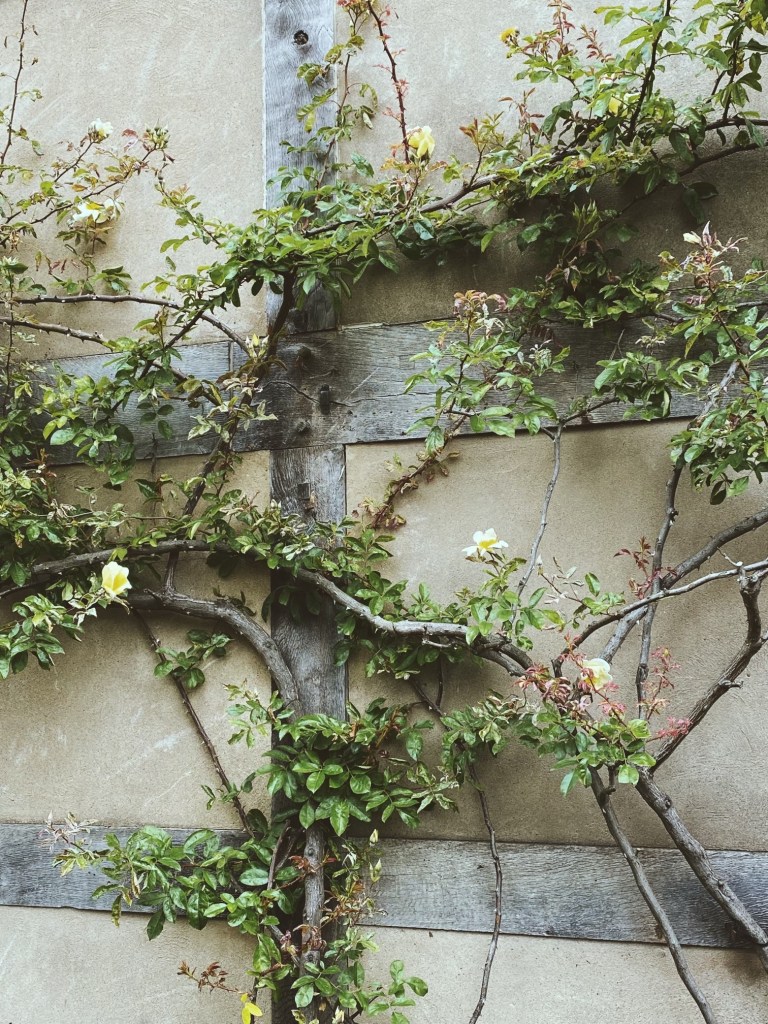
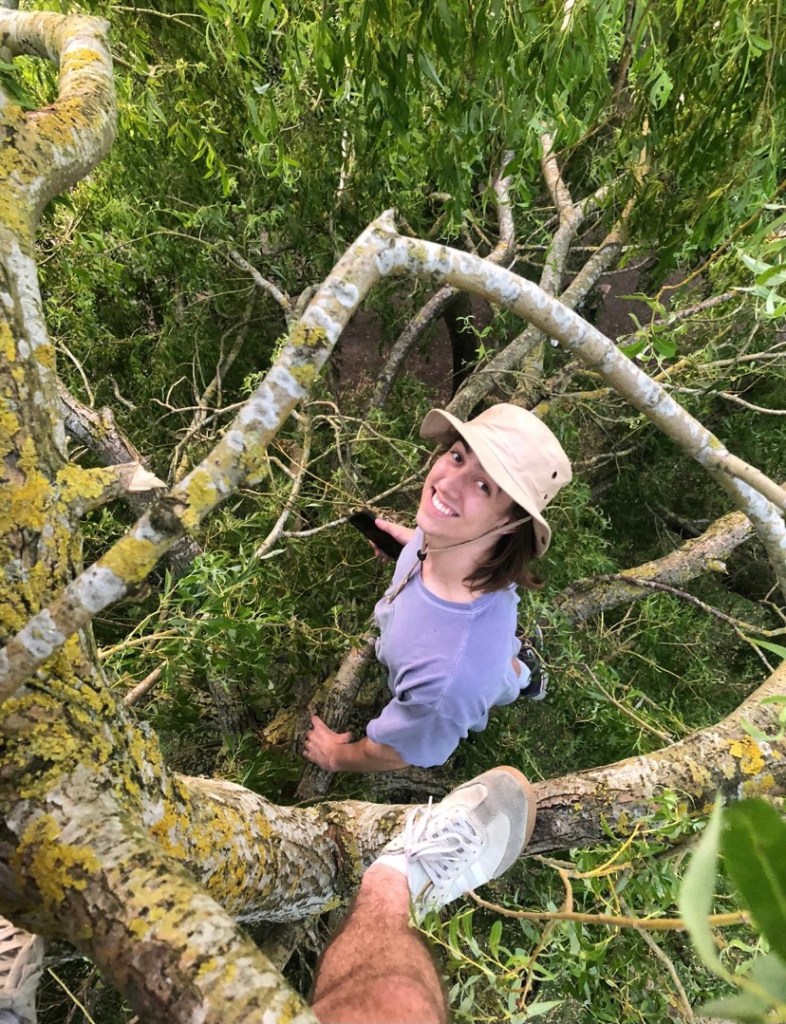
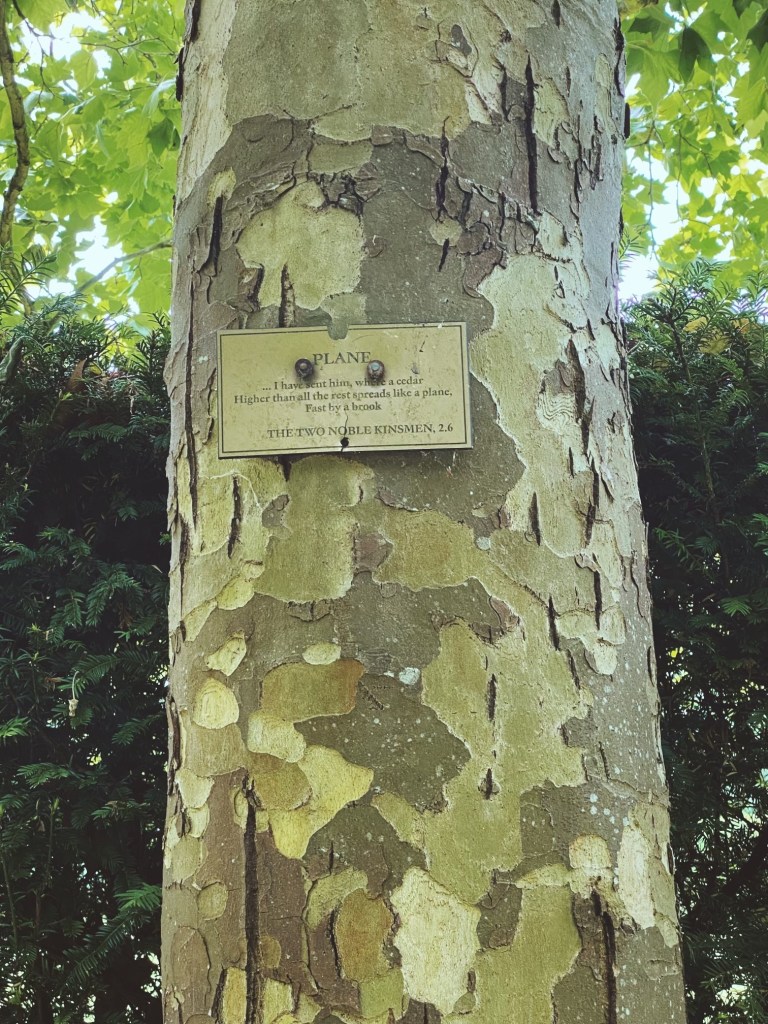
I think my favorite part of what we saw, though, was a grove of trees at Anne Hathaway’s cottage that were labeled with Shakespeare quotes related to each specific variety (cypress, elm, oak, etc.). Something tells me that Shakespeare loved trees as much as I do if he was so intentional as to call them by name. One thing that stuck out to me about our tour of Shakespeare’s Birthplace, The New Place, and Anne Hathaway’s cottage was how Shakespeare both built off of the work of others and, in turn, inspired others to build from him. The Shakespeare Center contains a display of the books and stories that Shakespeare read in his early years, such as Ovid’s Metamorphoses and Holinshed’s Chronicles, which was interesting to see when considering how often Shakespeare used old stories as frames for his retellings on stage in plays like Hamlet and Romeo and Juliet.
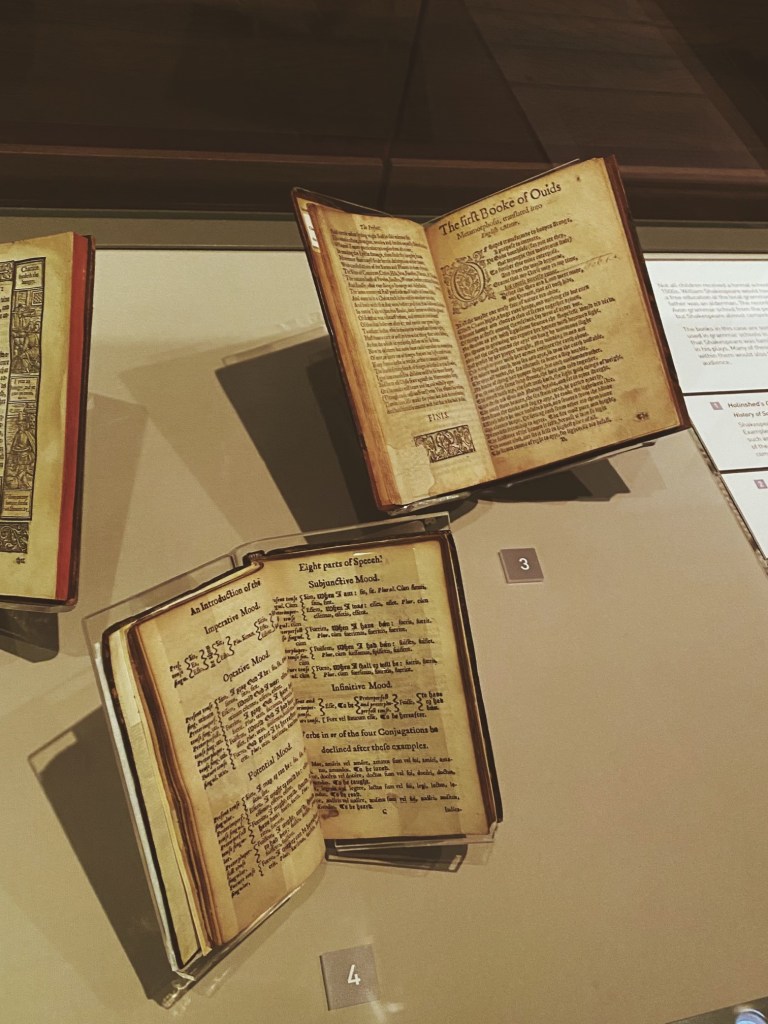
Yet, as you continue through these displays, it becomes apparent that so many people have also used Shakespeare’s work as a source of inspiration. A window from Shakespeare’s birthplace is etched with the names of hundreds of people who have visited there, including writers and actors like Walter Scott and Henry Irving. This is what great art does: it builds from something beautiful, it inspires, and it leads to more valuable contributions of art in the world. I feel like this trip has been similar in the sense that I’ve been lucky enough to learn and be inspired by the kind, brilliant, gifted people that I’ve met here. As sad as it is to say goodbye, I’m grateful for all of the little moments of sunlight during this past month in London and Stratford. Thank you again, Casey, Shawn, and Courtneay for making this such a lovely experience!
With Warmth,
Kath
June 13th: Girl on an Altar
Making our way from the hotel and trekking a longer-than-average distance from London, the group found itself in front of the Kiln Theatre for Girl on an Altar. We arrived early, but time before the show was quickly whittled down by a search for quick food (that was, for me, not fruitful) and, among a smaller group of us, a discussion about what foods we were most eager to eat again once we are back in the States. I recall chips with salsa/queso coming up from Hailey, but I cannot remember any foods that I especially miss.
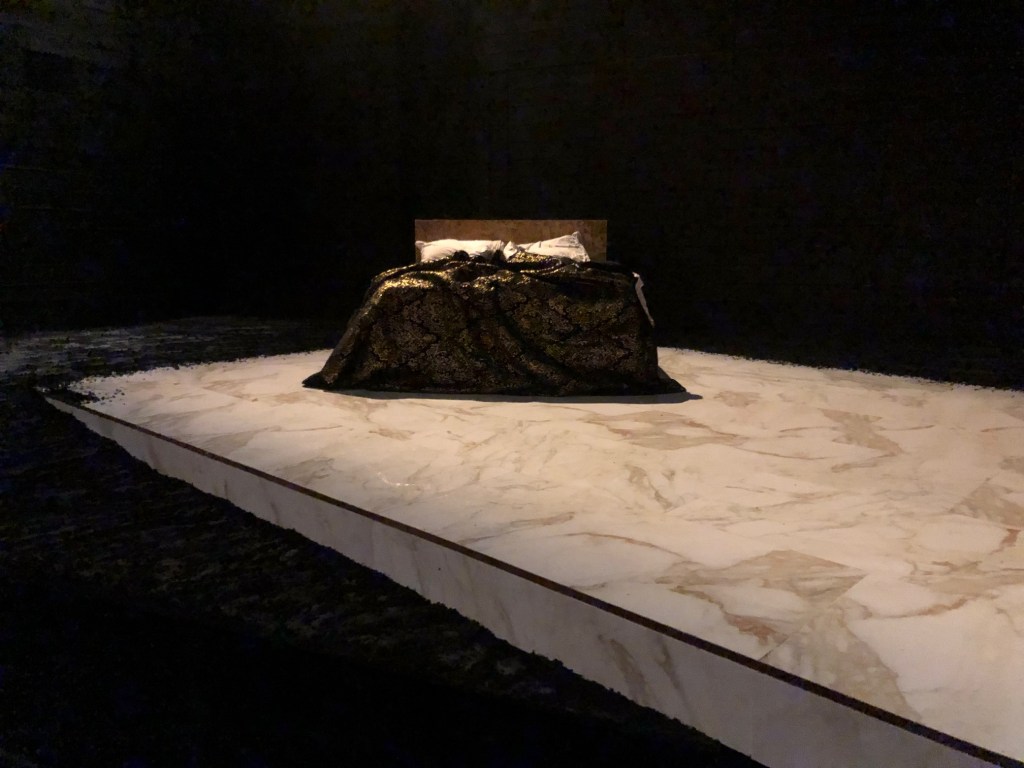
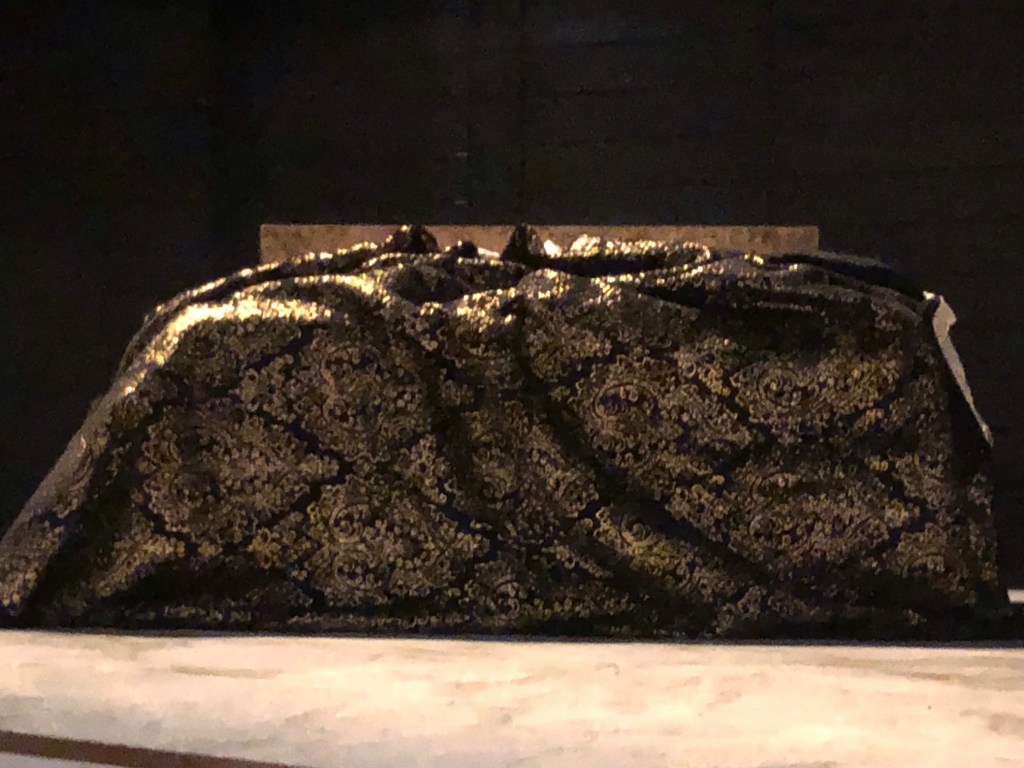
Moving on from culinary concerns, as the theater opened and we began to file in, I noticed two things. First, my ticket placed me in the second row from the stage, and I pondered how my experience would be altered by such close proximity to the actors. Second, I took in the parts of the set visible prior to the show commencing. There was a central area of the stage with a glossy, marble-like floor, on which sat a bed with an opulent duvet. Surrounding that were surfaces sloped and shape to resemble a more natural, weathered environment, covered in a material that resembled clumps of black dirt or gravel; after the end of the show, Margaret got up close to the stage and concluded that the material was a kind of soft foam, which admittedly is more sensible and comfortable than my initial guess of ground-up chunks of rubber. There were side doorways at downstage right and left, and the walls, which reached up fairly high, were composed of wooden boards painted black and laid horizontal. Later on in the show, a section of the upstage portion of that black wooden wall was pushed and pulled like a scaled up sliding door, revealing a large room with mirrored walls.

As far as the performance was concerned, all of the characters were strongly defined and each of them were relatable or understandable despite their flaws. I appreciated and was enthralled by the various points of view provided by the changes I perspective from character to character. It balanced out the prevalence of the characters, though Clyemnestra and Agamemnon definitely held the most sway, and it made the depiction of the play’s themes (loss, guilt, power, denial, etc.) more well-rounded since every character’s view was heard by the audience regardless of the character’s gender or social status.
There are several things that bothered me about the production, with most of them being either issues with the play itself (as opposed to any decision or execution of it by the actors) or annoyances that may better fit the description of nitpicks. In the second act, Clytemnestra and the audience learn that the old palace, where women who have fallen out of favor with various power figures, as well as bastard children, are relegated to, is a nightmarish place where most of the women have gone mad and the lack of food and water causes children ad women alike to perish. While I could be misremembering things, I recall Clytemnestra mentioning out of favor women an their listless, almost empty lives in the first act, and they were a far cry from what is shown in Act 2. With the concession that I am not intimately familiar with the Greek myth that this play adapts and thus this aspect may be true to the source material without my knowledge, I feel that the intense doom and gloom of the old palace in the second act was overly dramatic and interfered with my immersion; this feeling is reinforced by the fact that Antigone, a Greek tragedy that I am familiar with, demonstrates how important proper burial of the dead was in ancient Greek culture, regardless of the deceased person’s alliances or morality. Also, the old palace being such a wretched place effectively deletes all of the complexity of Agamemnon’s morality to the audience, since there is effectively no way to reconcile the possibility of him being a good or even pitiable figure with him starving numerous people for being unwilling or inconvenient to his political and personal life.
One tiny thing that hindered my suspension of disbelief was a tattoo along the left ribcage of the actor who portrayed Agamemnon. While this may be a nitpick, given the production’s modernized costumes and set dressing, Agamemnon would be shirtless and absolutely killing it in a scene, but then I would see “Human Error” printed on his side in typewriter font and my immersion would disappear for a little while. I understand that there is lots of sweat, skin-to-skin contact, and eventually having about a liter of liquid poured on you involved in this role, but I think the application of makeup to conceal that tattoo would make a world of difference.
My one outright complaint about this production, or perhaps more toward the Kiln Theatre itself, involves their terrible protocol for warning audiences. This play acts out situations of dubious sexual consent as well as general sexual content (characters embracing and kissing in a very charged manner, Clytemnestra not having any top covering as she changes from a towel to a nightgown, etc.). These subjects are sensitive and triggering to some people; a large enough percentage of people to warrant including a warning about that content. But no such warning was given! The worst part? Whoever was responsible for making the postings outside of the auditorium clearly knows that warnings are necessary for audience safety, given their posting from that night’s performance:
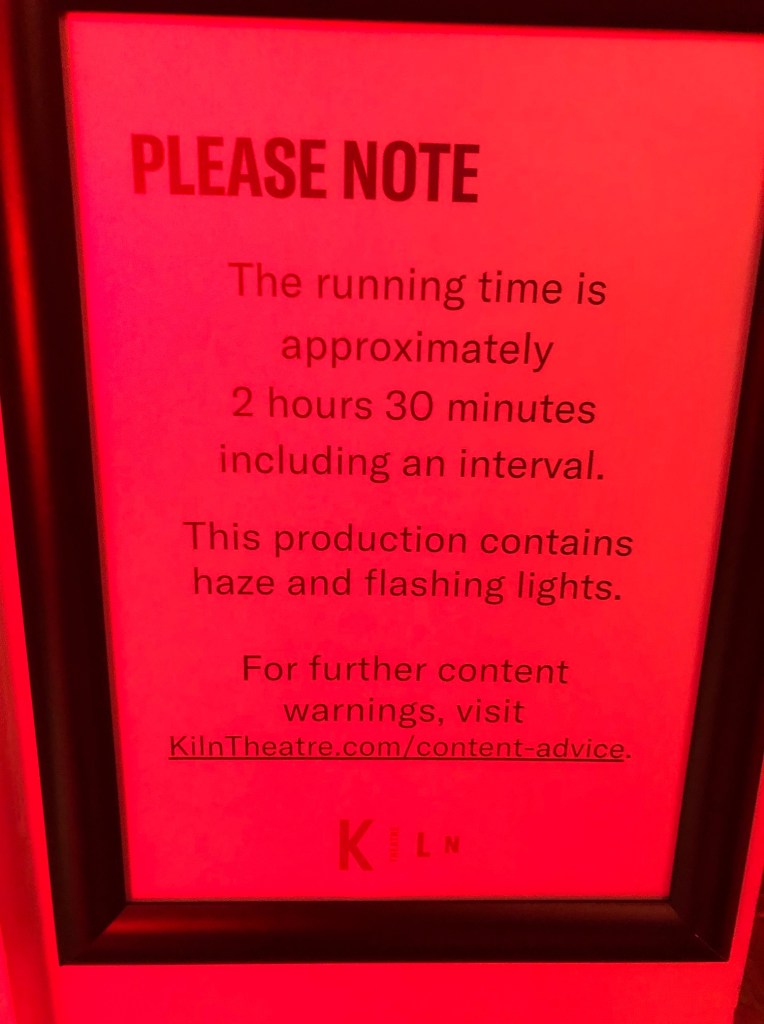
To include (admittedly valid) warnings about theatrical effects like haze and flashing lights, and not include warnings about common traumatic triggers present in the performance displays either a titanic lack of good judgement or a lack of respect or knowledge about emotional/mental responses.
The quality of theatre in this example of London’s fringe was certainly high, especially given the cost of admission. I only wish that the quality of the pre-show/front of house team’s awareness was on par with that of the production.
June 8th Part 2: The Corn is Green
Our second voyage to the National Theatre instilled more excitement than the first, at least for me. Between being more familiar with The Corn is Green than The Father and the Assassin and gaining first-hand knowledge about the quality of production the National is capable of, I was eagerly looking forward to seeing the play we read in class come to life.
We were in the Lyttelton Theatre, a different space than the previous performance, which was a proscenium with minimal, if any, playing space forward of the curtain. While proscenium is certainly the most common stage configuration in contemporary theatre, the use of it in this production was far from typical. For the length of the first act, all of the events of Williams’ story happened on a simple platform without any masking behind it, so all of the stage’s internal workings like fly rails and lights were visible to the audience. The second act saw the introduction of a larger, unmoving set of a house interior that reduced the view into the backstage and, during the last scene, masking flew into place and blocked that view, forcing all focus onto the happenings inside the house. Aside from providing an interesting sneak peek at a part of the facility that is usually hidden, it contributed to the feeling of the visuals onstage being more and more developed as the action of the play develops, which I will expound upon shortly.
This production devised a sort of prologue and accompanying scenes interspersed at different points of the play’s events that, rather than expanding the world of the play, provides an imagining of the playwright’s life, emotional states, and method as he wrote The Corn is Green. To elaborate, the start of the show finds Emlyn Williams at a party, and subsequently called to his typewriter by a chorus of miners to begin writing the play The Corn is Green. As the play proper goes on, Williams stands on the edge of the scene speaking certain stage directions aloud and occasionally inserting himself into the action to alter or correct the story as he develops it.
This surprised me, but I quickly fell in love with that creative decision. By making the events of the original play be a story that the character of Emlyn Williams is creating, simpler set pieces and blocking, as well as the aforementioned exposed workings of the theater, all serve to show the development of the story in Williams’ mind from a concept to a complete play (while also conveniently lowering the technical demands of the production). It gives the audience a second story to follow without adding any clutter or clunkiness, and, most meaningfully, it presents in Williams a “real life” example of the importance of education and what it can do for an individual.
In the play proper, the ensemble of miners served the practical purposes of bringing set dressing and props into the scene, at least in the first act, and filling up seats during the one large schoolhouse scene. Outside of that, they interact with Williams and sing rather beautifully in Welsh during the added Emlyn Williams moments, representing both the poor mining community of his own upbringing and his own identity as a Welshman compelling him to write the play (they also sing on the outskirts of the play proper on a few occasions, representing the Welsh background and the reality of life in the mines embedded in the children Ms. Moffat is attempting to teach).
Experiencing the play live enriched the story tenfold for me. It made several moments that never seemed noteworthy incredibly funny, and the character portrayals, particularly those of Ms. Moffat and Morgan Evans, were strong and engaging. Very close to the end of the play, shortly before Morgan walks away from Ms. Moffat for the last time, Emlyn steps in and briefly replaces Morgan, speaking his lines to Ms. Moffat who, in that moment, became the instructor who nurtured Williams’ potential and enabled him to, as Morgan put it, get over the “stone wall” that separated where he was from the rest of the world.
I view this play, now, as a love letter to education, written with characters analogous to the playwright’s own life, and it reawakened the motivations that lead me to become a teacher in the future.
Leaving London
We left London and headed to a much smaller place in England: Stratford Upon-Avon.
Because I had enjoyed the city so much, I really didn’t expect to find nearly as much enjoyment in Stratford. We arrived and I immediately fell in love. It was such quaint little town and you do not have to look very far to see the history at all. Everything is cobblestone and brick, and it was so much more peaceful and quieter. Shawn told us that everything closes early because this is a “sleepy little town.” I loved that, it was so cute and perfectly in tune with my old soul. After all the hustle and bustle of the city it was nice to spend these last few days relaxing and taking everything in.
Everything we saw was remarked on how cute it was. Everything from door handles and walls to monuments and parks were covered in flowers and Shakespeare quotes.
We went to Shakespeare’s birthplace and the house that he purchased for his family and where he wrote over half of his works. From these places I learned a lot about his own story and how it might’ve inspired his writings. I learned a lot about his family, which I enjoyed and found valuable. It gave me a wider picture of who he was and what life was like in England all those years ago. The second day we went to Anne Hathaway’s cottage which was my favorite part. The gardens were picturesque and the epitome of peace. I would’ve loved to sit under one of those trees with a book and listen to the bee’s buzz. It was cool to see all the Shakespeare quotes that were connected to everything we were seeing. I found a lot of quotes that I connected with and that made me want to read more Shakespeare. He’s always been one of my favorites but by following in his life’s footsteps I felt more connected to him and his work. We went to trinity church where he was buried. It was strange to think that one of the most influential people in our world’s known history was laid to rest under the stones in front of my feet. I wondered what he would think when he was alive if he found out that we had traveled 4,490 miles to visit him and his home four hundred years in the future. The whole town seemed to be dedicated to him and his honor. Everything was Shakespeare themed, I enjoyed it there.

All the things we did here were a calm and sweet way to end the trip, such as the cat café and the butterfly house. It was a nice way to reflect on all the ways I have personally grown and changed since I arrived in London. It was time that I was very grateful to have with the people who I have connected with and grown to love on this adventure.


I couldn’t be happier that I faced all my fears, stepped out of my comfort zone, and came on this study abroad trip. It was the best thing I’ve ever done for myself and the best month of my life. I am going to miss it so much; I know my heart will be broken in the coming weeks. I know I’m going home, but I must leave a home that I’ve found in this place to get there. I leave a big part of me in London and take a new part of my heart back with me.

For the last time, until I one day return:
Signing off from London,
Margaret
Goodbye London.


Anyone Else Ship Victoria and Albert?
The Victoria and Albert Museum was beautiful inside and out. I loved the statues and the paintings. The jewelry exhibit was a particular favorite, capturing history in sparkling and shimmering jewels. However, the theatre exhibit was fascinating, I loved that they had a whole room dedicated to showcasing theatre’s history and educating the public on that process of creation.


The costumes were beautiful. I thought that the set designs were cool to see, it was inspiring the way that people thought outside of the box to create the ambience and story of the show in a set. A lot of these sets reminded me of what we went to see. The Sweeny Todd set was intricate, multilevel, and detailed. Shiloh informed us that just the model probably took hundreds of dollars to create. The Sweeny Todd set reminded me of The Phantom of the Opera and Les Mis. The way the different levels added to the directorial choices that were available. In all of these shows the characters had the opportunity to pop out of different places and place themselves above or below certain parts of the stage to encourage engagement and attention to the entire set, not just the ground level.
I also liked the set model that did the opposite and created a big hole in the floor under the swinging girl. Without knowing anything about the show I already got to see some of the metaphor of the set and understood what it was trying to communicate. It reminded me of the set for House of Shades, where the father was able to open a trap door and there was lighting coming from the bottom, just like in this set model. It also reminded me of Life of Pi, when he jumps off the boat and falls through a small hidden hole in the show. It is this type of unusual thinking that creates diverse and new unimagined ideas in theatre. It is a way of keeping theatre alive and refreshing with new secrets, ideas, and tricks.
I also liked the little model light board where you could play with the lighting on a real set. Because I’ve been thinking about lighting and observing it a lot on this trip it was neat to get to see some of the behind the scenes and helped me to connect more in my mind about how those things work.
Signing off from London,
Margaret

