Okay, so a pleasant surprise! Glengarry Glen Ross is traditionally a play about masculinity, self-worth, and male gender roles, so it was quite intriguing to me that they decided to have an all-female cast. It could’ve really gone poorly, just distorted the message of the play or not really added anything thematically. But overall, I think it worked on several levels. Every line that included a reference to “being a man,” “manning up,” “having the balls,” etc. had a different ring to it than before. I started to question if those sentences really sounded different, coming from women, and what it might suggest if they did. Things that referred to stereotypes of women or their prescribed behaviors also felt more backward, or at least more notable. And the American accents were pretty on par (sorry, War Horse, but your accent game wasn’t exactly up to snuff). I didn’t like the actress who played Moss as much, either; she seemed kind of mechanical and one-note (but I have no acting training, so don’t take it from me).
And the costumes! It was so interesting how they decided to combine masculine and feminine aspects of dress for each character. If the actress wore a skirt, she probably had tennis shoes on, but if there were pants, it was likely she had heels on. For other characters, there were more indicators too: Shelly had a pixie, but Moss had long hair, and George had a sort of in between cut. It almost seems an attempt to universalize the play’s message, that being stuck in the past and prioritizing work to define success are problems all professionals of all backgrounds face at some point. And the Ricky character, played by the fantastic Rosa Salazar, had his (her?) own thing going on, black and white most of the time with a trench coat, white collared shirt, black shoes, etc. She was quite androgynous, dramatically more so than the other characters. I wonder if this is because the Ricky character was the most conventionally “successful” of the salesmen, and the designers wanted to imply that all individuals have the chance to achieve those standards, regardless of sex. I’m not sure if that’s right, but I am sure that Salazar was incredible.
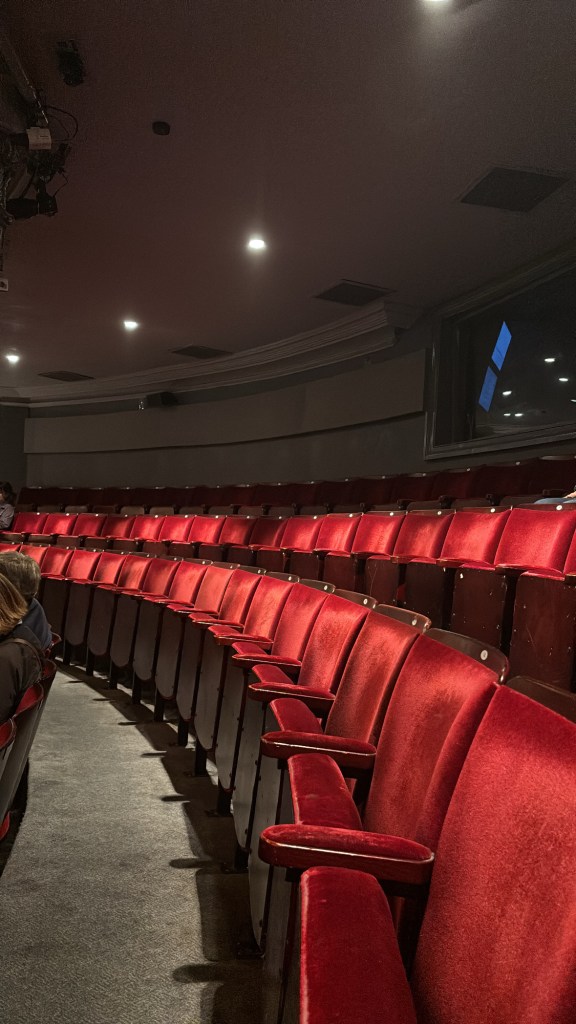
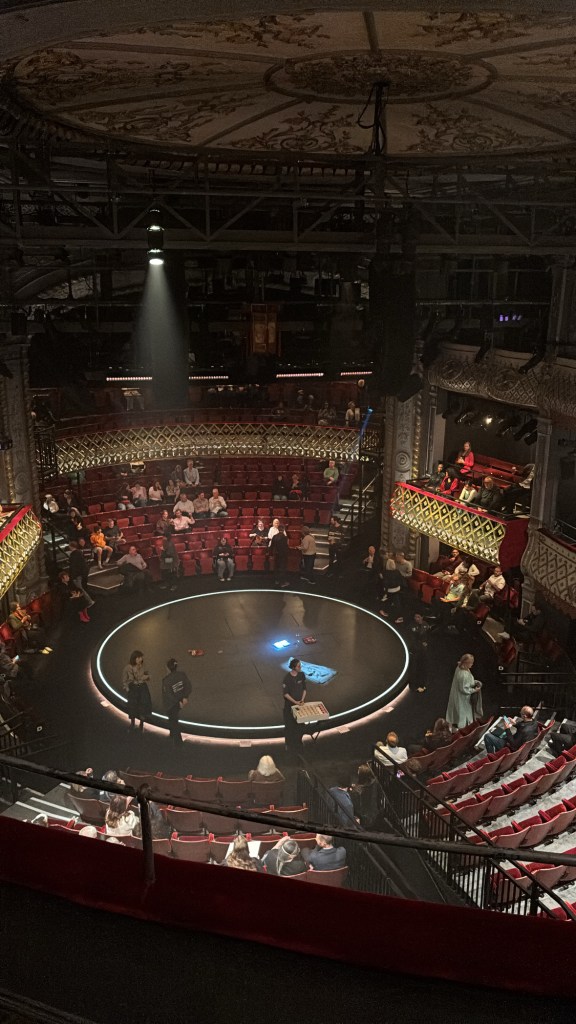
The design of the theatre itself was quite beautiful. I love a good ceiling, whether it be a cathedral or a museum, and I discovered a new joy in this theatre’s ceiling. The Old Vic has been around for over 200 years, so it makes sense that the ceiling itself it would be a work of art. I really enjoyed the plush red seats, too. I don’t know if the stage is always the way it was for our show, but I thought the way it was oriented was really interesting. Members of the audience in the front row were level with the stage, and I wonder if that was done to ground the work and communicate the familiarity of it in the modern world. I also found myself searching for backstage, as the seats and entrances surrounded the stage in four corners. It allowed for more dynamic movement and scene setting, I think, because each exit to backstage could be used as a different off-stage room. Also, desks rose out of the floor of the stage, which was quite impressive, although the stage was never empty as I recall, so I’m not sure about the rising desks’ usefulness. Still, perhaps just an efficient use of space.
Overall, it definitely prompted admiration for Mamet’s original play and evoked contemplation about the way we define success and the role of masculinity in that as well. Would see again!
– Reese
 Theatre in London U of A