We ventured out of London and into Bath for the day. I felt far underdressed when we went to afternoon tea at the Pump Room, where Jane Austen once sat for tea. We enjoyed the best earl grey that I had ever tasted along with numerous small sweet and savory snack foods. Before touring the baths, we were given the chance to explore and dig around in shops. There were numerous vintage clothing stores as well as jewelry spot that we explored.
We made our way to the Roman Baths. I was shocked by the ritualistic nature of attending the baths. There were so many specific steps in order to have the best soak, and yet I truly believe there is no way that anyone left the baths cleaner than they entered. Citizens were encouraged to work up a sweat, coat themselves in oils, scrape the dirt off of their bodies, and then soak in the baths. However, the baths were open to be used as toilets during your soak. Pairing this with the heat of the water as well as the lack of movement in the water led to a rather counter productive type of cleanse. Learning the other history do the baths and their significance among citizens was interesting despite the less than sanitary practices. The community that the baths allowed was fun to learn about.
After the tour of the Roman Baths we were released to explore the city. I found myself at a coffee shop in a small plaza that was built surround a beautiful tree. The life surrounding this little spot led me to sit and stay for a while. There was a man playing music and many groups of families and friends socializing. The community was quieter and certainly slower than the life in London. Bath turned out to be an adorable little place with lots of music, shops, and history to explore.
Somewhere between 60-70 AD, the Roman Empire built baths in what would later be called Bath, England. The are in which they were built was formed to help them worship Sulis Minerva, the goddess of healing.
Our day in Bath started with some Afternoon Tea Time, where we were served mini sandwiches, treats, and for the first time ever, tea that I actually enjoyed drinking! I’m still shocked, I’m not a tea person. The architecture was also so beautiful to look at. It’s something that’s continuously sparked a conversation during the trip of how intentional and purposeful architecture used to be. It’s so interesting how detailed and fine tuned everything used to be.
Walking through the different baths, feeling the heat of the water spread throughout the rooms, it was incredible to think about how well preserved these rooms are. Baths and areas built about one thousand years ago are still standing and kept clean! That’s incredible! I got a video of the natural baths and you could see bubbles coming up from the water, the water boiling because of how hot it was outside, which kind of made me want to get in. At the very end of the tour, it gave us a chance to taste the bath water. I did it. Don’t do it.
In the free time that we had, it was spent walking around the streets of Bath looking at all of the different stores that were set up. One of my favorite places was this guitar store where finally, after days and weeks of missing my four sweet children (three guitars and a ukulele), I was able to play something again. Sweet sweet relief. I also went into a book store and found a copy of War Horse. I bought it, of course, and am so eager to read it. If it’s anything like the play we saw, I’ll be in a pool of tears about halfway through.
Our time spent in the city of Bath was luxurious, historical, and breathtaking. I really felt Bath’s differences from London from the people as well as the overabundance of nature surrounding the city. Having afternoon tea at the Pump Room was very elegant and it was something I had never experienced before! They brought us different kinds of tea and many small finger foods. All of us around the table felt like royalty!
After having afternoon teatime, we went walking around this beautiful city to see some of the famous places. We visited houses that were featured on the famous Netflix show, Bridgerton. One of the houses was a museum we got to venture in and see the artwork that was displayed. Right out of the museum we found gardens that were very beautiful with a playground, tennis courts, and even an outdoor theatre! We got the chance to watch a little bit of a production’s dress rehearsal, which was fun to stumble upon, being such theatre people! On our walk there was saw many beautiful trees and a waterfront that several people were gathered around. Many of the locals that we spoke to were extremely nice and welcoming.
We were also able to take a tour of the historic bath tower with guided history lessons throughout, helping us understand what people at the time used the rooms for. There was a gym with projections that I thought were interesting to see what they used to do for exercising including wrestling and lifting weights. We also got to learn the history of the baths in the tower, how people would think that the hot springs were holy and would worship the gods that sent it to them. We even got to taste the hot spring water…I would not recommend it.
My experience of the play, Mother Courage, was sensational and emotionally impactful to say the least. This was my favorite show of the trip so far! I was deeply invested in the characters as well as the story and the message that the playwriter, Brecht, conveyed to the audience. I thought that Shakespeare’s Globe Theatre was a perfect venue for Mother Courage, as we got very front standing spots, so close to the stage that I was able to rest my arms on it! I could see the emotions felt by the characters very clearly and what deep emotions they were.
As Brecht likes to distance the audience from the characters and the world they live in, I still felt emotionally connected to many of the characters. Although he does this to convey the message of the play to the audience rather than them identifying with the characters specifically. I thought the message of the play was clearly conveyed through the techniques of the actors and storyline that was brought to life. I thought the actors making eye contact with the certain audience members, talking to them and even reaching out and touching one of them resulted in the viewer’s alienation from the characters on stage.
Personally, I enjoy the performance of a play more when I am emotionally invested in the characters and the story. I don’t believe that the play is less successful in conveying its message of never-ending war and its costs. If I had not been emotionally immersed in the play, I might not have liked or understood its grand overall stand on the politics at the time, which are still relevant in today’s day and age. The play allowed me to really pay attention and love the characters that had a heartbreaking ending, due to their place in the war.
“Mother Courage and Her Children” was quite an interesting way to spend an afternoon. The play was wonderful, but the fact that it was the hottest day yet, in an outdoor theatre, and we had to stand the entire show, made the play’s intense subject matter feel even more intense. While it was hot and uncomfortable at times, being a groundling at Shakespeare’s Globe was a very special and unique experience that I will cherish.
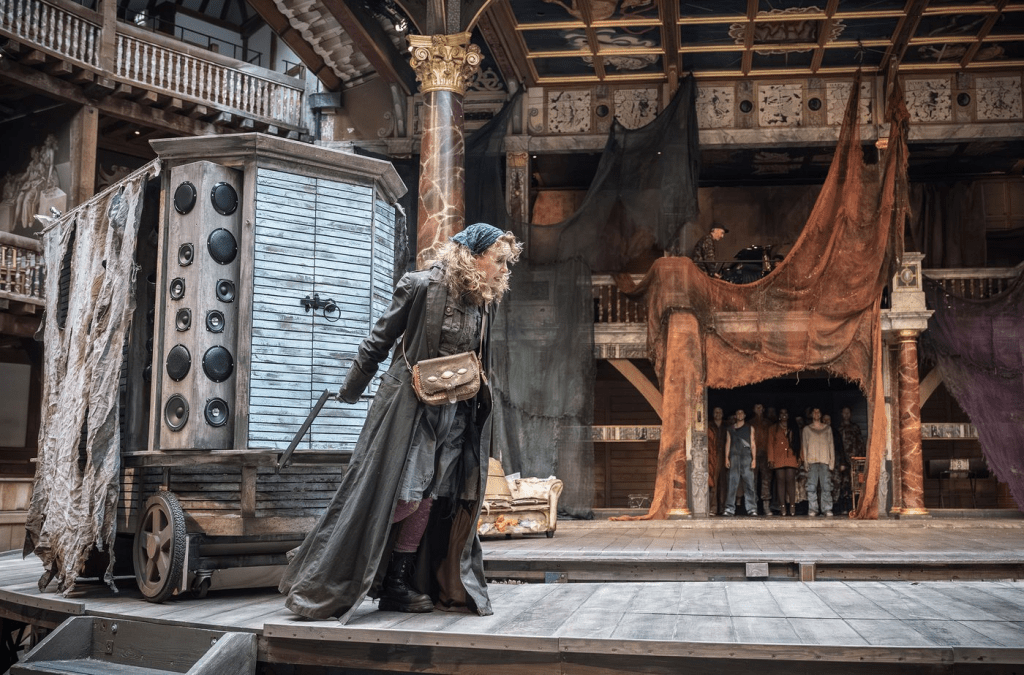
In terms of the content of the show, the play follows a woman known as Mother Courage and her three children during the 30 Years’ War in central Europe. Mother Courage makes a living selling wartime supplies out of a canteen wagon, and she enlists her children to help her with her endeavors. Throughout the course of the show all three children get involved with the war in different ways and die. The show is a commentary on the tragedy and horror of war, and the social and political systems that create it.
In Brecht’s writing he liked to use the alienation effect. This is the attempt to distance the audience from a state of pure catharsis, and instead make them examine the work through a critical lens that gets them thinking about the larger themes of the piece. Mother Courage definitely succeeded in having this effect on me. At first I thought that the play did make me achieve a state of catharsis, but after further examining my feelings on the play, it did have more of a cerebral effect than an emotional one on me.
I believe that the key thing that Brecht does in this play specifically to achieve this effect is making Mother Courage an incredibly complex character. If Brecht wanted the viewer to simply feel the tragedies of war in an emotional way, he would’ve made Mother Courage an innocent actor in the world of the story. The audience would’ve watched horrible things happen to a loving mother and felt horrible for her. This isn’t the case though, Mother Courage has many flaws. One of these flaws is the fact that she uses the system that the audience is meant to despise for her own advantage. She views war as potential for business. While her part is small, she is contributing to the war, and that same war ends up killing her children. She also sometimes looks out for her own personal gain over other peoples. For example, when Swiss Cheese is being sentenced to death, she doesn’t immediately offer all the money she has to let him free. This financial decision could’ve been the difference between life and death for her son. These flaws are what make the story cerebral. It makes the viewer question how someone could act that way towards their own children, and asks the viewer whether they could get to that place themselves. While she does have flaws, in the end the audience does empathize with her situation and feel bad for her.
Another thing that this production in particular did to break the audience out of the story was having a lot of audience interaction. This choice was very intentional, and it made it so the audience never forgot that they were watching a play. Everytime that I would start to forget the theatricality of the piece, the actors would come out and talk directly to the audience. This choice made me examine the metatheatricality of it all, which kept my mind from being sucked entirely into the story.
Overall, it was a great production with wonderful performances. Michelle Terry was an absolute powerhouse, and the production made me excited to see “A Midsummer Night’s Dream” at the Globe later this trip.
I don’t believe this idea was effective in Mother Courage and Her Children. This is also partially to do with the setup of the Globe Theater, especially as a groundling. The play included a lot of character work within it, as members of the cast would make eye contact with audience members, point, and have small interactions, and even use them as elements of a joke every once in a while. When it comes to the actual writing of the story, I also feel that there is a strong connection between the reader and the characters, as the characters have a very colloquial tone and seem very uniquely human.
Now that the assignment is out of the way, oh my god. Words cannot describe how much I loved this play. I have never cried this hard at a piece of theater in my life, and I can say with absolute certainty that this play, in this specific production, is my favorite theatrical production I’ve ever seen.
This show was not at all what I expected. To be honest, I was expecting something boring. I knew nothing about the show or about Brecht coming into it, so the title and posters alone led me to believe it would be more of a period piece, centered around family life issues and a “caged bird” trope. Not to say that those can’t be interesting, but I’ve seen them before. I was wonderfully surprised by this show. Not only did the plotline surprise me, but the technical elements and setting did too.
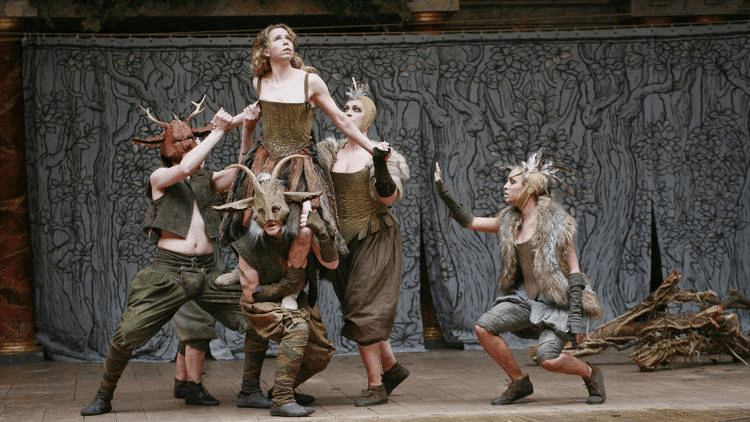
One of the standout parts of the show to me was the costuming choices. They were so beautifully put together and so well chosen for each character.
This is a show that I have not stopped thinking about since I saw it. I truly feel like this was a piece of theater that permanently affected my brain, and I’m tearing up now just thinking about it. I want to see it again. I don’t usually want to see plays again.
Mother Courage, oh where to start… I absolutely loved this play so much. Not to put a stereotype on the cover of this play, but I was not expecting to like it as much as I did, especially in the 90-degree heat in direct sunlight! Contrary to the heat, we did have the best seats in the house! Not literally because we did stand for 3 hours to watch the play, but we were right on stage almost! We were in the pitt, one could say.
Never have I seen a play by Brecht, but I really liked the way that he made me think about the play and its timeline. This play is set in the 17th century during the 30 years war in Europe. Although this play is set here, I do believe that his storyline was elevated by bringing in 21st century ideas and themes. The producer of this play at Shakespeare’s Globe Theatre put small twists on the play to make it more modern, which I appreciated. The fact that this play can be modernized a little bit but still convey the timeline shows Brecht’s talent for depth and lessons that can still be learned hundreds of years later.
Brecht uses things such as the “pow” of a gun or an explosion to make the watchers jump and remember that they are seeing a play and that it is not real. I believe that the use of stage effects is useful to help convey his deeper messages of the war and the means to survive in this day and age. He also uses Mother Courage to show that even though her children died, she is not a hero. Her love for money and survival is what ultimately pushed her children away and closer to death. The songs she sang after an important or emotional time that were often about war, death, or survival, helped to turned the page. This showed that no matter if horrible, hard things happen, you have to keep going to survive.
The lack of time that he allows for the audience to feel the pain that she felt made us look deeper at the economic state of the world and why things occur. For example, he interrupts Mother Courage from mourning to show the devastations of the war as she explains that the war is driven by profit at the cost of lives. Peace would destroy her business as she goes on to explain. Mother Courage has courage, but not as simply as it seems. By using her survival within a system that is broken, she has to more or less survive rather than continue on with courage.
We saw Mother Courage and Her Children on Saturday and WOWWW what a play. It was absolutely beautiful and moving, I was laughing, crying, and feeling all the emotions. The costuming and the set was so perfect to the story and the actors were absolutely amazing. I would absolutely go see that play again and it was worth standing in the heat for so long.
I do believe the Globe theatre’s production of Mother Courage uses Brecht’s alienation technique while still allowing the audience to be engaged emotionally. I think a great example of this is the musical numbers throughout the play. The songs interrupted dramatic, emotional parts in the play. A lot of the time the songs kind of made light out of situations that were happening that weren’t funny at all. This made us, the audience, not become fully absorbed in the suffering of the characters we were watching and instead reflect on the message of the play and what it was trying to get us to understand socially and politically. The actors also addressed the audience and engaged with them, not very typical in other plays, creating a theatrical illusion.
The Globe production also made humor in very unexpected moments and about a lot of things weren’t actually funny and I connected a lot of that with how Cabaret does their show. The instability of emotion and jumping from sadness into humor stops the audience from sitting in their sadness and can create a really awkward feeling of ,”should I laugh even though this isn’t funny and actually really messed up and sad.” This makes you think more deeply into what’s going on in the story and all aspects of the story and the flaws of the characters in it and the society they live in. I thought the production did a great job in conveying Brecht’s message. It made you feel bad for Mother Courage while still seeing how she was extremely flawed and put profit above peace when it came to war. It was the perfect mix of pitying the characters while still forcing you to look deeper into every aspect of them and the story.
Just . . . wow. This is my new favorite so far, maybe ever of the plays I’ve seen (and I’ve seen at least 20).
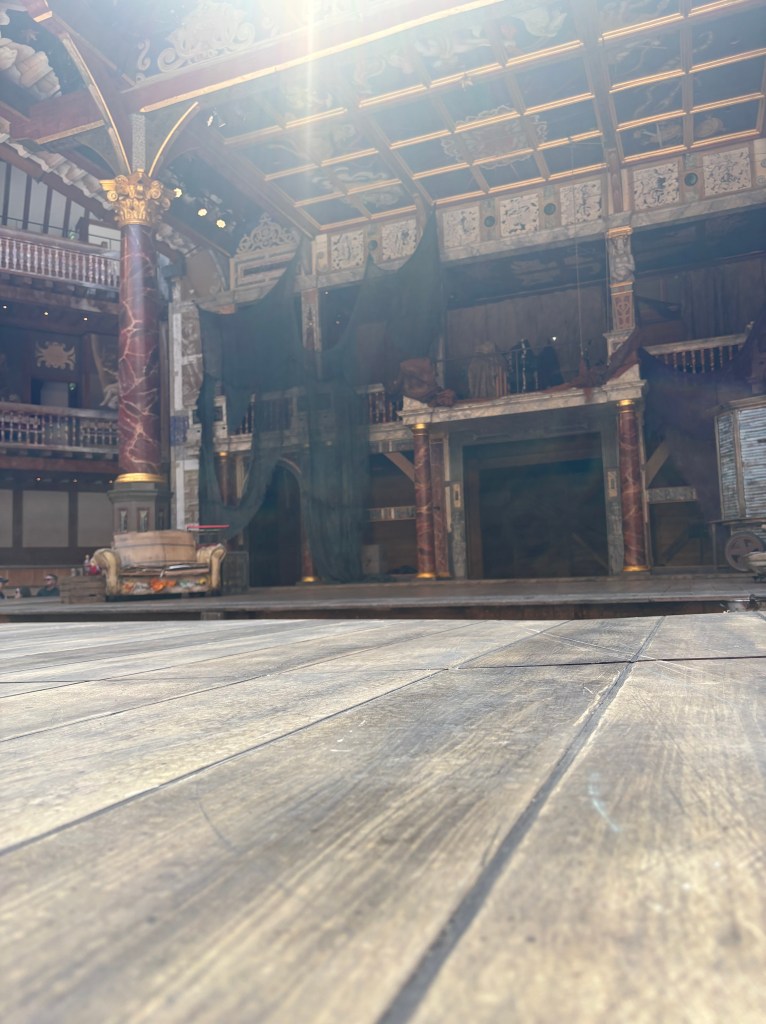
My view of the stage!
So much of its appeal comes from the design of the theatre itself. Because it’s open air and we had groundlings tickets, I didn’t get the sense that I was watching a rehearsed, written, carefully planned performance; it’s almost like you’re viewing a series of private conversation through a keyhole (except, of course, there are also explosions and a cart rolling around). The actors speak directly to the audience, point to people in the crowd, and walk around on the ground, making it seem like you are a part of the action, a character in the story in a way. It was the most immersed I’ve ever been in a theatrical performance, and my soul honestly just soared. (Side note: fuzz, dust, and pigeons naturally drifted across the stage and in the air, making the atmosphere seem more war-torn. So cool!)
Because of this, however, I think the Brechtyness of it all was lost a little bit. Brecht intentionally disassociated all emotionality from his characters, so the audience would critically engage with the themes and symbolic imagery of his plays. With this adaptation’s particular engagement and the compelling performances, the plot is more personally impactful than the script alone. The fact that I could reach out and touch Courage’s cart, that breaking of the fourth wall, also degraded any sense of apathy I would have toward the play’s characters. I think this was especially clear in the closing scene, when Mother Courage drags her cart around the stage alone, bowed over with the strains of living. She stops midway through her journey, and it happened to be the exact spot where I was standing against the stage. Seeing the pain on Michelle Terry’s face, the utter shock and despair, from about three feet kind of eliminated the possibility that my brain could ignore the harsh reality that Brecht’s play presents.
As to that reality, I think Brecht described the universally dehumanizing effects of war quite well. Although his original script technically depicts the 30 Years’ War, the Globe adaptation works as a commentary on modern warfare just as well. I especially enjoyed the sense of godlessness and absurdity that pervaded the show. Haven’t eaten in three days? Let’s pretend she’s my wife and she’s collapsed from hunger, that ought to get someone’s attention. One of Courage’s children dies? Well, back to my cart, have to carry on with the business. The endless profiteering and pursuit of wealth was also an interesting theme, and it was incredible to see how Mother Courage used it as both a coping mechanism and a livelihood. The Globe’s reprisal is almost less tragic than Brecht’s original work, despite the augmented emotional effects. Brecht very much highlights how mundane the atrocities of warfare and conflict are in the modern world, to the point that the reader is supposed to feel apathetic toward the contents of his play. When the message becomes personal, as with the Globe’s production, it doesn’t communicate the tragedy of desensitization in quite the same way.
What a privilege it was! I’m just incredibly grateful to have had the experience, and I am so looking forward to seeing A Midsummer Night’s Dream in a few days. Shakespeare in Shakespeare’s Globe will be quite different from Mother Courage, I’m sure, but no less transformative and engaging.
Coming soon!
Until next time, take courage, and serve your fellow man or something (sheesh, that was a heavy play).
It’s hard to articulate how I felt about this show, but I’ll do my best. For starters, it’s important to know that seeing a show at Shakespeare’s Globe Theatre has been a dream of mine for quite a while now. I remember my dad talking about when he saw a show there, and I’ve been enchanted with it ever since. The atmosphere at The Globe is so unique and different from anything I have seen before, and now I have bragging rights to say I’ve seen Mother Courage and Her Children at the very theatre Shakespeare acted and staged his plays in!
Brecht is known for the use of alienation or distancing in his plays, attempting to prevent the audience from becoming emotionally immersed in the story. I strongly believe that if one wasn’t aware of this technique, they couldn’t have guessed it based on the performance I saw of Mother Courage at The Globe. The Globe is such a unique space, and I believe that it’s almost impossible to create such a distance from the characters while being so immersed in the performance. I absolutely loved how this show involved the audience. I believe that aspect of the show made it feel as though I was a part of the story, as if these people weren’t acting at all, but simply living, and I just happened to be fortunate enough to watch them. Because of this, I didn’t notice any of the classic Brecht techniques that would make the audience feel less attached or distanced from the characters; I thought the exact opposite.
I don’t think one could assume that just because our emotional immersion wasn’t interrupted, that the message of the play is less significant or that we can’t take anything away from it. I believe that theatre doesn’t have to distance us from emotion for viewers to think critically about ideas. Mother Courage proved that, so maybe Brecht isn’t all that smart after all.