I would argue with Brecht if he was here in front of me. Right here. Right now.

First things first…we watched a production at Shakespeare’s Globe Theatre!!!! How cool is that?!?!?!?!? As we walked in, I imagined how it was to be there long long ago. Of course it’s not the original because the original burned down, but it’s severely close! And not to mention, the tickets were only £5, or $7. 

The production was Mother Courage and her children by Bertolt Brecht. In the original, the play is set in 17th century Europe during the 30 year war. It was written in response to the invasion of Poland by German armies in 1939. It took Brecht a little over a month to write the play. 

In the version we saw, it was set during a non-specific war in a very dystopian setting. They wore modern clothes that were ripped and dirty. And had modern props and furnishings. So it could be believed that this takes place in a very dystopian future of our own world. 

Brecht is very well known for his use of “distancing” and “alienation” in his plays in order to prevent the audience from becoming emotionally immersed in the play. I did not get this AT ALL. People were crying throughout the play and really crying at the end. If that is not emotionally involved, then I don’t know what is. So in terms of whether or not these things were achieved, NO! They were not. People were emotionally involved. 

Brecht used these techniques because he believed that it made the audience think more critically about the play. I can sort of understand that. If you’re so focused on one character and become biased towards them, maybe you miss things. I am not sure. I felt that I was connected with just about every character and was able to view the whole play. So I don’t really agree with Brecht. 

I think the only alienation we got from the Globe’s production was that it was set in a modern day war. A lot of us haven’t experienced that. Especially our little study abroad group. But I know a lot of people in the world right now are currently experiencing it. Probably some people in the audience with us have. It’s very real. Someone in the audience said they were crying because there are people experiencing these horrors right now. So as a whole, I can’t say that the play was alienating. 

I do not think that this caused the play to be less successful at conveying its message. In fact, I think it was even more successful at getting the message out because of what’s happening currently in the world. 

Here is a picture of the stage:

And here is a picture my dad sent back to me when I sent him the above picture:

P.S. I would probably not argue with Brecht. I would lose that argument. I might recruit my brother to help me. He is good at that. Yeahhhhhh.

*Hey Alexa, can I raise Brecht from the dead?*

*Hey Alexa, how do I raise the dead?*

*Hey Alexa, how do I stop Brecht from writing a play in response to my argument?*

*Hey Alexa, how do I send him back?*

The Children of Sisyphus

We queued up out in the sun for what felt like an eternity to get the best seat, or rather stands, in Shakespeare’s Globe. I was leaned up on the stage and it was certainly the best view I’ve had of a play. One of the first things I took away was that this production of Mother Courage and Her Children was so wonderful when it came to world building. The costumes and set design immediately placed us in an apocalyptic world. Brecht’s work also built such strong characters. They were all very real and human, but we weren’t given direct back stories of them or how they got to be where they are. Each person was also a complex individual, each with their own motivation in life and reasons for doing what they do. This leaned into Brecht’s style of alienation through a lack of full understanding of a many characters. This was also achieved, of course through the death of characters. The often cruel and abrupt deaths of characters created a jarring effect in the audience. This was also more plainly done with sound. The incredibly loud and shocking sound of the gunshots and bombs certainly pull you out just as you’re leaning in.

There was a particular moment in which our “emotional immersion” was interrupted that stood out to me very heavily. Mother Courage has just finished her song about simply being another number, another cog in the machine. Michelle Terry’s performance was so excellent and the song was tragically comedic, therefore, it won a solid round of applause from the audience. However, as people continued to cheer, Kattrin came in absolutely broken. I was shocked by the continued applause for the previous song despite the horror on Kattin’s face in that moment. We were so absorbed and it took so long for us to shift out focus to the matter at hand. I almost felt guilty. I thought that moment created an incredibly quick and effective switch in the mood of the play and audience.

This show, of those that we have seen, has certainly been my favorite. In fact, it has likely become my favorite show in general. It was a perfect balance of comedy and tragedy. The characters were real and the messages were buried rather than spelled out for us. Brecht slowly guided the audience to the point he was making. With such light guidance, there was much room for interpretation. Audiences were given the chance to come to the conclusion on their own. The music was wonderful, the acting was phenomenal, and on top of all of this, it was performed in Shakespeare’s Globe. Despite standing for hours in the heat, the brilliance of this show made me forget that my feet hurt. I stopped feeling the ache in my feet and the sweat dripping down my nose and I was left standing there wanting more. I felt it all throughout this one show; I laughed, I cried, I grieved, and I grew. The experience I gained was simply indescribable.

Mother Courage’s biggest fan right here.

Bertolt Brecht’s concept of his “alienation effect” was designed to stop audiences at plays from becoming completely emotionally absorbed in a play. Instead of losing themselves in the story, Brecht wanted the viewers to remain aware that they were watching a performance. He didn’t want the audiences to enjoy his stories, he wanted them to think critically about the political and social issues being presented. On Saturday we saw The Globe’s production of Mother Courage and Her Children, which I think succeeds in using Brecht’s alienation tactics. But at the same time, it also allows more modern moments of emotional connection. As a huge fan of Brecht I found this balance ultimately strengthened the play’s message about war and survival!

One of the clearest ways the Globe production creates alienation is through its staging and performance style. The actors often addressed us in the audience directly, breaking the fourth wall and reminding us that the events on stage are constructed. The addition of songs are also used in a distinctly Brechtian way! Instead of deepening emotion like in a musical, the songs were loud and sometimes jarring, interrupting dramatic tension and forcing the audience to reflect on the meaning of what had just happened. For example, after tragic events, the music can feel unsettling or ironic, preventing the audience from becoming fully swept up in sympathy. (except at the very end that was so beautiful.)

The production also uses visible theatricality to distance viewers from the characters. At the Globe props and stage mechanics like the “dead bodies” rolling away were often intentionally obvious. This openness draws attention to the performance itself rather than creating a realistic illusion. By keeping the audience aware of the actors and staging, the production makes viewers analyze every decision. 

Another important distancing technique is the portrayal of Mother Courage herself. Although she is a sympathetic character in many ways, we were repeatedly confronted with her moral contradictions. She profits from war even as it destroys her children. Rather than presenting her as a tragic hero in the traditional sense, the production encourages viewers to question her actions and the social system that shapes them. This created a lot of emotional tension: I felt so so bad for her losses, but I also recognized her complicity in the cycle of violence and profit that caused them. 

However, the Globe’s production did not completely prevent emotional immersion. Some scenes, especially those involving the deaths of the children, were deeply moving. The audience can still feel grief and compassion. In fact, I think this emotional engagement may make the political message more powerful. If the production were entirely detached in true Brecht-style, viewers might not fully understand the human cost of war. The emotional moments gave such a good weight to the critical analysis Brecht wanted audiences to question.  

Because of this balance, I did not think at all that the play was less successful at conveying its message. Instead, the combination of emotion and alienation makes the production more effective. The audience is emotionally affected by the suffering on stage, but they are also encouraged to step back and ask why that suffering occurs. Brecht’s goal was never to get rid of emotion completely; he wanted the emotions to lead to thought and social awareness instead of entertainment. The Globe’s production achieves this by making viewers both feel for Mother Courage and critically examine the world that produces her tragedy.

I absolutely loved The Globe’s Mother Courage and found that rather than weakening the play’s message, the balance between emotion and distance ultimately deepened its impact!

-Erin

Did Grace Pervade??

Wednesday evening, we went to the Royal Haymarket Theatre to see Grace Pervades, starring Ralph Fiennes and Miranda Raison. I knew absolutely nothing about this show and was happy to realize that it is nothing short of a love letter to theatre. The script spans 1878-1966 and tells the true story of Ellen Terry and Henry Irving, two prominent actors of the nineteenth and twentieth centuries. The duo formed a relationship that spanned many years as they worked together on productions. At the heart of the show is a story about how theatre connects us and alters our relationships. How does theatre alter our relationships? How does theatre deepen our relationships? These questions occurred to me as I watched, and I still find myself wondering about them now as I review them. 

The production itself was very good; the actors were entranced and truly poured their souls into their roles. They told their story in such a true and compelling way, which was absolutely beautiful. My only “eh” review of the show comes from the script, which at times lacked. I often found myself bored with what was happening and wishing things would speed up. Oddly, the show and the relationship between Ellen and Henry were told from the point of view of Ellen’s two children; this part honestly really confused me and felt random. There was no clear reason why the children were so important to the story, leaving it feeling open. Also, I must say that our seats for this show were quite awful. I enjoyed standing in the sun for three hours at the globe more than sitting in these weird skinny bench-like seats. 

Overall, I found the production to be great. I just wasn’t a huge fan of the script, and that was what stood in the way of truly loving this show! Also who was grace and did she prevade? #idk

The Menu But Theatre

Despite the terribly uncomfortable seats in the upper circle of the Royal Haymarket Theatre, David Hare’s Grace Pervades was a brilliant piece. I will admit, in order to get it out of the way, there were times in which the play dragged. It could very well have been the stiff seats getting to me as well. However, I believe that these point in the play were very human moments. The realistic nature portrayed in the characters by the actors was humbling to say the least. Seeing a show specifically about theatre and acting was touching on a very personal level. I felt all of the things that the characters said very deeply; their love for acting, their need to perfect, a sense of getting lost within that need. All of these aspects were familiar. They were such beautiful and accurate depictions of things that I have felt while in a theatre environment. Shawn Irish referring to it as “a love letter to the theatre” feels very fitting.
I could write a whole second post about Ralph Fiennes alone. He completely took over the space with his presence. There were many other actors on that stage making wonderful choices and fully embodying their characters, and yet Fiennes still stood out. His character choices were strong consistently throughout the show. Fiennes was simply captivating to watch. I will be going through to find his other roles in film.


The lighting in this show particularly stood out to me. There was such a sense of isolation in numerous moments. Moments with characters downstage with only their upper half lit. The rest of the stage was absolute darkness. Those stood out to me so strongly. The lighting transitions were also done so well. They all had such beautiful pacing and left a little glow around the actors.


This show stuck with me quite a bit because of its theatrical topics as well as the wonderful acting. It was all so well done, and I have never once seen a show where technicians were brought out for bows. That in particular stood out to me as well. If I could watch it all over again, I absolutely would.

A play about theatre = TheatreSquared (Their shirts are cool)

Grace Pervades starring Ralph Fiennes at the Theatre Royal Haymarket was a strong production with bright highlights. While the seats in the back of the theatre made my back feel as though I was as old as the theatre itself, I would recommend this production to appreciators of the art of theatre.

The plot of the show follows Henry Irving, a famous creative director and actor at the Lyceum theatre. It explores his relationship with Ellen Terry and their working relationship, as well as the stories of her children and how they navigated the world as theatre artists. While the play could be enjoyed by anyone, it is definitely made for theatre artists and practitioners. The play explores the late 19th and early 20th century as the art of acting changed to a more realistic approach. This lends itself to many references that require prior knowledge to have a deeper understanding of the play. It doesn’t detract from the play, but the play definitely reads better if you have an understanding of the world of the show. This being said, as someone with this prior knowledge, I thoroughly enjoyed the play about theatre.

Ralph Fiennes delivers a powerhouse performance in the role of Henry Irving. While the performances across the board were impressive, Ralph Fiennes was the definite standout. He brought such a deep level of textual knowledge to the performance. When watching him I was fully immersed in the story, and he was magnetic. He portrayed the awkward and passionate artist with a level of humanity that made me empathize with his situation. I was able to see a part of myself in the performance. His performance asked the question of the limits of how far one goes for their work, and as an aspiring performer, this production made me think about the work in a personal way.

While the story and performances were both top notch, the design is what really made this production stand out. The set was very minimal, with there being a square stage and simple backdrop, but it worked perfectly for the production. Additional set pieces were added in each scene as needed, but the look always stayed minimal and open. There was a beautiful set change in one scene when it was showing a production of Hamlet that Ellen’s son Edward was producing. The set consisted of three marble columns and two marble chairs in the middle. This complete transformation of the set was an inspiring touch to the production. 

In addition to the scenery, the lighting of the production was truly gorgeous. I have been noticing that in general in the UK, the shows use less light than shows in the United States. This rang true for Grace Pervades, but they did it in a really beautiful way. There were scenes throughout the show in which characters would go downstage to deliver exposition. In a show in the United States they would most likely put a front spotlight on that person’s face to light them, but in the production they used a lot more angled light and side light to illuminate the actress. This created unique shapes and shafts of light that drew the eye across the space in a unique way that isn’t achieved with a simple follow spot. These themes of unique lighting, and heavy use of side light continued throughout the production. It created such an interesting visual effect that needs to be experienced by a live viewer. It felt as though the lights were their own character in this production. I would highly recommend this production to anyone who wants a thought provoking piece of theatre.

  • Thatcher

Voldemort: Shakespeare Edition

The production of Grace Pervades was an incredibly interesting experience to watch in the theatre. As a big fan of the actor, Ralph Fiennes, I really enjoyed watching him perform on stage! I thought he acted wonderfully well with his other scene partners and conveyed his emotions to the audiences tremendously. The female lead in the show, Miranda Raison, also did extraordinary well in her performance and showcased her range of emotions through her character arc during the show. I also thought the son of Terry in the show did an excellent job and I could pick out several individuals I know in the real world who is that exact type of person. The daughter of Terry, however, did not strike me as anything but ordinary as far as acting goes. I thought she conveyed natural emotions throughout the show, but the story did not offer her any crucial plot points for her to express advanced acting skills.

As being an actor myself and a future teacher of acting, I thought of the show as heavily educational. So much so that I found myself wanting to even take notes on the dialogue that was spoken surrounding the history of theatre. I was glad that this performance was a true story because most theatre that I have seen on the west end has been on the fictional side of stories. It was a fresh new change to the performances that we have seen so far!

The story was very intriguing, as they moved through the lives of Sir Henry Irving and Ellen Terry as actors alongside each other as they navigate improving their performances as well as balancing their own lives with children and falling in love with each other. I did wish that they dove deeper into what became of Ellen’s children after the death Henry and Ellen. Overall I really enjoyed this play and would recommend it to anyone who wants to become an actor.

Did not feel very royal. I’d like to speak to the King.

My personal review of the Royal Haymarket’s production of Grace Pervades. 

As a whole, I was not very entertained. I found the show to be droning. It felt like it remained at a constant. There weren’t really any ups and downs. Nothing in the show excited me. I wasn’t impressed with the stage design. I wasn’t impressed with the acting all that much. I found my mind wandering a lot. Not to mention that the seats were the most uncomfortable seats I have ever been in in a theatre. But I feel that my opinion of this production might be affected by a few things that make my opinion unfair. Number 1, I forgot my glasses. We were seated in the furthest and highest spot in the theatre. I can not see things that are far away. So I couldn’t really see who was talking unless they did big motions to convey that they were. Number 2, the seats which I mentioned. And number 3, a very tall lady was positioned in front of me and kept moving to where I just could not find a resting position that worked for me to see the stage. So basically, I couldn’t see.

So maybeeeeeee, my review isn’t very fair. So I will talk about the things I liked! That’s more interesting anyway! 

I really liked the transitioning between scenes. It was very smooth and there was always something happening. They used lighting well. They were able to make parts of the stage completely blacked out while having one thing lit. 

Also, big thing, Ralph Fiennes was one of the main characters. For those who don’t know who that is (I didn’t know who he was until we left the flats to go to the show (I don’t know actors)) he is the actor that plays Voldemort *ahem* sorry… the one who should not be named in the Harry Potter series. I liked his character. He was very funny, and I think he did very well! But duhhhh. The costumes were also pretty fun. They were actors playing actors, so there were fun costumes when they were acting out different plays within the play. But I couldn’t really see them. 

Ok, I said some good things. 

My issue with the set design is mainly that it was all over the place. There was a screen that was used as the background that changed pictures for different scenes. It just reminded me of my high school productions that used projections to create the set because we didn’t have the furnishings to do so. From up high, the projections looked faded, since it is a thing that you need to be looking at straight on since it’s two dimensional. 

I was also just confused on what the play was even about for the longest part of Act 2. I didn’t realize that it kept switching from past to the future, then to past but slightly more ahead, then to future but slightly more ahead. I was not getting that at all. Apparently there was a projection that was even further up showing the year and location. This projection was blocked off from my view because of the ceiling. I, with others around me, had to duck our heads to view it. This projection should have been placed where all seats had the ability to see it. 

Overall, I was bored. Would I watch this show again? I would like to, but with much better viewing, and with my glasses. I feel that maybe I am missing something. In fact, I know I am, because I was daydreaming throughout the first act and part of the second. 

If you made it this far to the end of a show critique that you didn’t see, thank you!

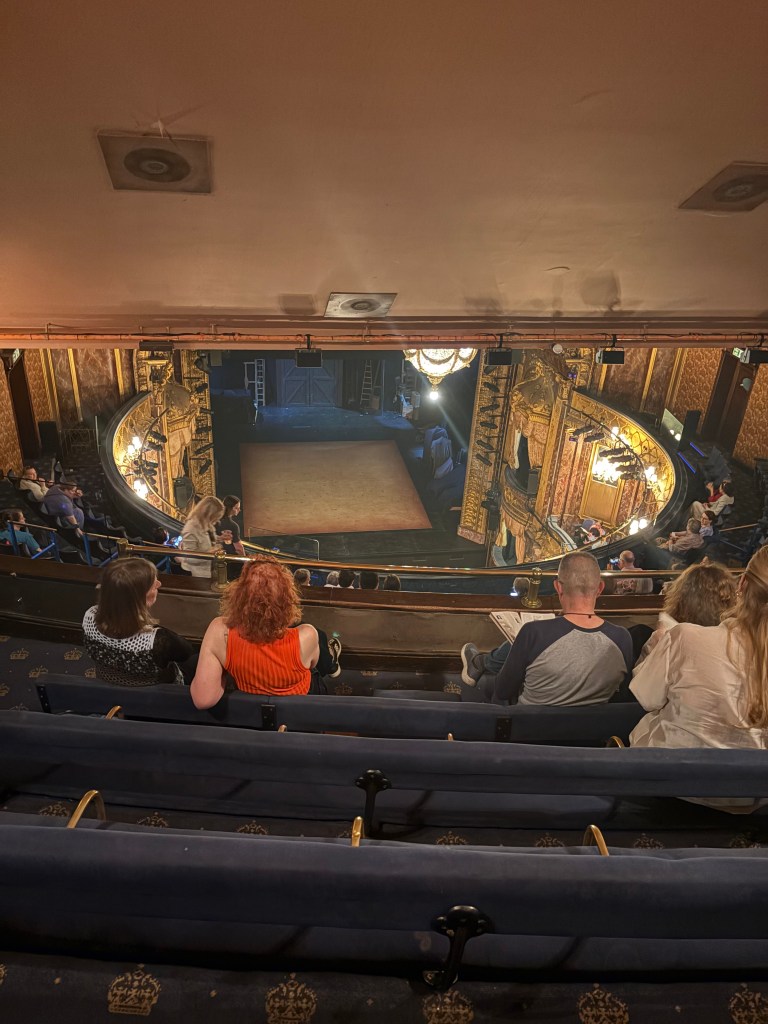
Here is a picture of the stage:

As you can see, we were very high up. And the ceiling and speakers blocked some view of projections.

And here is a picture of the seats (featuring Tim’s shoes):

Look away David…

I’m very sorry to say that this review of the Theatre Royal Haymarket’s production of Grace Pervades might be, just like the production, a little boring. After the first few moments of the production, I was excited to see where the storyline went. After the first half of the production, I was hoping the production would get better in the second half, as most other productions tend to. After the first half of the second act, I realized this production would really only be a disappointment.

It really was not a bad play or production. The costumes were amazing, the acting was great, and it kept my attention as much as it could. But, although the play was not bad, I also felt it was not great. It was just alright. It was not exceptional. It was just a play. There were some moments that grabbed my attention more, particularly any time the actors were acting out scenes from Shakespeare. This aspect gave the production a sort of metatheatrical feel, which is something Shakespeare himself used in his own plays several times. I also enjoyed the conversations between the daughter and her two friends, as they were usually quite comedic. In fact, there were several moments throughout the play I remember being funny enough to actually insight a chuckle or two from me. But, other than that, I really don’t have much to say about it.

I think, based on how little I remember of the play, it shows just how average it really was. I feel as if there were really no ups or downs for the play. There were no high points of action that really brought the audience in, nor were there any low points that allowed for the audience time to not be fully engaged. The entire play seemed to be at the same level throughout the entire thing. It was an interesting idea, but I had no reaction once it was over other than happiness to be out of those pretty uncomfortable chairs. I’d like to think that a change in seats would have helped my idea of the play, but I don’t believe even the most comfortable of seats would have changed my view on the entertainment value of this play. The storyline was just simply not all that interesting, and along with the production decisions, it stayed uninteresting. It was okay, just not great. Sorry David.

  • Jill Qualls

MOTHER COURAGE LOOKED ME IN THE EYES

Mother Courage and Her Children, written by Bertolt Brecht, was a heartbreaking story about war, the corruption it can have on people in the midst of it, and the brutal unfairness of it.

In terms of feeling alienated from the characters in the show, I did not. There were a couple of times that an actor would make eye contact with me during a moment, which while entertaining, only drew me into the show more. 

I think the play was successful in conveying its message of war and how it tears countries, families, people apart. Mother Courage truly loved her children. I never doubted that while watching her, despite watching what she had to do: denying her own son, bringing them into war zones to sell whatever they could for money, leaving her daughter buried in another grid of a warzone that means nothing to her. 

It was hard watching Eilif go off to join the war because he wanted to fight for something more than what his life was living. It was even harder to watch him believe that his actions were good, helpful, all to eventually lead to his death. And Swiss Cheese, doing the honest thing, doing what he believed was right for the help of others, for the people who trusted him, all for it to end with him being killed. And Kattrin, who dreamed of one day running around with her brothers again, who in her final moments, sacrificed her own life to save others, so that they could have a future in a world that treated her so horribly. 

It’s the terrible realization that no matter what path these children went down, motives and intention being their own, it ended with their deaths. And Mother Courage, who had to face all of them (yes, I believe that she knows that Eilif is dead) and keep moving, because she knows that the second she takes a moment to feel, she’ll lose everything that she worked for, despite having lost so much. Her attitude throughout the entire show is in a constant state of aiming for what’s next, giving no time to reflect on what was.