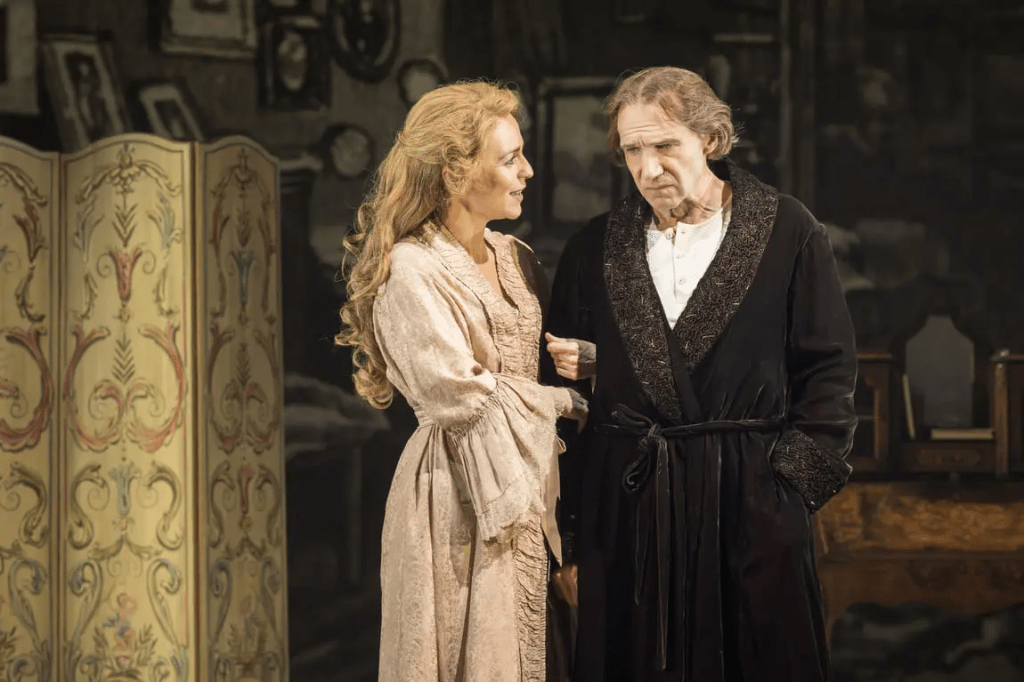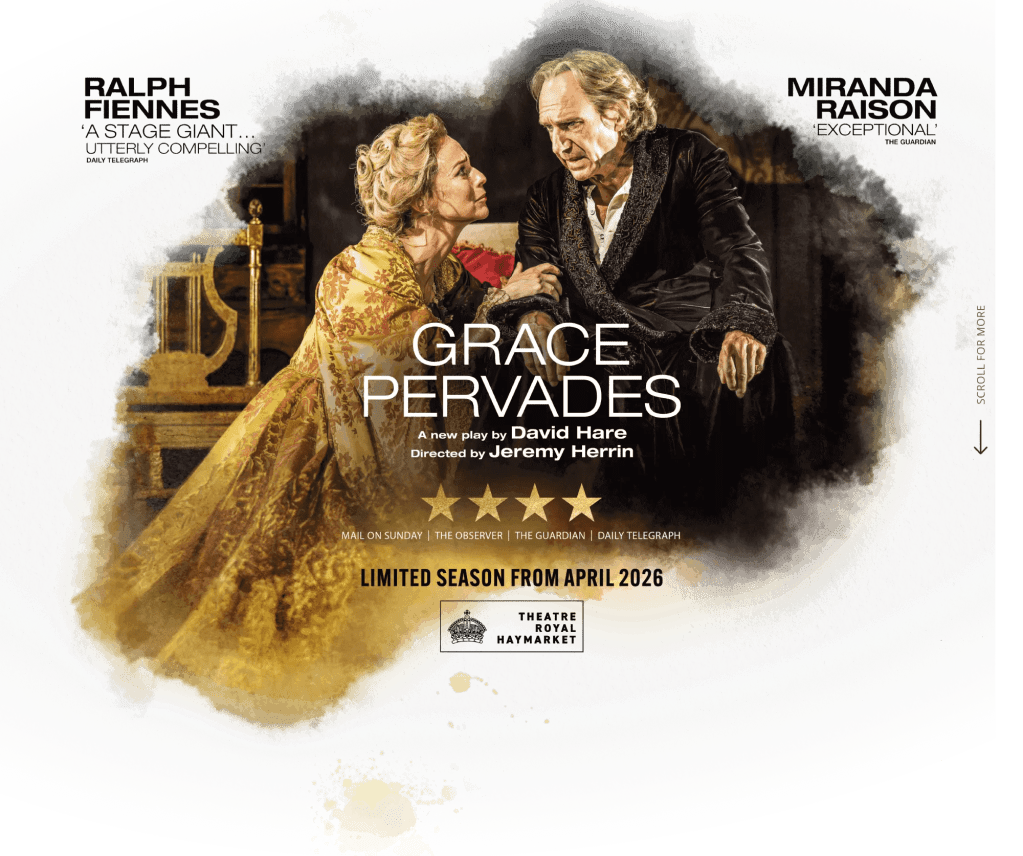
When I learned that we would have the privilege of seeing Ralph Fiennes in a stage play, I was intrigued and thoroughly excited. I’ve seen his work in a few films–The Menu, Schindler’s List, The English Patient, and of course the Harry Potter series—and I always thought he seemed exceptionally talented. After watching him in the theatre, my opinion was not only confirmed but amplified; he’s incredible!
The command that he has over the audience is truly something else. It’s easy for me to imagine why he has played so many Shakespearean roles; I think it is true of him, as of his character, that certain actors aren’t as suited to “smaller” roles depicting everyday life. Some actors must be kings, martyrs, poets, all the greatly heroic and tragic figures of performance. The timbre of his voice just penetrates the air, capturing attention and imbuing each word with a certain gravity. I also enjoyed the Teddy character; I think everyone, within theatre or outside of it, knows someone who believes faithfully and arrogantly in their own genius, more than anyone else’s. The actor played it well, I think, and humorously at that.
I found the lighting very interesting as well. They used the front of stage frequently for monologuing, with a spotlight on the speaker and the rest of the stage often in darkness. It proved effective both at isolating attention on the speaker and hiding the rearranging that was happening at the back of the stage. It was difficult to understand all the nuances of the lighting design, however, because our seats were . . . less than optimal when it comes to having a clear view of the stage. Much of the lighting was top down as well, which was no help. I definitely gained an appreciation for the seats we had at The Mousetrap! The degree of proximity to the stage you need for enjoyment also depends on what’s happening on stage. At War Horse, we also had balcony seats, which were far from the stage but it didn’t matter because everything on stage was big, colorful, bright, explosive. War Horse is a very visually theatrical production, so you can enjoy Grace Pervades, however, was incredibly interpersonal, mostly dialogue and less action, so reading the actors’ expressions and body language was more important. Being 100 feet above the stage with the ceiling obscuring the top of the stage made this rather difficult.
Nevertheless, it was a very interesting play, and I’m grateful to have seen it. I think if I were more immersed in the theatrical world, I would’ve found it even more engaging, but that just means there was more for me to learn about the craft and production of theatre. It had a similar theme to Whiplash in highlighting the complete personal sacrifice required to achieve artistic greatness. Henry Irving dedicated his life to elevating the theatre, building his own company and shaping modern theory about the art itself. As a result, he was an absent father, absent husband, and absent adulterer. Miranda Raison’s character foils him in a way, questioning whether that degree of devotion is necessary; after all, Ellen Terry maintained a relationship with her two children, lectured on Shakespeare, and engaged in external projects while remaining the most successful actress of the Victorian age. It was also interesting how the four main characters—Ellen, Henry, Edie, and Teddy—each kind of embodied a different school of thought for theatre. Whether it was experimental, realism, classical, or otherwise, they all seemed to represent a theory of performance. Overall, exploring a lot thematically, and very academically engaging!
Gracefully,
Reese
P.S. I watched a YouTube advertisement for Grace Pervades, which included stage-level shots of their performances, and man! It was like a different show altogether! Seeing their faces was a gamechanger. Food for thought!