What I love about theatre is the way “place” becomes a character of its own. The stage is not just a background, but it is acting as a real setting, relying on the audience’s imagination to complete the world in their minds. Setting is such a crucial part of any story because it creates the space for every action, every word, and every feeling. It remains powerful and present throughout the entire performance. In War Horse, the setting was beautifully brought to life through the use of a striking split-screen in the back and through simple objects, while the tone of each scene carried the story forward and grounded us fully in each place. And while visiting the Victoria and Albert museum, I found myself paused by this image as it evoked the same emotions I felt while sitting in the National Theater watching War Horse. (And not just because of the two bright grooves in the road looking like wheel ruts that could have been a cart or plow being pulled by a horse!)
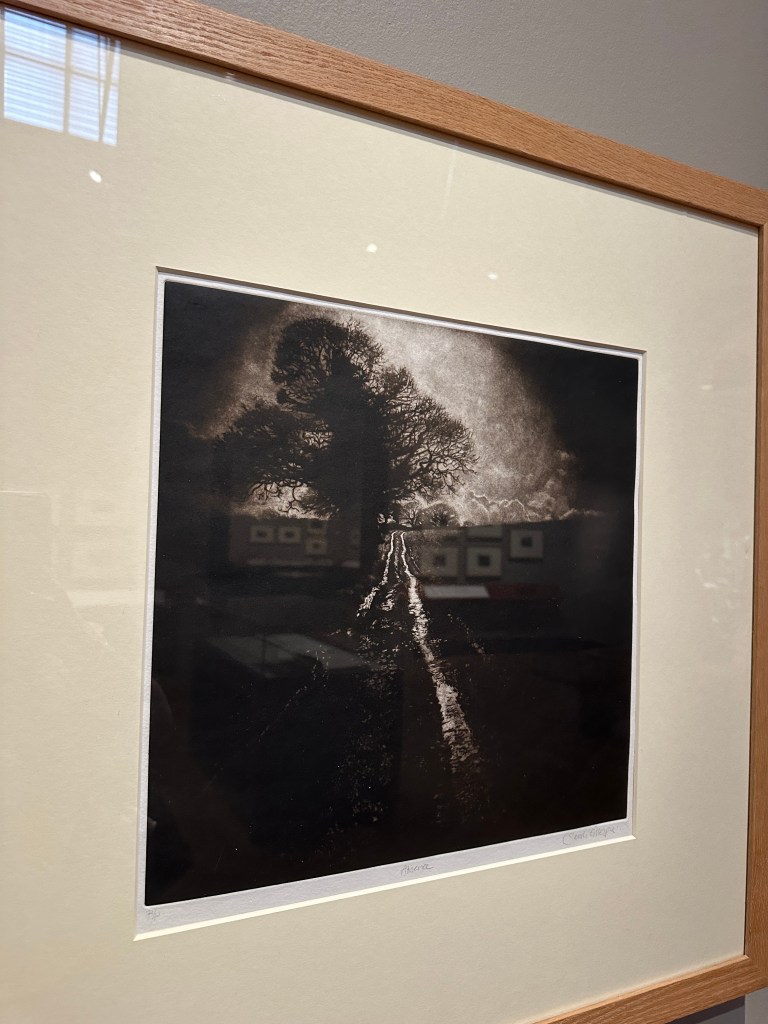
The piece is called Absence, a mezzotint by Sarah Gillespie from 2019. Gillespie was born in 1963 in Winchester, England, and studied 16th and 17th-century techniques at the Atelier Neo-Medici in Paris before reading Fine Art at the Ruskin School of Drawing & Fine Art at Oxford University. Her works often focus on the natural world, such as moths and birds, and other natural things. Her aim appears to be re-focusing our gaze on things that we see daily, but don’t take the time to notice or appreciate. And this image stuck out to me greatly, with its deep contrast and feelings of solemnity and solitude, but also beckoning hope. It captures the same feelings of isolation and danger, but also emotional endurance, as the path must continue on, which we see in War Horse and this artwork.
I noticed right away this dark country road feels like a comfort but also a corruption, like it very well could be the country roads Joey and Albert once rode freely through, but also it could be the kind of rural landscape they might have traveled through during the war.
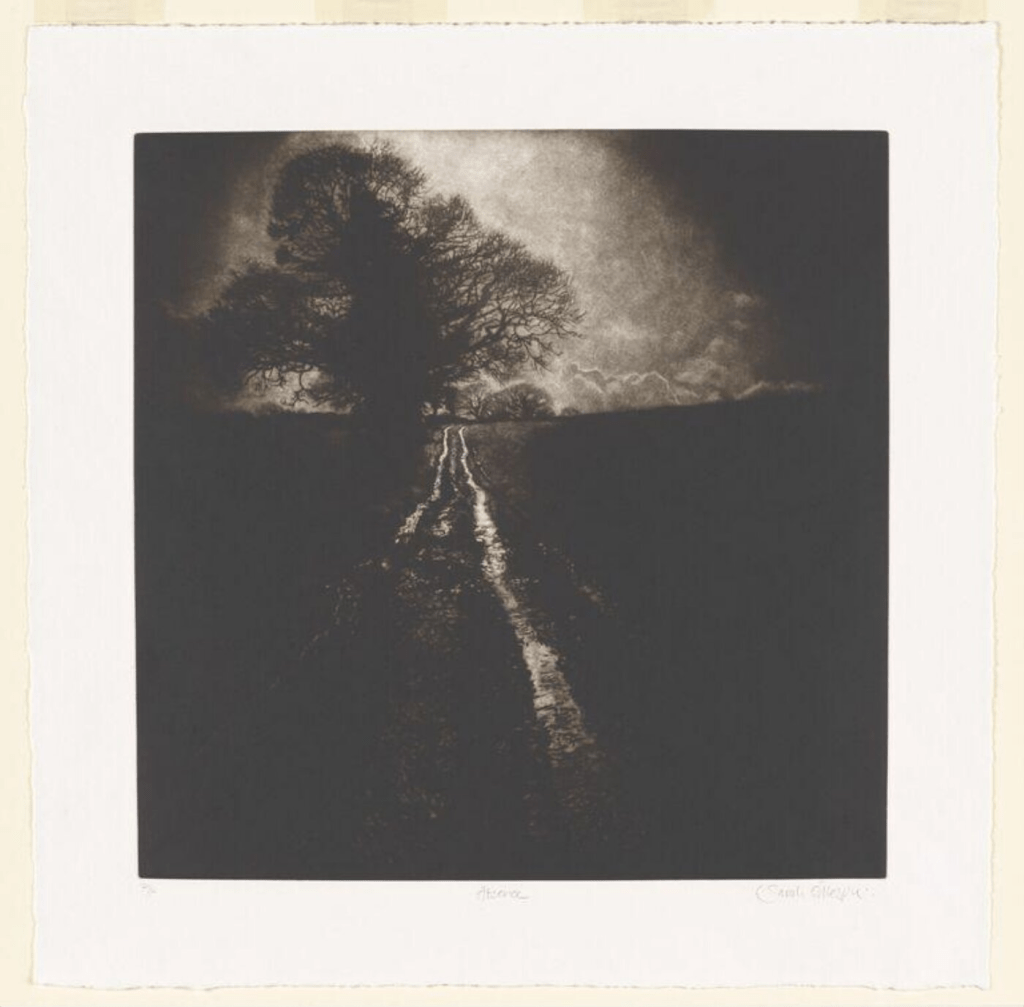
And the bare tree and story sky fit the atmosphere of War Horse very well, like nature itself has been darkened. The play showed World War I as brutal and dehumanizing, affecting not just soldiers but animals, families, and the land itself as barbed wire fences replace picket fences, and the land becomes littered with crows and lifeless bodies.
The fear of stepping out into the unknown (especially in the uncertainty of war) and not knowing where a trail may lead can be terrifying, but often it is the only direction left to go. Still, that thin strip of light on the road is where the hope is found. It is the courage to prevail against the darkness, amidst the uncertainty and brokenness. It appears as a broken road, but maybe when one looks back on it in a place of light, they can see not only what they survived but how they were strengthened by it.
And as for the title, Absence, of course, I also can think of this image as the setting of the rural land where Albert is without Joey. The absence of his joy, his comfort, his friend, his light. But still, at the end of the path remains that parting of the clouds for them to be together again. That is what made both War Horse and Gillespie’s Absence so moving. Neither one needs to show everything to make us feel everything. A dark road and a tree and a thin line of light, or a simple stage object, a faint image on a screen, and a puppet horse, can become enough when the audience is willing to believe in it, see through it, and search deeper within themselves to learn from it.

