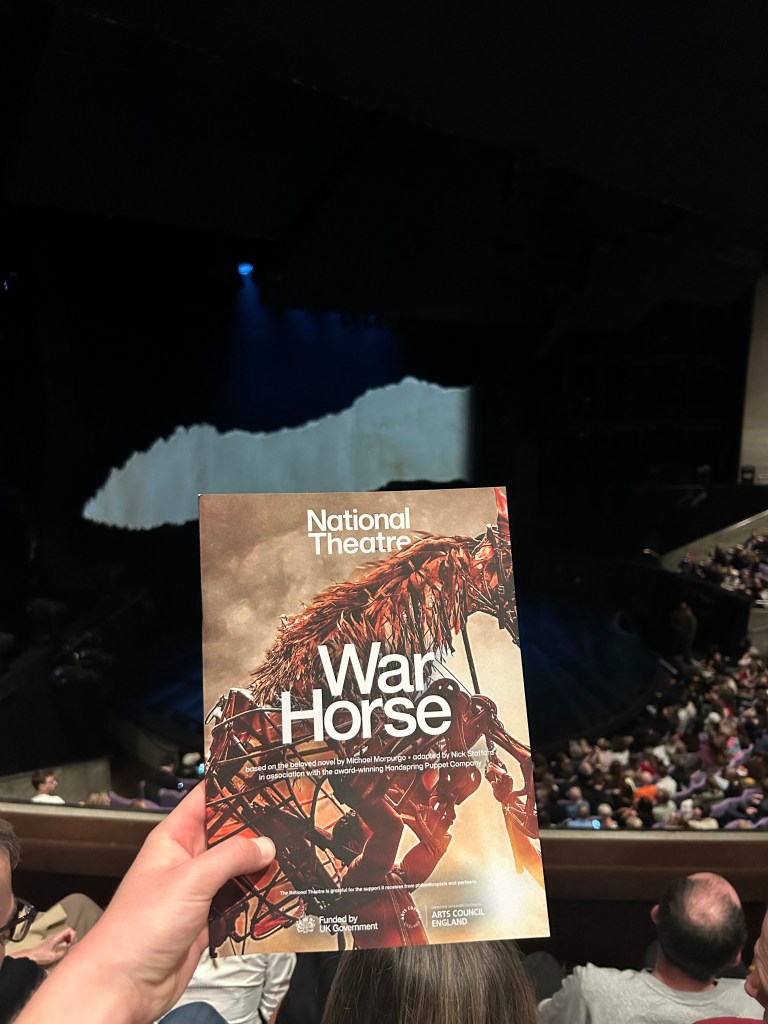
Seeing War Horse at the National Theatre on Tuesday night was such a special treat. The production quality was incredibly high, and the story was powerful and moving. The whole production blew me away, but it was the final moment that started the floodgates. War Horse is about a boy named Albert who gets a horse he names Joey. When his home town of Devon gets involved in World War I, Albert’s dad sells the horse to the military. Albert wants to join the war to stay united with his horse, but he is too young so they get separated. The rest of the play follows Joey and Albert’s story as they both eventually end up in the war, and then finally reconnect at the end. While the play is about the relationship between Albert and Joey, in the final moment Albert comes home and gives his mom a hug as the lights go dark. These last 15 seconds of the play have stuck with me over the past 24 hours because of just how tender, loving, and heartbreaking the moment is.
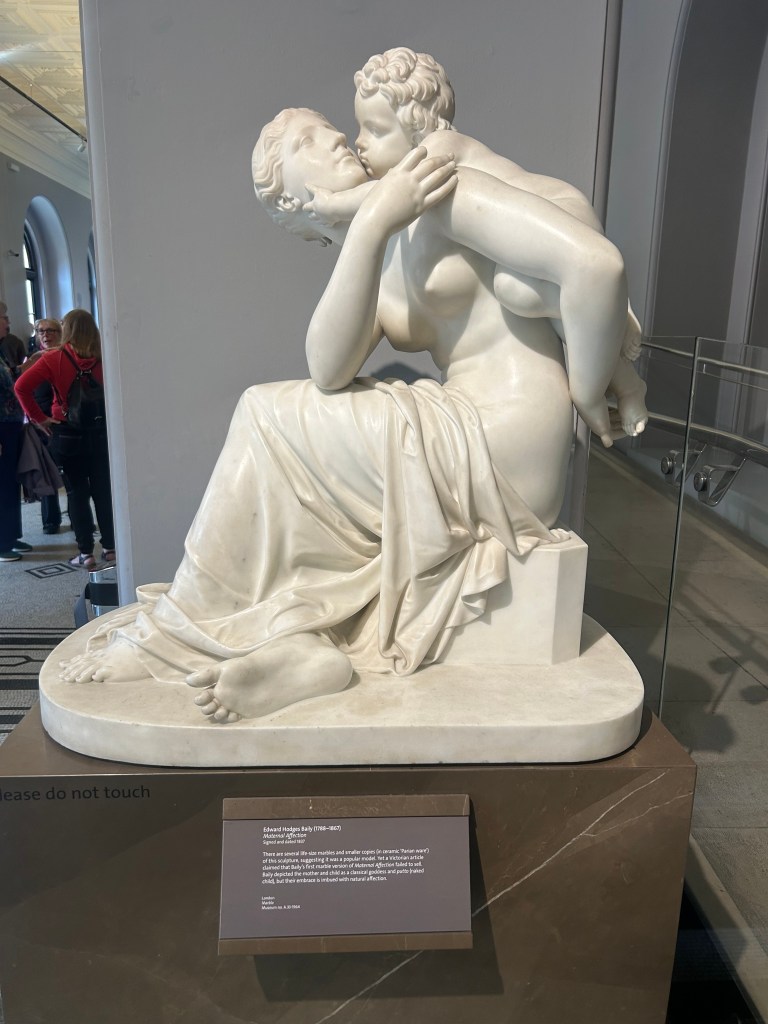
The prompt of this post was to find something at the V&A Museum that related to one of the shows we’ve seen and explain how it deepens our understanding of the show. As I was wandering around the museum this morning, I was having little to no luck in finding a piece that struck me, but just as I was about to leave I walked into a room full of statues, and the piece “Maternal Affection” caught my eye. The statue depicts a child embracing their mother. This made me think back to the night before and the final moment of the show.
In the play there were only a few interactions between Albert and his mother, but she was the one who was supportive of him, and she was the one who discouraged the idea of selling Joey in the first place. While this relationship is not the focal point of the show, I am glad that they let that reunion be the final moment. The sculpture made the moment even more impactful for me because it reminded me that Albert started out as a baby. Not only did Albert start out as a baby, but every single soldier who died in World War I did as well. The play uses Joey as a representation of innocence to reflect on war and the choices that we make, but the statue made me think about the once innocent nature of every character in the play. The differences that cause the conflict do not negate the fact that we all start out the same, an innocent baby who needs connection with their caretaker. In the final moment of the show, it wasn’t the soldier who survived a war hugging his mother, it was the inner child who just needed to give his mother a hug.
In looking at the play as a whole, this theme of us not being all that different rings through. One other scene that particularly struck me was a moment where Joey gets caught in barbed wire. One soldier from both the British and German side approaches Joey, and the two soldiers work together to help free Joey. In that moment they forgot their differences and united for the good of the horse. If we as a society can do that more often, then the play will have achieved its goal.
War Horse was a thrilling way to end our first week in London, and I am looking forward to the rest of the show that I will be able to see while I am here.
Cheers,
Thatcher

