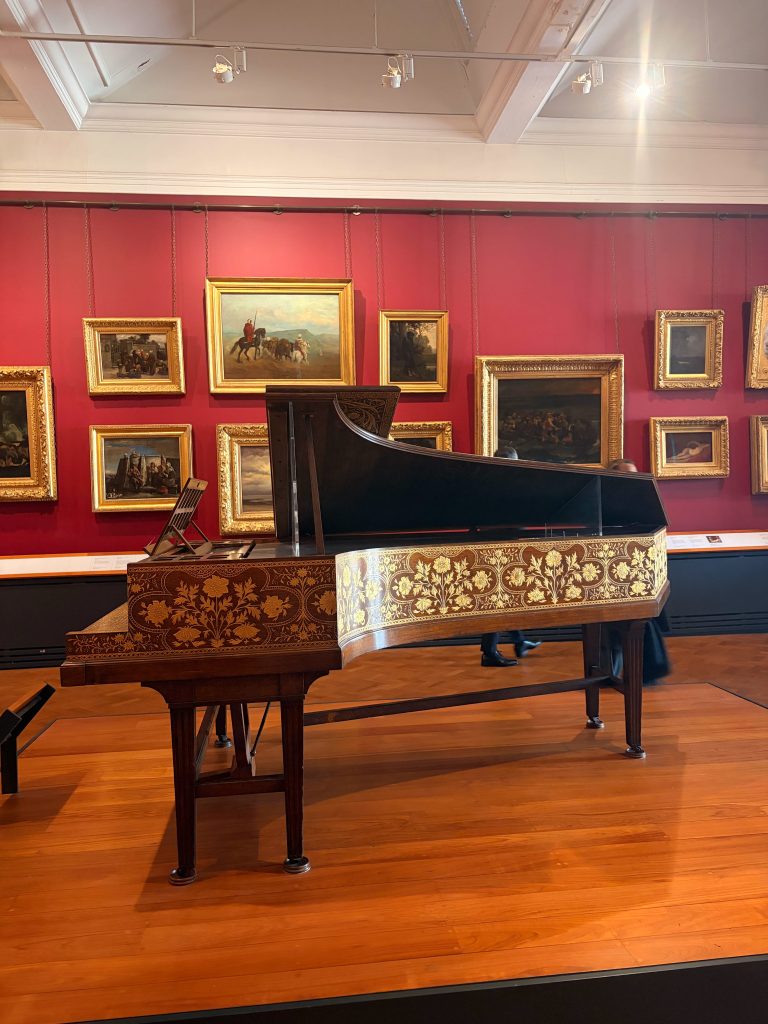
Our time spent at the Victoria and Albert museum was a morning spent admiring paintings and tapestries as old as the 1500s, marble statue sculptures of royalty and prisoners, and golden plates and spoons that were used in high teas with the most expensive people in London. However, our wander to the Theater and Performance exhibit was the most exciting part for me (currently typing this while shaming myself that I spent more time admiring Charlie Chapman’s iconic hat and cane than I did on 500+ year artifacts – but oh well!). I was very appreciative to be in the presence of props and original costumes that I have idolized for years, as well as feeling extremely thankful to be in a museum that features and carefully attends to entertainment showman artifacts, because that is not always the case where we are from (save the Kennedy Center!). As we were leaving the museum, I passed a huge oak grand, double-decker piano with gold-painted detailing on the sides, and I was immediately drawn to it. Its size was so powerful and elegant, and I was so excited to find the connection between it and The Mousetrap. I loved the detail of the piano being in the study room, subtle in the first act, turned vital in the second act. The point of the suspects going to a room off stage and playing the tune of Three Blind Mice over the radio is an extremely telling and intentional detail that I thought was genius. The whole reason the show is entitled “The Mousetrap” is because the murderer is killing 3 people, the “three blind mice”, so I thought playing that tune was a good nod. The piano from the museum was what I would imagine the piano in The Mousetrap would be if we could see it on stage. The vintage era look and size is mysterious, like how the show’s stage is, and I think it would be exactly what the set designers and prop masters would be looking for if they wanted a piano on stage!
 Theatre in London U of A