Puppets! (not Kermit)

After a not so successful trip to Buckingham Palace, we made our way over to the stunning Victoria and Albert Museum. The second the museum came into view, I was astonished by its beauty. The building itself is so intricate in its design, yet so timeless that it hardly needs the details it already possesses. However, I wasn’t aware of what was waiting for me on the inside: exhibits upon exhibits of the most gorgeous and unique pieces of history I’ve ever seen. From theatre and film, jewelry, sculptures, and paintings, I felt like I hadn’t scratched the surface of all there was to see by the end.

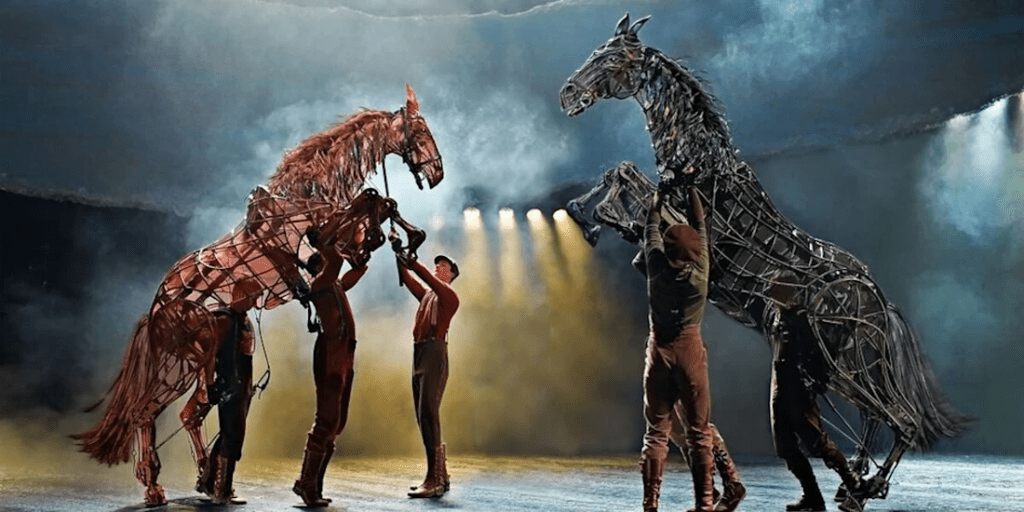
Because I’m a nerd when it comes to theatre and film, that was the exhibit that captured me the most. As I came across the section of the exhibit about puppetry, specifically the puppetry done in the show His Dark Materials, I couldn’t help but recall the show we saw last night, War Horse. A video was playing above the costumes portrayed in the show, speaking on the nature and intricacy of puppeteering. Of course, they were speaking about the puppeteering in the show, not a performance live on stage, yet many of the aspects I found to be quite similar and applicable to the stage as well. Though I don’t know much about the world of puppetry, I felt as though I gathered some insight into the horses I saw on stage last night.

One of the things that stuck with me that I heard in the museum was the fact that when puppeteering, the head of the puppet is the most important part. During War Horse, I noticed this. The head of the horse was moving at all times, whether it be the ears slightly twitching, the head yanking back when training to plow, or even its eyeline. These little details truly do make all the difference, and assist in the audience feeling a greater connection towards the puppet, due to its such lifelike characteristics. They also mentioned this fact in the exhibit, stating that puppets have such lifelike characteristics and even “quirks” that help the actors as well, which I do think is true in War Horse. I found the acting to be very natural and real, and I do think that if the puppets hadn’t been as lifelike and realistic, the acting wouldn’t have been as realistic either. Overall, I’m so grateful for the insight I gathered from the exhibit today; my curiosity is definitely spiked even more!

-Emmy
Men and Bulls: How Different Are They Really?

My first thought for this assignment, since I am still recovering from the traumatic and heartbreaking (yet wonderful and life-changing) experience of War Horse, was to find some sort of object/painting depicting a horse. As expected, this was not very difficult. I found several paintings and sculptures depicting horses in general, and even horses ploughing like Joey was forced to do in the play. But, when it came to picking my one object from the Victoria and Albert Museum, I actually landed on a different animal completely; a bull.

Now, if you’ve seen War Horse, you may be asking yourself, “How could a bull possibly have anything to do with a play about a horse?” There are no bulls in the play, nor are there paintings. But, have some faith, I have a good explanation, I swear. The object I am specifically referring to is the painting by James Ward titled Bulls Fighting.

The first thing I immediately thought of when I spotted this painting was the fight for leadership between Joey and Topthorn. Both the horses and the bulls fought each other for some position of power over the other. With this painting, we don’t get to know how the fight ends. With Joey and Topthorn, we see both the horses fall, and we never really fully get to know for sure who “won” the battle for leadership and power over the other. In the end, the horses actually seem to become friends. So, in this way, the horses are unlike the bulls in the painting. The bulls actually better represent the men riding the horses, as, in the play, they were the ones who encouraged a fight between the two horses to decide who would be the one in power. This exact idea of men fighting each other for power is a theme repeated over and over within this play.

This theme shows up again in the relationship between Ted, Albert’s father, and Albert’s uncle. The two brothers were constantly fighting for power over the other, even when it continuously kept hurting themselves and the people around them. This exact idea connects directly back to the overarching theme of the play being war in general, which can sometimes be hidden behind the story of the horse. This painting helps bring to light the actual issue and themes occurring within the play of war and power causing destruction and misery. The play is not just about a horse or a boy’s relationship with a horse. This play is important for recognizing the horrors of war, and this painting can help people realize that through the symbolism of the bulls.

– Jill Qualls

Horse, Literally.

Last night we saw War Horse, which was amazing and my favorite play so far, thanks to my love of historical fiction. I left with chills as the movement of the horses was ethereal. Today, I felt inspired to find something that truly represents this play well. As I walked through the halls of the Victoria and Albert Museum, I could think of nothing better than a literal horse. 

Within the play, there are historical representations of a time in Europe when horses were essential to everyday life on the farm and used in war, as modern advancements had not yet been developed. Horses were used by soldiers before modern military technology existed. This play is set in WWI and shows the battles that soldiers and their animals went through physically and mentally, and how important relationships are between them. Horses during this time were also used to plow fields, labor for farms, and as companions. Considering the importance of horses, and the main character, Albert’s best friend, choosing a horse seemed fitting.

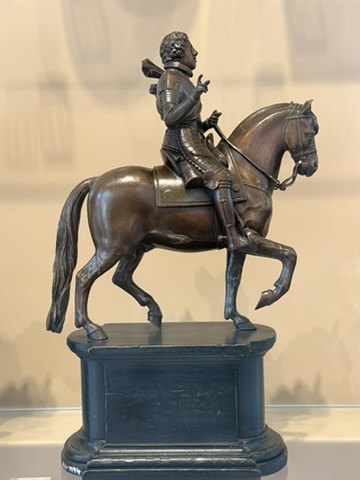
The picture I took shows a man riding his beloved horse with his battle gear on, representing the play’s time period. The military outfit the man has on in the picture, as well as the riding gear the horse has on, shows combat-like symbolism. Joey, Albert’s horse in the play, was his companion and what Albert used as motivation to fight in the war. Albert did not have to go fight, but did so to find his horse and friend he lost to his dad’s “need” for money and inability to keep promises. The horse in this picture and the man have a relationship much like Albert and his horse did; they are loyal. 

This sculpture teaches us that horses were used for many reasons and were necessary during this time period. They were not only used as a tool but also served as loyal friends who could impact those around them deeply. This is seen through Albert and Joey’s relationship, which was deeper than that of an animal and its owner. 

NEIGHHHHHH (britishly)

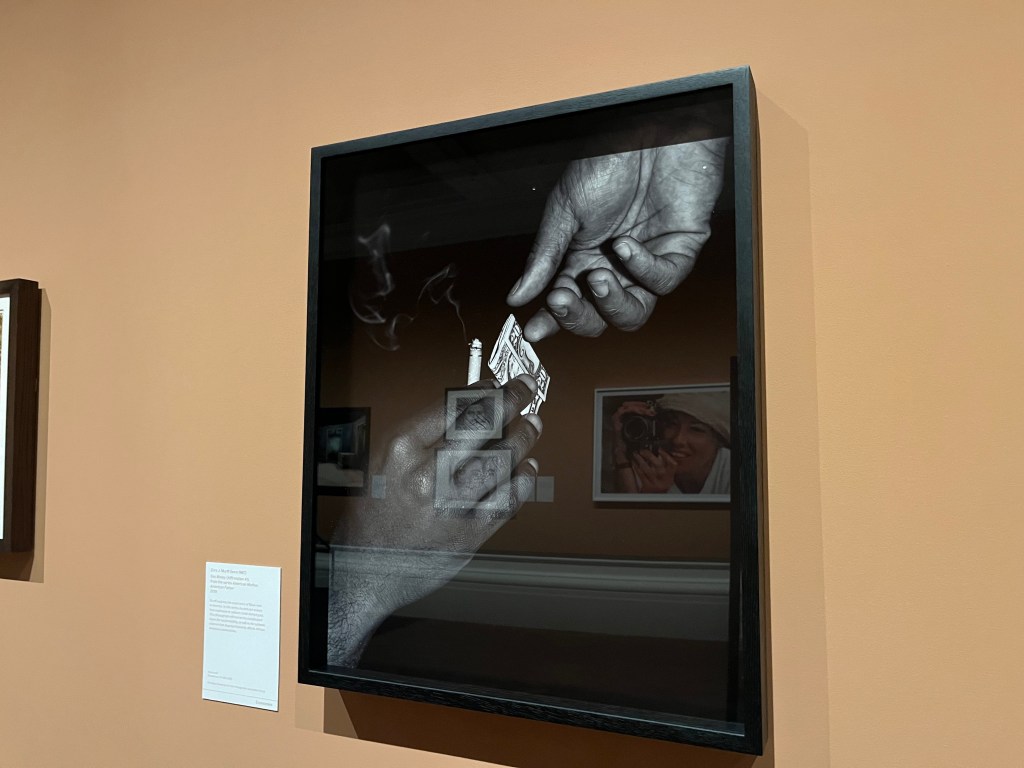
The photograph I chose from the Victoria and Albert Museum is called “Gas Money” depicting two people exchanging money. The play that this picture reminded me of was “War Horse” that we saw last night. 

War Horse reflects themes of survival, sacrifice, and reliance on money. In the photograph there are two people making a transaction that is suggested to be for need, dependence, or survival. This photo represented the choices that people had to make throughout the play, especially Albert’s family, when it came to money and economic stability. 

War Horse consistently showed throughout the play how hard times and war can turn lives, animals, and relationships into profit because of the need to survive. Joey was bought and sold multiple times throughout the play, all for profit. At the beginning Joey is bought by Ted at the auction even though they can’t afford him, creating financial strain and tension between him and his wife. Albert is told that when Joey grows up he will have to be sold. Ted bets Joey off to his brother in exchange for money but luckily Joey ends up winning the bet. Ted then later sells Joey to the army for a hefty sum of 100 pounds without even taking into consideration Albert’s relationship with Joey and the promise he made that Albert could keep him (basically Ted is the problem.) This shows how economic pressures influence a lot of the decisions in the play, especially with Ted, and how loved ones, like Joey, can turn into a profit. The exchange of money in the photograph symbolizes how war often reduces life to transactions because survival depends on it.

The photograph also represents inequality and power. One hand is above reaching downward to get the money while the other reaches upward to give the money. This image helps represent authority and dependence. In the play there were many characters trapped in circumstances beyond their control because of their status including poor farmers, soldiers, and townspeople. People were having to make hard decisions like joining the army, selling their animals, and being in positions of power that a lot of them were not ready to make. Horses like Joey were extremely useful and valued high in that time and made many people strip them of their humanity and only use them as tools.

The black and white muted style of the photograph also matched the colors on the stage because they were very muted browns, whites, blacks, and plain colors. The illustrations at the top were drawn with black and white ink which also matched the colors of the photograph.

Artistry takes many forms

My visit at The Victoria and Albert Museum was nothing short of spectacular! I was fascinated as I walked through the grand hallways lined with historical artwork and pieces, all connecting to a story. One of the exhibits that drew me in the most was the theatrical exhibit…typical, but true! I loved learning how props and prosthetics were made for shows along with wigs and costumes. There was a lovely display of theatre costumes throughout the years describing who wore them, when, and where, including Elphaba from the popular show, Wicked.

As I walked through the painting rooms, one of them really stuck out to me and as I read its description, it reminded me of the show we had just experienced the night prior called, War Horse. This oil-on-panel painting done by John Callcott Horsley in 1839 showcased a woman silencing her companion’s flute to listen to the caged bird, the bird seemingly outperforming the musician. I saw the caged bird as Joey, the horse, and the woman as Albert. For the entirety of the show, Albert is constantly trying to silence others above himself, who are misjudging Joey. The bird singing is Joey trying to tell the others, without the simplicity of the human language, the right way to do things. He even silences the tension and violence of war between the two opposing sides of World War 1, with each party deciding to stop fighting and help Joey out of a death trap. In this instance the woman in the painting could be perceived as peace and the musician could be seen as war. The bird out-performing the musician reminded me of Joey out-performing war and showing us the humanity of the world, even during hard times of battle and suffering, they were able to reach common ground and work together to save Joey’s life.

A Puppet, A Pauper, A Pirate, A Poet

The obstruction of the Buckingham Palace garden party led our class to shift gears. Our plans for the day shifted to an early trip to the Victoria and Albert Museum. I am always up for a trip to an art museum, especially one with as much variety in medium and the V&A. Along with viewing the art, I loved getting the opportunity to people watch as well. The most interesting people attend art museums.

After getting to see War Horse the night before, I was immediately captivated by an exhibition on puppet making. The exhibition included original puppets used in the drama show His Dark Materials as well as a short video breaking down the process of creating and using puppets in film. The creation puppets for story telling involves so much research and attention to detail in anatomy and behavior. In watching War Horse I was taken aback by the life that the horse puppets had as well as other animals. For much of the show I was fully seeing a live horse on stage. I would get confused as to why people were standing so close to the horses only to remember that they were puppeteers. The puppets they had created allowed for so much life-like movement and so many realistic mannerisms. The twitch of the ears, breathing, shaking, flips of the tail. They all worked together to make this puppet become real. Seeing the full process of making and working with puppets was incredibly interesting. Deciding the things to prioritize for connection with actors as well as life like movement was fascinating. Having just seen such a puppet central show only made this exhibition more intriguing. War Horse has certainly placed itself high among shows I have seen. The story was beautiful and the use of human bodies, props, and space were executed so well. Getting that glimpse into the work put into the creation of Joey was definitely the highlight of my day.

JOEY IS THE GOAT AND R.I.P TOPTHORN

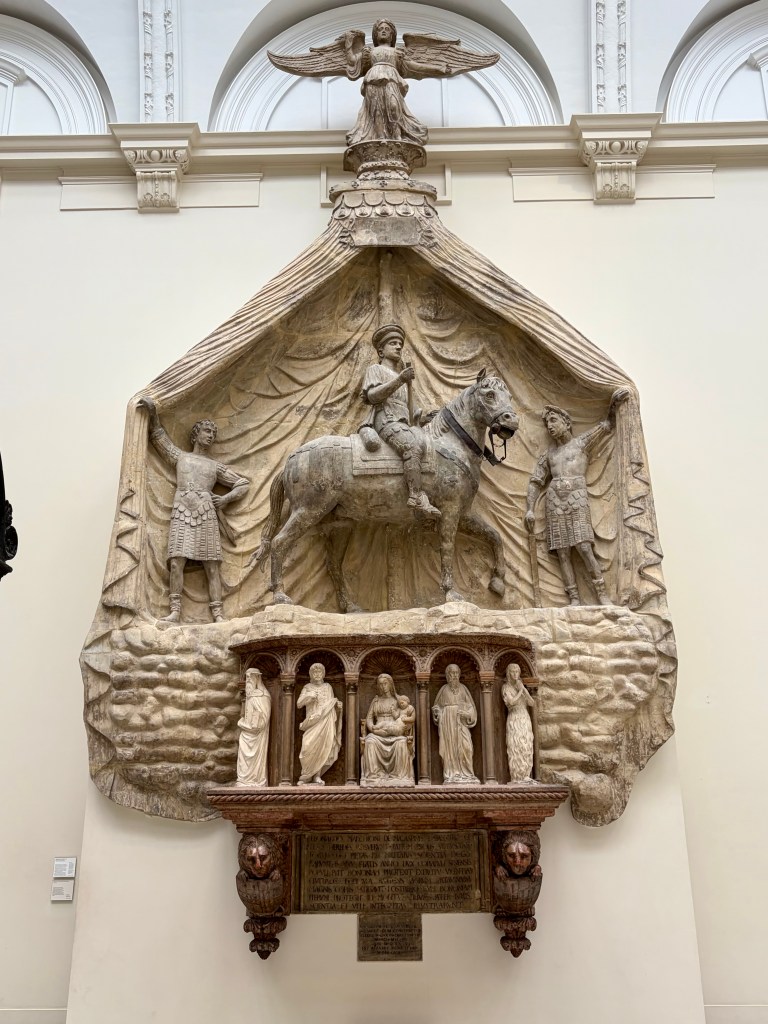
This morning, we took a tour of the Victoria and Albert Museum, walking through exhibits showing art from the renaissance, tapestries crafted hundreds of years ago, and theatre/film relics. One sculpture that I walked past grabbed my attention; this one above, titled the Equestrian Monument to Marchese Spinetta Malaspina.

It reminded me of the show we saw last night, War Horse. It is, without a doubt, now my most favorite play. The story was beautiful, the tech and the horse puppeteering was incredible, and I ran out of tears by the end of it because of how emotional the entire show was. 

I connect the sculpture above to the show’s themes of innocence and different perspectives on power. At the start of the show, we see Joey at his most innocent; just a baby who’s being taken care of by Albert, who loves and cares and creates a deep bond with him. As Joey grew, the bond became stronger, but Joey still felt innocent because almost all he knew was the love of someone who truly cared for him. It wasn’t until the actions of someone who was not innocent, someone greedy, that Joey was thrust into a position where his innocence was lost in war. There he was treated like a soldier, another potential casualty, a tool to be used by man to either keep their power or take someone else’s. 

The sculpture shows a soldier, riding a horse, holding a weapon. From the soldier’s perspective, this is his epitome of power. He is higher than the other soldiers, on top of a beast that he has used to gain his advantage over others. Then, you look at it from the horse’s perspective. An animal that never had any choice in what its life would be like, who was most likely given this role by the soldiers, not out of love, but used for selfish, inhumane goals. 

Joey and Albert both go through trials and the loss of their own innocence on their journeys to find each other, but are both given reminders that not everyone is selfish, or lustful for power, or greedy. There are people, both in their world and ours, that believe that love and our actions to others have infinite more impact over domination and power. Those are the kind of people that we should rely on.

Henrik, did you write this?

I have been looking forward to seeing A Doll’s House since it was added to the syllabus, because I have spent so much time studying it. I analyzed the script for my Regie Book in Script Analysis last semester, and completed my final over the show in my Fundamentals of Theatrical Design, so I was extremely eager to see the show on stage for the first time. As soon as I walked into the theatre, it was clear that what was showing was an adaptation of the script that Henrik Ibsen originally wrote. The script opens with stage directions and detailed descriptions of the set, “a room furnished comfortably and tastefully, but not extravagantly. Between the doors stands a piano. Near the window are a round table, arm-chairs and a small sofa…”. The stage for the show that we saw was exactly opposite of the description that Ibsen described in the original script. The set was modern, empty, lifeless, and dull, which is not the Doll’s House set that I previously knew, or was expecting to see. The room was designed to be a basement, with a carpet that was casual but clearly not lived in. There were moving boxes (a new packaged television), an unwrapped plastic Christmas tree, and no furniture. I noticed the lack of furniture almost immediately, and throughout the play I saw the effect it had on the actors and blocking of the show. Because the set lacked so many things (audience distractions sure, but also script details and context for the actors), the actors looked and, I assume, felt awfully awkward when interacting with one another during severely emotional outbursts. While I’m sure it was an intentional choice the actors and directors made, it was obvious that when the characters were experiencing serious and “real” emotions, they would fall and crunch into the floor, because there was no furniture. It was distracting to me that there was constant up and down, going from standing to laying on the floor. This is a direction choice of the play that introduces the theme of Nora being a “doll”, and reinforces the theme that Nora is not capable of doing things on her own. I think the lighting choice of having a LED square on the roof the whole time definitely reinforced the idea that Nora is trapped in a cage, never getting out, not to mention that she is in a basement. I also loved and really respected the fact that during the whole Act 1, Nora’s character never left the stage. She was on stage for the entirety of the first act, which really made her look and feel trapped, and like she was always running/hiding from something. All in all, the adaptation we saw was nothing like what Henrik originally wrote, or what I was expecting, but the elements they did add did complement the design choices they made. Would I prefer this version over the original, probably not, but nonetheless, I can appreciate and enjoy some live theater!

Ibsen is Twerking in His Grave

A Doll’s House at The Almeida Theater was…an adaptation for sure! The script was a complete modernization of the original play, and even deviated from the original themes. Although it shared the same name as the Ibsen work, I would say it is a completely different play. Nora did not feel caged or stuck to me. In fact, Torvald seemed supportive of her and didn’t trap her like the character in Ibsen’s script did. Especially in the beginning of the play, he was very open and warm to her, didn’t call her any demeaning names or use language that might suggest he wanted to keep her under his control. Until the scene with the dress and the final scene when he learns the secret, he plays as a genuinely supportive and caring husband. Honestly, I was rooting for him more than I was Nora. Nora felt very much in control of her decisions, like she was actively making the worst possible choices and knowingly being a bad person. The whole point of Ibsen’s play is that Nora and Torvald are just symptoms of their society and are not truly in control of what they do or say. However, there is no real evidence that Nora was taught to be submissive and diminish her own desires. Even the set, though it was in a basement, was very open and bright. The use of a large light on the ceiling of the set that almost looked like a sky light and the bright white walls and carpet only reinforced that feeling. Additionally, her access to modern technology and having two friends who she can openly talk to truly diminished any sense of isolation the director wanted to create. This all being said, I did enjoy the show. I think it needed to be its own play and distance itself from A Doll’s House because it differed so much from the original intention. In conclusion, this production should have been called, “I’m Looking for a Man in Finance.” 

-Milly

A Doll’s House. Seriously, where is the bathroom?

Ok so. When watching A Doll’s House, I know there was a lot of conflicting opinions. A lot of the play had become very modernized, and the script had changed quite a bit. There were also some major plot points that were taken away from the original, such as a Nora’s situation with her father. 

This being said, I overall really enjoyed the play. As Shawn Irish said, this was a very digestible and accessible version of the play specific to a modern audience. I thought that while the message was conveyed differently, it was still conveyed. 

When it comes to the actually presentation, in regards Nora’s “caged bird” trope, I feel like the acting the most effective feature. When it came to the set, it actually felt very spacious and open, rather than a direct approach of a very small set and claustrophobic space. However, one main thing that was rather effective, was the the location did not leave the house. I think this was also due to the playwright and how the story was written. The director probably played a bit more a role in the message than the designer, as there were very little set pieces and props. However, I did not notice too many directorial or design features that contributed to the message, despite a few that will be mentioned momentarily. 

One thing that I think really did contribute a lot to the story was song and sound choice. Specifically, there were two moments when sound was used. At one point throughout the play, Nora is holding a baby monitor, while things are moving around her. This of course was probably a directorial choice, and used to convery the feeling of stillness and inability to move freely, but the main standout was the music in the background. At first, I was very confused by this choice, but as the song went on I realized that the music was quite disturbing. I was able to feel the feeling of stress and discomfort that Nora probably felt in that moment. Another time where music was used was a dance scene. I will say, that adding the addition of a dance segment was probably more a directorial choice, but Nora’s dancing and presentation, along with the sound being congruent to Nora’s relationship, had a very unsettling impact and truly showed Nora’s nature of believing the only way she is valuable is through sexual appeal. 

Overall, good ass show. I really liked it, and while I know a lot of my peers had criticisms surrounding it, I truly could not stop defending it, and certainly cannot stop thinking about it. 

Also, Torvalds actor was amazing. 

– Lucinda “Da Realest” Eells