Maybe the real Doll’s House was the friends we made along the way

This Friday night we went and saw a production of “A Doll’s House” at Almeda Theatre. I wasn’t sure what to expect going into this production given I had never read the play, but let’s just say that I was not ready for what I was about to see. The production was completely modernized, new time period and text. This post will be focused not on the original script, but this production and script. 

A Doll’s House tells the story of Nora as she struggles with a dire situation related to her and her husband’s financial situation. The play explores the trapped nature of Nora’s life as she navigates whether to tell her husband Torvald the full situation of her playing a part in their situation, or just figure out how to solve it on her own. With the play being set in the present day, Nora’s social standing in the world is different from what it would’ve been in the original play set in the 1800’s. While there was definitely an attempt to keep the birdcage-like nature of Nora’s situation intact, her character felt like it had more autonomy than the original. 

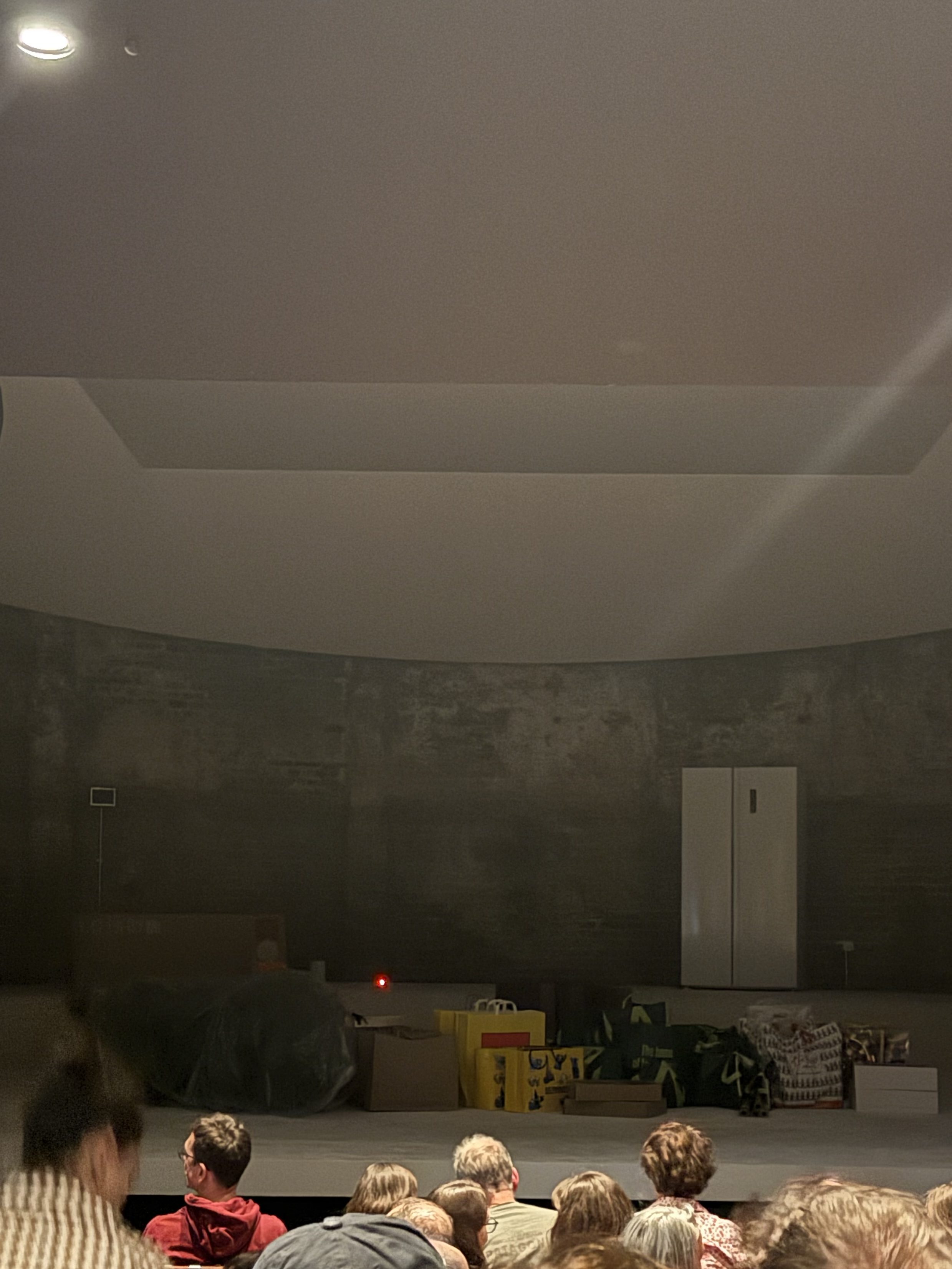
The set was a carpeted basement that was left incredibly bare. It had no chairs, couches, or other pieces of furniture. This created an interesting dynamic for the actors on stage. When a character had a moment where they had the urge to sit or lay down they had to do it on the floor. This personally did create an unnatural feeling of almost being trapped because there was nowhere to sit. I really like this choice, but it did feel uncomfortable.

Another choice that they made was to keep it a single location. Everything was set in the basement, so the space was kept very confined. People would enter and exit, but all the action happened there. One interesting entrance that was made was having Nils enter through the audience. Everyone else entered through the door onstage, but Nils entered through the house. I believe that they made this choice because he was not directly going to be affected by the situation, but it did feel a bit unmotivated at times.

The moment that struck me most was the end of act one when Nora put on a nurse/maid costume and danced for Torvald and Peter. They played the TikTok song “Man in Finance” and had her dance sensually for the entire duration of the song. She danced with both men, and this was one of the most interesting dichotomies of her character. On one hand she was pressured into it to an extent, but on the other hand it showed the power that she has over the situation. This moment really showed the complexity of the character. In the original, Nora had much less power, but this Nora did have some autonomy over her life. Overall it was an incredibly interesting and evocative moment.

I enjoyed the play, but the ending did feel a little bit off. There was a moment where it suddenly drew attention to the current War in Iran, and that took me out of the moment. On top of this, the final scene felt like a very obvious thesis of the show that told you what you were supposed to take away from it. It had its highs and lows, but I think that it was a great bonding experience for the group given the conversations that came out of it.
Cheers,

Thatcher
shout out Amex

In A Doll’s House by Henrik Ibsen, I don’t believe they represented the script accurately. You could say that she was kept like a “cage bird” in the basement, but to be fair, in the adaptation that we saw, she willingly stayed down there. I’m sure it could’ve been claustrophobic, but he didn’t lock her down there by any means. In the script it’s suggested for us to dislike Torvald and feel pity for Nora. But to be honest, I didn’t feel any of that watching it. In this adaptation it seems almost as if she took the money to become rich instead of genuinely wanting to help him. The reaction that Torvald had to finding out the secret was a little too aggressive, but it wasn’t completely irrational for what she did. The ending was disappointing to me because I feel like it took away from the rest of the play. In the script, she decides to leave her family and go find a life for herself, which, to me, is way more effective. Overall it was super interesting watching this version because I was fully expecting it to be in the time period of the original script. I think the modern adaptation was good, and I actually very much enjoyed it; it just didn’t even feel like the same play to me. If I’m just judging it off of what I saw and acting like I have no prior knowledge of the play, I’d say I pretty much liked everything about it. The costumes worked well to me because they felt natural and accurate to the modern time period. The set was cool, but I didn’t realize it was the basement until they said it out loud, and that wasn’t at the beginning. The sound was good; however, I am curious as to why they used mics considering it was in such a small space. I thought this show was well done, and the actors did an amazing job, but I wouldn’t go as far as to say it was A Doll’s House.

Nightmare Before Christmas

Going into the theatre this was not the play I was prepared to see, that being said I was pleasantly surprised by the modern adaptation of “A Doll’s House.” The adaptation took a more raunchy type of tone to the play and made you have to look and think more to see the “caged bird” experience that Nora was experiencing.

The best part of the play showing Nora in a restrictive experience was the sexy nurse dress she wore to the party and when she was dancing for Torvald. The experience of watching her wear the outfit and dance for him makes the audience super uncomfortable and at first I couldn’t really understand why I was feeling uncomfortable because this is a normal thing that couples do. The more I thought about I realized it’s a statement of the sexualization she is experiencing (along with many other women) and realizing the only times I ever really watched Torvald be affectionate towards Nora was when he was sexualizing her, making her only an object to touch and admire and not giving her much other substance. She talks about her appearance a good amount throughout the play, hinting at the importance and even using it to her advantage to reiterate my statement. 

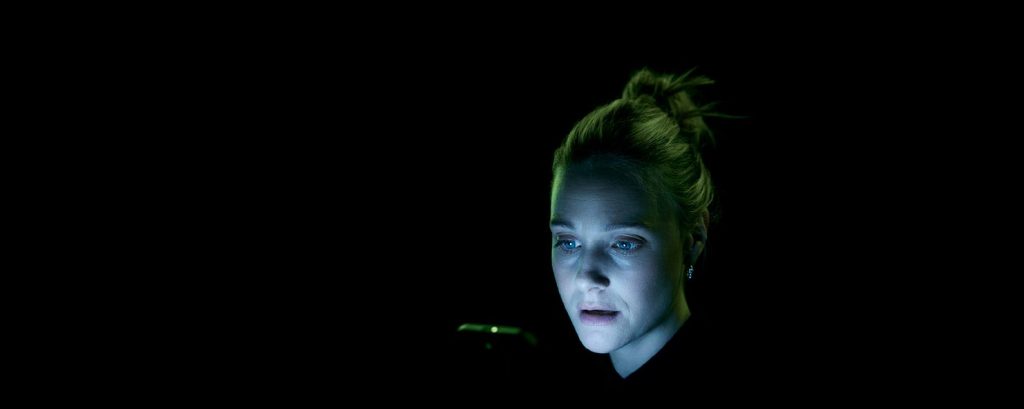
There’s a few parts throughout the show where the music turns on, there’s no one talking, and people are walking around while Nora is staring at objects (usually the baby monitor). The lighting is spotlighting her with darkness or dark blue light surrounding her making her distressed, depressed face a vivid visual. This part of play shows her internal feelings that aren’t shown through her extravagant, lively outside appearance. I think it’s a beautiful portrayal of using actions and visuals instead of dialogue to show that closed in, caged bird feeling she can’t show on the outside and is having a hard time admitting to herself.

I will say what might be a controversial take that this modern version of Nora isn’t as much of a “caged bird” as the original. When you think about how this is based in current time, Nora has resources to get away if she wanted to and had a college degree and a right to get a job and start a life for herself. She was a good amount at fault for the amount of money she had put them in debt for and how she did it and seemed to kind of throw that to side and not really want to take accountability for it (what I mean is only deciding that suicide was the only option when she got caught and blaming him for it.)

Overall I really enjoyed the play. It made me laugh, panic, and feel bad for all the characters at some point. I personally didn’t end up liking really any of the characters and thought they all had faults but also feel that’s what makes the play so human because if people watched our deepest, darkest secrets on stage they probably wouldn’t feel very fond of us either. The actors were amazing and I thought the set was simple yet purposeful. I would definitely go see that again. The plays that make you think deeply and leave feeling differently than when you came are my favorite.

Nora’s Cage in a Modern World

In any modernization, adaptation, or performance of a story, I believe the most important thing is preserving its central themes. I went into this play completely blind, unaware of what was about to unfold. As the show went on, I found myself surprised, confused, and a bit unsettled by some of the choices (hello freaky dance scene!), but still intrigued by the story and impressed by the outstanding acting. I mean, truly, impeccable performances. At intermission, I asked friends who had read the original how this version compared, and they told me confidently that it was almost nothing like Ibsen’s play. Which was a bit initially disappointing for me since I have loved his work in Hedda Gabler and the modern performance of that play I had seen last year! 

Now after reading the original script, I understand why A Doll’s House was so ahead of its time. Ibsen daringly exposed the toxic expectations that shaped many marriages through the dialogue and unspoken social rules behind every interaction. In the 1800s, the idea of a woman being trapped, controlled, and treated like a doll was evidently clear. However, bringing that message into a modern setting requires a delicate balance. Today, many women have more visible choices, so an adaptation must show not only what has changed, but also what struggles have lingered and still remain. 

I am glad I read the original script after seeing the production because it helped fill in a few of the gaps I felt while watching, as well as expanded the intention of the theme. 

That being said, the message is still powerful. When a woman is reduced only to a wife or mother, she is stripped of her autonomy and humanity. Often, society teaches men to see women this way, while also convincing women that it is all they are meant to be. I thought the production made some interesting choices to explore this. The lack of furniture created a stripped-down stage that forced us to focus on the dialogue, blocking, and physical movement. I especially noticed how often Nora sat on the ground while speaking to Torvald, physically beneath him. In the final scene, though, Torvald is the one on the ground, holding the monitor with their children’s laughter, while Nora stands above him. To me, this reversal and ambiguous ending suggested that Nora now has a choice. She is not necessarily penniless or completely ruined if she leaves (like how it would have been in the 1800s etc); she can make her own way in the world. 

Still, I felt that the adaptation weakened some of the original’s meaning. In Ibsen’s version, Nora’s entrapment is tied to her father, her husband, and the role she has been TAUGHT to perform. In this version, the doll imagery was clear through the nurse’s costume, but a bit less effective because Nora seemed to choose it herself. I would have loved to see a bit more of how this action was manifested into her own will. Just like how women were taught to behave like perfect gentlewomen back in the 1800s, many women today are given the impression they must perform to get what they want from men. I thought the play could have explored this just a bit more. After reading the original and understanding how Nora’s father also controlled her and treated her like a doll, I wish the adaptation had included more of that dialogue and more clearly shown why Nora felt pressured to perform in order to keep her place as a wife/mother. (I did think that the inclusion of sex as the main appeal of their love/marriage versus societal expectations to have a family was a clever and tasteful modern take!) 

Overall, it was an interesting and entertaining adaptation. Now seeing this show, I’d love to see a true version of the play with it’s proper blocking and set design, and compare them, as I am still a bit unsure of where I stand as far as how it is portrayed as an adaptation. Nevertheless, it was a thoughtful and compelling performance.

Us Women Really Just Can’t Catch a Break…

I don’t have much prior experience with the original A Doll’s House by Henrik Ibsen. I do have prior experience with a very modern adaptation of another one of Henrik Ibsen’s Plays, Hedda Gabler. Similar to this adaptation, the play we watched on Friday was a shocking jump from what one would expect just from reading the original play.

I believe the director of this play portrayed Nora quite well as a caged bird. One of the most interesting ways the director displayed this I actually noticed after the first act. If I am remembering correctly, Nora does not leave the stage once in the entire first act of the play. She is confined within the walls of the set which symbolizes the cage. Even when her character has costume changes or the set is moving and changing all around her, she is not allowed to exit the stage like the other characters are. Another aspect I noticed after the first act was the usage of music and lights within the play that symbolized the caged bird story. The scene where Nora is almost frozen staring at the baby monitor while the red lights are flashing all around her and the intense, anxiety-inducing, music is blaring creates a distinct feeling of Nora being trapped within the confinements of her own responsibilities. As the other characters are moving freely about around her, Nora is stuck in one place as the scene grows more and more intense which signifies her role in this dilemma as the problem maker is experiencing the problem worsen but she cannot escape her own actions.

One of the more director focused decisions that I feel truly conveyed Nora’s character as a caged bird is how they decided to end the play. From what I have been hearing in conversations around the group, most people seem to dislike this change from the original. I actually have to say I loved this decision. To have the play end on a note which leaves the audience wondering if she actually leaves or not is the exact feeling that needs to be portrayed when creating a caged-bird story. In the original, the caged-bird gets free, as in, Nora leaves her husband definitively, because this was something new and controversial at the time. The decision for a wife to leave her husband and children was simply not even a discussion. Therefore, if a wife did leave, they would be outcasted by society, but if they decided to stay, they would be praised. Now, in modern times, women have a choice. But, this choice comes with different consequences. If the Nora in the play we watched decided to leave, she would face hate and guilt for destroying her family and abandoning her husband and children. If Nora decided to stay, she would be criticized for not choosing herself in an age when feminism is seemingly growing stronger and stronger everyday. She would be faulted for her decision to keep a family together that would eventually be harmful to everyone in the future, especially the children. These consequences the Nora we watched would face are exactly what makes her a caged bird. In this adaptation of the play, there is no way for Nora to “win.” Either way, she is in the wrong in some way, even if she never makes a decision at all she is criticized. This directorial decision portrays the caged-bird aspect of every role women must play in modernized society by highlighting the different consequences that women face today rather than the original.

The feminine urge to leave your husband..

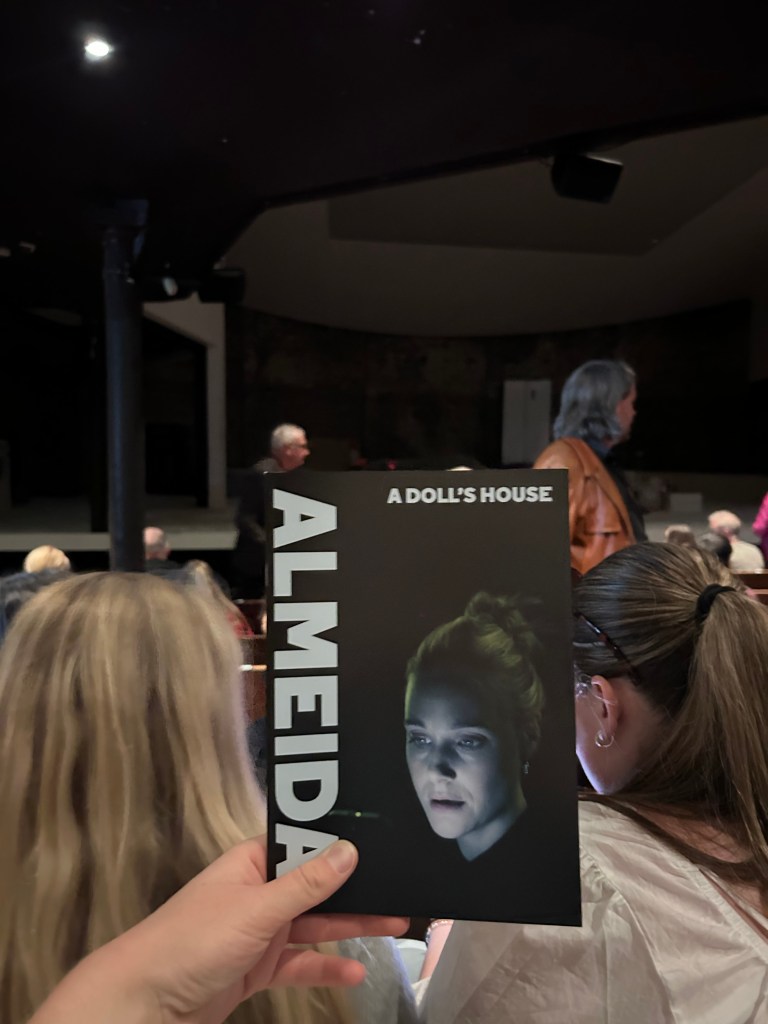
Well, now I can confidently say that my first experience with Ibsen’s A Doll’s House was nothing short of memorable. I hadn’t had any previous experience with this play other than knowing the time period prior to seeing it on stage, so I pretty much went into this performance blind. However, when I noticed that the show’s poster featured the main character staring at a phone screen, I couldn’t help but feel unnerved. I think the fact that I knew this was a classic play dealing with social issues of the 19th century, yet that’s not what the poster was hinting at, almost made me mad that they were trying so hard for a classic play to be modern.

With these thoughts in my mind as the show started, these feelings only heightened. Despite this, I could plainly see how the director was attempting to convey the “caged bird” experience to the audience that was also present in the classic version. Nora was either on the floor, pacing around the floor, or standing completely still while everything was happening around her, which I thought was a really interesting way of depicting one being “stuck.” The other aspect of this particular show that stood out to me was the lighting. At first I didn’t notice it, being sat close to the back of the theatre, but about a third of the way through the first act I noticed it: a large skylight projected onto the ceiling. I wondered how the lighting was changing ever so slightly, and that was my answer. I also loved how the use of the skylight represented Nora feeling caged in a different way, a way that is not as noticeable, but just as significant. It was as if the light was so far out of reach from her, which I believe speaks to the theme of the play.

Overall, I can say that while I was skeptical of what felt to be a forcefulness of modernization, I ended up enjoying the show and appreciating how the actors and directors alike portrayed the story, however different it may be from the original.

Why was she in a nurse’s costume…..

I have had the pleasure of working with A Doll’s House before. I thoroughly enjoyed reading and analyzing it. This adaptation was not what I read. At all. I knew this was going to be a modern adaptation, but I did not expect anything like what went on stage. I do not think the designer portrayed Nora as a caged bird, or at least not as much as I had hoped. There was no architectural feature that made her look caged in, in my opinion. The only caged feature was the amount of floor time she had. It had an almost trapped or chained to the room feeling. Other than that, the house was vacant, bland, and open. I thought the costume design was very interesting, especially the nurse’s dress. At first, when I saw the dress, I was very confused. I thought it did not go with the play and was just a random prop. As soon as she put it on, I made the connection. She was the doll. In the original adaptation, Torvolt pushes Nora to become his doll. He pushes the idea of being a stereotypical housewife onto her. However, in this adaptation, Nora pushes that narrative onto herself. She is the one who gets the nurse dressed out of the box. She asks Torvolt to tell her to put the dress on. This differs heavily from the original. The lighting was something that I also found appealing because it really did not change at all. Two scenes really stuck out to me. It was when the lighting went orange and blue. Orange is a more flamboyant color, while blue is a more calming color. I found it interesting that they used orange in a scene of them organizing the house, and then used blue in a very promiscuous scene. The lighting differed from what the scene was actually about, which I thought was interesting and intentional. 

Would love to see Henriks reaction to this one!

This friday night we went to see Henrik Ibsen’s A Doll House at The Almeida theatre. This theatre is regional and super intimate in the London Borough of Islington.

Going into this show I had previously read the script and wasn’t rather fond of it. One of the main things was that it just felt so boring and like it didn’t hold much of a story. I knew this production was going to be modern but I had no idea how different it would end up being.

As soon as the play opened and Nora started cussing I knew we were in for a ride. One of the main themes of the show is how Nora is “caged like a bird” she is kept in her house and her husband makes her up to be a doll, hence the name Dollhouse. In this version however I feel like sooo much of that plot was lost- the only thing the director and designer did to display this was make Nora hardly leave the basement. Overall in this show Tovalt really was not a problematic person, different from the original I actually didn’t hate his character or feel like he was manipulating Nora. The whole Dollhouse theme was lost for me until the very end- but then at that point it’s like, if you’re not gonna carry that theme throughout it feels pointless. 

Design wise I actually really enjoyed the emptiness of the set and the actor did an absolute fabulous job! I wished there was a little more to the lighting design but I did think the costume design was fairly well done.

Overall I will say that, while I was bored reading the original script, I was not bored watching this play. I was too busy waiting to see what other random tiktok songs they would add into it and attempt to connect with younger audiences. I think aggressive adaptations of these classic plays is just something I’m not necessarily into. BUT it was a super fun experience and a great laugh with my friends. 

-Erin

Barbie Life in the Dream House? No…

Experiencing A Doll’s House at the Almeida Theatre was something I will never forget. It was an incredibly impactful show, especially knowing the history and time in which it was written. I thought it was interesting, the choices made by the director to place the show in a more modern depiction. Having never seen the show or read it before, I had no pre-connotations of what to expect, which I was glad for. It gave me a fresh and completely new outlook on the show with no expectations. I thought that this new modern version of the show spoke more to the current generation and gave the audience more of a chance to relate to it on personal and intimate level.

I thought the director of this production conveyed Nora’s restrictive and claustrophobic experience tremendously. I thought the “caged bird” depiction showed through by Nora’s body language choices of consistently being on the floor throughout most of the show. She was also showed using her body as leverage during the show to appease her husband including dancing and several other ways when it seemed like she was out of options. I also noticed Nora being confined to the basement for most of the show, away from her kids and the rest of society which demonstrated the inner claustrophobia she felt within her marriage.

Looking at A Doll’s House from a designer’s perspective, I saw how the costumes conveyed the themes of the show. What stood out to me specifically was the dress her husband, Torvald, chose for her to wear, not just for his own pleasure, but for the party they were going to as well. This dress was revealing and embarrassing for her to wear, but Nora put up and dealt with it because she wanted to appease her husband giving in to his restrictive nature.

A Doll’s Room

As we recover from jet lag and settle into our British lives, we made our way to our second show; a modern take on Ibsen’s A Doll’s House. The set was designed to resemble a very modern, clean, and empty house. This led to a lot of blocking taking place on the carpeted floor. I quite liked this aspect and the humanity it brought to the conversations being held. I find myself laid out on a carpeted floor frequently and often find very good conversation down there. The lack of a changing set brought in the title in a similar way to original adaptations. The stationary setting creates that feeling of being stuck, especially for Nora, as she is present the most in this unchanging space. The act 1 finale captures this sense of helplessness as well. A woman turning to sexualizing herself with her own husband in her own house in order to get something was very powerful. It created discomfort in an intentional way. The use of the skylight-like lighting brought the “cage” to completion by offering the visual of a hypothetical outside world while keeping Nora as well as the audience stuck inside. I had a fear that the modernization of the story would lower the stakes of the loan that Nora took out. I was pleasantly surprised by how anxious I was about the the sum of money and scandal behind it. I do think it took away the commentary on gender in the conflict. The stakes were high but they no longer had to do with what a woman was and wasn’t allowed to do in a society.

This production was not what I was anticipating, especially for my first time seeing the show done; however, I thoroughly enjoyed it. I thought it carried the story and stakes well. There was a loss of the original discussion on gender roles. However, I do think there was an interesting new conversation on the more current gender roles in this production. Overall, I very much enjoyed this take on A Doll’s House.