So Many Writers and Poets

Westminster Abbey is a key piece of European religious history. While the Abbey has played many important roles in the church, arguably what it is most famous for is being the final resting place for many well renowned artists, writers, and royalty.

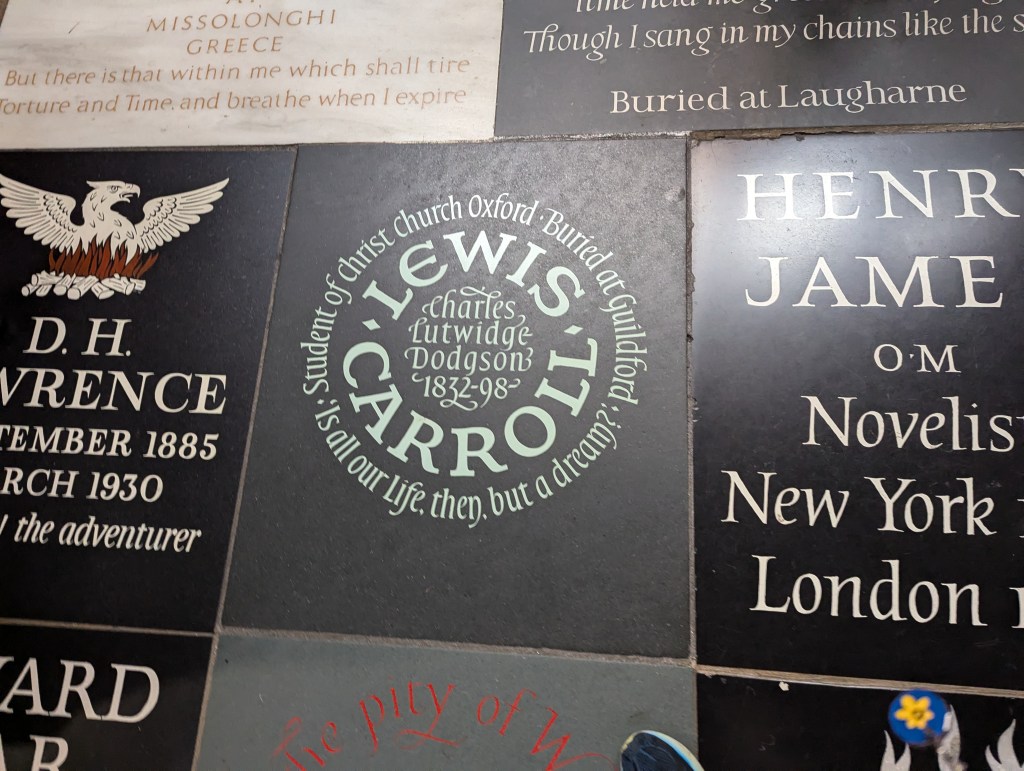
While looking through the plaques commemorating these dead historical figures the one that stood out to me immediately was Lewis Carroll, most known for writing Alice in Wonderland and Through the Looking Glass. His real name was apparently Charles Lutwidge Dodgson and was a highly religious man, which may be part of the reason he was given a plaque at Westminster aside from his renown. Upon doing further research into him I discovered that major details of his personal life, specifically relating to the Alice books, are still wrapped in mystery. The biggest detail of his life that is still greatly debated is his relationship to the girl who allegedly inspired the alice in the books. Charles was friends with the family of the dean of Oxford college, being close with him, his wife, and his children, one of them being Alice. This Alice is also the first person he told the story of Alice in Wonderland to verbally, and encouraged him to write it down. Despite having the same name, Charles refused that she was the inspiration from the book’s character, and there has been no strong evidence to the contrary other than the superficial. It was alleged by some that he had an inappropriate relationship with Alice, and that he may have been a pedophile. This idea is backed by the fact that a large portion of his photography had young girls as the subject, and in  some they were not or partially not clothed. When I read this I thought it was pretty damning evidence, but some scholars argue that at the time it may have been viewed as a common practice and that child nudity was supposed to symbolize purity, though this point is still debated. A large part of the reason it is hard to come to a conclusive answer to their relationship is because of how private of a person he was, and that large portions of his diaries and photography were destroyed by unknown people, although it is presumed that part of it was his family trying to keep their name in good standing.(I recognize I went off on a little bit of a tangent I got a bit swept up in the research) This mystery and his possible troubling relationship with children makes his legacy very confusing, but his work in the creative field can not be ignored 
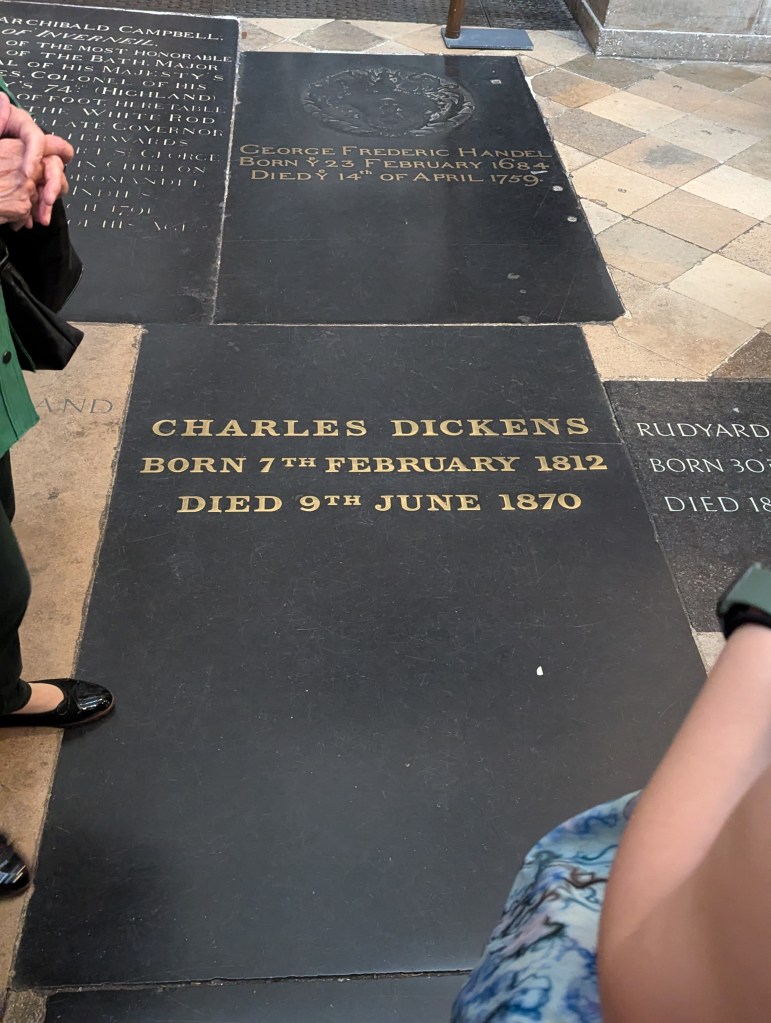
Another plaque that stood out to me was Charles Dickens. He was an English writer who wrote numerous books and short stories, but was most well known to me as the person who wrote the Christmas Carol, which inspired the greatest Christmas movie ever produced, A Muppets Christmas Carol. While not quite as good as its muppet based counterpart, the story has stood the test of time as one of the most popular Christmas stories, having never been out of print since it was released in 1843.
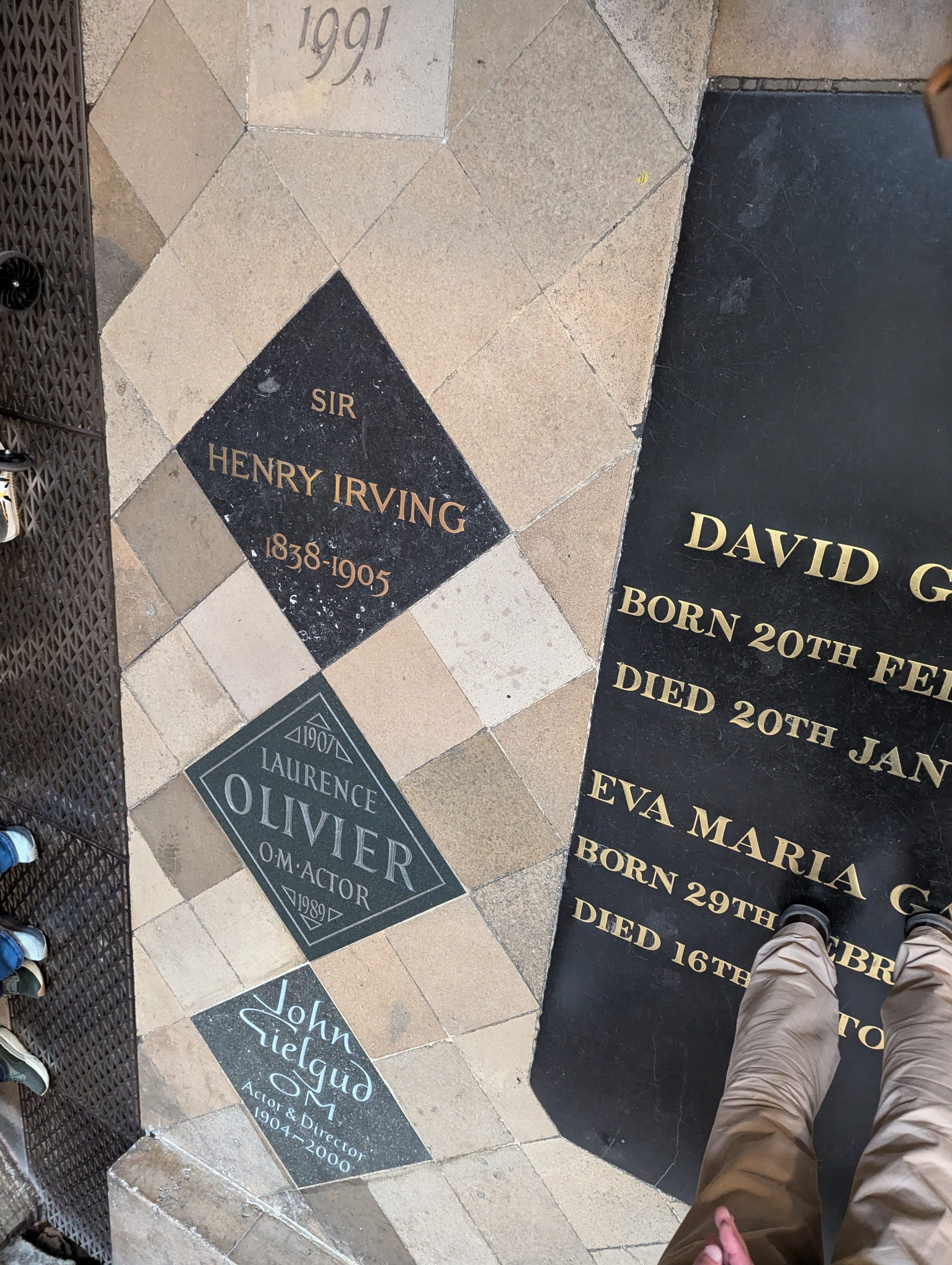
A name that stood out to me as one I have repeatedly heard but never knew the story of was Laurence Olivier. Since coming to London I had heard of multiple plays being the recipient of an Olivier Awards, but did not really know what that meant. Apparently it is a well recognized professional theatre award given primarily to theatres in the west end. This award was named after Laurence Olivier for his long and well perceived career in the theatre, which included roles such as Othello in the play of the same name and Solness in the master builder. He was born and died in England and died in 1989, shortly after the West End theatre awards changed their name to the Olivier Awards in 1984.
Ilaria’s Pub: Romeo and Juliet: The Rodeo

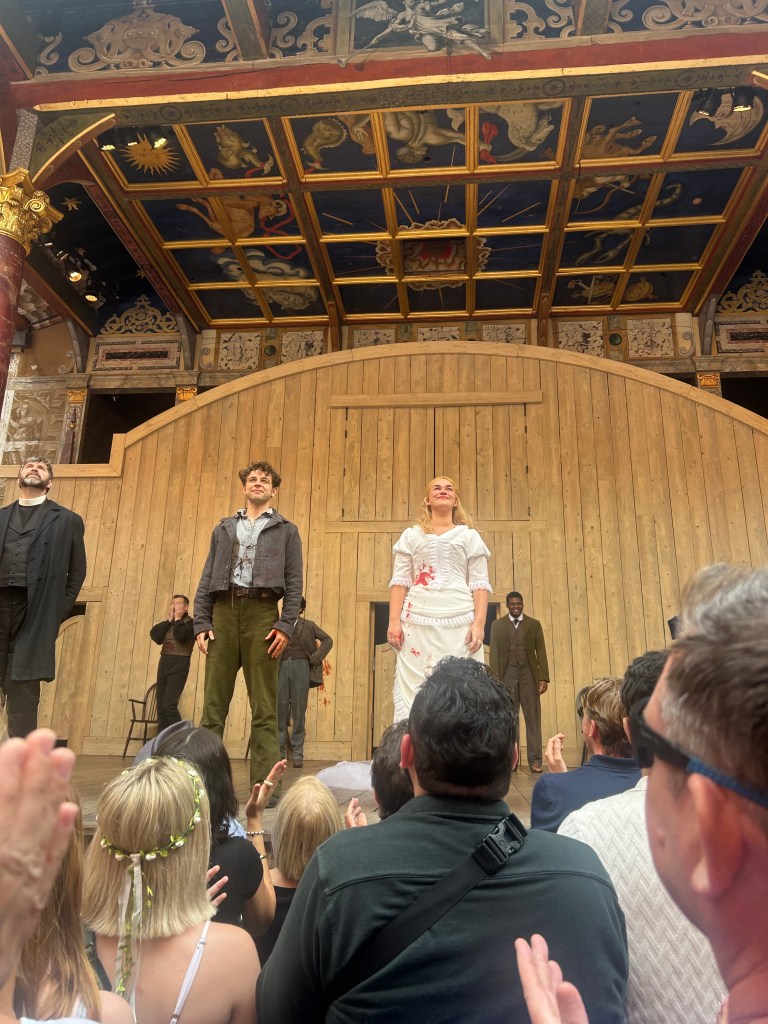
I made my way through the multitude of people and claimed a spot at the very front of the stage. I had the opportunity to stand in the yard for the entirety of the three-hour production of Romeo and Juliet and I was ecstatic. I never thought I’d see a Wild West adaption of the classic Shakespearean tale much less in the famous remake of the Shakespeare Globe in London. I have always adored Shakespeare and have read Romeo and Juliet twice, so I knew I wouldn’t be disappointed. However, I also didn’t expect to be completely blown away by this experience. 

It felt like a true and just interpretation of how the play was performed during the 16th century with the exception of the genre and setting changes. In the original production of Romeo and Juliet, the family feud drama and cross-stared lovers begin their secret relationship in Verona, Italy sometime between the 14th and 15th centuries. However, in this interpretation, they conduct their love affair within the American Wild West in the 19th century. After viewing the show, I found this change to be extremely fitting and vastly interesting. “The fascinating, diverse, and often disturbing history of the Wild West provides a rich backdrop for Romeo and Juliet. The ‘ancient grudge’ between the Capulets and Montagues gains new force in this contested space, where violence is often the solution to divided communities” (Shakespeare’s Globe). 

The usage of old English stayed true to the classic script for the majority of the time which can be complex and difficult to understand for a modern audience. However, each actor’s portrayal of every line, every instance including their vocal inflections, facial expressions, and physical movements made the story come to life. Even if each character spoke in a completely different language, one would still be able to comprehend the actions and basic narrative clearly. The actors’ various small and apparent gestures, the production choices concerning the set design, musical elements, and direction all contributed to a spectacular performance. It felt like I was attending a party where I was able to witness first-hand friend and family drama. It was an absolutely magical rodeo that I didn’t want to leave!

Abbey (Westminster, not Road)

Westminster Abbey was such a cool excursion! We were led around by a Blue Badge tour guide named Molly. In order to become a Blue Badge, these tour guides have to train intensively for two years then pass a series of exams to prove that they have the knowledge base necessary to guide all around London and several other places within a day’s travel (such as Bath, Oxford, and Hampton Court Palace). Needless to say, it was incredibly educational!

We started in the oldest part of the abbey, built about 1000 years ago. This is where the monks resided and where abbey officials still live to this day! There were names carved into the benches that dated back to 1017; I was taken aback by how legible they still were and the thought of how many feet had walked the same path that I had just walked.

Then we moved into the more modern part of the abbey complete with ornate gothic architecture. The vaulted ceilings felt like they went up forever, and the stained glass was absolutely sublime! We got to see the tombs of many former monarchs including Elizabeth I and Mary Queen of Scots. All of these fancy tombs had statues of the people laid within on top of them, all with their hands up in prayer. Even as someone who grew up Jewish and doesn’t hold too strongly to any faith, there was an air of divinity that existed throughout the abbey. There were even a couple of times that a woman’s voice came over an intercom and led those who wished to participate in a prayer.

One of the craziest things about Westminster Abbey is the amount of people buried and honored within its hallowed grounds. There isn’t a graveyard – these people are actually buried underneath the floor of the abbey. It felt a bit odd and disrespectful to literally be walking over their dead bodies, but hopefully they’re okay with it since they’re being honored in Westminster Abbey and all. The three memorials that were the most exciting to me were those of Stephen Hawking, Sir Laurence Olivier, and William Shakespeare.

The first memorial that really delighted me was that of Stephen Hawking. He was a theoretical physicist and cosmologist whose most well known discovery is black hole radiation. Hawking was born in 1942 in Oxford. At age 21 he was diagnosed with amyotrophic lateral sclerosis, more commonly known as ALS. This led to a steep decrease in motor function throughout his life, to the point where he was wheelchair bound by the end of the 60’s, and by the 80s he was only able to communicate through computer programs. This did not stop him from continuing his work, and he published several books, the most famous of which being A Brief History of Time and The Theory of Everything. I actually often fall asleep to an audiobook recording of The Theory of Everything; I like to believe that I am learning through osmosis as I sleep. Hawking passed away in 2018.

Sir Laurence Olivier is also memorialized within the abbey. He was born in 1907 in Surrey to a clergyman and his wife. He went to drama school and quickly rose to fame in the 1930s, first appearing in a West End production of Noel Coward’s Private Lives. In 1963 he became the founding director of Britain’s National Theatre, a place where we get to go and see a production next week! He also had a thriving film career. His 1948 Hamlet was actually my first introduction to that Shakespearean tragedy. He won several awards throughout his career including an Oscar. Olivier died in 1989.

Of course the most exciting memorial was that of William Shakespeare. He’s actually buried in Stratford-upon-Avon, but is such a pillar of English culture that it would be insane to not honor him in Westminster Abbey. Shakespeare was born on April 23rd, 1564 and died on the same day in 1616. He wrote 39 plays that we know of today, 36 of which appeared in the first folio (which we got to see a copy of at the V&A!). These plays can, for the most part, be classified in three categories: tragedies, comedies, and histories. Some scholars argue that some of his later plays, such as The Tempest, should be in a fourth category called either tragicomedies or romances depending on who you consult. During the Elizabethan era he was part of a theatre troupe called The Lord Chamberlain’s Men that was the most popular troupe of the time. Once the Jacobean era began the troupe was renamed to The King’s Men. Through all of his writing Shakespeare is credited with introducing over 1700 words to the English language as well as many turns of phrase that are still used today. Personally my favorite is “in a pickle” which is spoken by Trinculo in The Tempest.

Overall, I am so incredibly grateful to have had the opportunity to go to and explore Westminster Abbey!

Mister Westminster and his dead friends

Getting to tour Westminster Abbey with our study abroad group was such an informative and beautiful experience. Our tour guide Molly, did a great job of being a guide who gave us so much information as well as keeping it so lighthearted and hilarious. She really made the tour everything it was and I loved getting to hear all the knowledge she had to share. 

  So, we saw a lot of resting places. Seeing the resting places of many of the monarchs and closely related families was so strange. Knowing that their actual bodies were in there and have just been sitting there for hundreds of years is so weird. I know that’s a bit of a childish word to use, but that is the only way that I can think to describe the experience. Especially because of the untraditional presentation of their resting places, it was even more surreal. I expected it to feel more like a crypt, but it felt instead like a sculpture museum oh, and by the way there are dead bodies everywhere. 

The other way that people who had passed were marked was on the floor below the feet of the Abbey. There was one specific section that was full of authors and theater-makers. Some of them were buried in the Abbey and others were just honored with markers but not buried there, such as Jane Austen and Shakespeare. Shakespeare was honored with a statute and wall sculpture that was much larger than many of the others. It was a sculpture of his full body, and he was leaning on a sort of dias with a long roll of parchment hanging off of it. His body is actually buried in Stratford-upon-Avon, the place that is most associated with him. He wrote 32 plays in three categories, histories, tragedies, and comedies, and is one of, if not the, most favorite playwrights of all time. By the end of our trip, I will have seen three of his works, Romeo and Juliet, A Midsummer Night’s Dream, and Hamlet. 

Another theater maker who was just after Shakespeare’s time was David Garrick. He was an actor, playwright, and theater manager who rose to extremely high levels of fame during his time. Due to this, he was buried inside Westminster Abbey. He also had a large wall monument, which was a sculpture of him pushing aside curtains. It was the most fun monument, as fun as burial sites can be I suppose. 

Laurence Olivier was also buried in the abbey. His ashes were buried under a 1 ½ ish foot by 1 ½ ish foot ish tile in the ground. He is who the British version of the Tonys is named after. He was an extremely influential British actor who was beloved by many. He is most well known for his roles in Hamlet and Wuthering Heights. He was also one of the founders of the National Theater, situated now on the south bank of the river Thames.

As for the Abbey itself, it is still a functioning church. There was twice when someone came over the intercom to lower our heads in prayer. Right around us leaving at 12, they also had a church service. While you do have to pay to tour the Abbey, you do not have to pay to go to church there! I am not sure how they managed that, because there really weren’t any seats where the main church area was. My assumption is that there is a smaller chapel where they actually hold church unless it is really big event. I had made the false assumption that the royal families go to church in the Abbey when they are in town, and that was part of the reason it being open to the public shocked me so much, but it turns out they go to church in Winsor. 

Shakespeare Died! (A long time ago)

Getting to tour Westminster Abbey was a surprisingly cool experience for me. I definitely expected it to be cool, but I think what I didn’t expect was the sense of deep history that I felt as I walked the halls. Walking through the Abbey, there were certain portions of the tour where we were literally walking on the graves of prominent people of London. I also think that getting to be in a building that is that old is such a surreal experience. Learning about the history of the Abbey, and all of the different important, historical events that took place there, just reminded me of how crazy it is that I only get to exist on this earth for such a short amount of time.

             I think one of the coolest things tha5t I got to experience when visiting the Abbey was seeing the gravesites or memorials of so many amazing artists who have made an impact on the artists of today. Among these, the three that really stood out to me were, William Shakespeare, George Frederic Handel, and Lawrence Olivier. For those who live under a rock, William Shakespare is a legendary playwright during the Elizabethan time period who wrote 38 plays, 154 sonnets, and many more lesser known works. His most famous plays include, Romeo and Juliet, Twelfth Night, A Midsummer Night’s Dream, Hamlet, Macbeth, The Tempest, Much Ado About Nothing, The Taming of the Shrew, and many others. Many of his works also have been adapted into modern day books, movies, tv shows, and other plays.

            George Frederic Handel was a legendary German – British composer who was born in 1685 and died 1759. He is known for writing at the peak of the Baroque era of classical music and wrote countless works that are still performed today. His most famous works include Handel’s “Messiah” and “Ronaldo” both of which catapulted him into the highest ranks of composers.

            Laurence Olivier was English actor and director. He was the founding director of the british National Theatre, which is still running today. While serving as the director of the National Theatre, he also played roles in two promininet shakespare productions including the titular role in Othello and Shylock in The Merchant of Venice. He also directed multiple film adaptations of Shakespeare plays including Henry V, Hamlet, and Richard III. He also has the West End’s “Olivier Awards” named after him, which is the UK’s Tony Awards.

            Getting to see the memorials/burial sites of so many amazing artists was such a cool experience. I was so glad that we got to go, and hope to carry the legacy of these artists into the work that I create in the future.

-R

My Girl Jane and Her Friends

I didn’t have a good idea of what Westminster Abbey would be. I am very aware of the function of a Catholic Abbey and have seen plenty of those in my life, but add the Church of England, the relationship to the royal family, and the general knowledge of all the famous people buried there, and I was a little unclear with what we were walking into.

The Abbey ended up not being far different than the other abbeys I’ve seen that are still operating. What was vastly different was the grandeur of the chapel itself and the amount of tombs and grave markers throughout. I expected the graves to be more of a catacomb situation of plaques stacked on the wall. Instead we got random stone slabs on the floors, on the walls, some more ornate than others, some more descriptive than others, just scattered around the entirety of the Abbey. They weren’t confined to just 0ne room, they were all over, the hallways are laid with grave markers that hundreds of people walk over every day. Outside of the actual chapel itself they are haphazardly strewn about with no rhyme or reason. I was very happy to see there was at least a little more organization once we got into to the actual chapel as it was starting to overwhelm me a bit.

I was drawn to the writers’ and artists’ corner of the chapel. I had been anticipating this corner as I knew it held a plaque for Jane Austen, my favorite writer. If you will remember from my post about Bath, I was able to visit the Jane Austen Centre there. Jane is not buried in Westminster Abbey, but in Winchester Chapel in Winchester where she died after falling gravely ill. Jane was a novelist, one of the first well known female novelists. She wrote six novels in total; Pride and Prejudice, Sense and Sensibility, Northanger Abbey, Mansfield Park, Persuasion, and Emma. Her works live on today, and most of her novels have been adapted to stage plays. She is most known for writing strong female characters who search for love and meaning to their lives in a society that restricts who they can be.

In the same corner of the chapel, was the memorial to Laurence Olivier. Unlike Jane Austen, Olivier’s cremated remains lie underneath his memorial. Laurence Olivier is an actor and director who rose to prominence in England mid 20th century. His first West End Production was Private Lives which helped catapult him into stardom. One of his most notable roles was Hamlet in Shakespeare’s Hamlet. He was not only a stage actor, but went on to do several films including Wuthering Heights. He was the founding director of the British National Theatre. After his death the West End awards were named the Olivier’s after him.

Another writer of note at the Abbey is William Shakespeare. Like Jane, he is not buried in the Abbey, but in Stratford-upon-Avon at the Holy Trinity Church. Shakespeare wrote 39 plays, 154 sonnets, and several other poems and pieces of writings in the Elizabethan era. His plays can be split into several categories, the historys, the comedies, and the tragedys. All of his plays are heightened language and written in iambic pentameter. To this day, Shakespeare’s work is highly regarded in the theater and literary communities.

Romeo and-the-derailment-of-everyones-life Juliet

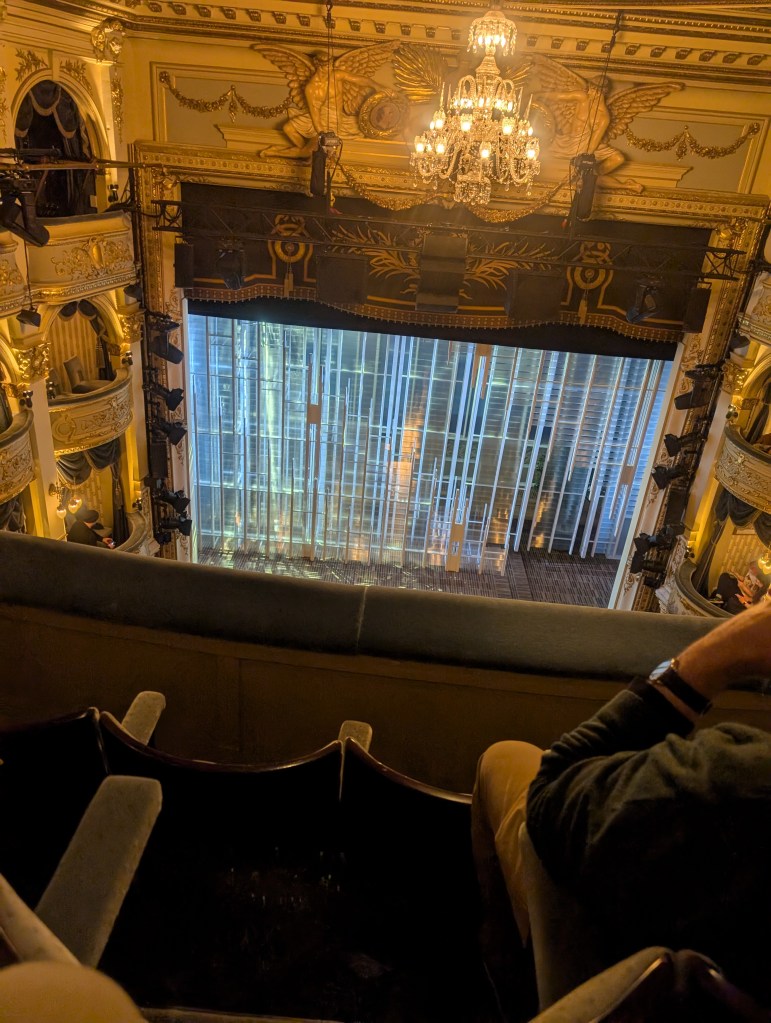
Getting to see a show was a wonderful gift of an experience. While I know that is isn’t the exact space that Shakespeare would’ve practiced in, being only yards away and seeing the shows he created in a space that was as true to the original as possible was good enough for me. While the shows themselves may take some slight artistic liberties when it comes to the way the shows would’ve been performed, it personally did not take away from the experience I was having, and if anything made me feel more connected to the hundreds of years of legacy baked into these plays. 

We saw Romeo and Juliet and it was set in the 1870s (ish) in the U.S. western frontier. Obviously, there isn’t anyway this would’ve been a time or setting that Shakespeare would’ve seen. But I also think that many understand that we have to see these shows evolve past their original time and placement, so I don’t think that was controversial at all. I did wonder why this time and place. I absolutely loved this production and thought it would really well, but I couldn’t quite put my finger on why, other than it was something different. This may be something I need to do more research on in order to find the parallels to today or to then that attracted the creative team to this. Honesty, I am going to abandon all my theater training for two seconds and say that if they chose this simply because it worked and was interesting, that’s enough for me. I know we are supposed to choose things for deeper reasons as theater artists, but I think sometimes fun or interesting can be enough. 

To start off with the things that were amazing, and I absolutely adored, it was awesome to get to be right next to the balcony and bed when they were rolled into the stalls. Although it was very hard to stand for three hours, it was absolutely worth it for the view and to be so close to the rolling set pieces. Juliet’s performance during the balcony scene was worth the price of the ticket alone.

The most noticeable difference was the use of guns instead of swords and knives. That change makes it clear that Romeo is responsible, at least in quite a large way, for what happens to the derailment of the life he and Juliet should’ve had. That life would’ve by no means been an easy one, but it would’ve been because of the one choice they were both, together, completely ok with being the struggle of their lives. In the play, Romeo is definitely the one who causes the negative situation on top of that,   when he uses a gun it feels much more intentional and aware than a boy who gets thrown into a situation and haphazardly kills on the path to get out. That’s not to say that I think that Romeo is completely aware of the impact of his actions and goes into any of these situations wanting blood shed, but he pulls that trigger many times each. But to give him some credit, he does try to calm both situations down beforehand. I think that they acknowledge that Juliet is totally and completely innocent in this by having her die by running into Romeo’s arms. I don’t think they are trying to pin the blame on him, but show that to be with him she was willing to run into harm and death. 

As I mentioned, I absolutely loved this show and gave it 4 ½ out of five stars. I would absolutely recommend this rendition of this play to anyone who wants a good laugh with an equal amount of pain and heart. The most difficult part of deciding to come should be whether you want to sit or stand! 

Blog Post 5: My Master Builder, Not Mad Just Disappointed

Note: There will be spoilers for both The Master Builder by Henrik Ibsen and My Master Builder by Lila Raicek in this blog post.

It is with great sadness that I write this blog post. I had been so excited to watch My Master Builder by Lila Raicek, I had greatly enjoyed the original play by Henrik Ibsen, The Master Builder, and the chance to see Ewan McGreggor, Obi-Wan Kenobi himself act in person sounded like a dream. Unfortunately, what I got was a production that didn’t incorporate my favorite parts of the original, and flopped harder than the main character did at the end.

Firstly, let’s talk about what I did enjoy. The set, lighting, and costumes were fantastic. Great amounts of detail were put into each one, bringing a feeling of realism that unfortunately contrasted with the rest of the play. It is truly a shame that all of this effort was wasted on this play.

That is all of the good that I have to say about this. There is so much about the play I could complain about, from the underwhelming acting to the uncomfortable shock value sexualization that added little actual substance to the show. However, most of the issues seem to stem from one main problem: the script.

There seems to have been an effort by Raicek to adapt Ibsen’s work in a way that puts a greater focus on the female characters and bring light to the real issue that is women being taken advantage of by men in power. However, in the process, much less focus is put on Henry, who is known as Halvard in the original. In Ibsen’s work Halvard’s delusional and narcissistic personality is evident as he constantly manipulates all of those around him. However, while characters may speak of Henry like he is Halvard, he is never actually shown doing anything to earn those descriptions. In fact, that is a major problem with My Master Builder, much of the play takes a “tell, don’t show” approach, with characters talking at length about past events and their ideas towards each other, but not actually doing much.

Back to Henry though, because he is a much more passive character, the play loses one of its major driving forces. Instead, the play is mainly moved forward by his wife, who does most of the action. However, the shift to a much more revenge motivated narrative doesn’t work as well, since Henry, the one who she is taking vengeance against, is a much weaker, often pathetic, character. While yes, he isn’t a great guy, he is nowhere near as intriguing of a character as the original, so you care much less about his fate, and the play as a whole. In fact, at the very end, when he falls to his death, the main audience reaction that stood out to me was laughter, which I doubt was the goal. I myself experienced an overwhelming feeling of indifference, as well as gratitude that the play was almost over, which is the last thing I want to be feeling after seeing a show.

At its core My Master Builder is a fundamentally flawed adaptation. It throws away almost everything that makes the original compelling and doesn’t do an adequate job filling in the remains. It’s almost miraculous that they were able to fumble the great source material and all-star cast. I can’t in good conscience recommend this show to anyone, especially when there are so many other amazing productions that seemingly had much less initially going for them. Anyways, this has been the next installment of my travel blogs, goodnight, morning, or afternoon, and I hope you’ll read the next one.

Ilaria’s Pub: Bath

Exploring an ancient city with landmarks that are older than the United States as a whole was a surreal experience. Being able to come into contact with history itself while walking through the Roman Baths has become one of my top experiences in London. I adored visiting Bath and learning about Roman culture during their conquered establishment in Londinium whilst we toured the interactive Roman Baths museum.

“Constructed in around 70AD (almost 2 thousand years ago) as a grand bathing and socializing complex, the Roman Baths is one of the best-preserved Roman remains in the world, where 1 million liters of steaming spring water, reaching 46 celsius (114 desires Fahrenheit), still fills the bathing site every single day” (visit bath.co.uk). 

As we walked through the extensive ruins, we listened to the historical context of each finding with a telephone-like device. For someone who becomes easily distracted and bored during a long period of time, this museum did a great job at introducing you to new historical concepts as if they were narrative stories with interesting yet relevant facts through auditory and visual features. It felt like taking a trip back in time where you were a traveler, learning about the local Aquae Sulis people and their customs naturally.

I walked through the 4 main features of the museum: the Roman Bath House, the Roman Temple, the Roman Bath House, and the artifact section showcasing daily objects, house amenities, and gravestones of the Aqua Sulis. Each was equally as enjoyable and vastly interesting to learn about. However, some aspects of the museum especially stood out to me.

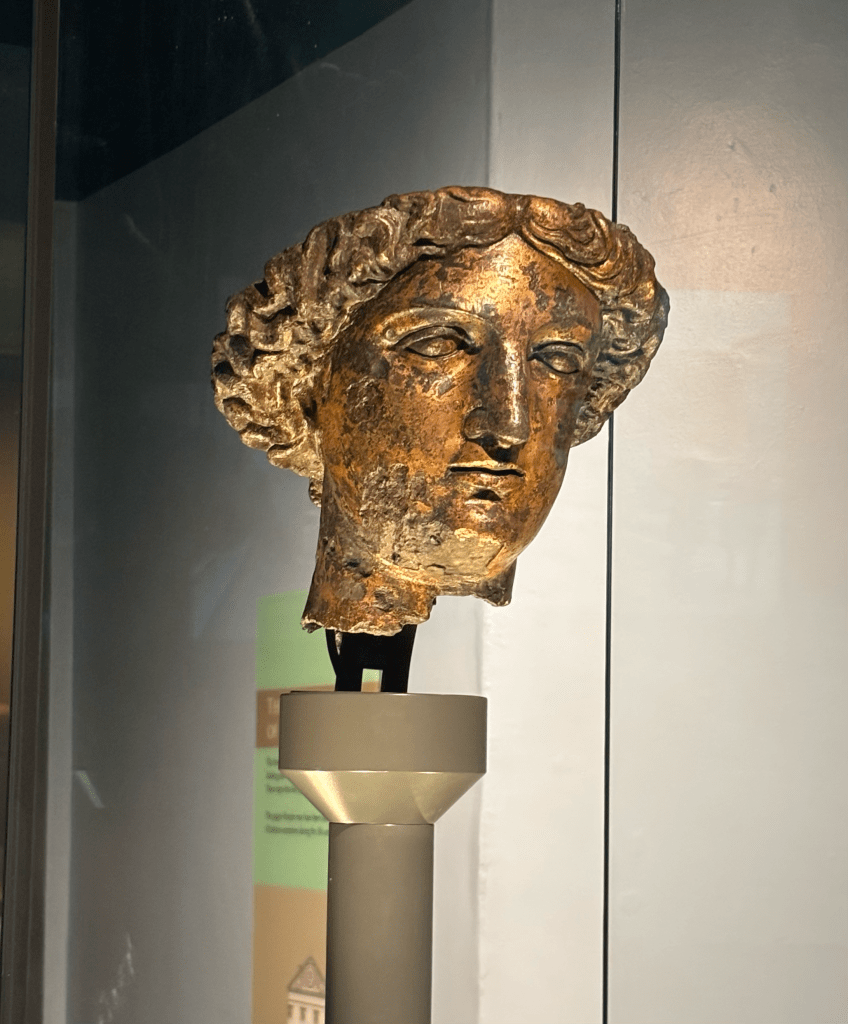
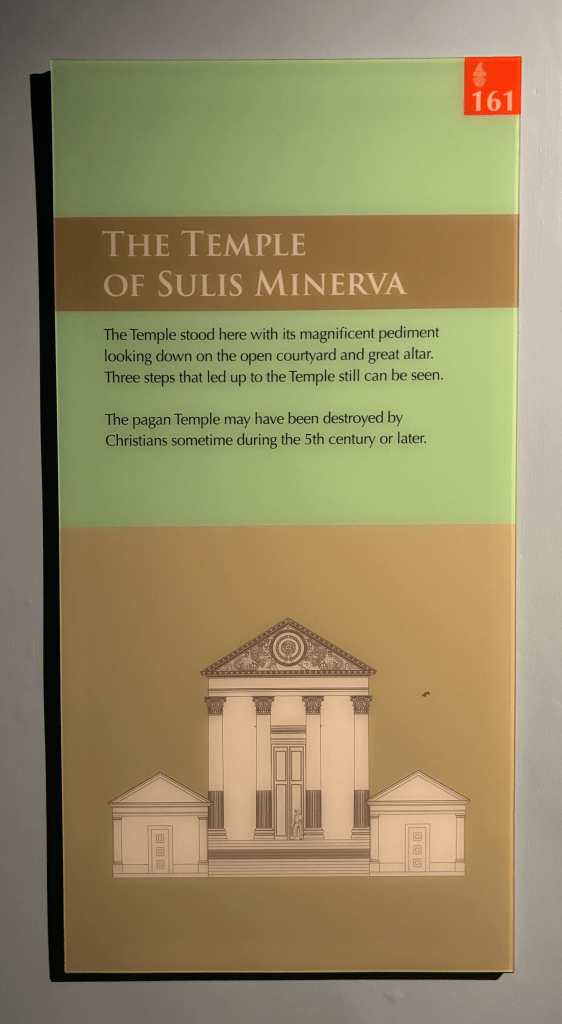
“The gilt bronze head of the goddess Sulis Minerva is one of the best-known objects from Roman Britain. The head is probably from the cult statue of the goddess which would have stood within her Temple beside the Sacred Spring, across the Temple courtyard to the site of the great altar, the site of sacrifice, which stood at the heart of that sacred space…Examination of the head has revealed that it has 6 layers of gilding. The first two use a technique known as fire gilding whilst the 4 later layers are applied as gold leaf.”

One aspect that stood out to me was the golden portrait statue that portrays the Roman goddess, Sulis Minerva. Minerva was the Roman goddess of wisdom, crafts, and strategy. Sulis Minerva was believed to be both a nourishing mother and a powerful agent of curses. People would make offerings to the goddess, including coins and wrapped-up tablets that people would carve the names of those who did them wrong, hoping the goddess would help them exact their revenge by imposing a curse on them.

It was fascinating to learn that although this period of Roman rule existed a thousand years ago, people still crave to exact pain onto others as a result of their own. Our human need to feel justice or satisfaction after we’ve been wronged still persists today. I loved learning of the ever-growing principle that the human condition rarely changes and history doth, indeed repeat itself. 

Romeo and Juliet with funny Hats

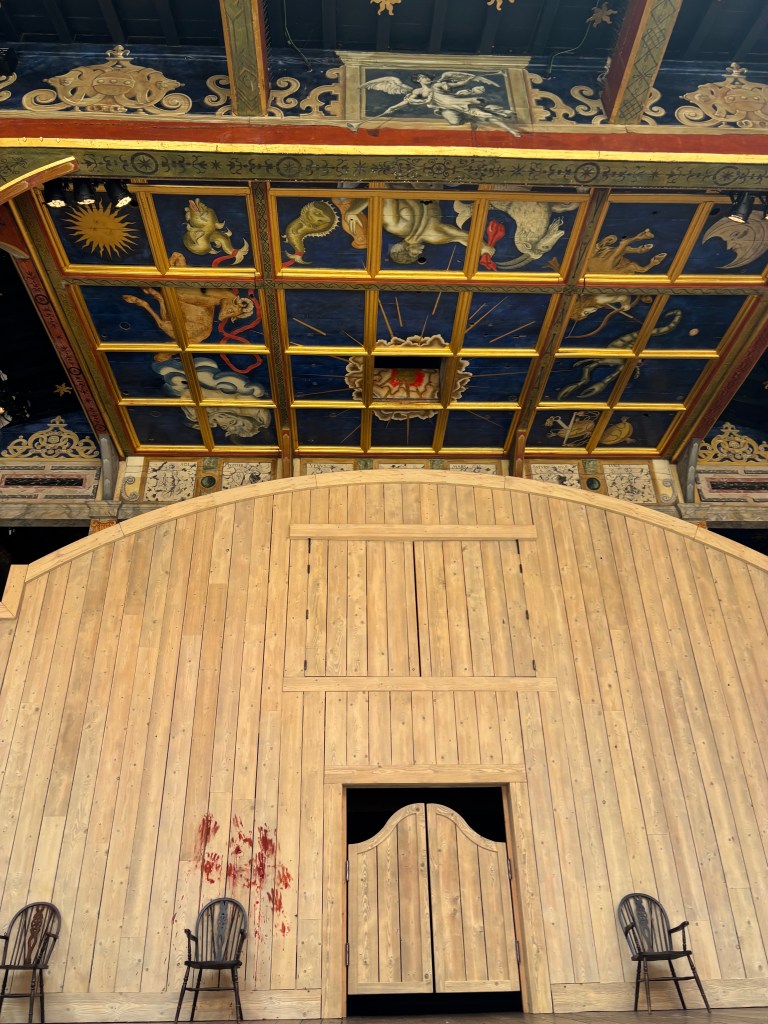
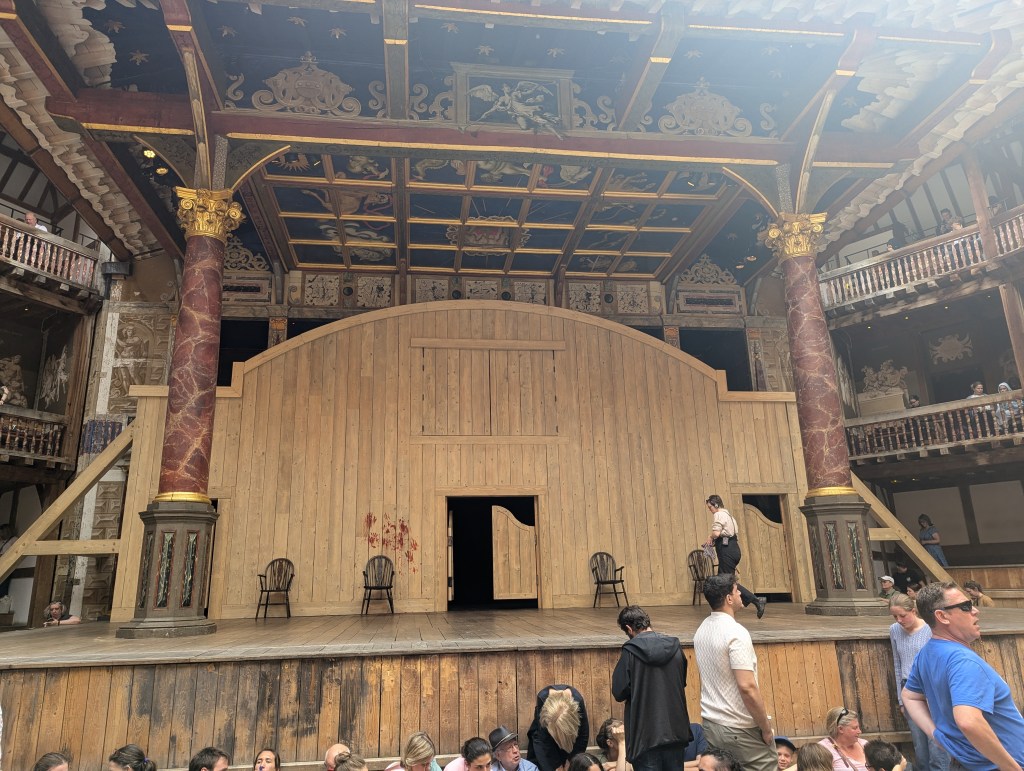
Shakespeare’s globe theatre is by far the unique theatre watching experience I have ever had. Even when first walking in I was surprised by the theatre’s structure. While I had been told that it was a full circle, I don’t think I really understood how that would look as a theatre until I got in there. I also did not anticipate how the standing room would work. In my head it was still a very organized system where people had general spots they could stand, but it was much more like a concert where everyone just squeezed in around the stage. The way that the actors utilized this space and its unique properties was also very interesting. While I knew about Shakespeare’s direct addresses to the audience, I did not anticipate the level of audience participation that was present. My favorite moment of this was when Romeo was trying to hide so he took off his hat, slid off the stage, and blended in with the crowd of spectators surrounding the stage.

I got to have the unique opportunity to be a spectator both in the seats and in the standing pit. While overall I preferred the standing, both had their benefits and drawbacks. During the first act I decided to sit in our seats, not wanting to stand for a long time after walking a lot the day before. While our seats were not terrible, there was a pretty severely limited view of the stage from them. I was sat just a little in front of the stage, and behind a pillar, so I had trouble seeing the actors when they would go to the front of the stage, or if anything was happening on the set itself. I also found myself having a lot more trouble following the dialogue when I was sitting. At first I just placed it on the Shakespearean language and had trouble understanding because of the speed it was spoken at, but while standing I did not have much trouble understanding at all. My best guess was while sitting because I could not see the actors as well, I couldn’t rely as much on their appearance and body language to determine the meaning of their words, and it was easier to zone out or get distracted while sitting

During the second act I decided to stand so that I could better see the actors and get to compare the two experiences. The change in perspective made a drastic difference in both my enjoyment and ability to understand the play. I could see the characters much more clearly, and aspects that felt a little too silly and not very funny before felt much more natural and clicked better once I could really see the actors. It was also really interesting to see some of the scenery get brought in around me, which created a very immersive experience. The main downside of the standing view was the standing itself, but it was not nearly as bad as I expected. It required a good amount of shifting my weight and switching legs to stay comfortable, but I feel like it actually helped me focus on the show better. I was so focussed on staying comfortable that my mind wouldn’t wonder or get distracted by random things around me.

The play itself was very good, and I feel like the decision to put the play in the cowboy era worked well, especially because the production did not take itself too seriously. This is not to say that the set and costumes were not done with absolutely amazing craftsmanship and skill, but the production definitely leaned into the comedy aspects of Romeo and Juliet and the campiness of old west themes. While bringing a gun on stage can sometimes be a bit gimmicky in my opinion, I feel like it worked well in this production and brought a good amount of shock factor without relying on it too much. The acting was all very well done, but I definitely feel like the shows costuming was the biggest standout.