Does anyone have a Walkman?

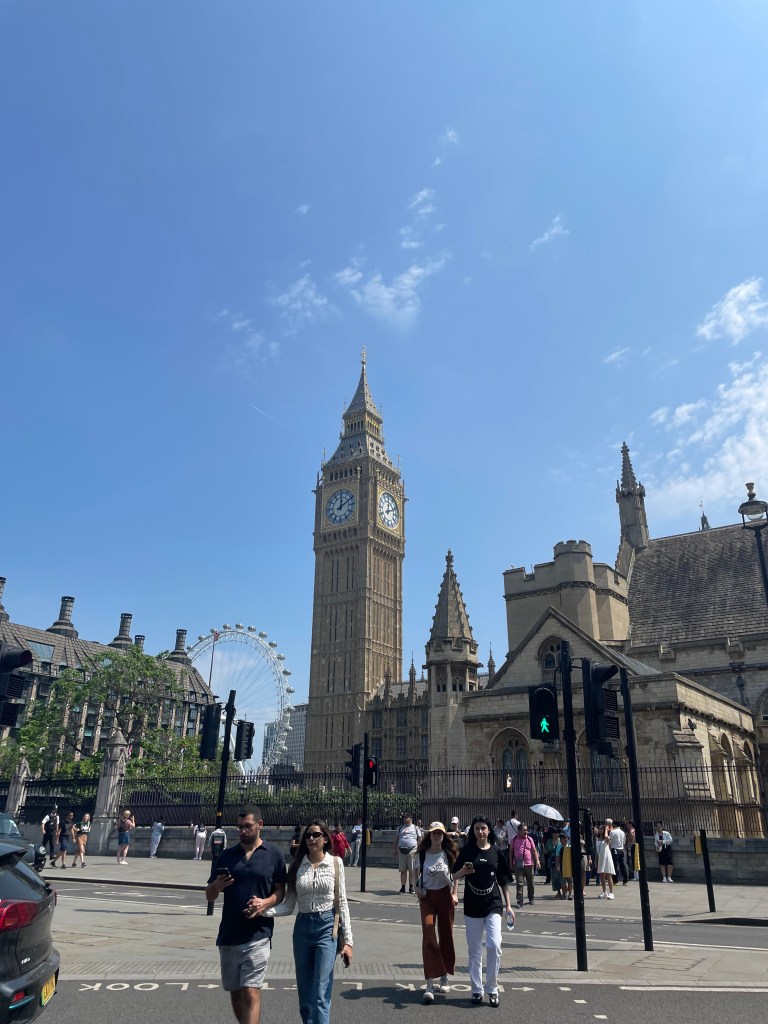
First off, I would like to say I have long been fooled about Westminster Abbey. The famous church where the United Kingdom crowns their monarchs is not the building adjacent to Elizabeth Tower (the iconic fancy tower with the clock which most of us incorrectly refer to as Big Ben). Parliament sits next to the clock tower and major London landmark. Westminster Abbey is actually north. Not drastically removed, mind you, I believe I crossed a singular street and then had to do a very short walk. Still! I feel I have been misled; although, I don’t really know why as I had never been informed incorrectly or really at all.

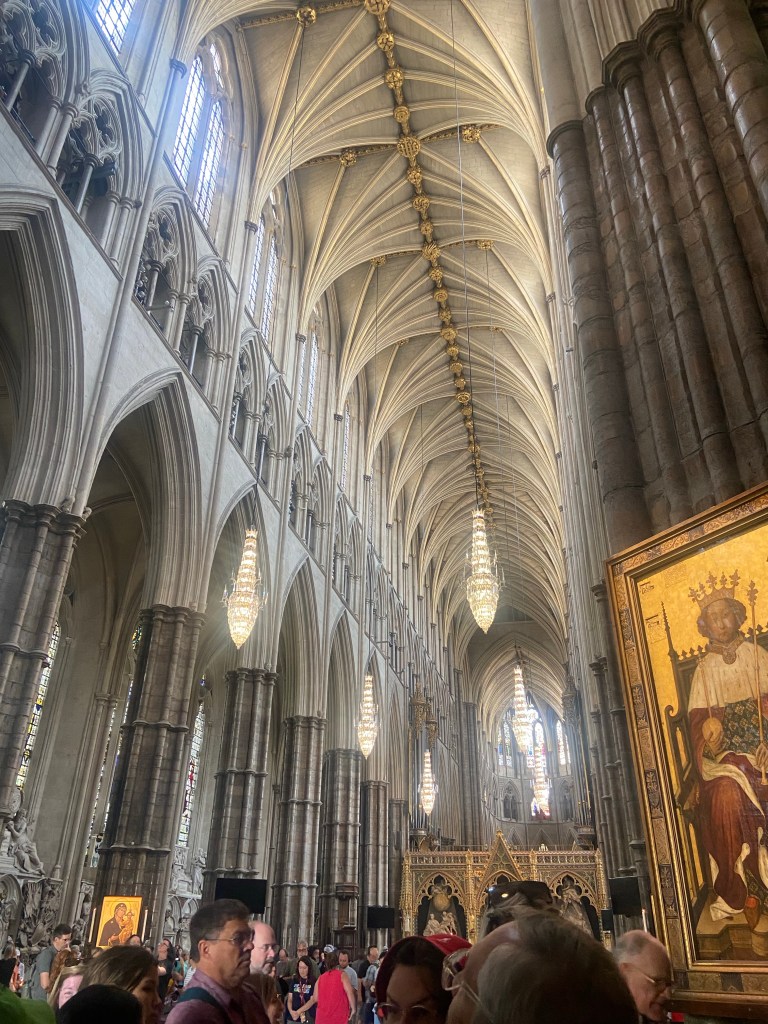
Anyway, Westminster is rather impressive. From the outside, you can see a large circular beautiful stained-glass window. What is standing today is largely the gothic style of architecture (my architecture major roommate, Madison, has informed me that it is perpendicular gothic to be exact). You can tell this very clearly by the flying buttresses and many pointy decorative choices. While it is quite impressive, the building seems like it wants you to think it is impressive. Gothic architecture often seems to be a blending of creative structural choices and showing off; Westminster is no different.

Overall, despite the beauty of the church, I was a bit…well, I know you can be overwhelmed, and you can be underwhelmed, but since I am in Europe, I think I can just be whelmed, so I’ll go with that.

I may have had a more pleasant experience if I had gotten to do a self-paced audio tour. No hate to our tour guide Molly, I have just loved walking around with an audio tour since I toured mansions in the Northeastern US with them. There is also the problem that accompanies every major tourist attraction: people. I felt rushed or like I could not see what I wanted to see because of all the other people who wanted to see the same things.  

Today, Westminster Abbey is a functioning church aside from being a major tourist and school trip draw. Notable events for us modern folk include William and Kate getting married at this church in 2011. Just over a month ago, on May 6, King Charles III was the fortieth monarch crowned at Westminster. William the Conquer was the first British ruler to be crowned at the site with this coronation occurring Christmas day 1066 (a fact that has taken residence in my brain since 3rd grade).

There was first a Christian congregation on the site of Westminster around 960 AD. King Edward, now known as St. Edward the Confessor, wanted to build a palace on the bank of the Thames in the 1040s. Since there was a monastery close by, he decided to enlarge it and turn it into a full church in honor of (St.) Peter the Apostle. To distinguish the church from the eastminster (St. Paul’s Cathedral), the church was dubbed Westminster. The Pyx chamber and supports of the undercroft are the only surviving features of Edward’s Westminster. What stands today was built during the 13th century.

Part of the purpose of Westminster was to be the royal burial site, and while many are buried at the church, the last monarch to be buried here was George II in 1760. After George II, monarchs started being buried at Windsor. Westminster was also opened up as a burial for commoners. Important Brits who are not actually buried at Westminster have memorials there. Shakespeare somewhat famously refused to be buried at Westminster; he is instead buried at the church he was baptized at in Straford-upon-Avon, and there is a curse on the grave if anyone should try to move the body.

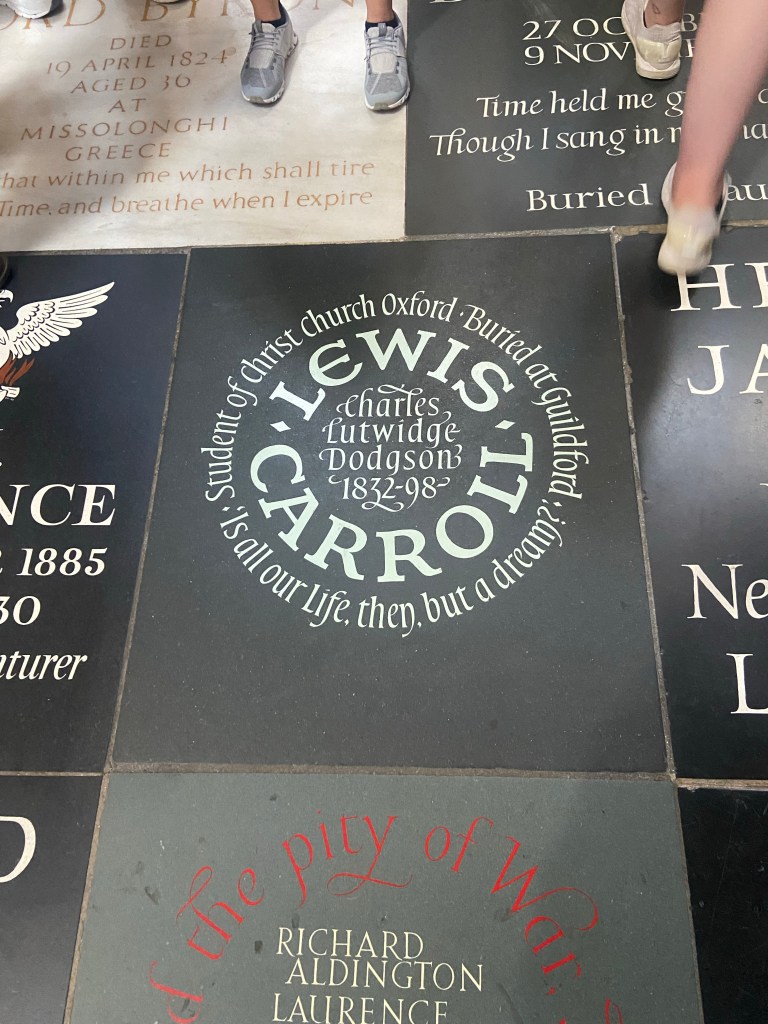
Authors such as Lewis Carroll and George Eliot are also only commemorated instead of buried at Westminster. I mention these two together as they are known by pen names. Their legal names were Charles Lutwidge Dodgson and Mary Ann Evans, respectively. Carroll has gone down in history as the creator of Alice and the mysterious and fantastical Wonderland. However, he was also a Mathematics tutor at Christ Church, a college of Oxford University, and a pioneer in photography. Eliot wrote seven books and is considered one of the leading female authors of the Victorian age.

Both are commemorated in Poet’s Corner. The first to be buried in this section of Westminster was Geoffrey Chaucer (Canterbury Tales). Two other notable men buried in this section are Charles Dickens and Rudyard Kipling.

Interesting, Mary I (Catholic and namesake of the tomato-based alcohol cocktail) and Elizabeth I (Protestant and alleged virgin) are entombed together. The two are the daughters of Henry VIII and half-sisters. Mary once imprisoned her sister in the Tower of London to discourage Elizabeth’s supporters and therefore better secure her throne. Mary is assumed to have died of cancer leaving the throne to Elizabeth and the country to the Protestants. There are three theories of why Elizabeth died: an illness, blood poising due to her makeup that was classified as a poison in the 1630s, or because she refused to remove her coronation ring which had grown into her skin. The inscription on Elizabeth’s tomb translates to “Partners in throne and grave, here we sleep Elizabeth and Mary, sisters in the hope of the Resurrection.”

After Elizabeth I died, the throne went to James I of England and VI of Scotland. He had his mother, Mary Queen of Scots, moved to Westminster Abbey. Mary was executed by her cousin Elizabeth and now forever lies across the hall from the other queen.

There are Prime Ministers interred at this church although you will not find the great Winston Churchill. Churchill did not want to be buried among men he would not even have a smoke with and instead only has a memorial. Another notable WWII era politician is memorialized at Westminster, but this one is not British. The UK government memorialized FDR in their historic abbey for being a friend of freedom and Britian.

So there it is, Westminster Abbey, a place that celebrates the renewal of a country and the end of the perceived greats.
Westminster Abbey – Day 23 

Westminster Abbey was a hot, packed experience. I loved looking at all of the architecture and the stained glass. But with the amount of people also inside with us, I wanted out.  I’m learning I’m not a huge fan of crowds. No scratch that I’m not a huge fan of crowds when I am hot and everyone else in the crowd is alo warm. Makes me feel icky, sticky and uncomfortable, and made me pay attention less to what was going on around me, and focus more on myself. Feeling grateful for all of the breezes and AC that I find. I really wanted to stand and look around for all of the actors, writers, scientists, the list goes on that are buried in Westminster Abbey. Like Darwin and Stephen Hawking but by the time Molly had concluded our tour I was getting to g.o. I needed ice water asap and to sit down. But the few people’s graves/memoriams that caught my eye were: 

Jane Austen

  • Great female eEnglish novelist of the 19th century 
  • 6 major works including Pride and Prejudice, Sense and Sensibility, Persuasion, and Emma.  
  • Born December 16 1775 to Reverend George Austen and his wife Cassandra. 
  • Jane had one sister and six brothers. 
  • Jane was engaged for a single night. 
  • Jane died on July 18 1817 at 41 years old. 

Peggy Ashcroft

  • Born December 22 1907 and died June 14 1991 
  • An English actress whose career spanned more than 60 years 
  • Made her stage debut in 1926, she played opposite Ralph Richardson and Laurence Olivier. 
  • She is well known for her Shakesperian and classical roles. 
  • She married three times and had two children from her third husband, Jeremy Hutchison. 
  • A memorial service was held for her at the Abbey and she has a memorial stone there as well, but her ashes are scattered Stratford upon Avon. 

Anne Bracegirdle 

  • Born 1671 and died September 12 1748 
  • An English actress and singer. 
  • As a young girl she was placed in the care of Thomas Betterton, who was also an actor, and his wife. Betterton acted in many plays alongside Bracegirdle. 
  • She started performing in 1688 and became popular playing “breeches” parts and also some Shakespeare, William Congreve also wrote plays for her. 
  • In 1705, she began to have rival Anne Oldfield, and many audiences preferred Oldfield. This led to Bracegirdle retiring in 1707. 
  • She made one last appearance at Betterton’s benefit in 1709. 
  • Braacegirdle made a request to be buried at the Abbey and her request has been fulfilled. 

Gorgeous Gothic

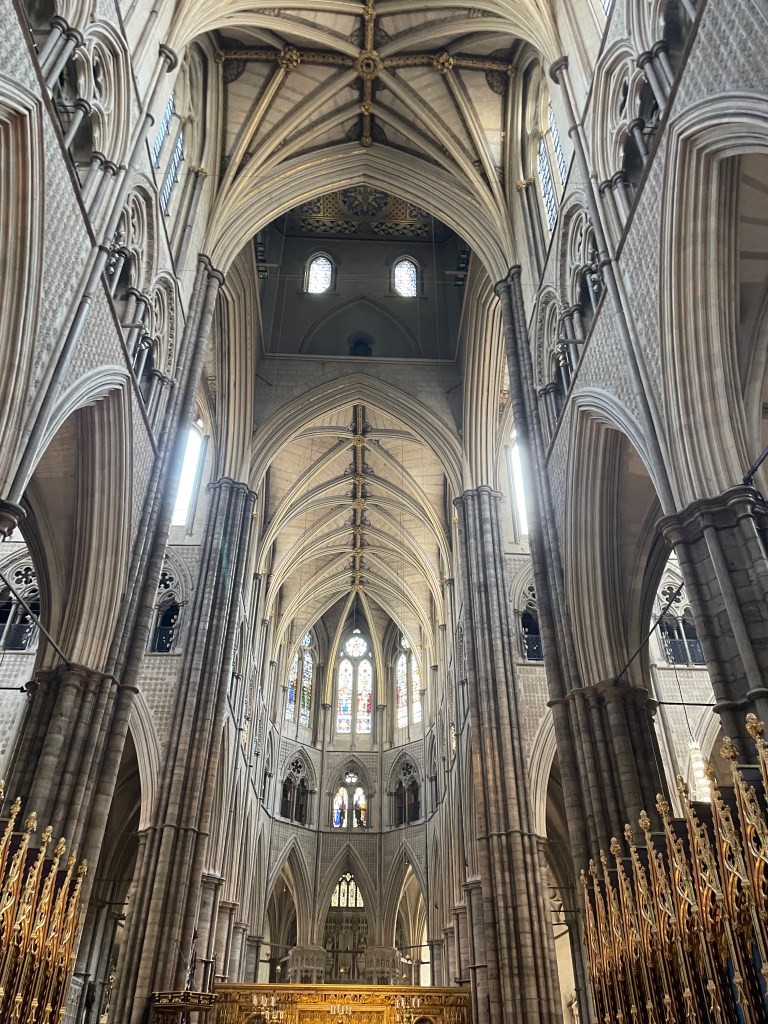
Today we visited Westminster Abbey, and I’m not exactly sure what I was expecting, but I definitely don’t think I was expecting it to be a church. It was absolutely beautiful though, and I understand why the royal family holds all of their important events there. The building was done up in true extravagant perpendicular gothic style with the tall stretching vertical columns and colorful stained glass windows. The architecture student in me was having strong flashbacks to my architecture history classes from last year.

I also was not expecting the church to be such an important burial ground area. I felt terrible walking anywhere because you were constantly stepping on someone’s grave no matter where you stepped. However, it was really cool to get to see some of the famous people who were buried there. The few who stood out to me were Lewis Carroll, Jane Austen, and Robert Adams.

The first two people were writers, and the third was an architect for King George III. Carroll wrote wrote the famous Alice in Wonderland and Alice Through the Looking Glass, which are stories I remember seeing since I was a child. Carroll and Austen weren’t actually buried at Westminster, but they had memorials dedicated to the authors. Carroll was buried at Guildford. He was born in 1832 and died in 1898, and I love the quote that was printed on his memorial. It read “Is all our life, then, but a dream?”

Jane Austen also had a memorial at Westminster. I was a little disappointed that her memorial was so small especially since she wrote my favorite book Pride and Prejudice. It doesn’t say where she was buried, but it did say that she was born in 1775 and died in 1817. I’m glad they gave her a shoutout, but I think the amazing author deserved a little more.

The final person that interested me was Robert Adams. He was apparently an architect for King George III and built at least six of the monuments that were in Westminster Abbey. I had to do a bit of outside research about him since I didn’t know who he was, and I’m glad I did. He was born in1728 and died in 1792.

After Westminster Abbey, a few of us went paddle boating, and I don’t think I’ve ever seen that many geese in my life. It was a lot of fun, and it was a pretty day for it.

Thanks for reading, and I’ll see you next time ❤

6/13: I still don’t like Guided Tours and Westminster Abbey

Westminster Abbey is one of Londons oldest and most respected churches, with lots of respected artists, authors, and scientists buried within the grounds and on display to the public. While it felt a little wierd to walk over the plaques (and tombs) of those that are dead, it was still very exciting to see so many respected people that I recognized. Except that our tour guide kept walking past the people I found interesting and talking for extended periods about tombs that I didn’t really care about, which is one of my biggest flaws with guided tours in general. Disregarding that aspect, there were a couple people whose plaques I found to be very cool. William Shakespeare’s was a cool little statue with Shakespeare doing a sassy little pose on top of a head, that I felt was very in character with his real-life whimsy. He is not actually buried at the Abbey, as he is in Stratford-Upon-Avon, but his recognition was cool to see in Poet’s Corner. The Bronte sisters and Jane Austin also had plaques in Poet’s Corner, but their plaques were just tiles with their names, birth dates, and death dates, which I found to be disrespectful. Seeing Stephen Hawkins memorial and where he was buried was also super cool, as I am a huge fan of his work and the movie The Theory of Everything, but I did not see it on our first go around and had to circle back to see it. His memorial having a ‘milky way’-like black hole on it was super cool and it made his memorial seem more than just another tile. One new person that I did not know before entering, and who I learned about from actually listening to our tour guide, was David Livingstone, a British missionary who traveled to Africa and stayed there. The British had sent someone to find him, because they thought he was lost, and the famous quote “Doctor Livingstone, I presume” was uttered by those who found him, one of the few British people living in Africa at the time. I think it’s absolutely insane, that after telling the British that he would rather stay in Africa, Livingstone died and the British took his body back to London. They did “leave his heart” in Africa but If I were his ghost, I would be absolutely infuriated at that happening. I would haunt the hell out of the Abbey for the rest of time, but maybe that’s just me. There were a ton of other really cool tombs there, but these few really stuck out to me.

Westminster Abbey!

Westminster Abbey was so beautiful and historic. Being there with so many important figures who have passed was a little haunting, but it gave me a larger appreciation for those who have done so much for humanity. The entire building was a piece of art that I’ll never forget.

One of the graves I found was of George Frideric Handel, a German-British composer in the 1700s. His grave stood out to me as I’ve actually done a few of his pieces in choir and really enjoyed them. He grew up in Germany but settled and did most of his work in London. He was one of the most important Baroque-era composers and created the genres of English oratorio and organ concerto. He also worked in Opera, creating 3 commercial opera companies to supply the English nobility with Italian opera. His music was admired and helped influence Mozart and Beethoven.

Another grave I saw was of David Garrick, an English actor, playwright, theatre manager, and producer who had a strong influence on European theatre practice in the 18th century. He was first noticed after playing Richard III in an amateur production of Shakespeares Richard III, and after growing in popularity he used his influence to reform theatre in countless ways, changing production matters and audience etiquette to make theatre and safer space to be in.

The last grave I’ll talk about out of the artist buried in Westminister Abbey is the grave of Thomas Campbell. He was a Scottish poet and was one of the initiators to start a plan to found University College London. He produced patriotic war songs in the early 19th century and had his poems set into music by influential composers such as Beethoven. 

Learning more about these influential artists helps me gain a deeper understanding of my craft. Going to Westminster Abbey and not only seeing the resting site of these artists but of Nobles and many others was an incredible, interesting experience.

Fringe Theatre can be Hot and Stinky

Fringe theatre is a very frivolous term because there are so many opinion-based factors that determine whether or not a theatre is fringe. This ranges from theatre size, to the size of the company that is producing it, and even to the quality and funding the show might have. Even with these examples, not all of them are applicable to every single fringe theatre. From what I have deduced, fringe is a very opinionated term and anything can be fringe if you make the argument. As long as the show is small enough and not being produced by a very wealthy and well know company (i.e. Broadway or West End), then it is fringe theatre. 

While on this trip, I have had the pleasure of seeing a fair amount of fringe theatre. Not all of them were great, but I can say that it was less the production’s fault and more the script’s fault. In my opinion, Glory Ride, Jules & Jim, and How to Succeed in Business Without Really Trying. Of these three, Glory Ride was the only one that brought me joy. The other two shows had a myriad of faults and I’d rather not write another hate post. Glory Ride is based on a true story of a famous Italian cyclist who saved the lives of many by getting passports in and out of the country during Musalini’s reign. Going into the show, I thought it was going to be a horrible impulse buy that would result in a two hour long history lesson, but I was very wrong. The show was beautiful, well-acted, and the singers had some of the best voices I’ve heard all month. I could tangent about what I thought of the show, but I don’t want to ruin the experience for anyone who sees it in the future. Instead I will talk about what made the space fringe. The Charing Cross theatre is unfortunately located directly underneath the Charing Cross Tube Station which means that throughout the show you get to hear the sounds of trains going in and out of the station. Although it happened a couple of times throughout the show, almost every single moment was perfect. For example, when the characters were sitting through a German bombing raid the trains from above added the perfect amount of spice to the atmosphere. Another strange part of the space was the stage itself. I was sitting in the front row, and the stage towered over me. When I stood up, the stage came up to my shoulder (I’m 5’10” ¾ btw ;). Luckily for me, there was not a lot of action on the back half of the stage, but the poor lady next to me wasn’t having as great of a time. The entire theatre was small too. So much so that I could hear the actors doing vocal warm ups before the show started. I don’t know if it’s true, but I am fairly certain the theatre doesn’t have any form of house speakers since the show started abruptly with no warning. The lighting and set weren’t complicated, but they still did a great job with both of them. The set was perfect for the story they were trying to tell, and the lights helped to shift focus when needed and give the correct mood to a scene. There were a few times when the entire first row was completely filled with light, but it wasn’t a bad experience, just a surprising one. All of these factors made the show fringe, but not a single factor hampered the enjoyment I had for the show. It’s a new musical, so it won’t be touring anytime soon, but if you get the chance to see the show then go see it.

The Errors of Comedy

We came back to the Globe! On Thursday we crossed the crowded Millennium Bridge once again to meet at the matinee showing of Comedy of Errors. Our seats were directly across from the stage at this show, which gave us a better perspective of the staging and movement of the actors. From the beginning, I could tell that this show decided to follow the traditional concepts of the scripts more than the production of A Midsummer Night’s Dream that we had seen at the Globe a few weeks prior. The costumes were more puffy and less colorful. The casting followed the script more than Midsummer’s casting. However, the plot of Comedy of Errors needs the specific casting of two twins, which was executed very well in how the costumes and mannerisms were identical, especially for the two Dromios. The actors played the script like they had written it. They spoke every line with the assumption that they fully understand and spoke every line from their full chest. For such a predictable script, the action and jokes were played as funny as they could be played. It’s not common that a whole Shakespeare cast has the ability to make the audience laugh out loud multiple times, whether that be through line delivery or slapstick blocking, I was entertained, nonetheless. The side characters and use of the set props made the play with the floating boats being carried over the groundlings to deliver the duke in different colored Lord Farquaad-esque wigs. I was very pleased that we had read and studied this play in class before viewing this play. I was already very confused at certain scenes so I have no idea how I would have perceived that show if I had never read it. Shakespeare’s classic rushed ending grew very beneficial during this performance as our amazing seats turned miserable when the four o’clock sun started burning our lower bodies. For an outdoor stage, I must give it to the actors for performing in eighty-degree heat wearing layers of petticoats or male bloomers and having to yell over about five airplanes and two babies screaming to go home. Though this play reads as a more boring and repetitive Shakespeare script, I felt that this company went above and beyond in how they delivered their lines and added much more comedy that was terribly needed for a show with comedy in its name.

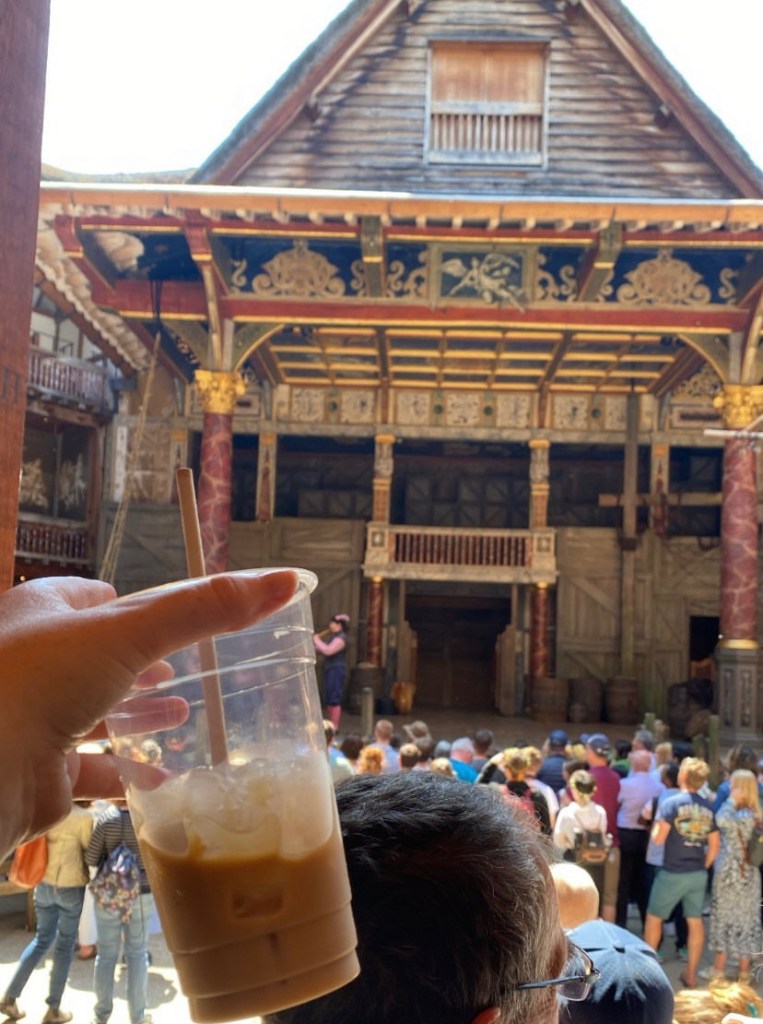
Plus, the Iced Coffee and Croque Monsieur from the Globe cafe were so amazing!

Another Trip Around The Globe

Shakespeare’s Globe-the beginning of theatre, movies, everything. It all started here. Our group saw another Shakespeare production a couple of days ago at the Globe Theatre. As we made our way into the Globe Theatre, I tried to imagine what the experience would have been like during Shakespeare’s time. Did audiences realize how they were a part of something bigger than themselves? Did they realize that they were witnessing plays being performed and written by who was and always would be the most known and greatest writer in the world? As I sat in the heat on the uncomfortable benches, I wondered how they ever did it in so many layers of clothing. Being a spectator in Shakespeare’s Globe made me feel like I had torn the tapestry of time and was peeking into the past. One thing that would not have been in the past however were the captions screens. I noticed immediately that there were caption screens to help hear and understand the play better. This was definitely a much appreciated modern touch to the ancient tradition of Shakespeare.

The play that we were seeing is known as The Comedy of Errors. After both being separated from their twins in a shipwreck, Antipholus and his slave Dromio go to Ephesus to find them. The other set of twins lives in Ephesus, and the new arrivals cause a series of incidents of mistaken identity.

This play was one of the plays that we read in our on-campus class before our departure for London. I must say that the play’s humor is so much more effective when performed rather than read. I found myself understanding jokes a lot more and laughing hysterically. The jokes just don’t hit the mark quite well without the bodily gestures and animated facial expressions of actors.

I think what also made this play so funny was the fact that the actors interact with the audience. I often wonder if this would have been done in Shakespeare’s time or not. I’m sure that the audience would have laughed, but would breaking the fourth wall be considered unprofessional? One instance of breaking the forth wall that I loved was that when there was a baby that would start crying, one of the actors had a line where they said, “Well.” The actor turned to the baby when it started crying and repeated this line more dramatically by saying, “Weeeellll” It produced a lot of laughter from the audience and eased the tension of the audience being distracted by the baby. It even happened a second time where the actor yelled “yeah” in agreement to the baby’s fussiness. I also loved how the women interacted with the people in the front of the audience. One even pointed out a man in the audience and spoke to him. Another reason I love these plays is because in the production, actors make entrances from the other side of the theatre, requiring them to have to pass through the audience to get to the stage.

While the play was much more humorous in person rather than when reading it, I found myself becoming a bit more confused at first because the actors who played the twins looked so much alike that I would have to try to pay more attention on who was who which led to me missing plot points of the play. Another reason that I missed points of the play or became perplexed at times was because my eyes kept reading the captions on the screens thus forcing me to sacrifice the chance to fully see their faces and movements when they delivered the lines. I feel as if this play would be much easier for those in Shakespeare’s time to understand because the language would have been much more familiar to them rather than to us. Nevertheless, many of the jokes were still knee-slappers for modern day viewers.

Speaking of modern day, plays at the globe may be performed more progressively than Shakespeare production performed in contemporary America. There is a significant amount of bending gender roles in plays at the Globe. This was also seen there at our viewing of A Midsummer Night’s Dream. Women will play the characters of men and vice versa. This is quite a twist of tradition compared to how things were done in Shakespeare’s time. Women were not allowed to perform on the stage so all of the female parts were played by male actors. Now, it is often seen that the male actors are played by females. I did not see any males playing females during either productions at the Globe.

There are also many other elements of Shakespeare’s play that are performed differently in the Globe now than they would have been performed during their original time. One way that they are performed differently is that there is a director for the plays whereas in Shakespeare’s time, each actor would have to direct themselves. Essentially, each actor only knew the time of their own parts rather than all the lines of the play to reduce the risk of the entire script being stolen.

As I tried to imagine how Shakespeare’s plays would have or would not have been performed during his time, I found myself feeling incredibly grateful and privileged to be where I was right there, in the present, taking it all in with modern eyes and modern ears. I would say that I was born in the wrong time, but then again, I don’t have to worry about dying from the Black Plague or having my thatched roof catch on fire. I can watch Shakespeare, ride the tube, and get coffee at Pret all in one day. What a life.

Soakin in the Sun with Shakespeare

We recently got to see our second production at Shakespeare’s Globe, another one of his comedies aptly called The Comedy of Errors. Of the two productions, Midsummer Night’s Dream was definitely my favorite, but I feel like it’s unfair to even compare the two so I’ll talk about Comedy of Errors as its own entity entirely. 

To start, I think the script just isn’t that good for what Shakespeare can do. The jokes are funny, but they are very repetitive. How many times can I laugh at Antipholus speaking to the wrong Dromio and vice versa? 

That being said, the answer was surprisingly most of the time. The delivery of the comedic moments was by far my favorite part of the production, the actors playing the Antipholi and Dromios put on great performances. I also loved the comedic timing of the actor playing the Duke, especially in moments such as when he was referencing the priest’s appearance, a character the same actor had played. 

I also really enjoyed the boat entrances that happened three times during the play, where a boat carried by crew would sail through the groundlings surrounding the stage. It was a cool visual and I particularly loved how the duke would wave the groundlings aside to make room for the boat. It embodied the semi interactive nature of the Shakespeare I’ve now seen at the Globe that I feel adds so much to the experience.

However, I did have some qualms with this production. The first of which was the mere fact that Shakespeare was not writing at 100% during this play. The emotional and sincere moments felt to me like they were dragging on, and it took me out of the comedy and absurdity that the rest of the world lies in. Then there was the main problem I had at this production, and it is not a fair critique but it was something worthy of complaining: it was hot, so very hot. We had really good seats this time, ones with a straight on practically centered view of the stage, and it was amazing. However the sun was out and the shade steadily decreased over the course of the show as the sunlight kept moving further and further up my black jeans. It was not fun and it became fairly distracting, but I do suppose it was an authentic globe experience, so I can’t complain too much.

Overall The Comedy of Errors was a good show that had its hardships, and while it was not the excellence that Midsummer was, it was still well worth the watch. And it would have been even better if it had been overcast.

The Comedy of Errors at Shakespeare’s Globe Theatre

Just a few days ago I took a tube ride all the way Southwark, London, and crossed the Millennium Bridge to see one of London’s most famous theatres. Shakespeare’s Globe Theatre.

Shakespeare’s Globe Theatre was built in 1997 by architects Theo Crosby and John Orrell. It is a replica of the Globe Theatre that was built in 1599 by the Lord Chamberlain’s Men. The company William Shakespeare wrote for, and part owned. Sadly, the original theatre burned down on June 29th, 1613. Three years before Shakespeare’s death. The fire was caused by a piece of burning wadding from the small cannons that were used in a performance of Henry VIII landing on the Globe Theater’s thatched roof. Thankfully, there were no causalities. The original Elizabethan playhouse is where the English poet, William Shakespeare wrote and produced most of his plays. It is said that the first play that Shakespeare wrote for the Globe Theatre was Julius Caesar in the year 1599. One fact about the Globe Theatre is that when the patrons fell out of favor with Queen Elizabeth I, their landlord Giles Alleyn wanted to cancel the Lord Chamberlain’s Mens’ lease on the land and tear down the theatre. However, the Lord Chamberlain’s Men took it upon themselves to deconstruct the entire theatre in the middle of the night and transport the materials across the river Thames and reconstruct the new theatre in Southwark, London. Their great efforts are what saved the Globe Theatre.

I’ve been in London for almost a month, and I have visited Shakespeare’s Globe Theatre twice. The first time I went to the theatre I saw A Midsummer Night’s Dream. This time I saw The Comedy of Errors. The Comedy of Errors is one of William Shakespeare’s first ever plays. It is also one of his shortest plays. The Comedy of Errors tells us the story of two identical male twins who were separated at birth. Antipholus of Syracuse and his servant, Dromio of Syracuse sail to the Greek city of Ephesus. Where the twin brother, Antipholus of Ephesus lives with his wife, his wife’s sister, and his servant Dromio of Ephesus. However, Antipholus and Dromio of Syracuse don’t know this. Once Antipholus of Syracuse steps into the city, he encounters friends and acquaintances that mistake him for his twin brother, which causes chaos to ensue throughout the entire play. The townsfolk and the twins themselves do not find out that they are twins until the end of the play.

The Casting Director of The Comedy of Errors did an excellent job of casting the actors who played the twin brothers and the Dromios. Antipholus of Syracuse and Antipholus of Ephesus looked so similar that I wouldn’t have been surprised if they were related to each other. Also, for the first 20 minutes of the play, I didn’t realize that there were two Dromios. They looked almost identical, and their voices sounded the same. The only difference between the two Dromios was that the Dromio of Syracuse had a slightly thicker mustache than Dromio of Ephesus. Every actor played their character well; however, some actors didn’t let the lines hit them, and a few conversations sounded like they were just reading words off the script. Besides that, it was a wonderful production, and I would love to see it again in the future.