The National Gallery

The National Gallery is located in Trafalgar’s Square in the city of Westminster. The gallery contains over 2,300 pieces of art of various types. The first section of the gallery heavily focuses on the theme of Christ and the Crucifixion. It was not really until the next section of the gallery that we moved off from the religious imagery and symbolism. Both of the pieces that spoke to me came from Ovid’s Metamorphoses.

The first piece was Orpheus by Roelandt Savery. This painting shows Orpheus surrounded by different animals in a wooded area in the foreground with a waterfall and trees in the background. This was one of the exhibits that I could pretty much immediately recognize by just glancing at it. The attention to detail in the piece shows not only shows the artist’s talent but also shows the myth of Orpheus well. There was one problem with this painting, and it was that Orpheus is shown with a Violin, but in the myth, he has a lute. This is important because the lute is a very magical ethereal instrument and changing it to a violin makes him more human.

The second piece was Pan pursuing Syrinx by Hendrick van Balen and a follower of Jan Brueghel sometime after 1615. This painting depicts the faun god Pan chasing Syrinx the nymph through Arcadia. This piece is also from Metamorphoses similar to Orpheus. The artist does a very good job in making Pan a predatory figure as fauns in mythology are known for being rapists. The palette used shows a clear distinction of color to show the brightness and purity of Syrinx against the evil and darkness of Pan. The myth says that while running away, Syrinx was turned into reeds and then put then in his flute. Even after her “death” Pan still was able to take advantage of her.

Singing in the Rain

Blog 5: the National Gallery

By Isaac Overman

May 31 2022

For our excursion today, we went to Trafalgar Square and the National Gallery. This of course brings up the Tate Modern and the inevitable comparison between them. The National was everything a fine art gallery should be. It had hundreds of paintings for different centuries and varied styles. I would find it a impossible to have no love for the gallery. It decimated the Modern in my opinion. The building was just as impresive as the Tate but with a better catalog of works from the greats. The Tate lacked some of the big names that I assosiate with great modern art, but the National had at least one famous work from most great painters up until the 20th century. Anyway, the paintings that jumped out at me where “La Pointe de la Hève” by Claude Monet and “Coastal scene” by Thèo van Rysselberghe.

La Pointe de la hève
Costal Scene

These two paintings share the same century and were relatively contemporaries. But Rysselberghe was apart of the post impressionist movement where Monet was of the old guard by this time. Both portray beach and cliff scenes. They are both excellent but different in the way that they are painted. Monet uses slightly longer brush strokes than Rysselberghe and is a little more crisp with his lines. However, Rysselberghe uses a unique style of pointillism that had just been invented to make it looks stunning but very different. I love both works for different reasons. They are only separated by a single wall and I think that’s how it should be. They are looking at the same things but painting them how it speaks to them and that is the strength of the National Gallery. It has art spanning many centuries. It demands the attention of its viewer. As it turns out, so does the rain. As several of us left, it began to fall a little more rapidly. So we all had beers and lunch in the upper room of the Lemon Tree Thai fusion Pub. As it rained outside, Ben told more jokes and Braedon polished off yet another Guinness. I realized that this is what London is all about—grey weather and new friends.

Ventures Through The Gallery

May 31

Today I got the opportunity to visit the National Gallery. Founded in 1824, the National Gallery is home to over 2,300 paintings from the 19th Century all the way back to the 13th. And among all the beautiful pieces, two in particular stood out the most to me.

The first piece being George Seurat’s Bathers at Asnieres. I have always been a huge fan of Seurat’s work, as he is a pioneer for the technique of pointillism: a style of painting that uses small “points” of brushstrokes and contrasting colors to give a beautiful illusion of the whole picture. He is most known for his painting of A Sunday Afternoon on the Island of La Grande Jatte, which is very reminiscent of this piece here. This painting displays a Parisian riverside, full of people lounging by the River Siene.

Bathers at Asnieres, 1884

What I find quiet interesting about this piece is the way Seurat uses color to emulate light throughout the scene. Looking left to right, we see the light dim within the scene to were we see the sky darken due to the factories in the distance. Because the upper right side of the painting is darker, it forces the viewers eyes to detour towards the brighter clothes and people on the opposing corner. In addition, Seurat uses brighter tones around the people on the island that in turn highlight and give them focus.

Portrait of Cornelis van Diest & his wife, 1636

The whole piece is very regal and stoic, yet has some very humorous elements. For example, this dog in the bottom right corner. He is gorgeous and also hideous, and I just think his presence in this photo needs some well deserved attention.

The other piece that struck out to me is Jacob Jordaens Portrait of Cornelis van Diest & his Wife. Created in 1636, Jordaens was a Flemish painter, which was a very popular style of 17th Century Belgium. This piece first stood out to me because of the strong and dark colors used, as well as the little features throughout.

Silly Doggie

Both paintings have very distinct contrasts. First, Bathers is very bright, soft, rounded, and illusionistic, whereas Cornelis is sharp, stoic, regal, and showy. Simply the body language expressed details stark focuses. The people in Bathers face away to the right (which again perpetuates the view flow around the piece) and Cornelis faces full front. In addition, Bathers is a very pastel and light piece, which is vastly different from the rich and dark color scheme used in Cornelis.

Both pieces are similar though in that there is immense detail put into both pieces. Cornelis is very clear to see the detail, with the many pieces to their outfits, the addition of the parrot & dog to aide in showing off their wealth, and the scenic elements of their surroundings. And while Bathers seems simple from far away, that is simply the effect of pointillism. Up close to the painting you will see incredibly precise paint marks of contrasting colors that create an illusion and make up the one color we see from afar. All in all, both paintings have precise attention to detail and while they were created centuries apart, share a similar view in precision.

Rubens and Delaroche

The National Gallery

May 31st

Today I explored one of the greatest collections of art in the world. I knew going in that it was revered in art circles, but I was still pleasantly surprised by the amount of popular works that they showcased. I enjoyed weaving throughout all the interconnecting rooms although it was easy to miss a section. I did not want to take pictures of them but so many art students and children were using clipboards to sketch their favorite paintings. It had a very lively and young atmosphere but still felt spread out. I was glad that it was not as crowded or loud as the Louvre was in Paris. They have so many fantastic pieces that I remember studying in Art Appreciation.

Degas
Renoir
Monet

Before I contrast two of my favorite works, I wanted to gush about the Impressionist paintings that the National Gallery exhibits. Musée d’Orsay is my favorite museum, but I was surprised by the amount of fabulous impressionist and post-impressionist artists they displayed. From Monet, Pissarro, Renoir, Van Gogh, and Degas, there were so many breathtaking paintings and I loved viewing them all.

Pissarro
Van Gogh

The first painting I was ecstatic to see was The Execution of Lady Jane Grey by Paul Delaroche who was a French artist. As I mentioned in my previous post, Lady Jane Grey was executed at the Tower of London and the painting captures a devastating, historical moment. It was a painting that I have always wanted to see in person, and it was as spectacular as I hoped it would be. The second painting that I will be contrasting is Samson and Delilah by Peter Paul Rubens. Rubens is one of the greatest Flemish artists and his painting shows a biblical character whose strength is stripped by the cutting of his hair.

Rubens
Delaroche

Delaroche painted historical pieces and worked in the Romantic era (1800’s) while Rubens illustrated religious masterpieces in the Baroque period (1600’s). Although nearly two centuries separate these two artists, they each focused on particular subjects, whether they were rulers or biblical figures, and created tension with their use of color and lighting. Rubens is portraying a scene of betrayal and moral weakness. Delaroche has captured a scene of tragedy and innocence. Both artists have witnesses in the dark, muted backgrounds with elements of gold in the forefront. They have the executioner and Delilah wearing a deep, scarlet red which starkly stands out from the other characters.

These two paintings are massive and magnificent in scale. I hope that if you every travel to London, you will make time to stop by the National Gallery to see these masterpieces that range hundreds of years.

-Tabi is Booked

I spy the National Gallery and Monet

May 31st, 2022

After reflecting on my time at the National Gallery, I have not only contrasted the museum to the Tate Modern’s, but I have ultimately found a deeper appreciation for older pieces of art. Having taken two art history courses in my life, I have realized that it is easy to think of a work of art as cool, interesting, or even sometimes a bit dull when it is not directly in front of you. However, when walking around the gallery today having these pieces right before my eyes, there were times where I was truly taken aback by how beautiful these pieces are. At least for myself, I did not truly grasp the beauty of the works – and the talent of the artists themselves – until I was standing a few feet away from them. Prior to today and this trip, I never would have thought that I would have the opportunity to see the Arnolfini Portrait or one of Monet’s Water Lilies. It is definitely a time that I will always remember, as I was able to surround myself with some of the most beautiful paintings in the world. 

Monet’s Irises

Two pieces that really struck out to me were Monet’s Irises and Monet’s Snow Scene at Argenteuil. While both are impressionist pieces, these two works pulled different emotions from me. Both emotions were positive, but I found it interesting how differently they were drawn and what Monet sought to create from the two pieces. Firstly, Irises (one of my favorite flowers) was incredibly fun to look at and analyze. The movement in the piece is incredible, as I saw the irises flowing with the wind. The level of nature in the work is breathtaking, with the rich purples, greens, and blues working together to create a serene portrait of a field of irises. 

Monet’s Snow Scene at Argenteuil

However, the painting of Snow Scene at Argenteuil depicts a snowy day at Argenteuil. This painting features people walking along a town with buildings in the background of the painting. This work has depth, as the viewer can see the transition of the painting as they look at the foreground compared to the background. This work elicited a strong emotion of nostalgia for me, as I connect snowy days in the town with ones of my own growing up. The white and blue colors in the painting work well together to establish a scene of beauty. I feel as though this piece does not have the amount of movement that Irises has, but the piece does not fall short of beauty.

-Maggie Martin

  • PS looking forward to Sky Gardens tomorrow 🙂

My Favorite Urinal

I have a deep appreciation for modern art. I believe that it allows our concept of what art is to transcend traditional practices. It demonstrates how art can be an idea rather than a display of technical skill, and through that logic I have a better chance of being a good artist muahaha. Art class was my favorite thing in high school, and it was there that I learned about Marcel Duchamp’s notorious piece, “The Fountain”. The piece is literally just a urinal with a signature on it but it stands for much more than that. Duchamp stated that the piece is an everyday object, raised to the dignity of a work of art by the artists act of choice. It’s basically the original “it’s art because I said so.” Many people back in the day saw it to be a bit of a middle finger to the art world. Duchamp signed the piece under the alias R. Mutt which is some kind of play on a sanitary products company called Mott, but in high school we joked that he used a fake name because he was scared of how pissed off people were going to be that a urinal was his art. Anyway, this piece has been a favorite of mine for years and when I stumbled across it today near the end of my time at the Tate I was so excited. I was alone, giddy and smiling, taking pictures of a urinal and the people next to me kinda laughed at me, but really I feel bad for them that they don’t realize they were in the presence of the greatest urinal in the world, or at least one of the greatest. Technically it was a replica, but the original doesn’t exist anymore, it got destroyed or lost or something.

Tower of London

Today we attended the Tower of London and spent a couple hours roaming the grounds, observing all the artifacts that are kept there.  We saw the royal jewels, ancient armors and weapons, and of course the torture room. While the torture room was very disturbing and creepy, I found it amusing how casually people observe it today as a tourist attraction. While I was in there, I overheard one of the tour guides say that the royals didn’t use the room that often and when they did it was typically to get information out of someone. She then explained the uses of each machine. There was a metal circle that was used for squeezing people, a rack used for hanging people by their wrists while their organs were drawn from their stomachs, and a wooden bed where they would stretch people by their limbs, “Not very nice.” I didn’t read much about the people that were famously imprisoned there, but what I did see was that in 1360 King John II of France, while imprisoned at the Tower, visits the Lions and gives 20 shillings to the Lion Keeper. I didn’t learn much else about him but I know that he was nicknamed “the good king” so it was probably a pretty big bummer that he was imprisoned but you know if he had the lion keeper on his side he probably had it better than some. The real tragic prisoners in my opinion were the ravens. There were around 10 ravens hopping around the yard at the tower who had all had one of their wings clipped, damning them to hop around the tower for the rest of their lives. This was part of a tradition that was hundreds of years old led by the superstition that when the ravens leave, the kingdom will fall.

Day One in London

My first impression of London was that I was delighted by how calm and clean it is for such a big city. I’m so used to big cities being filthy, covered in litter, and reeking of piss, so when I arrived in London I was delighted to find that is not the case! Everything is very clean and I even saw city workers power spraying concrete fixtures to clean the filth off them. So far I have been underwhelmed by the lack of culture shock that I have experienced. Behaviorally I have noticed a few things about the people of London. One of these things is they are always saying sorry even when nothing needs to be apologized for, yesterday when trying to shuffle pass these 4 guys in a crowded bathroom, all four of them said “sorry”

We all explored the tube together, which I’m sure was very fun for Shawn, Courtney, and Casey, the whole time they stayed at the front and back of the group in order to heard us like sheep. The station resembles the NYC subway a lot but is quieter. I would describe the people here as similar to New Yorkers in that they all seem to have their own agenda and don’t want to be bothered but are less aggressive and intimidating about it. I observed that the locals pass each other on the escalators on the left side which is something I don’t recall ever seeing in America. Most of the time we just stand and enjoy the ride.

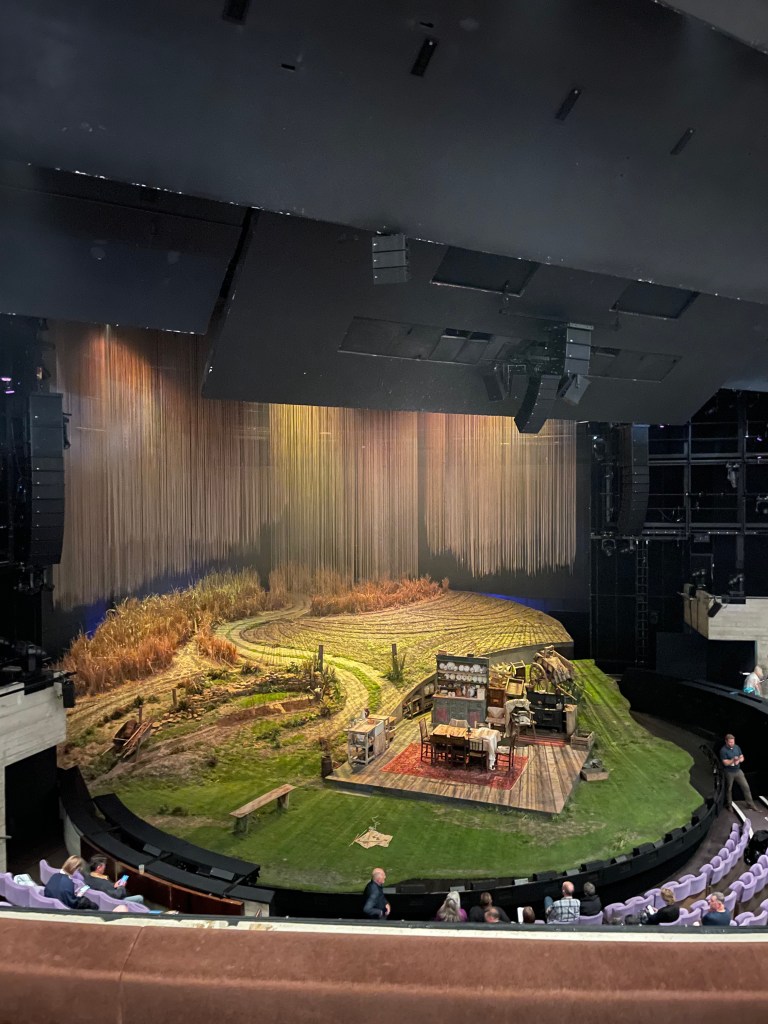
We ended our first whole day with Strait Line Crazy. The play was a beautiful portrayal of Robert Moses’s incredible and tragic story, leading to his eventual downfall after a lifetime of being stubbornly blinded by his own ambition. It was interesting watching British actors tackle American dialects and seeing how they all compared to each other on stage. Surprisingly I was least impressed with Ralph Fiennes attempt at an American dialect, but this did not distract from his incredible performance. Fiennes acting displayed a gradual and controlled decent of a character who’s obsession with power and control lead him to his lowest point as an over worked man, hated by the public, and left all alone without his friends and the eventual loss of his wife. I enjoyed the minimalistic use of the stage and set and enjoyed watching the play in a thrust style theatre. Having just performed in a thrust production myself it was cool to watch actors of such stature approach the same challenges that I had when dealing with a thrust, challenges such as strategically using the whole space and always having an actor face a side of the theatre at any given time. 

The Tate Museum

Home to one of the largest collection of modern art The Tate museum is a must see location. Its many displays of art will have something for everyone. I came across several displays of art that I enjoyed one of those was requiem NN 2006 – 2013. This piece of art was created around the “No Names” bodies found by the river. The specific river it was focused on was Magdiaera river in Colombia. The art show to images that are several years apart. As you moved and looked at the display the art would change back and forth between the two images. The way the images transform brings me to think about how time effects things and how it changes. Another view that I took from the art is that there is always more than on way to see the same thing or story. The following photos are of the display from two different angles showing the two views.

In the Tate Museum I found a room that I was really fond of. It was a room filled with many visual illusions, I have always like how it messed with your head. The art making things move when they are really not and many other effects. I have always been interested on how things like this effect the mind. One of the displays pulled my attention and it was a line based piece of art that made it hard to focus on what was 3d or not when looking straight on. I haven’t really come across something like this and found it interesting. I do not recall the name of the display but have included a photo.

The other piece of art that I want to talk about is the Display “then and now 2016” by Lorna Simson . This art is made from two found photographs after screen-printed and worked by hand. This art shows how ”The police violence against African American citizen continues to dominate the headlines.” I am fascinated by the way the ink looks pulled vertically connecting the two photo that are in black and white. The composition and design is what pulled me to this piece of art. There are so many things in the Tate Museum and even someone who may not be interested in modern art is sure to find something that they may like. There was a Mirror Room display that sounded interesting but required tickets to get in, maybe if I have time later I may revisit and continue exploring.