After spending a few weeks in London, I have been lucky enough to venture over to Borough Market twice. The first time, I had a BBQ wrap and then a German dessert: Bienenstich. The second time, I finally achieved my goal of getting a toastie! It was definitely more than I expected, as the food stand put onions in with the toastie too. After eating that too quickly, I managed to buy not one, not two, but three desserts (yes I did over-do it, but do I regret it? No.) Both of these times were so much fun, as the food was delicious. I really think I am going to go back for a third time before we leave London and get the bienenstich one last time. The caramelized nuts on top made it absolutely incredible.
I will always remember the experiences I have had in Borough Market. I compare it to the overwhelming feeling you get at a mall food court where there are so many options in front of you that you can’t decide, but this is amplified to where there are swarms of people trying to decide what they want as well but shoved into a smaller space with more options to choose from. Overwhelming? Yes. Worth it? Yes.
My Toastie!
I think it is absolutely incredible that within the city of London, one can find just about any type of food they want from many cultures around the world (besides cheese dip of course for reasons I have yet to figure out). It has been rewarding to go out of my comfort zone with different restaurants and try new foods that I normally would not have the opportunity to try back at home.
2 of my 3 desserts
Last night, I went to Patinga and tried Nigerian cuisine. This was my first time trying this type of cuisine, and I absolutely loved it. I ordered a coconut rice dish that had shrimp and goat meat in it. Then for dessert we ordered fried plantains with ice cream and Nigerian donuts. (An aside: I am so sorry Taylor and Kath that I dropped one of the donuts on accident. I am a clutz.)
Coconut rice
I have loved every second of the trip, as I am able to try new things: I am even trying Bao tomorrow in Chinatown. London is definitely unique in its own right, as their fish and chips are a local staple, but also for their plethora of food options that come from across the globe! It must be nice for the locals to have so many choices right at their fingertips, but it does make me wonder if locals try new restaurants regularly or if they have a few that they always go to.
It has been nearly a week since I went to see The Glass Menagerie starring Amy Adams. I am glad I gave myself time to think about it and saw other plays before beginning this blogging process. I was overall disappointed in the production and directing of the play and just wanted more out of the experience. The accents were spot on to my American ear, but the setting did not come to life for me. It was surreal seeing Amy Adams because she is in so many fantastic movies but even her character did not bring what I wanted it to. Tennessee Williams is a classic southern writer, but I do not think the director flushed out the background of St. Louis and the mother’s past Mississippi roots. I cannot think of anything that really clued me into her history except her strong accent.
Soon after The Glass Menagerie, I saw The House of Shades and The Corn is Green. These are British plays and I enjoyed them more than the American production. Although the words could be hard to understand, the set and various characters made the location seem significant. I did lose some implications because I do not know a lot about British politics which were heavily debated in The House of Shades. I really enjoyed how Emlyn Williams was an active part in The Corn is Green. It made me wish that The Glass Menagerie had put more time into fleshing out the idea of a memory play and the biography of Tennessee Williams. I am not sure of the director’s background, but I wonder if something from the American play was lost in the British production. In the same way I struggle to understand British accents, I also heard others complain about not grasping American accents.
I have spent so much time studying The Glass Menagerie and analyzing what Tennessee Williams put of himself into the play. If I had not known going in that it was semiautobiographical, I do not think I would have known of his history in the south and his rough family environment. The tone of Old Tom did not even feel particularly worn out and regretful. All in all, the set was relatively boring and the space between the actors left the dialogue feeling distant.
Even though I was disappointed by this play, it made me appreciate the plays I saw after more.
Like everyone else in the theatre abroad program, I was pretty underwhelmed by the Glass Menagerie, however I think I liked it more than a lot of my classmates. The play overall felt very low energy and I was very board by physical choices made by the actors. What I saw was a lot of scenes where characters stood 15 feet apart from each other and recited monologues back to one another with their arms by their side. Despite this the script itself is so amazing and the actors are so in the zone that the play and its many conflicts did entertain me. The whole cast truly embodied their characters, personally I just wasn’t thrilled with the choices that were made for those characters and I expect that my problem with it was more of a directorial issue.
This quintessential American play to me felt very British. Each member of the Wingfield family had a different accent and Tom’s actor often struggled to keep his. The lighting was very dim, and the main stage was a minimalist design which is a regular tendency of British plays I am learning.Truthfully the play didn’t feel like Missouri or America at all. It sort of reminded me of the old transatlantic style television which may have been an artistic choice but not one I cared for being that its based in fiction. I feel that the play being American affected the production in a way that made the acting and show as a whole feel awkward and forced. When I compare this play to the British plays I’ve seen here, they feel much more authentic and natural.
As an American I sometimes I struggle to understand the language used in British shows but after a little while I typically adjust and enjoy their shows like I would any other American show.I don’t know how British people respond to American plays really, I originally assumed that Americans were perceived as dumber and more obnoxious people, which may still slightly be true, but since arriving in London and seeing it for the incredibly diverse city that it is, I think the mass majority just see each other as equals with different cultures that can be respected and enjoyed.
The word that stuck out to me after seeing The Glass Menagerie with Amy Adams was “impersonal.” Memory should feel incredibly intimate and present no matter how much time has passed and how hazy that specific event has become. It sneaks up on you, it sparks emotion that you can’t explain, and it stays with you longer than you want it to. Unfortunately, this particular production of The Glass Menagerie, in my opinion, did little to capture that feeling. This production divided the role of Tom into two parts: older Tom, the narrator, and younger Tom, which could have been really effective. Yet, many of my classmates noted that they didn’t find older Tom’s delivery believable. I think, for me, the problem with Paul Hilton’s delivery was that it felt like a stereotype of what a writer in 1940’s America might look like: glasses, cigarette in hand, and a kind of casual arrogance underneath every clever word.
Hilton spends most of the production addressing the audience from a table near the front of the stage as if the character of Tom (a stand-in for Tennessee Williams) is presenting us with a fixed moral or a lesson he’s learned from reflecting on this particular season in his life. Yet, when I read Tennessee Williams’s writing, Tom’s voice sounds less certain. Unlike the production of The Corn is Green that we saw, where we see the character of Emlyn Williams literally question the lines of the past that he is fictionalizing, Paul Hilton’s Tom expresses little hesitation that would give us room to question the memory being given to us. Although I don’t pretend to be an expert in the field, as someone who studies writing, I do know that writing about memory comes with a level of responsibility. You question yourself and your heart as you decide how best to sketch people in your life and the things that you’ve experienced. I wanted to sense that Tom was struggling to render and understand the scenes that we were witnessing. Instead, this particular production of The Glass Menagerie presented the audience with neat statements rather than questions to ponder.
A fence around Russell Square Gardens looking green and lovely.
I guess what I’m trying to get at is why this production felt like a surface-level reading of The Glass Menagerie, and on the topic of seeing an American play from the vantage point of Britain, many of the actors’ choices when depicting characters influenced by the South also felt one-dimensional. Ironically, the character that was most heavily influenced by the South, Amanda Wingfield, was also the only character played by an American actress. For me, Amy Adams portrayal felt the truest to what it’s like to live in Southern America. She managed to tap into that sort of overtly hospitable, mothering, attitude that makes me think of the Southern church-ladies that I grew up around. Yet, I wanted the set of the play to reflect this. Most of the Wingfield’s “apartment” was squished around a pitch-black center stage. There were papers, wires, a typewriter, a piano, and other belongings stuffed haphazardly into corners, and my immediate thought was “this is not a Southern woman’s home.” If Amanda brings Mississippi values into her arguably more mid-western children’s lives, then I would also expect a sense of order, beauty, and hospitality to be present in how she presents her home and her belongings. I wanted Tom and Laura to create disorder in an otherwise neat and too-perfectly preserved apartment, but the entire stage seemed cramped and in disarray.
View from the Hampton Court Gardens, or a portal to Wonderland?
On the topic of the difference between Amanda and her children, I noticed that both Tom Glynn-Carney (young Tom) and Lizzie Annis (Laura) would slip in and out of a Southern drawl. Yet, as far as I understand, Tom and Laura were raised in St. Louis, so it was confusing to understand them as Southern. After all, if Amanda’s Southern upbringing functions as a symbol of a slowly disappearing way of life that is in conflict with the world her children live in, wouldn’t the effect be lost if her children were also deeply Southern? Then again, maybe this choice had something to do with tying in Tennessee Williams’s own upbringing. According to his biography on the Poetry Foundation’s website, Williams’s was born and spent his early childhood years in Mississippi (“Tennessee Williams”). Either way, the production at the Duke of York’s Theatre seemed to generalize all of the Wingfields as Southern Americans. I wonder, honestly, if British audiences were able to pick up on a kind of disconnect or if this production seemed indicative of what springs to mind when they picture the American South.
A mural somewhere near the Tate Modern Museum.
The production of The Corn is Green that we saw made me wonder if there are similar inaccuracies about Welsh and British culture that I don’t pick up on as I watch this play because I’m American. I was curious, for instance, about the idea of the Welsh language and the fact that Mrs. Moffat, the hero of The Corn is Green, also brings a stronger emphasis on learning the English language with her when she begins to educate the children of a small, Welsh town. Are Welsh audiences offended by the way this play glorifies someone that “educates” Welsh citizens into slowly becoming more English? Do they appreciate the ways in which this play revives the Welsh language through song? As an American, do I just assume that Welsh audiences care more about this than they actually do? I think that when watching plays that are so deeply tied to a specific place or time, there’s always the possibility of misunderstanding the source material when you don’t share the same background as the playwright. However, for me, the Duke of York’s Theatre production of The Glass Menagerie seemed to water down Tennessee Williams’s deeply personal memory play.
Cornflowers and such that I found on the way to Waterstones.
Westminster Abbey is one of the most famous cathedrals in all of Europe. Its where every royal coronation takes place and is the resting place of many important historical figures! The architecture is much more gothic in style than that of St. Paul’s Cathedral that we visited earlier in the trip. While touring Westminster Abbey, I was incredibly intrigued to see the coronation chair that so many monarchs have sat in on the most important days of their lives. Our tour guide Molly said that back in the day, the chair wasn’t protected from the public and was put on display in such a way that people could easily vandalize the relic. She told us that idiot schoolboys loved to carve their names into one of Britain’s most important historical pieces. This fact alone made me burst into laughter because WHAT?!?! Who on earth would ruin this great piece of British history like that? And why would the people in charge of the chair let that happen? You live and you learn, I guess.
Among the important monarchs buried here, many famous authors, scientists, and philanthropists are buried here as well. The graves and memorials that really stuck out to me were that of Charles Darwin, Stephen Hawking, and Isaac Newton. These men were all buried within feet of each other in this little scientist corner of the church. It seems strange to me for these men to even be buried in one of the most famous churches in the entire world as the church on the whole didn’t agree with a lot of the beliefs these great scientists held. Darwin was very adamant that we humans evolved from apes which I am certain the church did not like. Maybe it had to do with his fame. Darwin was an incredibly important contributor to science and with a name that big, the church obviously felt it appropriate to let him rest in Westminster Abbey.
Another little corner of the church where famous people were memorialized was the Poet’s Corner. Here, many famous authors like Jane Austen, John Keats, and William Shakespeare are memorialized for their contribution to literature. These authors aren’t buried in the church but memorialized and honored there. Jane Austen is one of my favorite authors of all time. Her novels are beautiful and highlight women in a way that was almost unheard of in her time. Women were often expected to be seen and not heard. Jane allowed the women of her time to see that they could and should have the same rights and opportunities as their male counterparts. I love strong and powerful women who lift up other strong and powerful women. Jane Austen will forever hold a special place in my heart and it was an honor to see that Westminster Abbey feels the same.
To end the blog, I will leave you with what I thought was the coolest thing in the entire building. BRITAIN’S OLDEST DOOR!!! Until next time, Dru
Today was our first day trip and I could not have been more impressed! The morning started with a train ride to Bath, England. First of all, the train system is so convenient, and America really needs to take notes. Why we are all obsessed with cars and not an incredibly convenient form of travel is beyond me. Anyways, the train ride was smooth, and I sat by my best friend, so everything was going great so far! My only complaint for the train ride was the fact that the train Wi-Fi wouldn’t let me stream music and I only had seven downloaded songs on my Spotify, and they were all incredibly moody and sad which made me laugh simply because of course I would only have those stupidly depressing songs downloaded. After about an hour and a half of those seven depressing songs on repeat, we arrived in Bath. The town itself is a picturesque view of small-town life in the English countryside. We planned on visiting the Roman Baths, which in itself is so cool, but there were so many other charming things to see alongside the ancient washrooms. We first walked down a quaint little street lined with cute restaurants and a charming bookstore. I ended up buying Pride and Prejudice by Jane Austen because it is my favorite movie and I just never got around to reading the book. (Mom and Dad if you’re reading this… yes, I needed the book and I won’t apologize for buying the more expensive copy because it had a cuter cover.
pretty cover 🙂
Love you!) Jane Austen also lived in Bath for a time, so I had to buy it in the spirit of the beloved author. Adjacent to the bookstore was a beautiful little square that was lined with benches, allowing for street performers to gather audiences. There was one particular street performer I practically fell in love with. He was playing La Vie en Rose on his trumpet and I nearly swooned. Plus, he was very hot and had nice shoes on, so it was inevitable honestly.
The Roman Baths were the main reason we came to Bath, so I guess I should stop talking about the hot trumpet player and start talking about history. I love history and will watch a good historical documentary any chance I get. What I am discovering about this study abroad trip is that it is much more exhilarating to actually walk through the said history myself. 2000 years ago, Roman people were cleansing themselves in these community baths and now in 2022, I was walking through them. CRAZY RIGHT? Back then, the Romans obviously didn’t have water heaters or soap as we do today. They cleansed themselves with the use of naturally occurring hot springs and scented oils. This makes one question how good the people smelled back then. However, if all of them smelled, did any of them smell? Food for thought.
Walking through the museum and learning about how and why the Romans bathed here really fed my brain all of the good historical delicacies it desired. The baths were incredibly well preserved and a beautiful example of Roman innovation. There were separate rooms where people would undress, hot rooms, cold rooms, and pools where people would gather and heal their bodies in the natural spring water. I will admit, the spring smelt like a stale fart in some places, but that’s just because of the sulfur. There was one exhibit that really caught my attention and that was the exhibit of plates found at the bath where Roman citizens would write down curses or complaints they had and give them to the goddess of the spring Sulis Minerva.
As I read the curses, I had to laugh because some of them are just ridiculous. Most of them are about theft in the bath. Not having a slave meant it was always a risk to leave your clothes unattended while bathing. When thefts occurred, people would call on the goddess Sulis to curse the thief. Sulis was the HR department of the baths.
All in all, my experience in Bath was so special and I hope to visit there again! To end this blog, i will attach images of my friend Abby dropping her ice cream on the ground after two licks. I laughed incredibly hard and i thought that these must be shared with the public. Enjoy!
My day started with incredible excitement. It is time for LEGALLY BLONDE THE MUSICAL. Getting ready for the outing, I knew I had to think pink. Elle Woods would expect nothing short of excellence. The only and obvious choice for an outfit was my pink corduroy pants. Dressed in pink and ready to scream until my lungs collapsed, we headed to The Regent’s Park where the Regent’s Park Open Air Theatre is located. We arrived at the park with some time to spare, allowing my classmates and I to walk through the incredible flower-filled park and grab some dinner at the little café by the theatre. After some pizza and a coke, we sat in the grass and took some cute pictures and chatted until it was time to find our seats.
The show was about to begin, and I was about to die from excitement. Legally Blonde is one of my favorite musicals of all time and my hopes for this show were incredibly high. Being in an open-air theatre, I knew this production would differ from others I had seen simply due to the setting being different. The set for the show was less realism and more suggestive and adapted to the space the show was in. When the musical began, I was absolutely elated.
The show opens with all of Elle’s sorority sisters singing, and I was not disappointed. The ensemble for this production blew me away. Elle Woods was played by a woman of color who was STUNNING and also a “plus-sized” queen which hit every expectation of Elle I had in my head out of the park. The musical itself was incredibly camp and I had a blast. The cast was so inclusive and featured trans women, plus sized icons, and a blended cast of all races. Here in England, that is not a new or crazy concept. However, America is just getting caught up on the idea of inclusivity in theatrical productions, so I was incredibly pleased with that aspect of the show.
The musical strayed from realism and stayed with the heightened exaggeration of the show, which I loved. It was a different take on Legally Blonde and I had the time of my life. As an avid fan of the musical, I was delighted by the choices made and could not have asked for a better experience.
Overall, this production made me feel a great sense of nostalgia and I made so many great memories seeing a beloved musical surrounded by great friends.
The only event scheduled for this day was St. Paul’s Cathedral, one of the city’s premier landmarks and a significant center for religious life for over a thousand years in its various incarnations.
Molly, the same woman who educated us during our bus tour, led us on an excellent tour of the church’s exterior, main floor, and the basement.
As previously implied, St. Paul’s existed in many different configurations across time. The first three structures dedicated to the titular saint all stood and fell before 1100 CE, and the fourth structure, colloquially known as “Old St. Paul’s,” was a massive Gothic cathedral, larger than the Wren rendition by a significant margin. I seem to remember Molly mentioning it as 600 feet tall at the spire, and describing how the building was so long that people opted to go through the building instead of going around it! It burned down in the Great Fire of London, and the current church, designed by Sir Christopher Wren, has stood proudly as a proud member of the St. Paul lineage since its completion, though World War II left it with a few battle scars here and there.
The interior was a gorgeous place, filled by light spilling through the windows and warming the marble floors and columns. Sound constantly reverberated through the giant, mostly open space due to its high, vaulted ceilings; thankfully most people visiting kept themselves quiet (our group included) so the echoes never became a problem. Molly led us all around the cathedral floor, informing us about the long history of the site, and explaining the significance of many of the tributary statues; much the same was done in the basement area, which, despite being a good deal dimmer than the main floor, felt warm in its own way and contained memorials to many more important war heroes, politicians, and scholars.
We parted ways with Molly after ascending from the basement, and I decided, as well as many of my other compatriots, to make the climb up to the Whispering Gallery, a place in the cathedral’s dome where, due to a unique feature of its construction, you can hear the whispers of someone standing g directly across the gap from you. Unfortunately, we didn’t realize that the Whispering Gallery was closed to the public until we had already started the climb up, and we had no way of getting back down other than making the significantly higher climb to the Stone Gallery and taking the down stairs from there. Some of the stretches of staircase were steep, narrow, or both, and I had to fuck my head on more than one occasion. When the option for escape was finally in reach, some of the group took a moment to rest and enjoy the breeze before heading back down. I, along with Cath, Maggie, Margaret, and Austin, chose to climb to the highest publicly available point on the cathedral. My reasoning was that, if I had come all this way, I might as well go all the way. The second set of stairs felt more cramped more often, and I hit my head on a ventilation shaft and a stone overhang as I rolled up my sleeves and huffed and puffed my way to the top.
This was far from the only doorway not built for the modern man!
All of the labor was well worth it when I made it to the Golden Gallery! It might not have been 600 feet like Old St. Paul’s, but 85 meters (278 feet 10 inches) is nothing to scoff at! The view was absolutely gorgeous; the whole city stretched out before me as I made my way around; the breeze cooled my face and arms after the work they had done to bring me there. I took some fabulous photographs (and had a few taken of me) before making the trek back down, speaking with Margaret about self-improvement and personal goal-setting along the way.
The group left and the individual members did their own thing after that. I wandered around (though at the time of writing, I cannot recall whether this was because I got lost trying to get back to the hotel from Holburn tube station or because I chose to amble around St. Paul’s for a while) until eventually making my way to the hotel and resting before I had to leave for the show I planned to see that night.
In hindsight, I almost certainly rested for a bit too long. The evening decided to whip me, for lack of a better word. I took a bit longer than I intended leaving the hotel, and I greatly underestimated my normal travel speed and how far away Holburn tube station is from the hotel. I ended up running to get there, but I made it in time to maybe make it on time. But no, my efforts were for naught! Because the app I used to track my tube route gives you what direction you’re supposed to go for your second station, but not the first! You know, the one that everything else hinges on?! So I’d gone to King’s Cross before I realized I went the wrong way, and then I got off and got back on the Piccadilly line going the right way. By the time I got off at Charing Cross, I was already late, but I hadn’t fully given up. But then I had to find the place! I had to frantically fiddle with my settings like a caffeinated squirrel to get Google Maps to work, and even then it didn’t show me where it was completely. I ended up toward the Embankment station, realized I was going the wrong way on Maps, and when one of the ushers outside the venue for Cabaret asked if I was alright (or something along those lines), I asked him where the Charing Cross Theatre was. I’d been legging it the whole way off the train, by the way. Turns out, it was UNDERNEATH the street level, down this little alley between buildings that anyone could’ve missed! I got there at about 7:45, and they couldn’t let me in.
I must say, the front of house people were absolute saints! They saw me panting like I was about to die, and they actually helped me out. They let me watch the first act on a screen near the bathrooms and dressing rooms (which was there for them to know when certain costume and prop handoffs were supposed to happen). One lady in particular went out of her way to find me a chair and give me a cup of water! Googling a synopsis let me know the gist of what I was missing, and at intermission, I went straight to my seat and got ready for a treat!
The way the set was built around a pre-existing balcony space meant that I couldn’t see some things that happened at the highest level on one side of the stage, but what I got to see was stupendous! The acting was good, the Spanish accents were nice and consistent throughout, and the singing and dancing was excellent! Some of the performers played instruments and danced at the same time! The lighting transitions were buttery smooth, and good mother of God the fight choreography was as extravagant as I’d expected and more! Maybe it was because it was the last show, but the energy from the cast was palpable, and it made the performance inherently engaging. This was reflected in the audience energy during final bows and the post-bow medley of songs in the show.
The staging was not what I am used to, but it was implemented very well.
To summarize, missing the first half of the show put a huge damper on my spirit. But getting to witness the second half properly brought my spirit back tenfold!
Wednesday marked another day trip outside of the jolly old city of London, and this time I got to come along! After a pleasant, roughly thirty-minute-long train ride, our group disembarked in Richmond upon Thames and made the short walk to the beautiful Hampton Court Palace.
Shawn discussed some of the history of this royal residence during a class meeting, so I knew ahead of time that the current interconnected building is an amalgamation of sorts between Tudor and Baroque structures. But I did not quite absorb what that meant until I finished up in a room from one audio tour, then walked into a connecting room with completely different architectural features. It might be jarring or disorderly for some, but I rather like it! It makes the place far more interesting than it might be otherwise and, silly though it may sound, I think it makes it a lot more fun!
Whenever we all got our headphones and audio tour packs, the group scattered like roaches when the lights turn on, so, as per usual with these sorts of historical tours, I embarked on my own journey. After taking some reference photos of the Clock Court (because of course my first thought in a new historical place is “I wonder if I could recreate that with stagecraft”), I started on the tour of King Henry VIII’s Apartments, which, despite the connotation of the name, consisted of a lot more than his private living spaces.
The first and foremost (at least in my mind) was the Great Hall, prime location for the meals of courtiers and merriment on special occasions. Shakespeare and the Lord Chamberlain’s Men (later the King’s Men under the royal patronage of King James I) performed in this room on a number of occasions, and my fondness for the Bard required me to take photos of every possible surface and structure in the hopes of possibly recreating it all onstage in the future. The wood paneled lower sections of the walls (if you can consider three or four times my height “lower”) were draped in large, elaborate tapestries of Abraham and other religious figures. Apparently, their golden thread once glittered and their colors were vibrant, but centuries of aging has understandably dulled them. I had a delightful chat with the attendant on duty at the time about the history of the building and learned some facts that were not listed on any of the placards. For example, the pretty stained-glass windows were not originally that intricate, but during the Victorian Era some panes had minor damage that needed fixing, and the people responsible for doing so thought “Instead of restoring only what we need to, why don’t we replace every one of them with something more ostentatious?” I also learned that King Henry VIII characteristic obesity did not set in until later in his life. For his youth and most of his adulthood he was a strong, athletic man, so much so that he wore hose that were cut short so he could show off his calves! Overall, I think this room’s aesthetic and character was my favorite out of the entire estate. It felt so lived in, and like such a place of occasion, that I could see the courtly goings-on vividly in my imagination.
The rest of the Tudor section of the palace suffered in comparison to the first room, but the servant’s rooms and passageways, the Waiting Chamber (or whatever the proper name was for the room where people would wait for the king to emerge from his private chambers), and the hallway now used as the Tudor Royal Family’s portrait gallery were all beautiful and helped paint the picture of courtly life in its time. The Council Chamber stood out above the other normal rooms because, in addition to replicating the original decoration and furniture, a projection shone onto the meeting table in the center depicted the hands and papers of its members, whose names, titles, and brief descriptions were hung on the back of their respective chairs. That, combined with piped in audio of a simulated Council meeting regarding one of King Henry VIII’s many marriage disputes, made the space feel palpably real (though I wish it were not so dark that my pictures turned out poorly).
The final portion constructed under the Tudors was the Chapel Royal, a location of various christenings and the seat of King Henry VIII’s religion practice and his religious control over the Church of England he would eventually found. The room was courageous, with the ceiling, oddly enough, being extravagantly decorated with blues and golds and symbols of heraldry and authority. I would share photos of it here, but I followed the posted signs (unlike a few American and British tourists) and restrained myself.
Next came the Georgian section of the castle, the source of the Baroque-Tudor stylistic clashes in the building’s architecture. The audio tour had guests travel through the rooms as a courtier would, coming closer to the monarchs and growing higher in privilege and authority with each passing doorway. I learned a lot about King George I, his son, the eventual King George II, and their respective spouses, as well as their myriad familial issues. But for all of that, they were remarkably good monarchs, generally staying out of Parliament’s way and not interfering with the lives of the common people. The death of King George II marked the last royal to reside at Hampton Court Palace for quite some time, his grandson, King George III, opting to live elsewhere.
With time before our scheduled return train getting low, I set out for the exit through the gorgeous gardens, unexpectedly running into Margaret, Leah, and Grason, and taking a slight detour with them to try our hand at the hedge maze and figuratively stopping to smell the roses.
Today was a delightful departure from the city of London, which, though fascinating, can feel cramped at times. And though I am currently nursing sunburns due to the visit, I would not hesitate to recommend it to anyone who wants to try out someplace different!
After what has somehow been both a swift and a slow five days, I am now permitted to exit quarantine in my hotel room! Granted, I am not off the hook just yet. I still need to wear a mask as much as possible while in public for at least the next five days, and it would behoove me to do so for the rest of the trip so there is no chance I end up testing positive again when I head back to the States.
After getting breakfast and eating it in my room, I made a return visit to Watches of Switzerland on Regent Street to look at and try on models I failed to get to the first time. Most of these were more affordable than the ones I tried on initially, though what affordable means in the luxury watch market is very different to what affordable means in other product markets. There were some very classy options from Longines, and I took a second look at TAG Heuer and Grand Seiko models that I previously perused. I received excellent, friendly service from a sales associate named David, who enthusiastically talked to me about watch styles, watch complications (extra functions other than the typical twelve-hour time-telling) and was overall a stand-up guy.
Not much else of note happened between then and the tube ride over to the Almieda Theatre. I recall being uncomfortably sweaty by the time we got there because it was such a warm day and I had worn more formal clothes to the watch store, but that cleared up around when the show started. The play, The House of Shades, follows a working class (potentially upper-working class) British family through its dysfunctions, divides, and deaths from the 1960s all the way to 2019. We had been given a trigger warning by Shawn and Casey for various sensitive subject matters via group chat, and there were notices regarding those same subjects outside of the auditorium. Needless to say, this play, despite its moments of hilarity, dwells in the grim, tragic, and traumatic (appropriate, given its Greek tragedy inspiration), and none of which makes for a fun or pleasant night at the theatre.
But none of that makes for bad theatre either. The script contains some of the best written dialogue of anything I have ever read, novels included. The interplay feels natural, and I imagine the words on the page would be brimming with personality even without voices to speak it aloud. Though, that may not be entirely fair to the actors, who had spectacular ability and presence in their characters. Their immersion in their respective characters was so deep it bordered on dangerous; considering the things that they do, feel, and say in this play, it impresses and amazes me that this production can sustain itself at this level of realism for longer than a few days.
I liked the set well enough. It did what it needed to do, felt liked in by the characters, and yet it allowed for technical theatre tricks and nondisruptive entrances by declining to give the family home physical walls. The sound effects and music from one to another smoothly, and all seemed appropriately selected as well. That smoothness goes double for changes in lighting. I must say though, I did not like the projections they used to display the years as the play progressed because my seat location (in the center but towards the rear of the stalls) relative to the dress circle seating above kept me from seeing them. I feel the same way about the closed caption screen hung above in front of the downstage edge of the stage; I found myself wondering how many seats they could actually fill during enhanced access performances if every person seated needs to see the screen. That said, the fact that the Almieda even had a screen like that was a first for me, andI would love to see that done in more places.
I mentioned earlier in the post, but I have to touch back on the sensitive content in this show. It is intense, particularly in the second act, and what little buffer the jokes or occasional tenderness provided did as little as friction against the tracks does to slow a runaway train. It was emotionally draining as the first act trickles to a close, and the second drove me into the realm of exhaustion, if the shakiness in my legs when I got up to leave was anything to go by.
Prior to any discussion about the play with my fellows, I think this play squanders the power of the trauma it bombards the audience with. I feel like the play does not have a message or meaning; if it did, it was buried under too many layers of thematic gunk and traumatic debris to find. The list of themes in it is absurdly long. Domestic abuse, violence, the politics of economics, Us vs. Them, manhood and womanhood, generational trauma, cycles of abuse, motherhood, abortion, the extent of one’s responsibilities to oneself or others; and those are only the ones I can remember a few days later! It is TOO MUCH!!! I could not take five steps down a certain thematic track without being derailed and placed on another one! By addressing so many things with such equal strength so frequently, I feel like the play effectively addresses nothing (assuming, of course, that addressing a topic was the purpose of the play at all).
This play rattled me, hard. The entire trip back to the hotel I felt as though I had been kicked in the head and my brain had yet to stop spinning from the impact. It made me feel things I have not felt in a long time; maybe even some things I have never felt before. It is, without question, the most powerful piece of theatre I have ever seen, and the strength with which I hate it (or perhaps only fear it) surprises me.


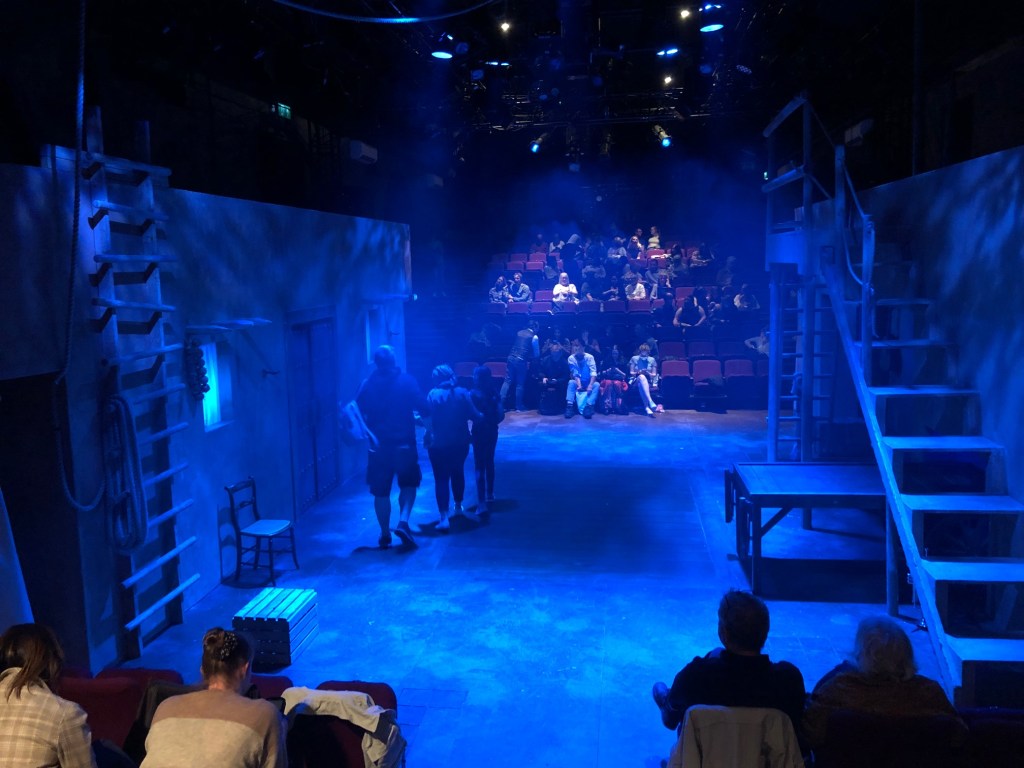


 Theatre in London U of A