#6 Cake Was Enjoyed. I Didn’t Die. Win, Win.

Borough Market.

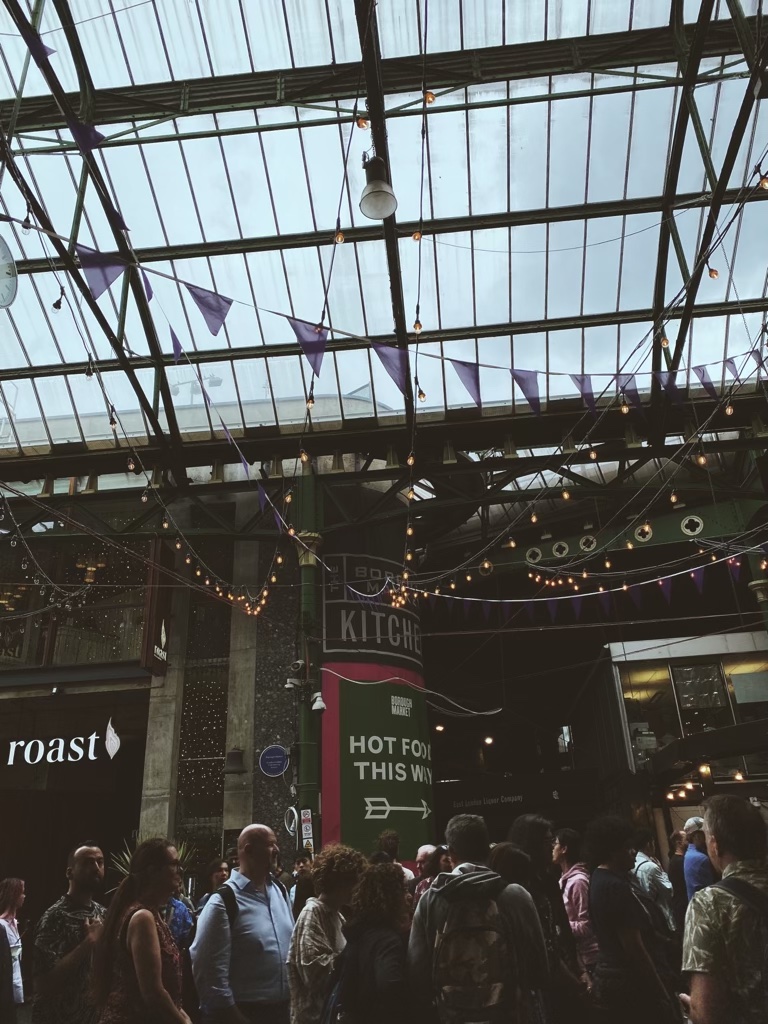
Burough Market has an entirely different vibe than Spitalfields. The pace at which crowds wander through is a bit more frenzied, a bit more rushed, and in general, more goal oriented: the goal being lunch. Everyone is hangry, and there is no time to doddle. My first stop took me to a fruit stand selling fresh-pressed juices. The cups of juice were literally sitting amidst gorgeous piles of the fruit that they were made of. I opted for watermelon, which was lovely but a little homesickness inducing. It made me think of those oppressively hot Arkansas Fourth of July’s where the day stretches on a little longer before finally giving in to the dark. Part of me wanted to be sitting in a flimsy, fold-up chair watching fireflies rather than walking through a busy street. 

Watermelon Juice!

            I can’t always eat adventurously because I have a gluten sensitivity (womp, womp), but one goal that I had for this trip was to find some allergen friendly fish and chips. Situated at the bend of a narrow intersection at the edge of Burough Market was the loudest, smallest fish and chips shop you’ll ever find. The words “Fish! Kitchen” glowed as an unnecessarily self-explanatory beacon in the distance. Every order was a yelled relay between cook and cashier with little reminders to help the two cooks keep-up. Yet, they still managed to get order after order out in just a couple of minutes and for the correct customer. I stood back a little to watch the rhythm of how they worked. As a barista, something about the dance that people in the food service industry do every day to get through the rush is fascinating to me. At “Fish! Kitchen” it went something like this: 

Cashier: (Looks searchingly through the crowd for customers. Asks for their order before they have too much time to think about it.) “What d’ya want, love? Wheat free, sure. You know we can’t guarantee…”

Head Cook: (Raises eyebrows imploringly. Spins. Batters a piece of fish to toss in the fryer. Looks again at cashier as if to say, “yes, and?”)

Other cook: (Spins. Fills five cups with mushy peas. Turns to check the steadily bubbling cod that the head cook has just forgotten.)

Cashier: “Gluten-free Haddock!!!” 

Head Cook: “Did you tell her that we can’t guarantee…..?!”

Cashier: (to customer) “We can’t guarantee that it’s allergen free.”

Cashier: (yells across fryer) “She said it’s okay!!!”

Head Cook: (yells back across fryer) “She said it’s okay?!”

Cashier: (yells once again with the barest hint of an eye roll across the haze of steam gathering over the fryer) “She said it was okay!!!!!”

Other cook: (Boxes orders and hands them to customers. Looks back at head cook concerned. Fills five more cardboard jars with tartar sauce. Triple checks a piece of cod in the fryer.)

Head Cook: (Listening to another order) “No! No!” 

Head Cook: (Waves hands desperately like he’s in a movie theatre trying to catch the attention of a friend who snuck in late.) “No more haddock!!!”

An unreasonably cute cardboard tin of mushy peas.

            Both my order and the next customer’s order were taken and made within the span of about a minute with just enough time for the guy next to me to ask, “you get the haddock?” I nodded. He sighed a small sigh of defeat, or maybe resignation, and looked down at his shoes. “Looks like that was the last piece haddock,” he said, and we both stood there awkwardly until a gleaming box of fish and chips was slid across the counter. I trailed past the clatter of the fish and chips shop and towards the outer perimeter of the market. Everything was quieter here as the lunch and dinner stands were replaced by small booths of pastries. I managed to find a small stand run by the “Free From Bakehouse” that sold allergen free sweets, and snagged a slice of Victoria Sponge and Passion Fruit Cheesecake. Oh my, that Victoria Sponge did not disappoint. I don’t think I’ve ever had gluten-free cake that’s as light as that was. The fish and chips were pretty miraculous too even though I forgot to order tartar sauce. Overall, the food that I got at Burough Market was probably the best that I had on the trip. Even though I didn’t get to branch out into different cuisines, I was happy to have found some British classics that accommodated my dietary restrictions. 
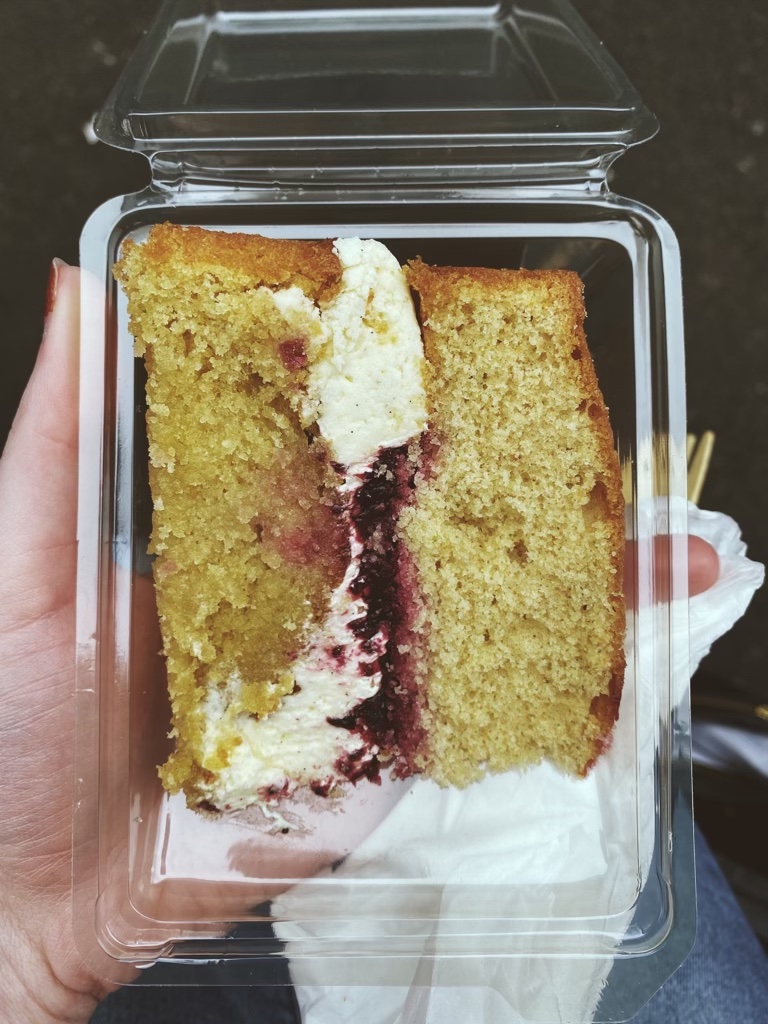
Glorious Victoria Spongecake.

Final Score

Watermelon Juice: 10/10

Fish and Chips: 8/10

Mushy Peas: indifferent

Victoria Sponge: 12/10

Passion Fruit Cheesecake: 9/10

Back again soon,

Kath
# 12 The Ups and Downs of Fringe (ahem…Lift)

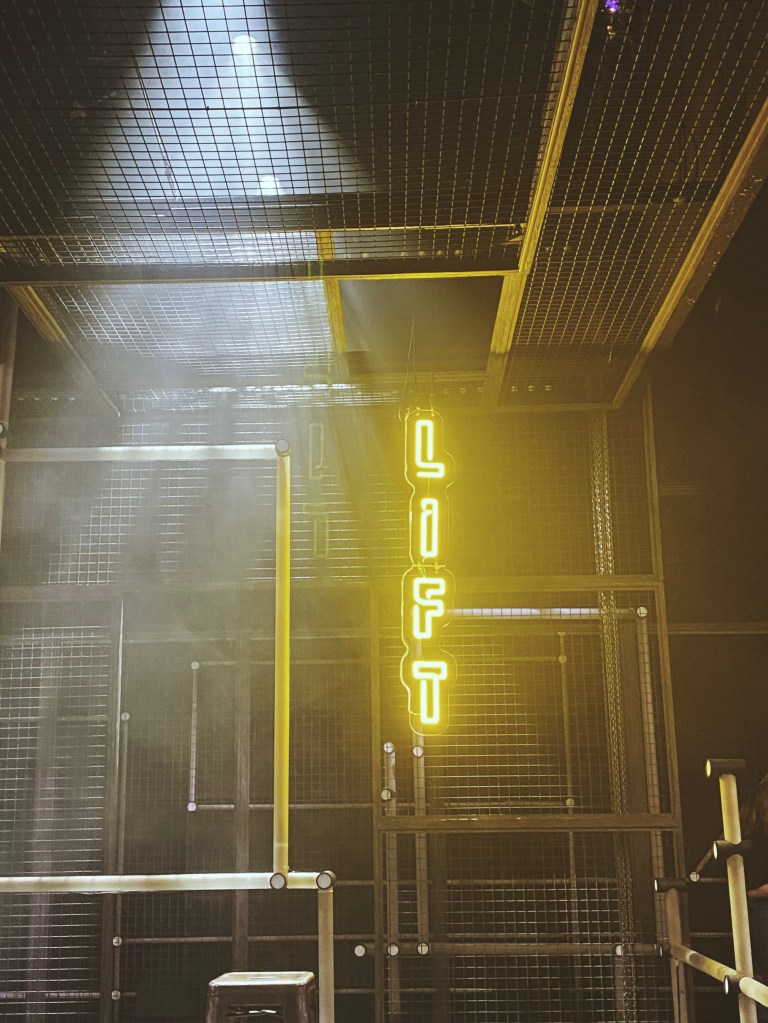
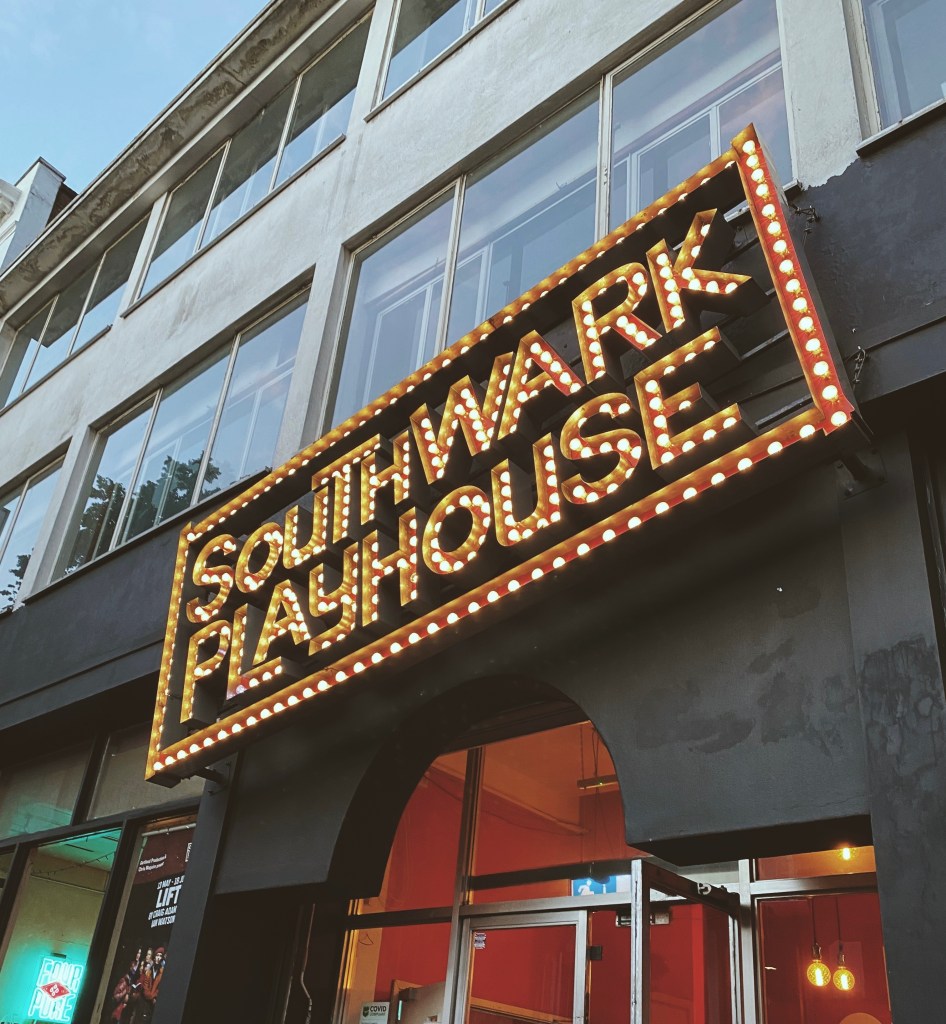
Fringe theatre is something that I have very little experience with, but seeing Lift made me curious about how other fringe shows make use of small spaces. The Southwark Playhouse had a very intimate, community-oriented atmosphere. Even the waiting area, situated in a kind of L-curve surrounding the bar, allowed for seating that encouraged conversation between strangers. It still surprises me, somehow, that theatre is as common as a source of entertainment in London as movie theatres are in America, and so much so that it can feel laidback and familiar in spaces like this. Something that I liked about Lift was the use of color. The set itself was little more than a few railings on an otherwise empty stage. However, each time the point of view between characters would shift, the lighting would switch from green to blue to yellow etc. I’m sure part of the simplicity of the set design is due to the necessity of working with a smaller budget. This use of color as a device was interesting because it would change the cast of light within the whole room and across faces in the audience. 

However, without a concrete set it was difficult to distinguish between characters. The whole premise of Lift seems to be that the people we come in contact with every day are reflections of ourselves. In other words, the stranger next to you in the elevator contains multitudes of stories and thoughts just as human as your own. Consequently, many of the characters shared the same name (Sarah, Kate, Angel, Gabriel), and their stories all drifted together, which made it really difficult to figure out what was going on. For most of the show, for instance, I assumed that the Dominatrix character was who the busker was writing to, but apparently it was Kate the secretary? I think? I’m still not totally sure. One advantage of performing a show like Lift as a small, fringe production was that it allowed the vocal performances of the actors to shine. They would drift through the audience on their way to the stage, and it felt like they were gathering us together to take part in what was coming next. Around fifteen minutes before the show started, the character of the busker started playing guitar as if we were all just passersby on a street corner, and for a second, I almost thought we were. For me, this is what fringe theatre succeeds at: building a community from the audience. Even if Lift lacked clarity, it did manage to engage me as a viewer. 

On the other hand, I felt that Girl on an Altar would have benefitted greatly from a larger budget/production. The play itself, a retelling of the myth of Clytemnestra, was largely told in monologues to the audience where the characters would recount events that happened off stage. The death of Clytemnestra’s daughter, for instance, happens entirely through the words of Clytemnestra. We watch as war, death, sacrifice, and the history of her life with her husband pass across her face. Yet, the stage itself contains little to involve the audience in this narrative. There is no altar in the distance as the battle rages, no army, and little representation of the prison that Clytemnestra is eventually cast into. Instead, the stage consists of a bed, a pile of ashes, and a dark room whose door opens from time to time during the play. 

This isn’t to say that the space in Girl on an Altar wasn’t used in a clever way. To be able to tell a story as broad in scope as Agamemnon and Clytemnestra’s and with such a small cast was impressive in itself. However, despite my enjoyment of the ways in which the character’s monologues mimicked the oral storytelling devices of mythology, this style of narration did grow confusing after a while. I also would have preferred the literal and metaphorical distance that a bigger production would have provided. The scenes of abuse seemed even more real and raw in such a small auditorium, and I wasn’t exactly prepared for it. While I liked how fringe productions that we saw engaged with their audiences, I can understand how things like budget, the size of a cast, set design, and lighting can make or break the reality of a moment. With productions like Girl on an Altar, the actual material seems to work better on a bigger scale. 

Victoria and Albert Museum, hey Amy pt 2

June 16th, 2022

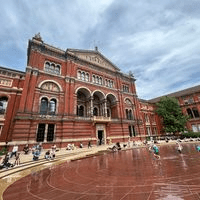
With our last day in London being today, I was excited to start the day off at the Victoria and Albert Museum. I remember passing by this museum on our coach tour on our first day here, and I was excited to find out that we would be coming back there! 

Ballerina outfit similar to Amanda’s Southern Belle gown

Going through the Theatre and Performance exhibit, one of the first pieces that caught my eye was the white ballerina costume and pink flower crown that was shown in the room dedicated to the ballet. When seeing this, I immediately thought of Amanda’s character in The Glass Menagerie. While Amanda and a ballerina seemingly do not have much in common, I believe they carry the same core commonalities. A ballerina is supposed to represent grace, elegance, and femininity. Growing up with a mom who was a ballerina herself, I know that they are supposed to be poised and controlled at all times on stage.

This directly compares to Amanda from The Glass Menagerie, as she is a Southern woman who holds the same values. Victorian in character, Amanda cares about her appearance, and the audience sees this characterization come alive when there is a costume change, and Amanda comes out in her long white Southern belle dress, as she strives to impress Jim, the alleged male caller. A dress that is definitely similar in style to this ballerina costume. Both the ballerina and Amanda are performative in nature, as both are representative of larger groups of women and how these groups appear to others as well. Whether on stage dancing or living a life true of Southern values, the performance of both types of groups cannot go unnoticed. It is important to notice this similarity, as women themselves are expected to present themselves in an idealized way which is heightened through how the ballerina and Amanda are presented. 

After visiting the museum, I attended the evensong at St. Paul’s Cathedral. I have been meaning to do this one day for the entire trip, but I finally got around to doing it, and I am glad that I did. It was quite remarkably one of the most beautiful things I have ever been to and heard. I will definitely remember the service and how I felt there for a long time to come.

London, you have been a dream. See you soon Stratford-Upon-Avon. May you have a tesco meal deal too 🙂

-Maggie Martin

The Mousetrap

June 17

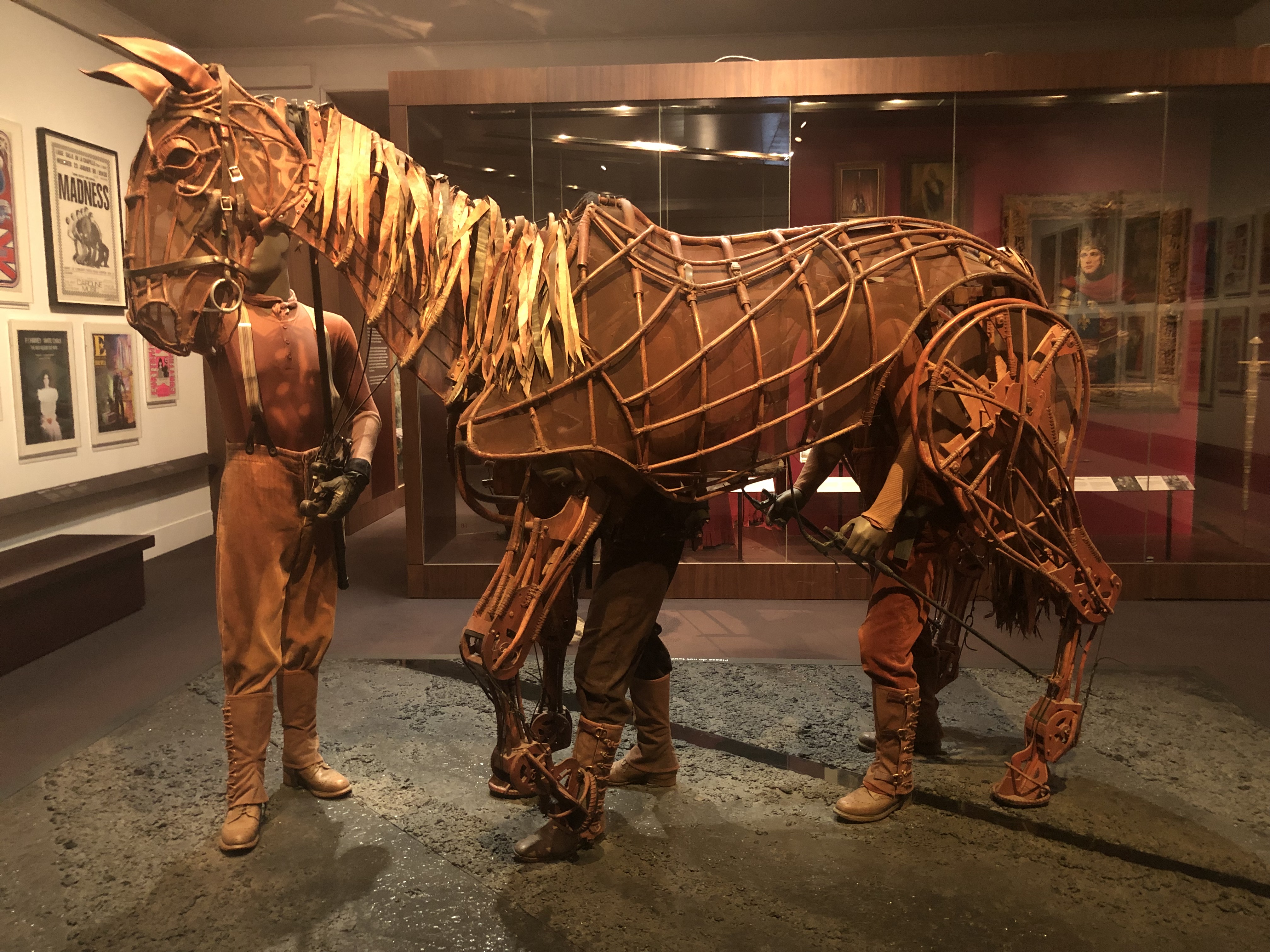
Today I got to visit the Victoria & Albert Museum, which is the world’s leading museum of art and design. It is home to millions of objects, ranging from portraits, jewelry, and artifacts, spanning over five thousand years of human life and creativity. Within all the exhibits is the Theater & Performance collection; full of incredible and historical performing arts artifacts. While walking through I saw amazing pieces of theater history, like the horse puppet from War Horse, Lola’s iconic red dress and boots from Kinky Boots, and platform shoes worn by Tina Turner herself in 1975.

Silk programme for the 2239th performance of The Mousetrap

But one object stood out in particular. Here is a Silk programme for the 2239th performance of The Mousetrap. This stood out because, not too long ago, I saw The Mousetrap and was at the 28,688 performance. It is insane to think that there have been 26,449 performances since this show was first premiered back in 1952 and when I saw it a mere couple of days ago. Within that time frame, the world has gone through a second world war, people made it into outer space, and the internet was created and changed the world. It is also quite fascinating to realize that this show has been around as long as Queen Elizabeth the Second has been the reigning monarch. And just like her, this show is a part of history.

According to the notes at the museum, this performance of The Mousetrap was done at the Ambassadors Theater, whereas I saw it at the St. Martin’s Theater. This got me into a bit of research about the history of the show. Written by Agatha Christie, The Mousetrap premiered in 1952 at the Ambassadors Theater. Originally called “Three Blind Mice”, the play is about the hosts and guests of the Monkswell Manor, who hear of a murderer on the loose through the radio and fear they may be among them. The lure of the show is, once the show has finished you are then a partner in crime and are sworn to secrecy on whodunit. In 1974, with only about 9,000 shows under it’s belt, the show moved to St. Martin’s Theater, where it has remained ever since, with only suspended performances during Covid.

This programme here is a document of the history this show carries. While it was not used onstage in the show at all, it is a symbol for the presence and significance it had. Written on the programme says ”Saturday, April 12th, 1958” “It thus becomes the longest running play of any kind in the history of the British Theatre.” It also lists the entire cast and company at the time, all written on vibrant red silk. This piece of The Mousetrap symbolizes the records set by Christies play, and the impact it has had as it has maintained on the West End.

Connecting the Dots

Victoria and Albert Museum

June 16th

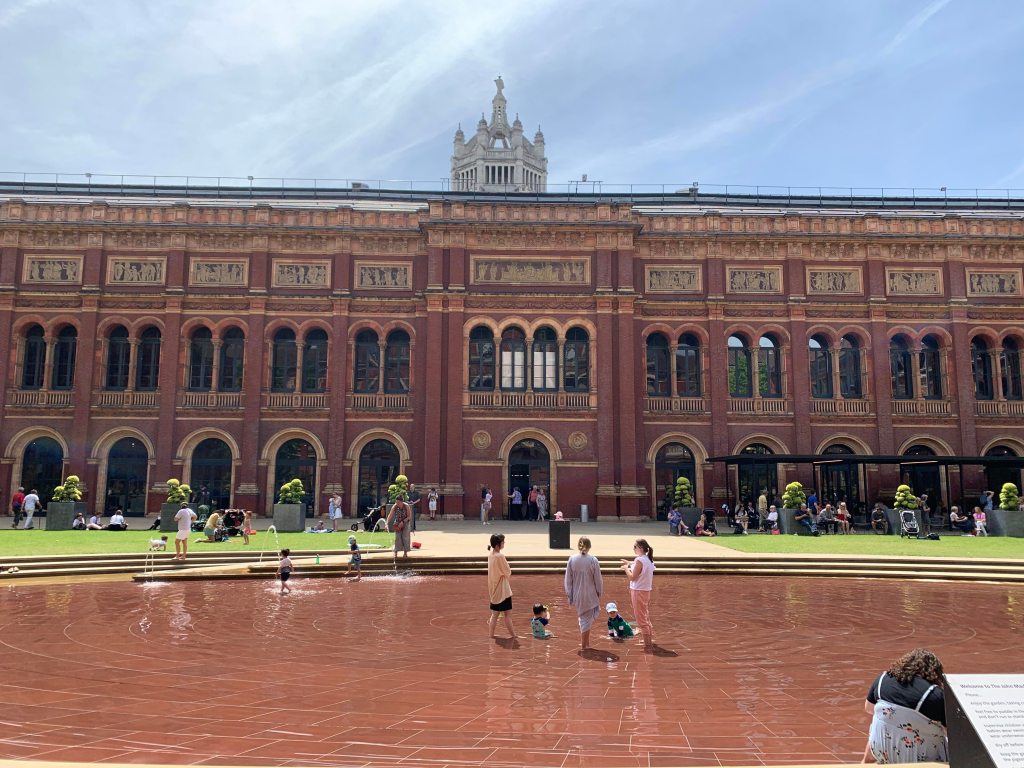
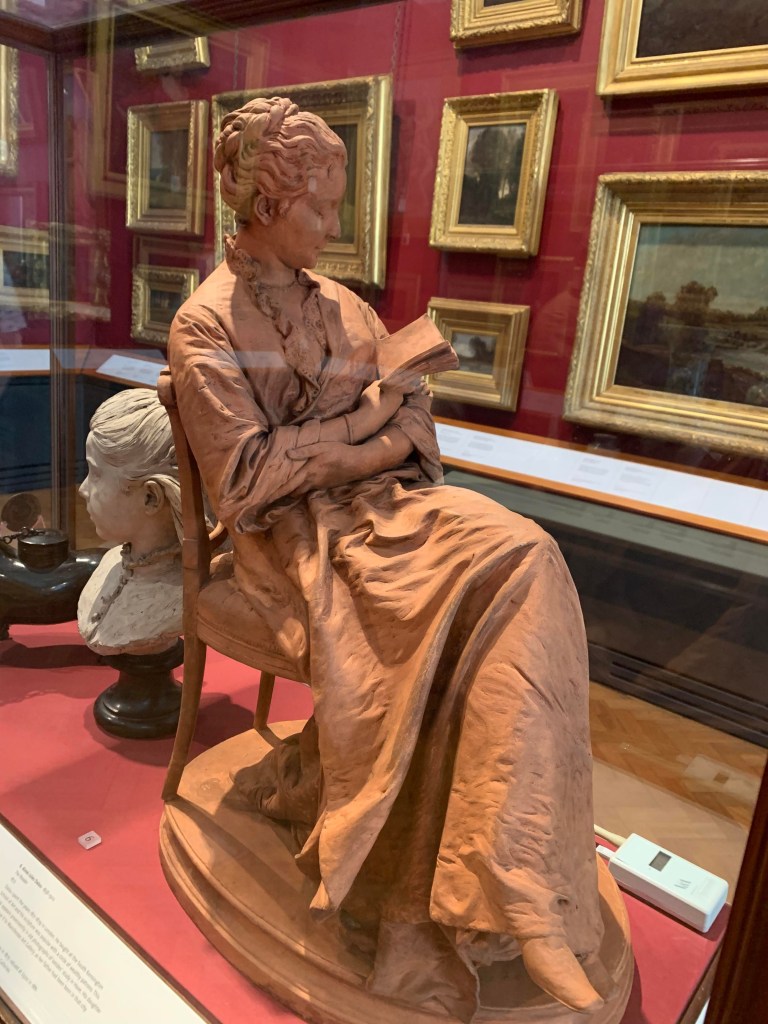
It is amazing how much history is preserved in London. The Victoria and Albert Museum contains pieces of art with a variety of backgrounds. Our group focused on the theatre exhibit, but it showcased a special Beatrix Potter exhibition, statues, paintings, miniatures, jewelry, and much more. It is worth note that the theatre section was the warmest gallery I have ever explored. I felt bad for the mannequins who must suffer through it all day. I really enjoyed the lively atmosphere of the museum. London offers many free entries, and it encourages families to engage with society. My favorite part was the sculpture exhibition especially of the girl reading. But I loved the outside pond area where children were splashing around in the courtyard.

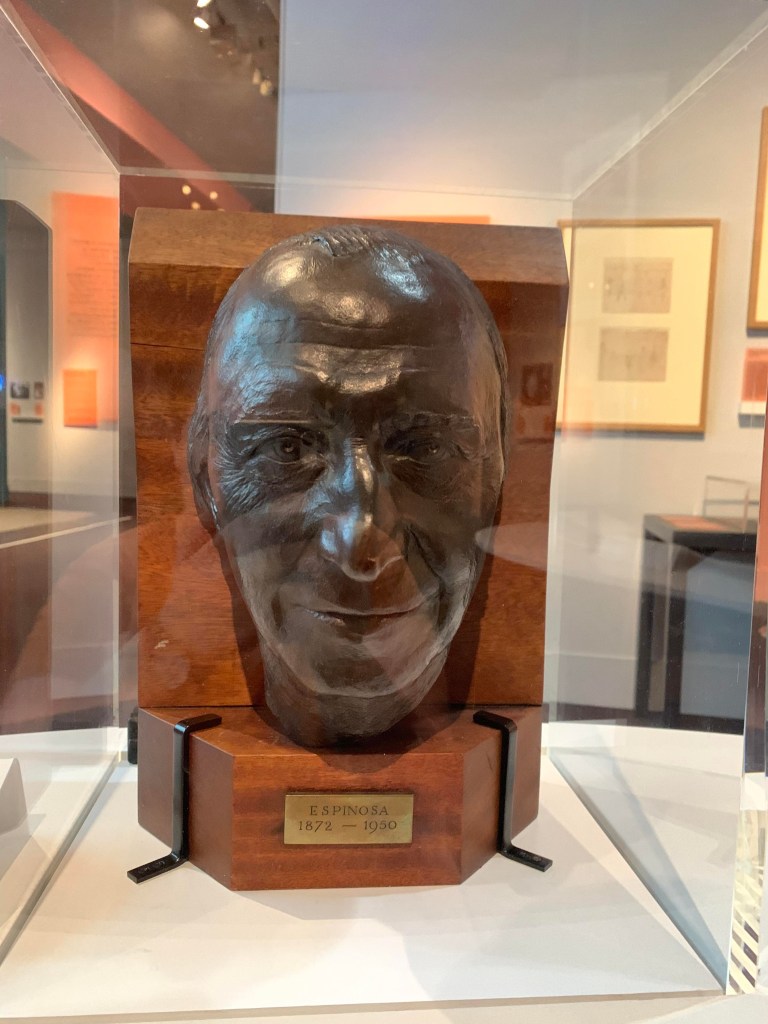
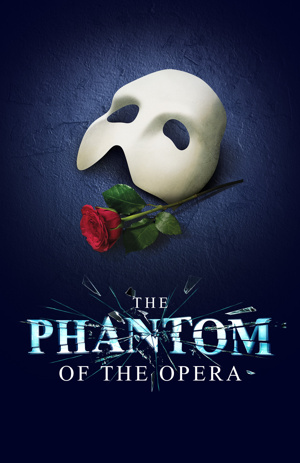
The play that was most imbedded in my mind while walking through the theatre exhibit was The Phantom of the Opera. I think it was due to the initial room which focused on the Royal Academy of Dance. There were intricate dancing costumes which reminded me of Christine’s initial role of a dancer but the one that caught my eye was the Mask of Edouard Espinosa. This mask is more of a bronze replica of a face, but I still immediately made a connection to The Phantom of the Opera. The Phantom has scarring across half of his head, so he decides to wear a white mask which conceals the marks. Even though the masks have completely different appearances and meanings, I tied in the Phantom’s duty of producing the opera with Espinosa’s cofounding of the Royal Academy of Dance. The mask was made towards the end of Espinosa’s life in the 1950’s but his lifetime overlaps with timeframe of The Phantom of the Opera which takes place during the 1880’s.

All these little details caught my eye and I kept drawing connections between this real man’s life and a character in a play. I enjoy that art and history let us find the thread that ties it all together.

-Tabi is Booked

Victoria Albert Museum (featuring comparisons to Life Of Pi)

Leah and I visited the Victoria Albert museum a couple days before the group today. This was because we met up with her childhood best friend and she was kind enough to pay for our tickets for the Fashioning Masculinities exhibit. It was a great exhibit which challenged the idea of modern masculinity and the wardrobe of men. It was an exploration of fashion over the decades and how society views affected what was worn, along with religious views. 

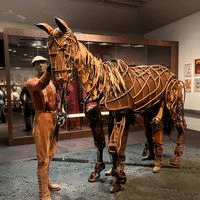
The exhibit I want to compare to a piece of theatre we have seen is the War Horse puppet to the play Life Of Pi and their work. First, the exhibit. The piece itself was a life-like and full scale horse puppet that was used in the  production of War Horse that performed in over 1600 shows at the National Theatre. The show horse officially retired from the production in March of 2013. The horse itself is constructed from an Aluminum frame, cane wood, waxed twine and many other materials. The most interesting materials being bicycle brake levers and car seat belts! It takes three people to operate this ginormous puppet. They are labeled as the head, the heart, and the hind respectively. They perform in the same way as the Life of Pi puppers; the actors are fully visible but the attention is always on the animal rather than the actors.

The puppetry in Life Of Pi was the greatest I had ever seen. I write this fully knowing the second best puppetry I have witnessed was that one time my younger cousin put on a great sock puppet extravaganza. But I digress. Even though I dont have the experience of seeing other puppets, I can still imagine how the warhorse would have felt on the stage. Its breathing, naying, braying and moving. The tiger, much like the horse, was operated by three actors operating in similar areas. The largest difference being that the tail had its own designated actor.

6/16 – London Day 24

Breakfast at Dillon’s

Hello all! My last day in London was today. I wonder how I will title the remaining blogs from now on… Maybe UK Day (insert # here)? Guess we’ll both have to find out tomorrow!

I started off my final day here by getting breakfast at Dillon’s cafe, which is attached to the Waterstones book store. I got a mocha and an almond croissant. They were just what I needed to get my day going! It made me wish I had more almond croissants while I was here, too, because it was perfectly made.

The script of Harry Potter and the Cursed Child at the V&A
Inside the V&A

After breakfast, I met up with the group so we could go to the Victoria & Albert museum! The Victoria and Albert museum is one of the largest museums in the world. The museum covers 12.5 acres, and holds over 2.3 million objects… crazy, right? We started off in the Theatre & Performance Archives, and let me tell you there was something for everybody in this section alone. What really caught my eye were the pieces that had to do with some of the shows I have seen while on this trip. If you didn’t already guess it, I’m mainly talking about Harry Potter and the Cursed Child. The museum had the script for Harry Potter and the Cursed Child on display, and this was the same version that I had read when the manuscript first came out! It was interesting to see how exactly the show started out, and to be reminded of myself reading it for the first time while imagining how the production would look on stage. Who would have thought I would ever see both parts of the play in person- especially since they have condensed it in so many other countries! I also learned that Harry Potter and the Cursed Child set some records: they set the record for the highest all-time weekly ticket sales, and won a record-breaking nine awards at the 2017 Oliviers. In addition to the script from Harry Potter and the Cursed Child, my eye was caught by a few instruments on display. Seeing the instruments reminded me of the prevalence that pit orchestra has in theatre. To view them displayed alongside such prolific pieces in the theatre community really drove home the fact that the music of a show is just as important as things like the costuming, script writing, etc. All of these play different, yet equally visible and key roles in a production. I could especially see this in works like Back to the Future and Legally Blonde, where live music was heavily featured.

A bracelet from the V&A
Instruments on display at the V&A

Another exhibit from the V&A I enjoyed was the Jewelry Archive. This area was stunning, and it had what seemed like hundreds of objects on display. The items on display ranged in their beauty and uniqueness, so when you walked down the hall, you weren’t exactly sure what you would see next!

Pistachio, chocolate, and coffee gelato from Amorino’s
Bao and sour plum iced tea from Bun House

When I was done at the museum (which to be fair, it is impossible to be completely done with the V&A), I did another one of those relay races of my favorite things to eat in London. I stopped at Bun House for bao once again, because third time’s the charm! I also went back to Amorino’s to get more gelato before returning to the hotel to take another much needed nap.

Dinner at Nando’s

After I woke up, I went to Nando’s for the first time- it was really good! I can see why it is a staple restaurant here. I got a salad with a plant based patty and it was definitely up there for me. There are very few salads that I have finished completely, and at Nando’s… there was nothing left on my plate.

The stage of Woman in Black

After my dinner, it was time for our last show in London, Woman in Black. Woman in Black is a ghost story that I do not wish to spoil for you, so let me just say that it is both thrilling and chilling. Not even five minutes could go by without me looking behind my seat to make sure there was nothing looming over me. There were jump-scares and moments that would leave your hair standing on end. I would describe it as viewing a horror movie and yelling “STOP!” at the screen whenever someone was going to make a stupid decision, but you were basically IN the screen yourself. If you like a good old adrenaline rush and getting spooked out, this is the show for you!

And ta-da! There is my time in London at an end! Stay tuned for Oxford and Stratford Upon Avon. We only have a few more days left… So I will do my best to make them count! 🙂

Victoria and Albert May Be Compensating for Something With the Sheer Amount of Items They Have on Display

Victoria & Albert Museum – Theatre Exhibition

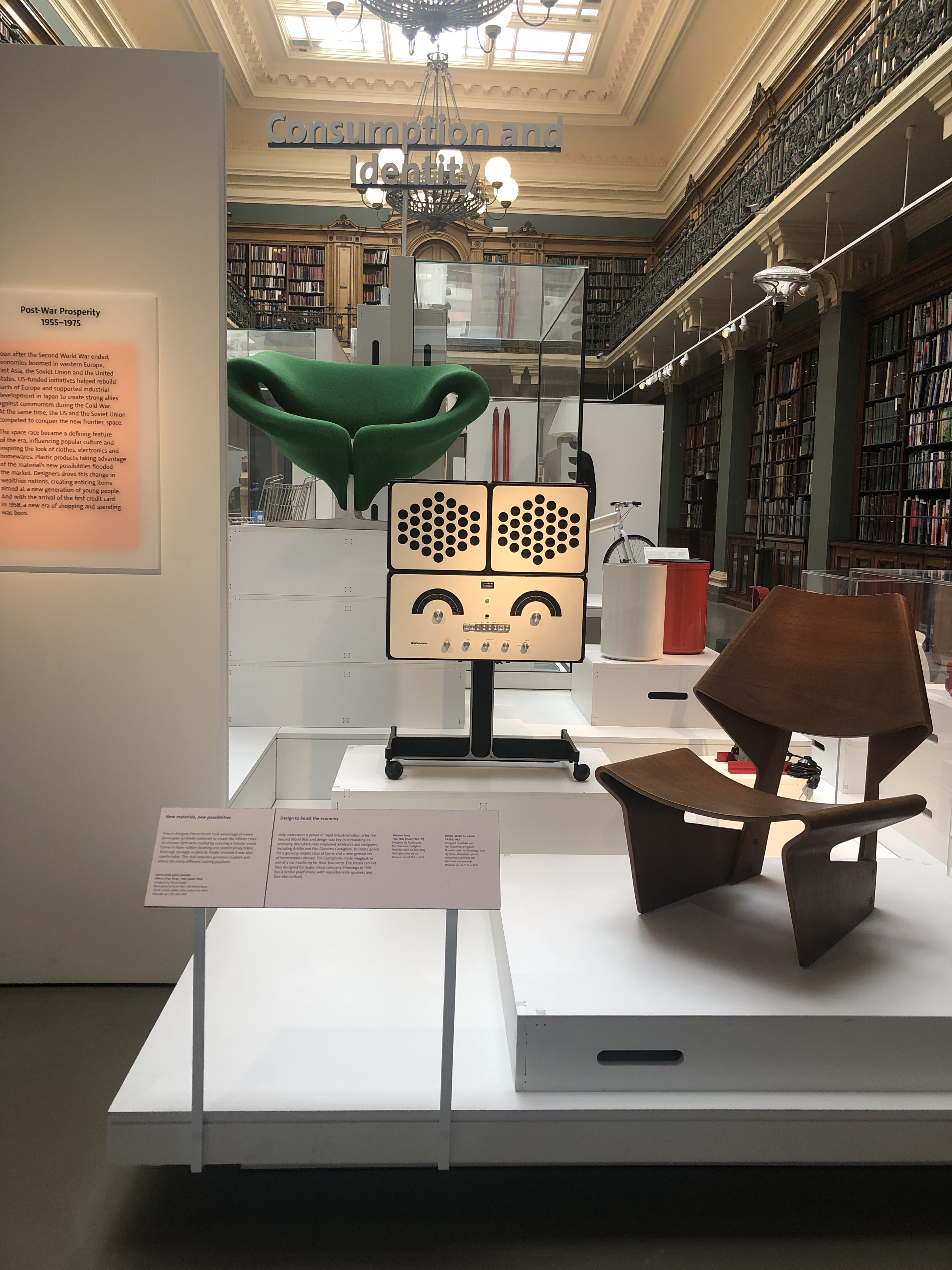
Our visit to the Victoria & Albert Museum was a little overwhelming, to be honest. Although I’m not the most attentive museumgoer (I don’t stop to read every plaque or examine every piece) I do generally like to take in every room and feel that I haven’t missed anything that might interest me. This was a fundamental problem on this visit because this place is immense and has no determined circulation pattern; it’s totally on you to find your way. After visiting the theatre exhibit, I gave it my best shot, but was fully overwhelmed by the many exhibits, directions and floors. After an hour and a half or so, I had to call it simply so that I stopped worrying about what I wasn’t seeing. This feels kind of silly in retrospect, but I’ll stick to my guns and say that it was the right choice in the moment. My silver lining is that I did manage to take in the “Design: 1900-Present” Exhibit, which had some furniture pieces that piqued my interest and I’ll be researching further down the line.

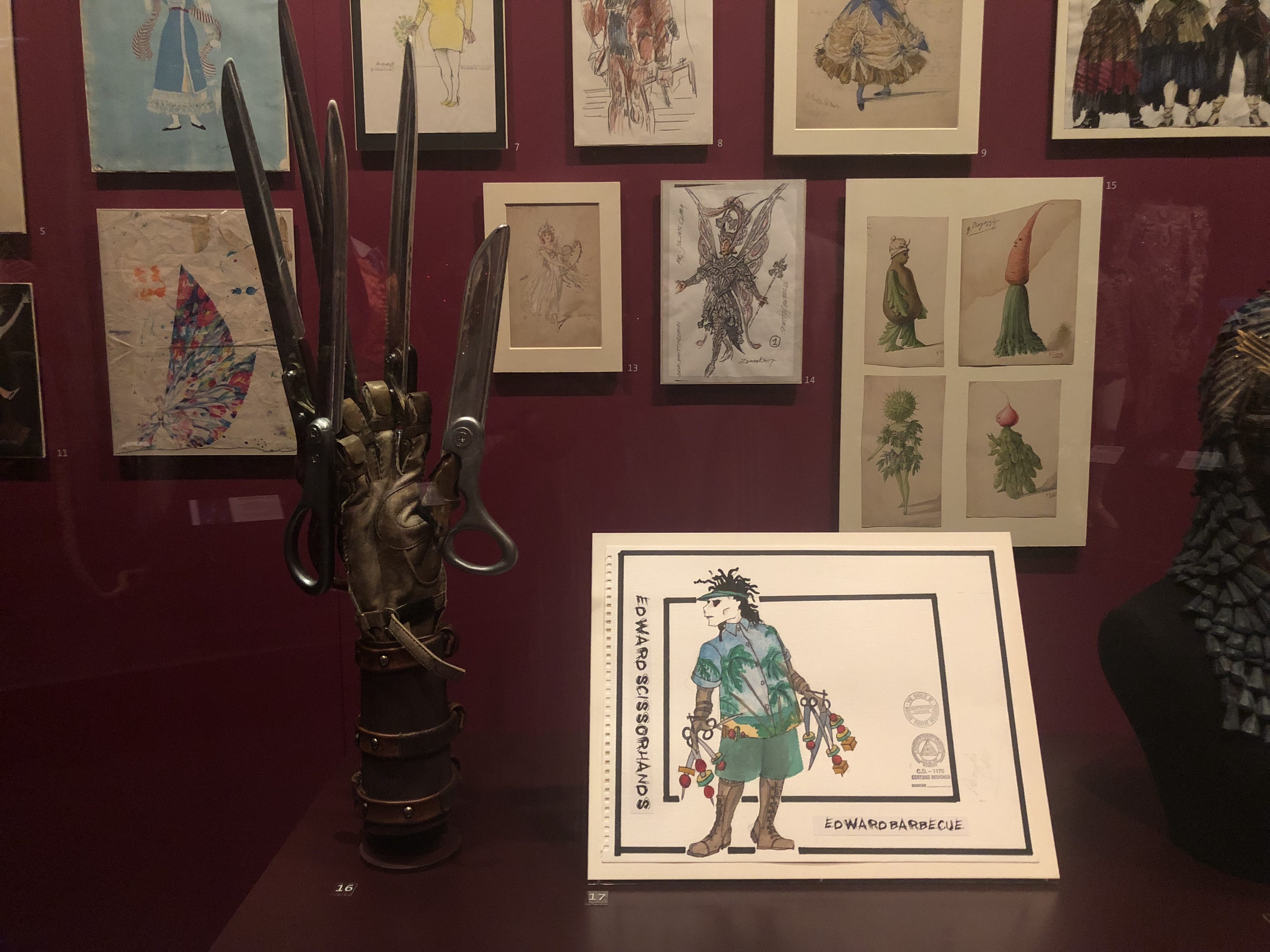
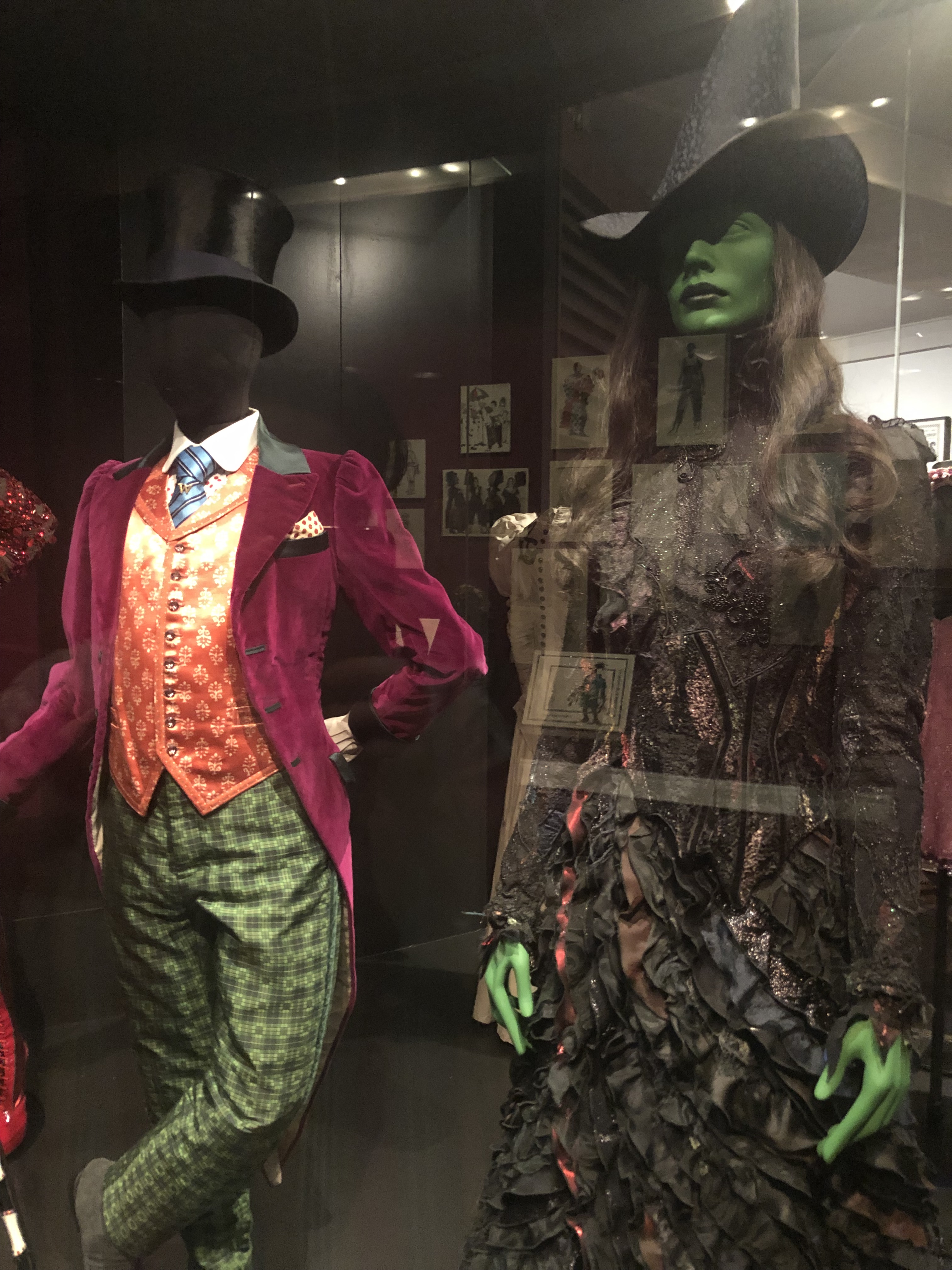
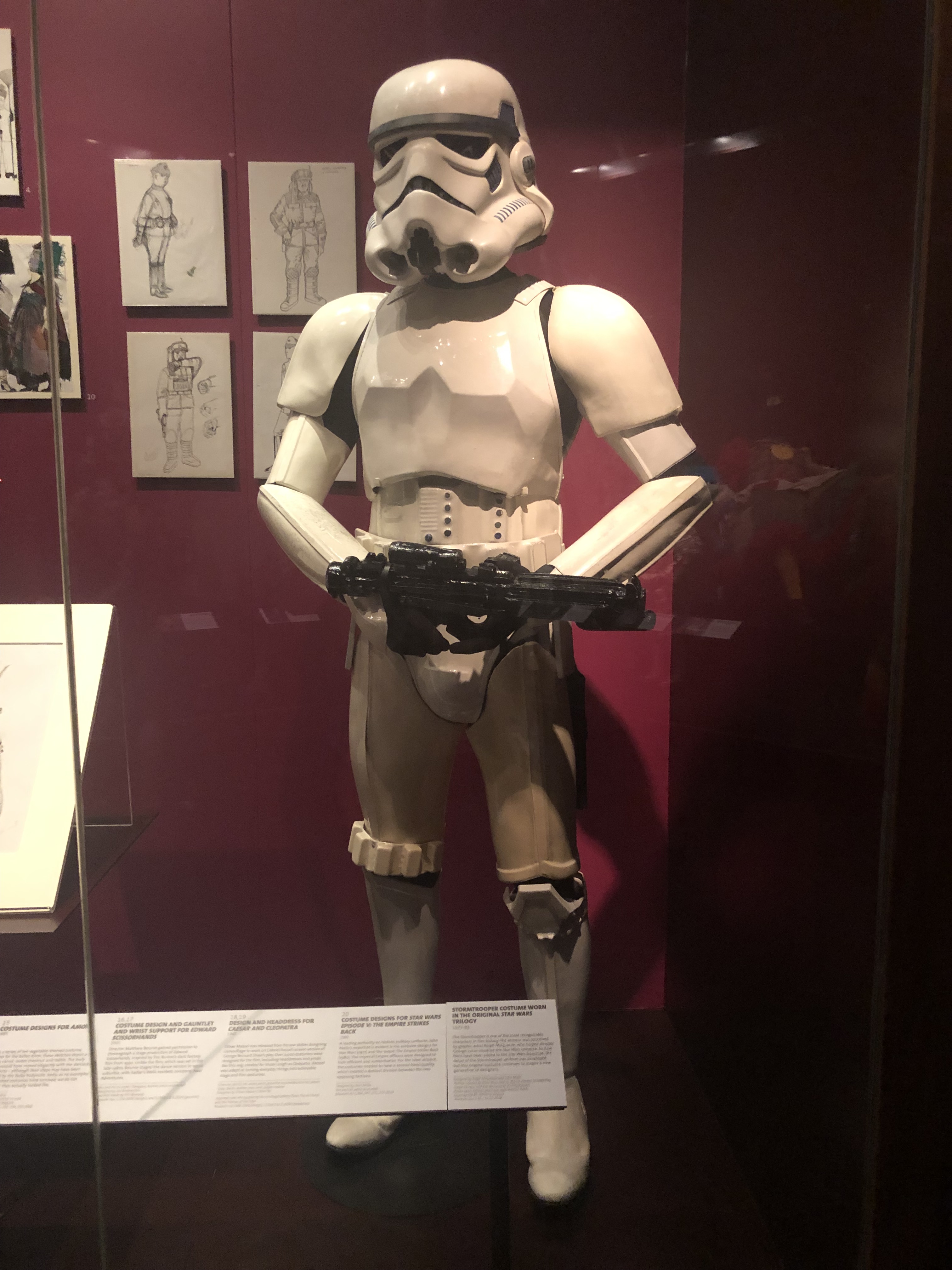
The central purpose of our visit was to visit their exhibition on theatrical design, which took the visitor through years of costuming and set designs, some even from the world of film rather than theatre. It was an expansive look at the way the art form has been elevated as a result of technical achievement and the translation of content “from page to stage.” There were some really great highlights in here, including Elpheba’s witch garb from my favorite musical, Wicked, and Edward Scissorhands’s glove from the stage adaptation of the Tim Burton classic. See the included images for more high points.

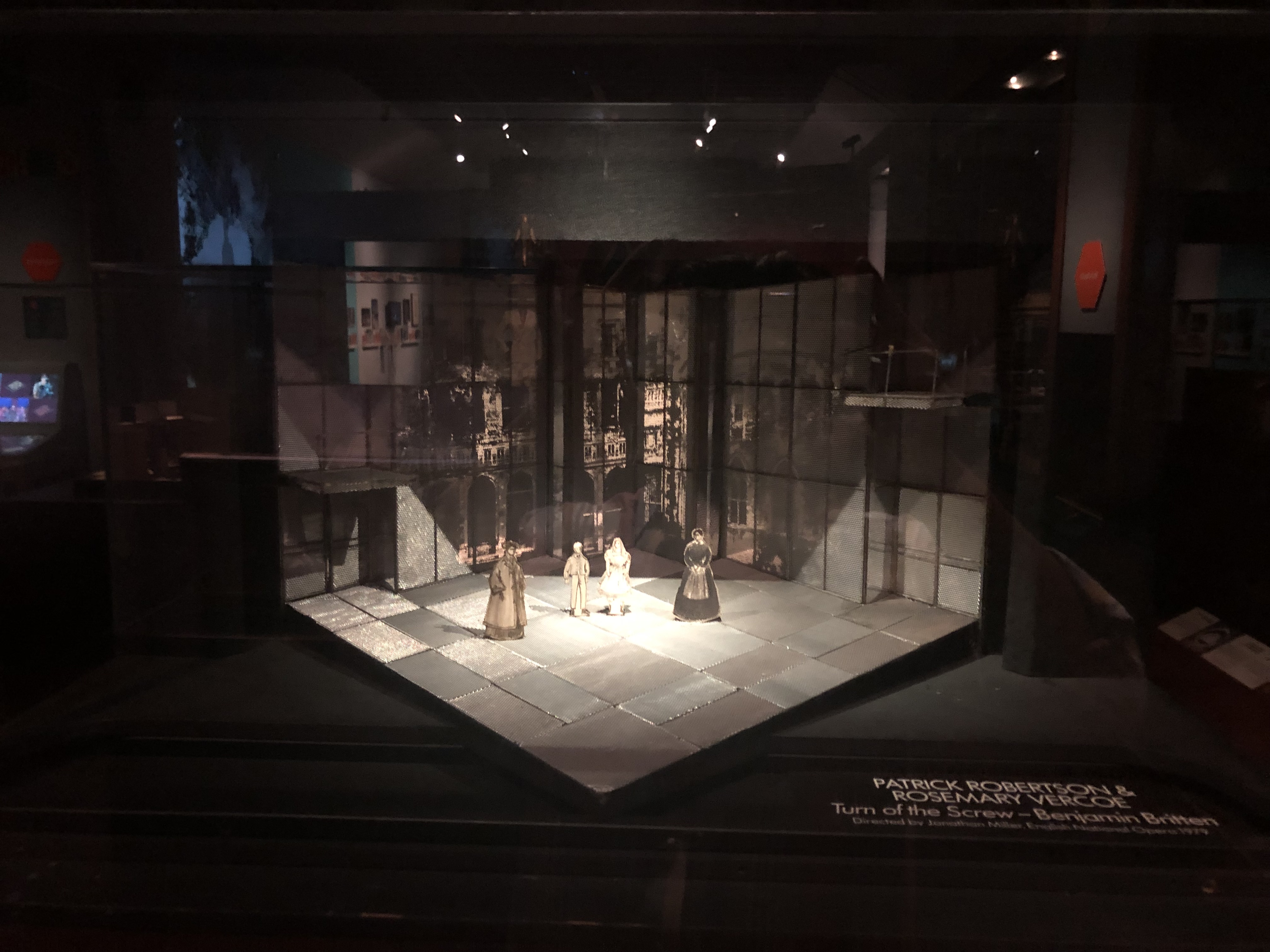
A particular set model caught my eye, from the 1979 staging of The Turning of the Screw. I’m a big fan of this story, which one of my favorite directors, Mike Flanagan, adapted into the masterful horror series The Haunting of Bly Manor. As I read about the set, I was taken with the way the floor employed forced perspective to create artificial distance between the audience and the back of the set. Furthermore, a series of screens and scrims with ghosted projections of the walls of the manor worked to create the feeling of a sprawling, expansive and mysterious estate, supporting the undertones of dread and fear of the unknown that punctuate the story. The hazy and slightly unclear atmosphere reminded me of The Glass Menagerie, and represent fairly well what that show could have achieved with the right creative direction. With a combination of transparency and projections, I believe a set like this which called focus to center stage rather than the wings, along with a background which established tone and underscored central themes instead of singular moments could have done the Tennessee Williams classic more justice.

This was, overall, a great survey of the sometimes lesser-appreciated sides of theatre which support the actors. I felt it was a due celebration of the achievements of those that work behind the scenes to bring the action to life in subtler technical ways, constantly pushing theatre to new heights.

[now playing: The Skull Beneath the Skin – Megadeth]

In Which I Stop Lecturing My Roommate About Buildings and Get Schooled on London Cuisine for a Change

Gymkhana – A New Food Experience

I have shamelessly benefited from having a roommate, Isaac (Table_4_Three) who is an expert in all things culinary, and two weeks into the trip I found myself sitting down in the Michelin-starred restaurant Gymkhana, near the Green Park tube stop, and just around the corner from the Ritz Hotel. This is an Indian restaurant, and I have hardly eaten Indian food, and certainly not any done at this level. I felt out of my depth, and definitely had to lean on his recommendations, but this dining experience, though expensive, remains a highlight of the trip.

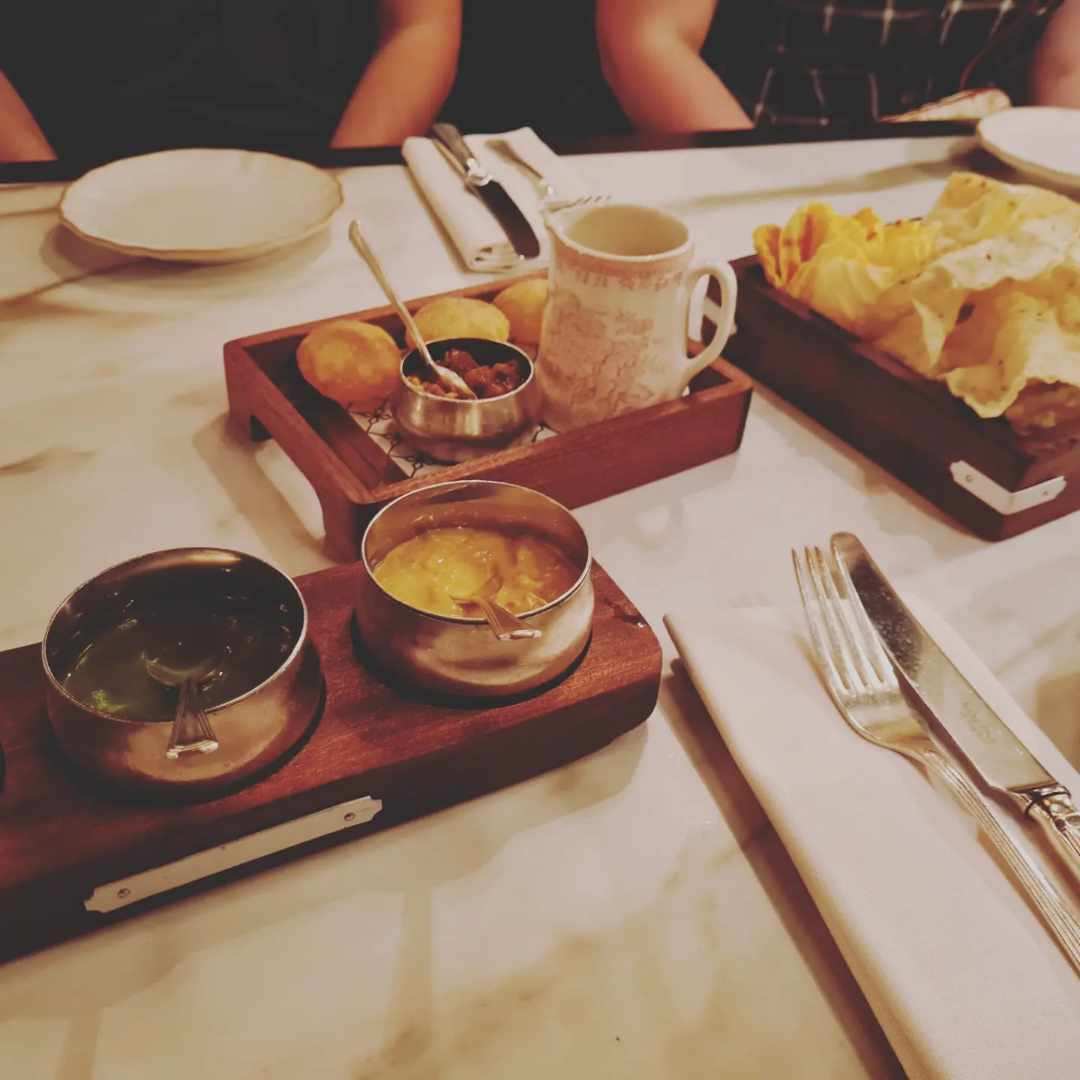
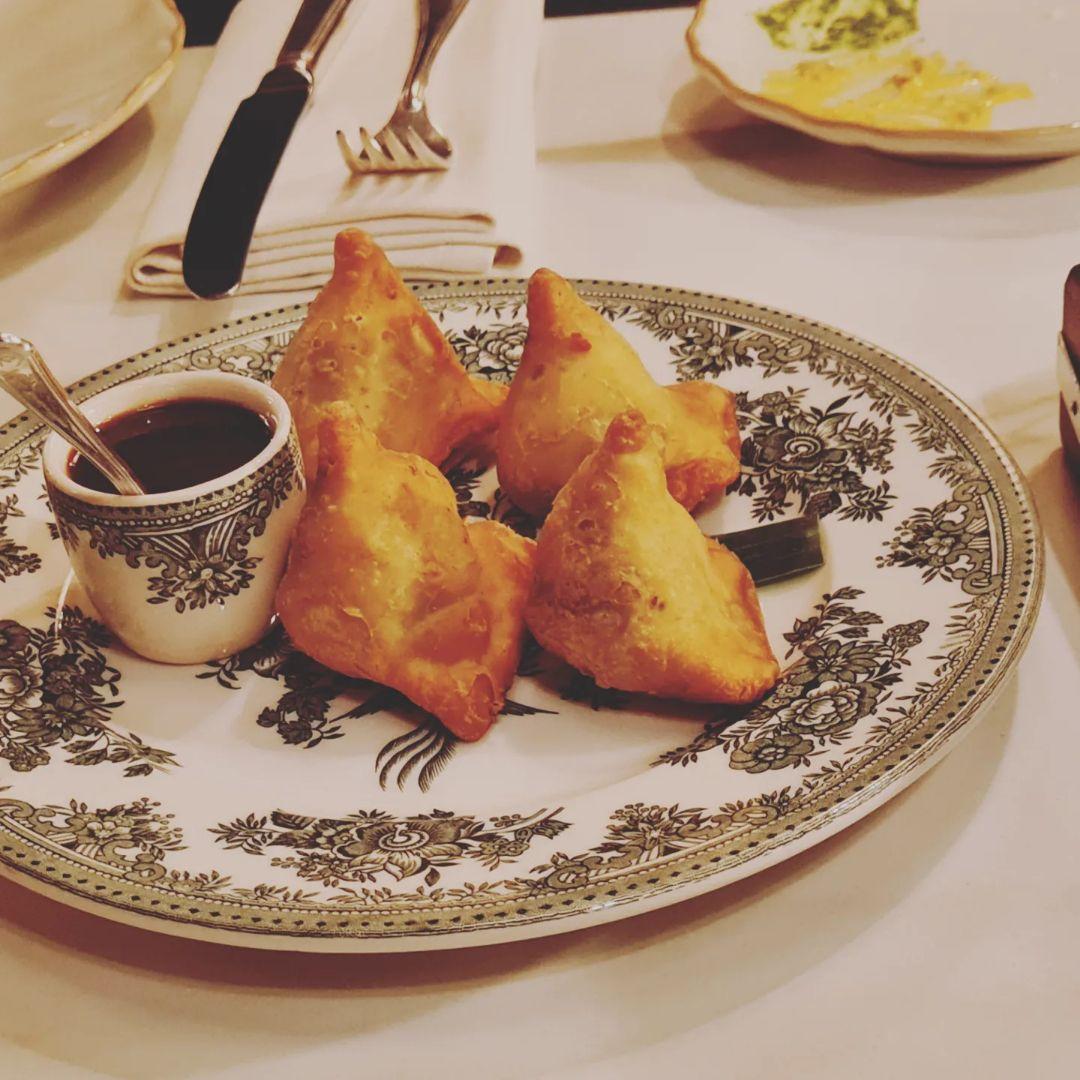
I ordered from the A La Carte menu, getting a starter of Punjabi Samosa. This is a savory, pyramid-shaped fried treat filled with potatoes and peas. It came with a delicious Saunth Chutney. My relatively undeveloped palate couldn’t tell the chutney from a sweet barbecue sauce. I was hesitant to share this opinion, but luckily Isaac agreed with me and I felt vindicated. Still tasty. As we waited for our main courses to arrive, we all sampled from Isaac’s tasting menu, which kept small sample plates coming consistently. Of these, my favorite was a dish that involved some impossibly crunchy yet light potatoes, seasoned with primarily cumin in a bowl with cheese and another delicious chutney. I wish I remembered the name, because I’ll probably never be able to find it again.

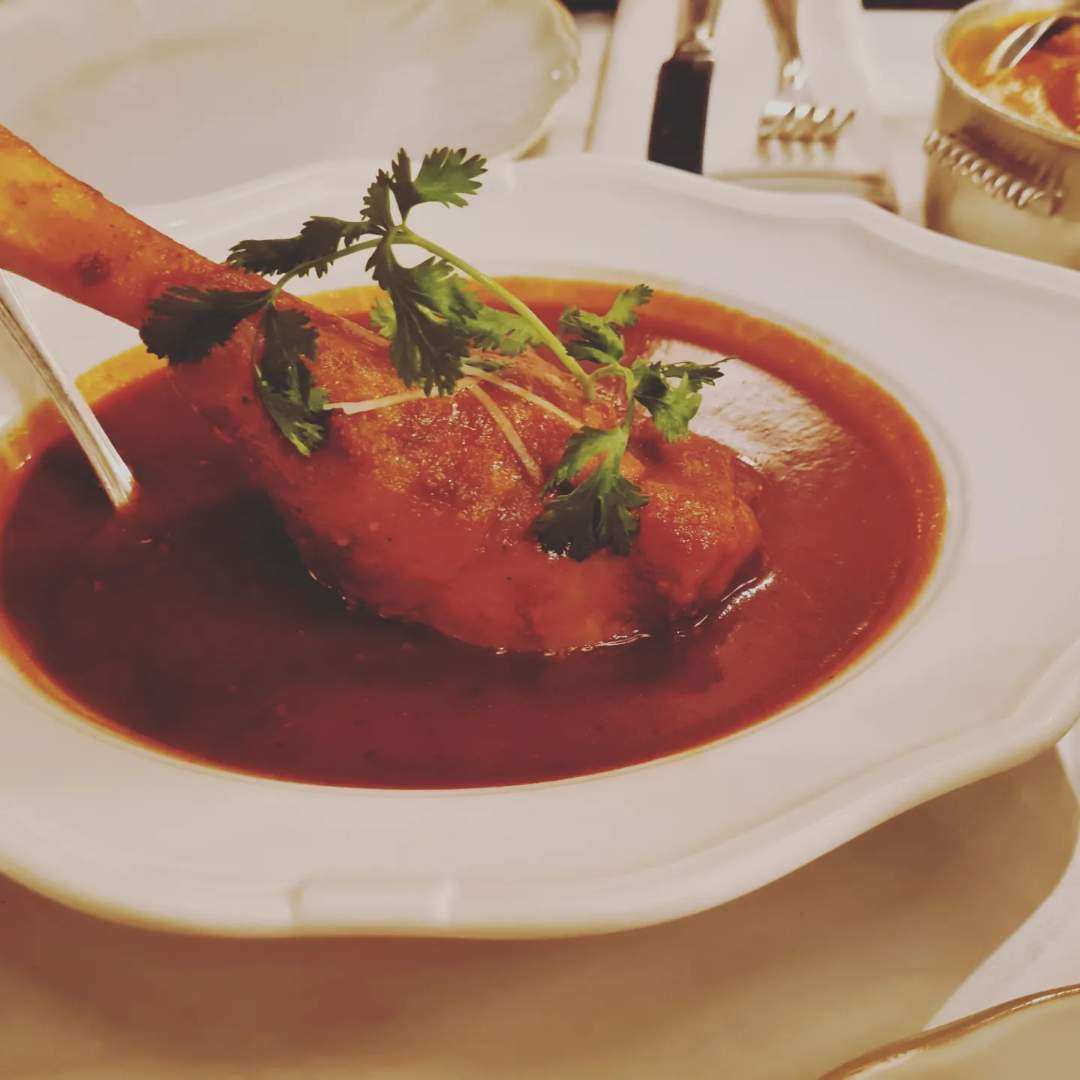
My main course was a lamb shank. When I ordered it, I thought I was ordering something I had tasted before, which is basically a few lamb ribs cooked until crispy. This kind of thing would lean on the flavor of the lamb without over-seasoning or using a sauce. What I got was something entirely different. I got a piece of meat that would compare well to a turkey leg in size, on a single bone and served in some kind of gravy or au jus. It was delicious and quite filling; the meat was practically falling off the bone, I didn’t even need a knife to eat it. However, the flavor of the gravy was a little overpowering, and Isaac agreed that it was missing some sort of accent that would make the profile a little more complex. Points for presentation, regardless.

Overall, this was a 9/10 experience for me, and not just because I felt like a real classy boy.

[now playing: Finger Lickin’ Good – Beastie Boys)

Girl on an Alter

Girl on an Alter was one of the most unexpected, best shows that we have seen. The set was pretty simple with a bed laid out towards Stage Right Center.  There was what seemed to be an almost Astro turf-like crumble on the floor made to look like dirt. The actors were still able to stand and walk across the “dirt”, so it was probably less tough than actual AstroTurf. Upstage there were these big wood-paneled gates that would open and reveal a “room” of mirrors and lights. There were two chairs on both Stage Right and Stage Left that were mainly used by the attendant Cilissa played by Kate Stanley Brennan.

As someone who has read The Oresteia multiple times, I was very hesitant going into this show. I am so pleased to say that I was incredibly happy with what I saw and with how the show was directed. The actress who played Clytemnestra, Eileen Walsh, made me feel so many emotions and so much sympathy for a character I previously had no regard or feelings towards. The audience was able to see how much pain she was in from the death of her child because of her husband in the most that I would call heartfelt performance.

Another performance that really stood out to me was Agamemnon’s played by David Walmsley. Even though most of the scenes he had were him getting angry or showing off by yelling, it was never too much, or felt pushed. At one point, Agamemnon and Clytemnestra are having a very serious back and forth about the death of their daughter and you could see the pain that was behind his eyes. This was one of the first shows that I was able to see such true emotion from actors other than in House of Shades.

At the end of the show, Clytemnestra kills her husband by “suffocating him. While doing so, the actress pours a bottle of wine over them, and a rig goes off in the bed filling it with blood as well. I really appreciated the symbolism of the wine because it was a symbol of her daughter’s passing, and it then became a symbol of her husband’s death. Overall, Girl on an Alter was one of the most beautiful shows we’ve seen performed and from a technical aspect as well.