Fringe Theatre is Awesome

Glory Ride was a delightful fringe show Alex, Madison and I saw on a free night last week. We went in with no expectations and left pleasantly surprised. 

Glory Ride was set in the early 1940s, and is a musical that depicts the true story of famous, Tour de France-winning cyclist Gino Bartali, who helped smuggle Jews out of Italy during Mussolini’s dictatorship.

 We started off almost missing the show, as it was under a train station in an alleyway. It was in a quaint theatre, only a little bigger than the one we saw Jules and Jim in. The space really worked for me and I think it immersed us in the world of the play well. The fact that it was under a train station surprisingly really added to the show. Every 15 minutes or so a train would rumble over the theatre. Specifically, there was a scene where they were hiding in a house while there was a bombing going on, and the train rumbled above them, adding to the drama. Something I love about fringe theatre is that it can be in more unconventional spaces, yet that can sometimes be a better experience than being in a huge professional theater. 

We also had the experience of sitting front row of the theatre. The stage reached the height of about my shoulders, so sitting right up on it was a bit of a neck-breaking experience. But it was cool being so close to the actors, and we really only missed the view of their feet, so it was worth it. The actors came up to the edge of the stage a lot, and it was really cool being so close to them and helped us be so much more immersed in the story. We were so close they even spit on us!

 The music in the show was also very good. It told the story well, and specifically, Gino and his love interest Adrianna had strong, booming voices that worked well together and told the story beautifully. Some of the supporting characters were weaker vocally than the leads, but it never took me out of the story. The Italian accents were really good but were inconsistent during the songs. Even though it technically wasn’t West End professional theatre, it felt up to that par and cost a lot less. I’m so glad we saw it on a whim and hope to experience more theatre like it soon!

I finally saw Poet’s Corner and Chaucer’s tomb

By Brittaney Mann

Normally places of burial make me feel sad and uneasy, but Westminster Abbey beautifully honored the lives of various important figures. Rather than feeling solely sad about their deaths, I felt thankful about the lives they lived. 

My favorite area was Poet’s Corner because there were so many people that I had read the works of and written essays about. One grave that I thought was very cool to see was Geoffrey Chaucer’s. Chaucer is considered one of England’s first great poets. Last fall, I was in a class where I studied The Canterbury Tales and Chaucer in general. During that time, we had the opportunity to watch a live stream where Chaucer scholars discussed new documents they found regarding a court case Chaucer was involved in. Some of the actions he included in his tales were not pleasant to read, but I still enjoyed viewing them through a lens of feminism and placing the women of his story within the context of all women at the time. It was very cool to see his grave because it made him all the more real.

While in poet’s corner I also saw Lord Byron’s grave. It took awhile to take a photo of it because everyone kept gathering on it, but I was able to walk back and quickly snap a photo. I have not read a lot of Lord Byron’s work, but I learned a little bit about him. When I was in a Frankenstein class, I learned that he was friends with the Shelleys and was there the night they shared their ghost stories. He did not have a totally pleasant life though; I also learned that he was a bit of a party person, had a child with Mary Shelley’s sister, and was just overall a very interesting person. I don’t remember much about him, but the term Byronic Hero is because of the characters he created and his persona. 

Moving on to a grave outside of Poet’s Corner, I really loved the Tomb of the Unknown Solider. It was decorated with poppies and blocked off so people could not walk over it; it is the only grave with that much protection. Our tour guide, Molly, explained that the poppies along the outside represent the flowers that used to grow on the battlefields. She also told us that even though there is one solider buried here, this is a place for all people to mourn their lost loved ones of any war. I noticed parallels between Veteran’s Day and the day the UK has to honor solders; Molly mentioned the eleventh day, eleventh month, and eleventh hour, which is what Veteran’s Day in the U.S. is. 

I am very appreciative of visiting Westminster Abbey. I loved to be able to honor and remember the people I learned about in school and learning about tombs of people I had not heard of before. 

Fringe Theatre – Jules and Jim

Jules and Jim was not only one of my favorite Fringe shows that we have seen but I think it also captured the ideals of Fringe theatre very well. The production itself only had three actors, the set was very minimal with sliding panels of glass, a widow with shutters, a doorway, and a table.This set was housed in Jermyn Street theatre that held probably about 100 audience members. It gave an intimate feeling to everyone seeing the show and allowed the actors to be very intentional with audience connection, as almost everywhere they looked they caught an audience member’s eye line. This personally gave me a feeling of being in the story with the characters, I felt like I had to be very thoughtful with when I wanted to have a vocal reaction, which happened quite often because I was listening more closely to what the actors were saving and doing, and I wanted to give them something to work with. Overall, it allowed the audience to become one with the piece because it was literally happening five feet in front of them. So even if they didn’t like the piece they still felt like they were involved in some aspect, whether that be an actor making eye contact with you or an actor coming into the audience and standing by you. 

The set that Jules and Jim had was one of minimalism for sure. But I want to focus on how they used the window with panels, which when opened revealed water and bubbles in between glass to simulate Kath swimming in a body of water. Patricia Allison, the actress who was Kath was standing behind this glass and pretending to be swimming as bubbles flowed through the glass. It did look a little corny and cheesy but it was also very creative and worked well for what they were going for, which was to simulate a character swimming on a stage without water. And when Kath reappeared from the water, her clothes had water all over them, though not completely soaked like they would be if she actually went swimming, we do love to see attention to small details and incorporating them on some level. 

This being my first taste of Fringe Theatre on this trip was a great experience and set the president for all of the other Fringe shows that I have seen and it made me actively seek out smaller shows, as I personally really enjoyed feeling like I had a connection to the actors. And most of the Fringe shows I have seen do not shy away from connecting with their audiences, which has made me rethink my past work and think about my future work. Would myself as an actor connecting more with the audience make a difference for the audience? Would it make a difference in my character development and how I approach a story? When I write should I be thinking about the audience more, or incorporate more audience interacting moments? These Fringe shows have left me with a lot of questions that are allowing me to analyze my work and others in a new light.

Westminster Abbey

Today, our group had the opportunity to visit Westminster Abbey. I have been so looking forward to this day because ever since I was a little girl, I have been intrigued by the royal family. One of my core memories from my childhood actually revolves around a major royal event that took place at Westminster Abbey. It was the Royal Wedding of Prince William and Kate. Growing up, I was obsessed with princesses just as the average little girl often is. I would constantly play dress up in my Cinderella dress and play tea party with all my stuffed animals. It was like I was born to be British and somewhere there was a mix up.

Anyways, one day my mother let me stay home from school for none other than the Royal Wedding. I woke up to the smell of scones and hot tea wafting in the air. We sat in the living room floor that morning sipping earl grey out of tea cups and eating scones with clodded cream off of old china that once belonged to my grandmother. As we ate and sipped, we watched Kate step out of the carriage in the front of Westminster Abbey. I remember thinking how beautiful she looked and how I wished that was me as she walked down the aisle of the church. I turned to my mom, “Maybe I can still marry Prince Harry one day?” She only laughed and said, “Maybe, just maybe.” Well unfortunately my name is not Megan Markle.

The next day, my mother wrote an excuse note to the school stating that the reason for my previous absence was for a viewing of the Royal Wedding. Believe it or not, they accepted that as a legitimate excuse. Every time I hear or read of Westminster Abbey, I look back and think of that special day that I spent with my mom. Now, I am finally getting to see the place in person.

Westminster Abbey was formed by Benedictine monks during “the middle of the tenth century, establishing a tradition of daily worship which continues to this day.”  Specifically, the first Westminster Abbey was established in 960. Westminster Abbey has been the coronation church for the British Monarch since 1066.  In fact, 40 coronations have taken place at Westminster Abbey with the most recent on 6 May 2023 for King Charles. We entered a room with pictures of pat coronations and the picture of Queen Elizabeth moved me. In the photograph she wears her crown and accessories of being a new queen as she sits in the throne. She looks so frightened and serious and rightfully so for she has just become a leader of a country at only the age of twenty four.

Seventeen royal weddings have taken place at Westminster Abbey with the most recent on 29 April 2011.  This was the royal wedding of Prince William of Wales now Duke of Cambridge, who is the eldest son of Charles, Prince of Wales, and Diana, Princess of Wales.   He married Miss Catherine Middleton now Duchess of Cambridge.

The one thing that one will notice more than anything are the burial markers and monuments for famous people such as renowned artists, scientists, writers, and political activists. One of the people buried in the chapel is Sir Isaac Newton. Considered one of the most influential scientists of all time, Sir Isaac Newton was a physicist and mathematician known for his work on the laws of motion, gravitation, classical mechanics, calculus, planetary motion, optics and more. Among other accolades, he was made President of the Royal Society and was knighted by Queen Anne in 1705 and died in his sleep in 1727.

While my favorite writer of all time, Jane Austen, is not buried at Westminster, she does have a monument. Jane Austen was an English novelist known primarily for her six major novels, which interpret, critique, and comment upon the British landed gentry at the end of the 18th century. My favorite novel of hers is Pride and Prejudice. Austen’s plots often explore the dependence of women on marriage in the pursuit of favorable social standing and economic security.

Lastly and most importantly, is the one and only floor burial that no one is allowed to walk on. It is the only floor burial site that is in the middle of the chapel’s aisle and is roped off in the way that it is. It immediately attracts the eye mores than any other monument or burial marker. The border of the marker is covered in beautiful red fake flowers. In August 1920 the Reverend David Railton, who had served as an army chaplain in France during the First World War, wrote to the Dean of Westminster with a simple but unprecedented suggestionRecalling a rough wooden cross in a French garden on which had been written ‘An Unknown British Soldier’, and reflecting on the anguish of bereaved families who would never know the final resting place of loved ones killed in action, he asked the Dean, Dr Herbert Ryle, to consider burying the body of one such ‘unknown comrade’ in Westminster Abbey.

The Tomb of the Unknown Soldier reads:

BENEATH THIS STONE RESTS THE BODY
OF A BRITISH WARRIOR
UNKNOWN BY NAME OR RANK
BROUGHT FROM FRANCE TO LIE AMONG
THE MOST ILLUSTRIOUS OF THE LAND
AND BURIED HERE ON ARMISTICE DAY
11 NOV: 1920, IN THE PRESENCE OF
HIS MAJESTY KING GEORGE V
HIS MINISTERS OF STATE
THE CHIEFS OF HIS FORCES
AND A VAST CONCOURSE OF THE NATION
THUS ARE COMMEMORATED THE MANY
MULTITUDES WHO DURING THE GREAT
WAR OF 1914-1918 GAVE THE MOST THAT
MAN CAN GIVE LIFE ITSELF
FOR GOD
FOR KING AND COUNTRY
FOR LOVED ONES HOME AND EMPIRE
FOR THE SACRED CAUSE OF JUSTICE AND
THE FREEDOM OF THE WORLD
THEY BURIED HIM AMONG THE KINGS BECAUSE HE
HAD DONE GOOD TOWARD GOD AND TOWARD
HIS HOUSE.

Overall, visiting Westminster Abbey was a great experience and opportunity to learn about all the people that had earned their burial place or monument there. It was interesting to learn about the royal traditions performed there such as coronations and weddings. I mostly enjoyed looking at the beautiful gold architecture and stained glass windows that hung above me. I also loved the black and white checkered floor and the candles that lit the room. The whole environment felt very serene and holy. I have always had a core memory of my childhood connected to Westminster Abbey and now I have a moment from my adulthood connected to the place.

Westminster Abbey

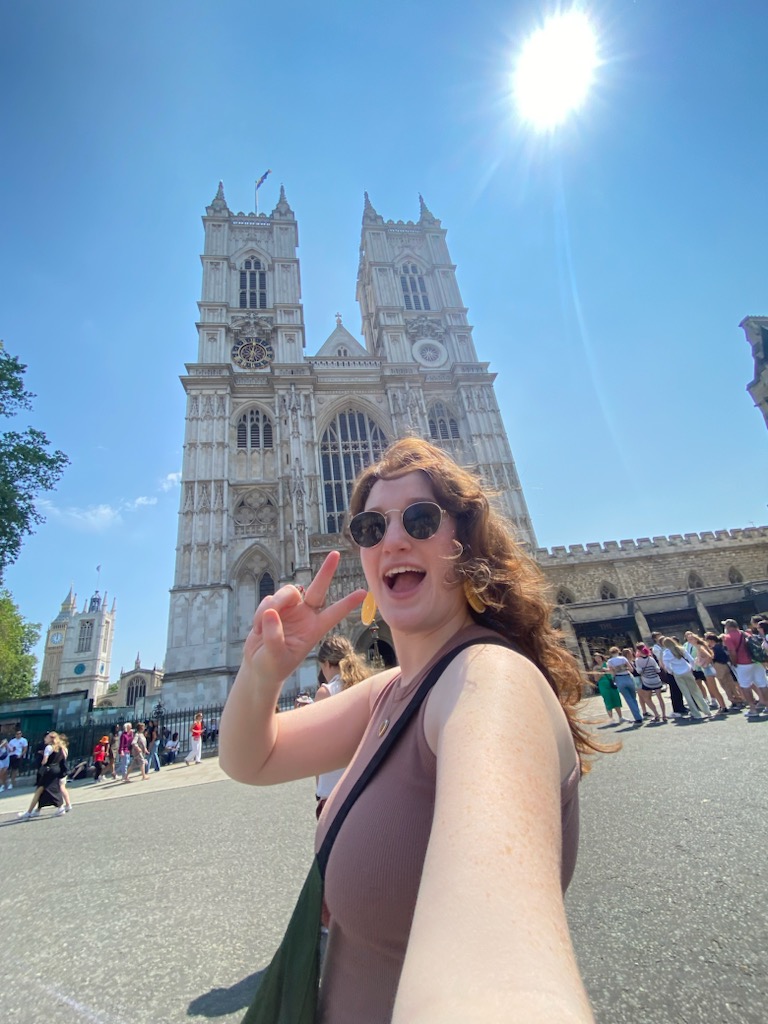
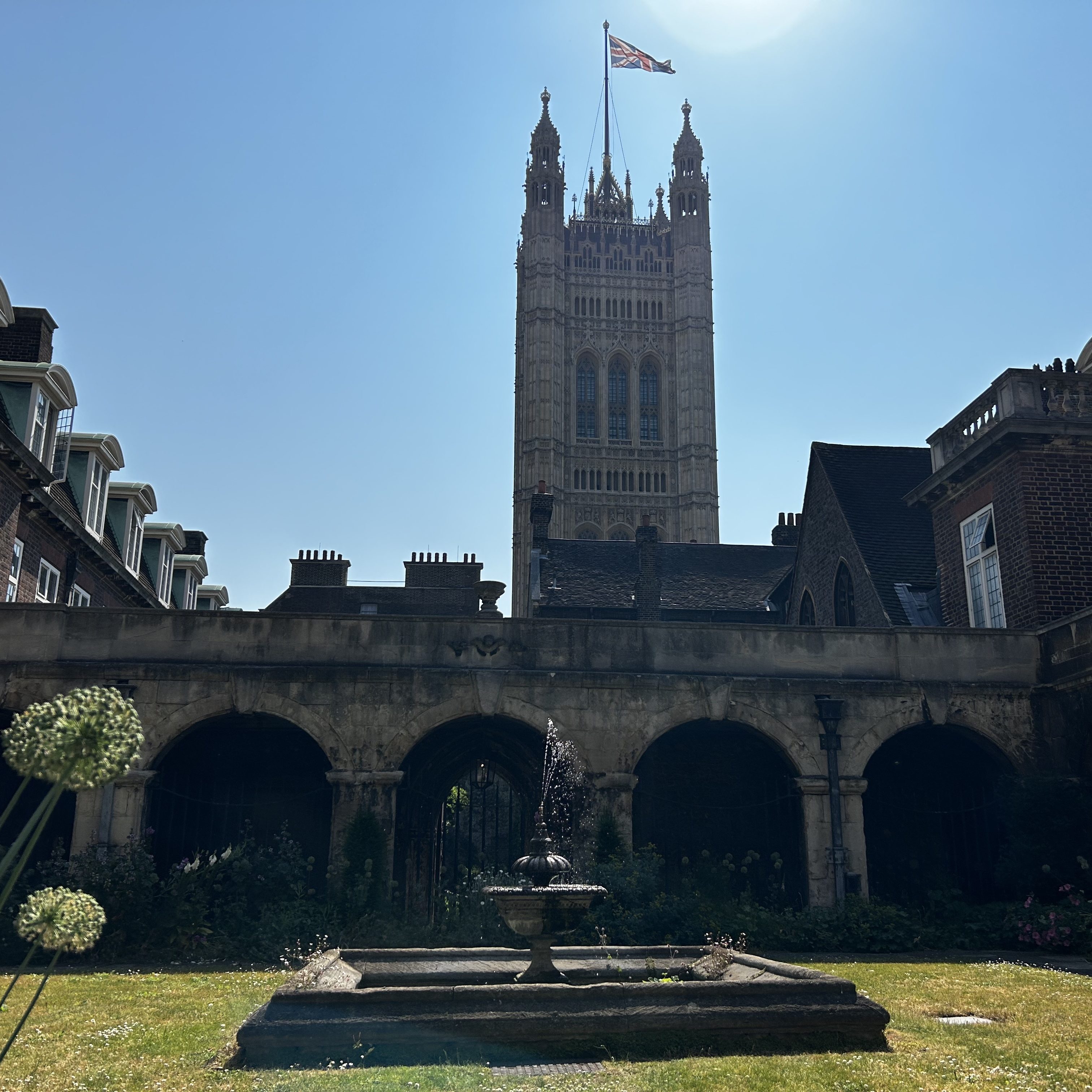
Today is my 23rd  day in London and today I visited Westminster Abbey.

In 960 AD, Benedictine monks founded Westminster Abbey and it was used as a place for Christian worship. To this day, it keeps that tradition and welcomes everyone to participate in prayer every hour. Westminster Abbey is a Collegiate Church in the city of Westminster, London, United Kingdom. Since the year 1066, it has been the main location for coronations. Forty English monarchs have been crowned king or queen at Westminster Abbey. The most recent coronation was the coronation of King Charles III on May 6th, 2023. The Westminster Abbey is also the burial site for seventeen British and Scottish monarchs such as: Queen Elizabeth I and Queen Mary I. It is also the burial site for over one hundred poets and writers such as: Geoffrey Chaucer and Ben Johnson, and for one unidentified British soldier who fought in World War I. Westminster Abbey has also been the venue for sixteen royal weddings. The most memorable weddings being the wedding of Prince Charles and Lady Diana Spencer in 1981, and the wedding of Prince William and Katherine Middleton in 2011.

While touring Westminster Abbey, I was surprised that poets and writers were buried or had plaques at the Abbey. I only thought that royalty was buried there. However, in the year 1760, King George II became the last monarch to be buried in the Abbey because of the lack of space. Monarchs then started to be buried at St. George’s chapel or Windsor Castle instead, and Westminster Abbey became the burial site for many famous poets and writers. One of these famous writers was Charles Dickens. Charles Dickens was born on February 7th, 1812, in Portsmouth, United Kingdom. Not only was Dickens a writer, but also a social critic who created many famous fictional characters and stories that we still know today. Such as Ebenezer Scrooge in the cautionary tale, A Christmas Carol. The poet Robert Browning is also buried at Westminster Abbey. He was born on May 7th, 1812, in Camberwell, London, United Kingdom. Browning was known for his dramatic monologues, dark humor, and irony. His most notable works are The Pied Piper of Hamelin, Men and Women, The Ring and the Book, and Dramatis Personae. Browning died on December 12th, 1889, at the age of 77 in Venice, Italy. Another famous writer that is buried at the Abbey is Sir Isaac Newton. Sir Isaac Newton was born on January 4th, 1643, in Woolsthrope-by-Colsterworth, Lincolnshire, United Kingdom. He was an author, a mathematician, an astronomer, a physicist, and a theologian. Newton is most known for having invented Calculus in the 1660s, and later in his life, formulating the theory of gravity. Newton died in his sleep on March 31st, 1727 at the age of 84.

Westminster Abbey – England’s Hollywood Walk of Fame

Today we went to Westminster Abbey, and I thought that the entire place was one of the prettiest we’ve seen yet. The architecture inside the church was beautiful, featuring tall gothic elements that created such a presence in the space. Beyond just the architecture it was fascinating to get a taste for just how deep the history of the church goes. It’s so old, and that’s something that has been a constant on this trip, but it is still hard to wrap my head around. It was really interesting walking into one of the rooms surrounded with stained glass because within the glass design there was a written history of not only the church but that specific room, even referencing the specific wall of stained glass that broke after firebombing in the Second World War. 

The other main feature of Westminster Abbey is the many famous historical figures who are for the most part buried within the church, and if not are honored there with plaques or statues. The disciplines of the people celebrated had so much variety, ranging from architects to scientists and then, where I was most interested, writers. Seeing the tomb of Elizabeth I was definitely interesting, but finding the Shakespeare statue was still cooler. That being said, there was something about the writers section in particular that annoyed me, and that was the lack of any spectacle awarded to both Jane Austen and the three Brontë sisters. Jane Austen, the writer of Pride & Prejudice as well as several other famous novels, was born in 1775 and died in 1817, and if her plaque at Westminster was my only source of knowledge then that is all I would know about her. The same situation was there with the Brontë sisters. Between the three of them so many massive works of writing were created, like Wuthering Heights or Jane Eyre, but in Westminster they were all forced to share a single plaque with their birth and death years. Granted, most every person honored there was only given a plaque with their name and lifespan – and some fancy ones had Latin – but still many of them had accompanying sculptures or ornate decor. It was just disappointing to see such monumental female authors not receive the same treatment as the several male authors. 

Anyways, I’ll close out this post by mentioning what was probably my favorite plaque dedicated to a historical figure within the whole church: the FDR plaque. It was just something I was completely not expecting, and funnily enough it even had more explanation than Shakespeare’s memorial, as this plaque said “To the Honored Memory of Franklin Delano Roosevelt, 1882-1944, a Faithful Friend of Freedom and of Britain, Four Times President of the United Stats. Erected by the Government of the United Kingdom”.

The Abbey of all Abbeys

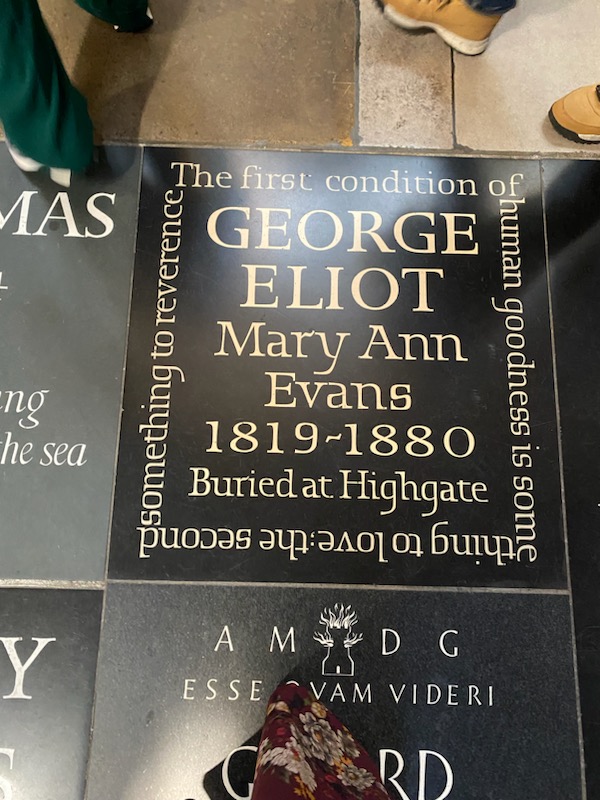
Today we toured Westminster Abbey in which we were told to focus on the graves we walked on and the statues we looked up at. Westminster Abbey was a huge structure that housed a place of worship, a royal wedding venue, the seven-thousand-year-old coronation chair, and over three thousand tombs. The building was surrounded by beautiful stained-glass windows and extremely detailed architecture. There were over a hundred things to look at no matter what room you were in or which angle you were looking at. As I stepped across the uneven stones that made up the floor, I couldn’t help but feel uneasy at how many graves I was walking over. Westminster Abbey housed thousands of well-known memorials for royals, actors, activists, academics, poets, and even commoners. The memorials that caught my eye were those of Nelson Mandela, George Eliot, and Charles Dickens. Mandela is buried in South Africa, but there is a memorial stone in the main room of the Abbey that was put there in 2018 in remembrance of him. It has the words forgiveness and reconciliation surrounding his name to commemorate all of the trials he had to face as an activist leading the apartheid. George Eliot, the pseudonym for popular author Mary Ann Evans had a memorial stone within the Abbey. As one of my favorite authors and an iconic representation of the perils of sexism and the power of women in the 1800s, it was inspiring that she was recognized. Charles Dickens was actually buried in Westminster Abbey in what is called Poets’ Corner. His grave was meaningful to me after growing up surrounded by his literature on all of our bookshelves at home. His name is one of the biggest names in Poets’ Corner and he was buried in Westminster as more of a spectacle for the public. Seeing so many big names and iconic statues all in one beautiful building was so surreal, there wasn’t enough time to look at everything and everyone!

Hirschy Highlight: If I walk into another building where dead people are buried in the floor, I’m going to scream.

Westminster (also pronounced WestMUNster) Abbey reminded me immensely of St. Paul’s Cathedral. While the architecture on the outside is very different, the graves and inner chapel definitely had similarities.

First off, I am SICK of these British buildings having the graves on the floor. I get so eerie about not stepping on graves, but when there are four or five graves right next to each other in the only available walkway, WHAT AM I SUPPOSED TO DO????

Also, maybe it’s just me, but I personally really don’t like when people walk on graves too. I personally don’t like when people have zero spacial awareness, so maybe that’s more what I’m talking about. But all today, there were so many people just galavanting over these graves and “headstones” (not sure if that’s the proper term for these). There were people just being plain dumb dumbs in the actual tombs of the more important figures too. In Elizabeth and Mary’s tomb, there was a plaque on the floor directly in front of the structure of their grave and some woman just decided to stand directly on the plaque in front of the grave… No care in the world and paying no mind to the people that are being ushered around her. And not to be that person, because I prefer real life experience over pictures, but her standing right there gave me NO CLEAR SHOT for a picture to show my friends and family back home. I HAVE A PHOTO ALBUM TO CREATE MISS.

The world is FULL of women in chevron dresses and I’m at my LIMIT.

Whew, anyway. Aside from the floor graves and frustrating patrons, I was very shocked to learn about some of the more popular names that were buried and not buried in Westminster Abbey. Winston Churchill isn’t buried in the Abbey as he specifically requested not to be buried in the same location as many people he “would not care to have tea with.” So, instead, a memorial plaque is placed on the ground near the grave sight of the unknown British soldier. That grave was also very interesting. A black plaque surrounded by poppies is the only grave that is forbidden to be stepped on. The Dean of Westminster came across a wooden cross marking the grave of an unknown soldier after the great war in France. He then decided to unbury the body and create a memorial for all the soldiers who were unidentified and allow them all to be honored among other great names like Isaac Newton, Thomas Hardy, and previous royalty. The slab’s text is made from shell casings from the war; the grave is buried in French soil, while the slab is made of black marble from Germany. I think it is very honorable that these soldiers have so much respect shown towards them that there was so much care taken for their grave even now. Every tour guide I overheard mentioned how important it was to “not fall onto this grave.”

One other interesting thing about the Abbey is how there are many “graves” to honor specific people, but many of the people listed aren’t buried in the Abbey. There’s a whole corner of the Abbey called “poets corner” where many famous names in literature are buried or memorialized. The Bronte sisters, Jane Austen, Thomas Hardy, William Shakespeare, and even Charles Dickens appeared in this corner. But, Charles Dickens’ grave is more complicated than most others.

When Dickens died, there was a lot of discourse about whether or not he should be buried in Westminster Abbey. The main reason for this being that many people didn’t agree with his proposition about evolution. It was a newer idea and rejected the ideas and teachings of the church.

While I was preoccupied trying not to step on anyone’s graves, I still very much enjoyed the visit to Westminster Abbey. I just wish I could talk to whoever thought “graveyard” didn’t mean graves in a yard.

I Feel bAD iN pain

I know we were “not allowed to take photographs” at Westminster Abbey or whatever but I did. And no one stopped me. So there. 

I felt just awful all day. I woke up to a text from Candice asking for a throat lozenge and my first thought was “Oh no I need one too.” the whole tour of the Abby was dreadful for me because I was dying the whole time. My head hurt really bad and my allergies were acting up. I listened intently to our tour guide, Molly, for the first hour of the trip but then I was mentally in a different place. I really liked the architecture of the Abbey but there was a lady behind me who kept asking me questions I did not know the answers to. 

“Whose grave is that?”

“I don’t know. Queen Elizabeth.”

“But it’s a man.”

“I don’t know.”

There were far more dead people at Westminster Abbey than I thought there would be. There were a lot of names I recognized there which was cool. Dylan Thomas of poem fame was buried there. My brother was named after Dylan Thompson so that’s cool. I was named after Lord Byron (chronologically) and he was there too. 

I feel like I’m melting. 

I am surprised that I have gone this long without my head exploding. This trip has been very long and I have not had a day to recollect myself and I think it has finally caught up to me.  I had to miss the show tonight which I hear was very eventful but I very much could not get out of bed and I know that if I went to a show I would have been so much worse off. 

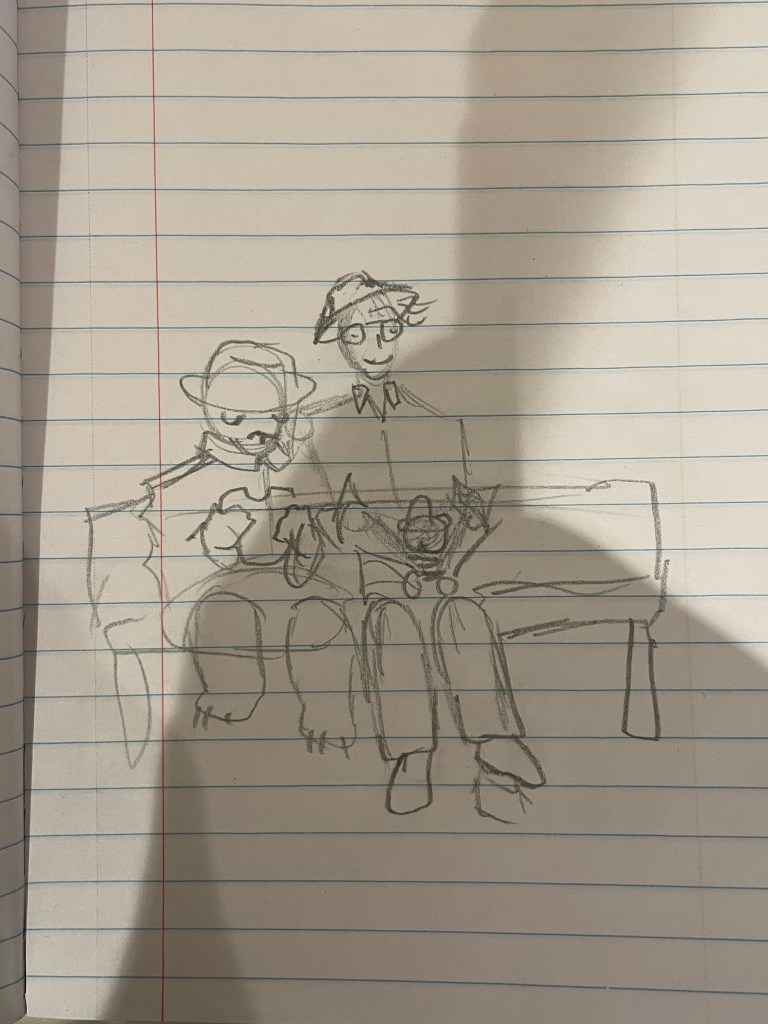
I Disney bounded as Paddington today and I got a photo with the Paddington statute at Piccadilly with my bears. Alyssa is not sending me the photo though so I drew a quick picture of what I think it looks like.

Okay, bedtime.

Westminster Abbey

Today we took a wonderful tour of Westminster Abbey. I was super excited to see where William and Kate got married! The tour started off semi slow, but soon picked up when we entered the coronation room. I also walked by what is known to be the “oldest door” in London. I really wanted to touch it but I had to walk away before my intrusive thoughts got the best of me. Towards the end of the tour we were shown most of the people buried there. The coolest one to me was Sir Isaac Newton, like I knew he was real but I still thought of him of just some name in history. Lowkey was kind of starstruck.

The first person that caught my attention was Charles Dickens. He was an English writer and novelist, and passed away in eighteen seventy. He wrote some well-known books like A Tale of Two Cities and A Christmas Carol. He passed away at his house in Rochester and people thought he should be buried at Westminster due to his popularity. It was said that in his will he just wanted his name on the tomb and he wanted to just be remember by his work.

Next was Robert Browning, he was a poet. While doing research it was shown that The Ring and the Book was his best work. He married another famous poet Elizabeth Barrett and had a son named Pen. They both passed away in December of eighteen eighty-nine. They were both sick and died in their son’s house in Italy. Elizabeth is buried in Florence, but the cemetery was closed, so they decided to bury him at Westminster. They have Robert buried there and a memorial on the tomb for his wife. His son’s ashes are right by his head in the tomb too.

Finally, the last person that I thought was interesting that was buried there is William Camden. He mostly known for publishing his dictionary, Britannica. It is the world’s “oldest continuously published encyclopedia”. He was buried there in sixteen twenty-three. There is bust with a carving of him holding his book in his left hand. While looking this up I saw that his bust got damaged in the civil war but was fixed up by the University of Oxford. Super cool day and very glad it wasn’t too hot in there.