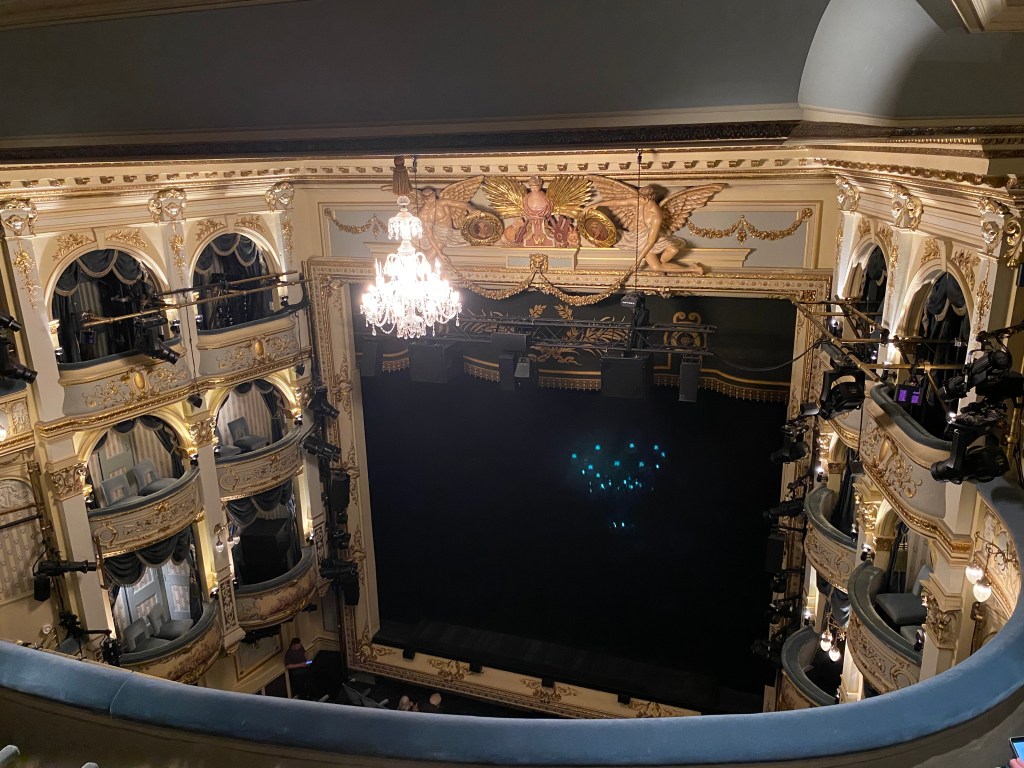
Last night, we went to Wyndham’s Theatre to watch “Long Day’s Journey into Night,” by Eugene O’Neill. I was so excited to watch this show because the play means a lot to me, and I was prepared for this heavy and long night. The theatre space we watched in was chic and beautiful, and I loved observing the environment before the show. As soon as the lights came up, I was giddy to watch Brian Cox. After seeing him in Succession, I knew that he would be perfect in the role of James Tyrone and couldn’t wait to see how he portrayed it. I was not disappointed!
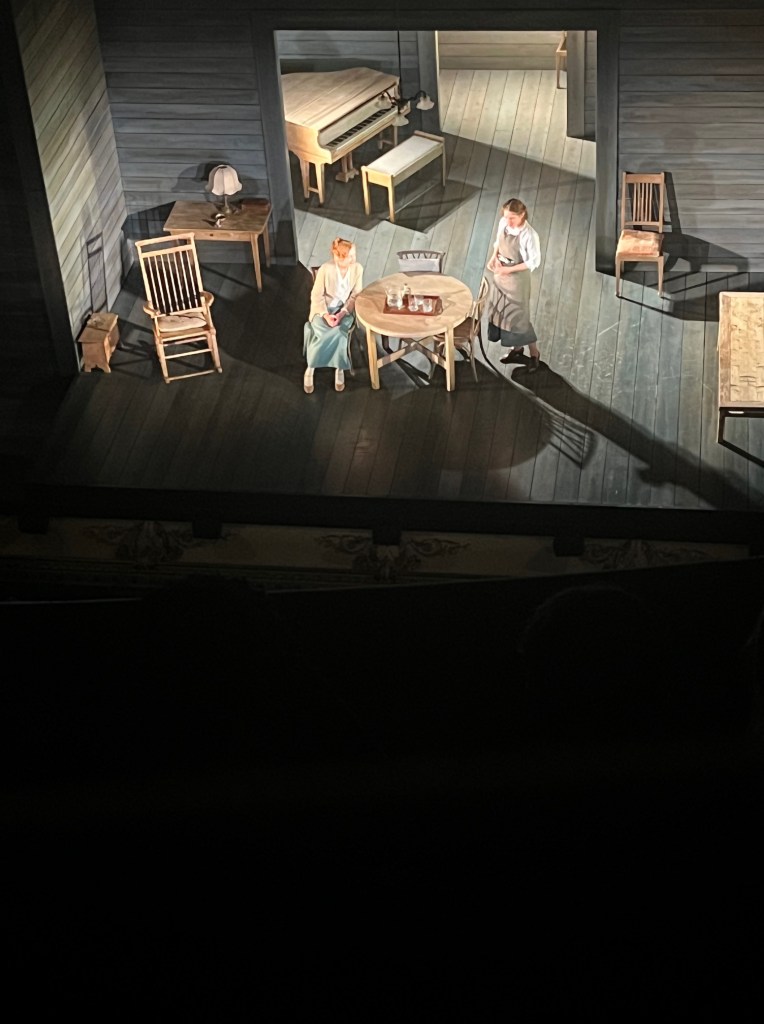
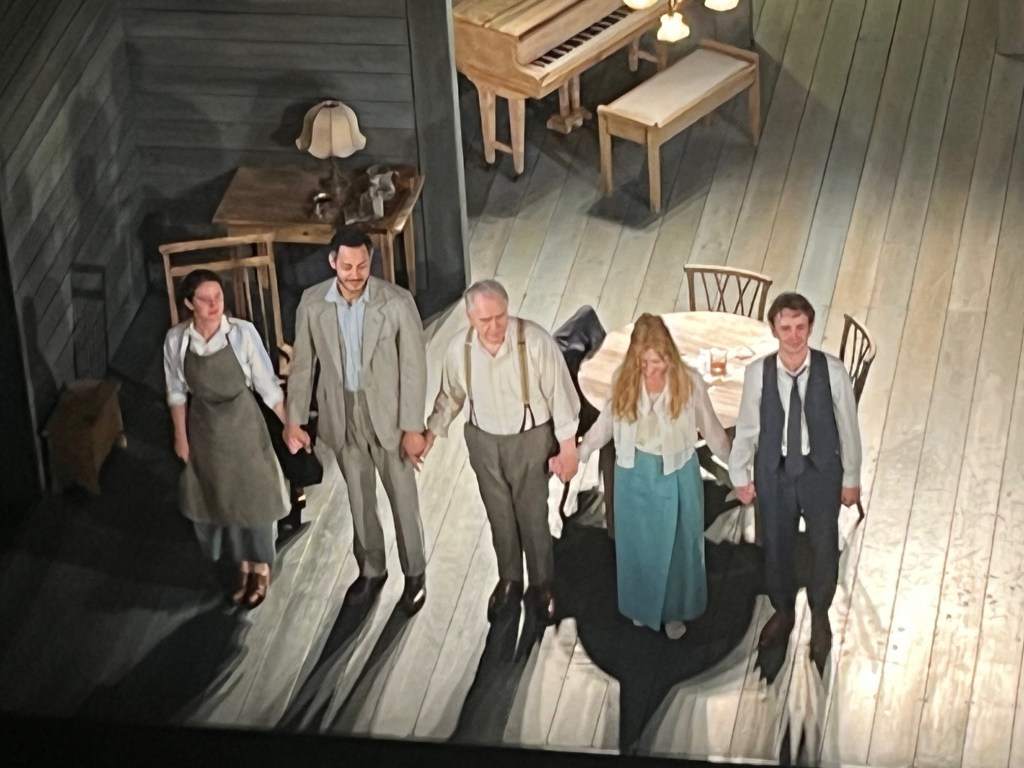
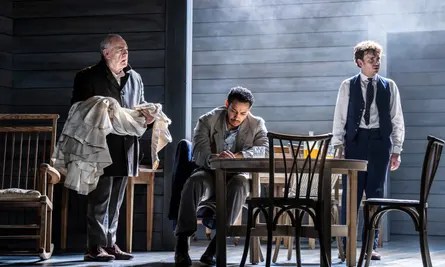
While reading the play, I was interested to see the set design of this production. I liked how there was a center room where the main action took place and how the piano was situated just barely out of view in the room behind, alluding to its importance later in the action. I was a little confused because the room seemed like a dining room and they kept mentioning going to eat, so I was wondering if there was another room they were supposed to be eating in. I am not sure how I pictured it, but when reading the play, I thought there was a living room or den where the central action was taking place, with the kitchen/dining room being off-stage.
It was intriguing how minimal the set was, with no decorations and little furniture. I feel that this was a deliberate choice by the designer to represent Mary’s complaint of their house not feeling like a “home.” The muted and matching tones of the wall and floor were also interesting and gave the room a cabin-like feel. The lighting design worked in tandem with the set design to provide a bare and pale persona to the actors, which made the room feel stuffy and empty at the same time. Between each scene break, there was a complete blackout, which was an interesting and exciting choice for me because it created a stark contrast between the scenes. The lighting designer could have chosen to have a smooth lighting transition between them, but I felt this was a deliberate decision to leave the audience in the dark as to what was to happen next.
The sound design was eerie. I enjoyed the cues during transitions– they created even more suspense for the audience. The foghorn was an important motif, and I was glad they incorporated it into the sound design. Also, the creaking when Mary was pacing upstairs added to the family’s apprehension.
One thing I was especially looking forward to seeing was how the actors would embody their slow decline into substance abuse. Overall, I would say that they did a great job. Mary’s character definitely had a journey and throughout the production, it was obvious when the drugs were creating a fog over her mind and turning her into a different person. I liked how Patricia Clarkson played Mary’s character with more mini energy– her motivations came from internal obstacles and were not always overt. Laurie Kynaston, playing Edmund, had great dynamics in his acting and allowed things to weigh on him until he couldn’t take it anymore and exploded with frustration. Of course, Brian Cox did brilliantly, as I knew he would. I was interested to see how he could demand the stage with his voice, especially when yelling at his children, yet still remain soft with love for Mary. I feel like that Cox might have related to his character strongly because his monologue telling his life story had me in tears. The whole show had me in tears, (poor Shawn had to hear me suck my snot in for 3 hours), but that’s neither here nor there.
The only actor that slightly drew me out was Daryl McCormack, as James Jr, because I felt that his American accent caused him to lose energy in his voice and took emotion away from his acting. I still think he did a great job, but it was obvious that he was putting on an accent, so as an American, it was hard not to pay attention to it.
Overall, I believe I would recommend this play to everyone, even non-theatregoers. Especially if they have experienced living within an addictive household/knowing someone who has struggled with it– it is cathartic to be able to relate to art. However, this play was also hard to watch at times. While it is a great release to feel seen through theatre, when watching productions with heavy material, it is important to try and separate your reality from what you are watching. Plays addressing trauma are important, but boundaries are more important.
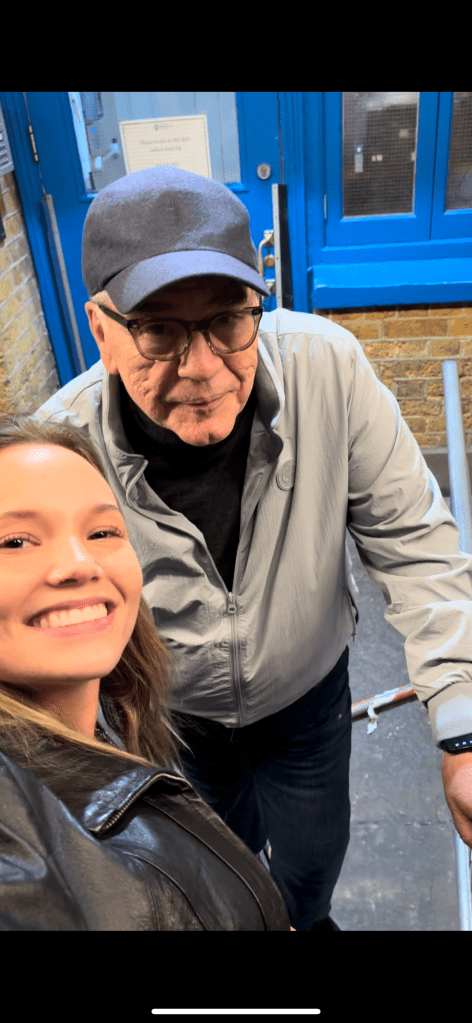
Also, I got to meet Brian Cox! He was a very sweet Scottish old man, entirely different from the raging father I have seen him play. I talked to him a little bit about theatre, and he listened! At least, he successfully pretended to.
I would be careful to recommend this production of the play to other theatergoers. It would completely depend on the theatergoer because this is such an artistic and desperately tragic story. There are some people in my life, family and friends, who could not watch this play for the difficult topics, their lived experiences, or their lack of attention span. I do not believe this play exists for entertainment. This play is for the poor souls who struggle and need to be seen. The topics of this play are addiction, escapism, blame, trust, coping mechanisms, festering in the past, life, and death. Most of the story is told with tediously long and impressive monologues. It is hard to get through, and we do need works of art like this that display realism in difficult situations. Plays that make us a little uncomfortable at times, so we can ask ourselves “Why?”.
This production as a whole is well done. The director and designers paid attention to Eugene O’Neil’s overly specific stage directions to an impressive degree, especially with the casting. Mary had her signature faded reddish brown hair that she reminisced about for so long. Jamie didn’t look at all like the rest of his family, while Edmund looked like he really could have been a son of Mary’s. James Tyrone didn’t seem the older but devilish silver fox he was described to be, but was played very well by Brian Cox. I probably would have made the same casting decisions.
The following sentences are some of the other things I saw that were good but I would have designed differently. The fog horn in the background was a good touch and was played only in moments of clarity and truth. I saw the significance as the characters navigated through their individual fogs. However, I wish I saw more fog. Way more fog. I would have flooded the stage with fog that crept in through windows and doors. Simulating the hazy tortured living the characters endure at the end of every day. The music was very interesting. Very very minimal. I think there could have been more, more instrumental climbs and falls would have made the monologues more interesting and simulated lyrics of poetry.
The lighting with windows and sun angles were really cool! I thought the sun angles were very cool and accurate if we assume the audience is facing true north. The sun in the morning crept through the east window and set early afternoon through the west window. I really liked the white light at the end casting the family’s distorted long black shadows. It gave the ending this haunted uneasiness.
The set did well, I would have liked maybe a little bit more. Bookshelf, formal unused dining ware, or pictures maybe. But perhaps that ties to the theme of a house not being a home. The plainness of the room was notable and forced the audience to pay more attention to their words and expressions than the set design. I thought it was creative and important in the plot to center the action on the parlor, but in the play, it was supposed to be a little more decorated for mere appearance because that is just the pride and shallow ways of the Tyrones.
As far as the writing goes, I think that this retelling could have been made more modern. The monologues were too long for me to stay immersed in the story. It has been the only show of the trip that I have wanted to keep watching my invisible wristwatch.
–I thought Mary and Cathleen were the best parts of the play. Cathleen gave the play much-needed life and moments of comedy. To myself, Patricia Clarkson is now Mary Tyrone. She played the part very well and brought attention to some of Mary’s habits that are very important to the story. For example, her shaking hands and denial of addiction. There was a part in particular where Mary broke the 4th wall while dangling her feet off the stage to talk to the audience. Genius. Loved how in the context of the story, she’s talking to people who aren’t there because she’s hallucinating. So to her other fellow characters that makes her look crazy, but to the audience it feels like she can finally see what the others cannot. Like she seeing beyond the sad repetitive world. But like I said, to her sons and husbands, she just seems to be on another plane of reality and out of touch.
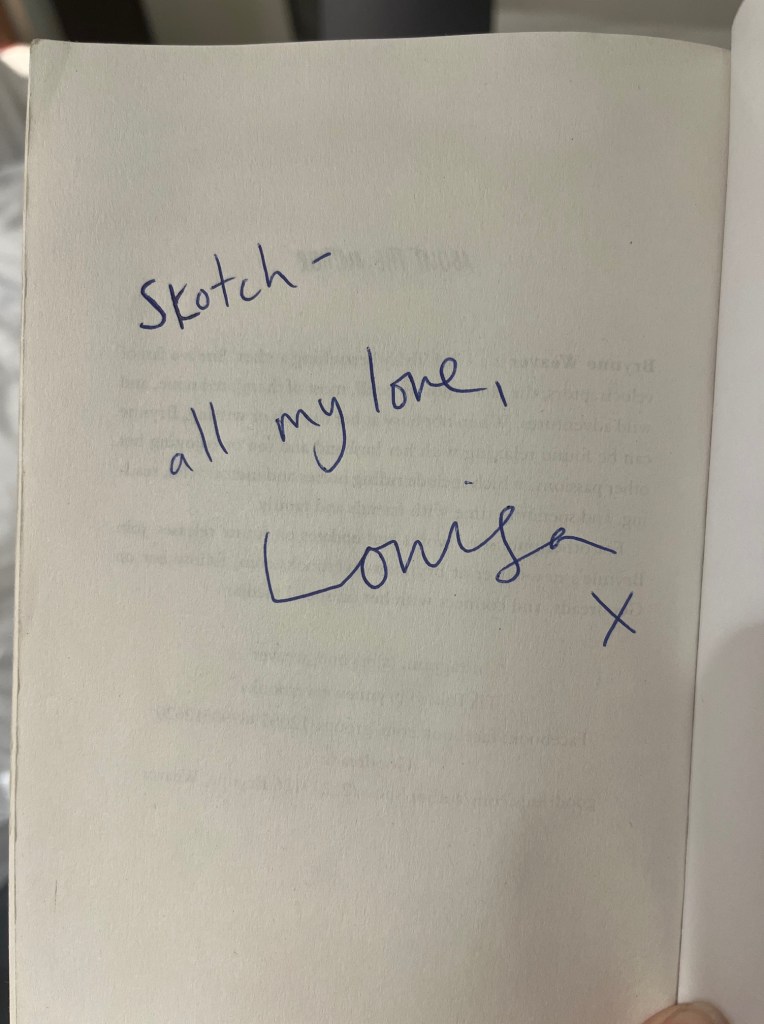
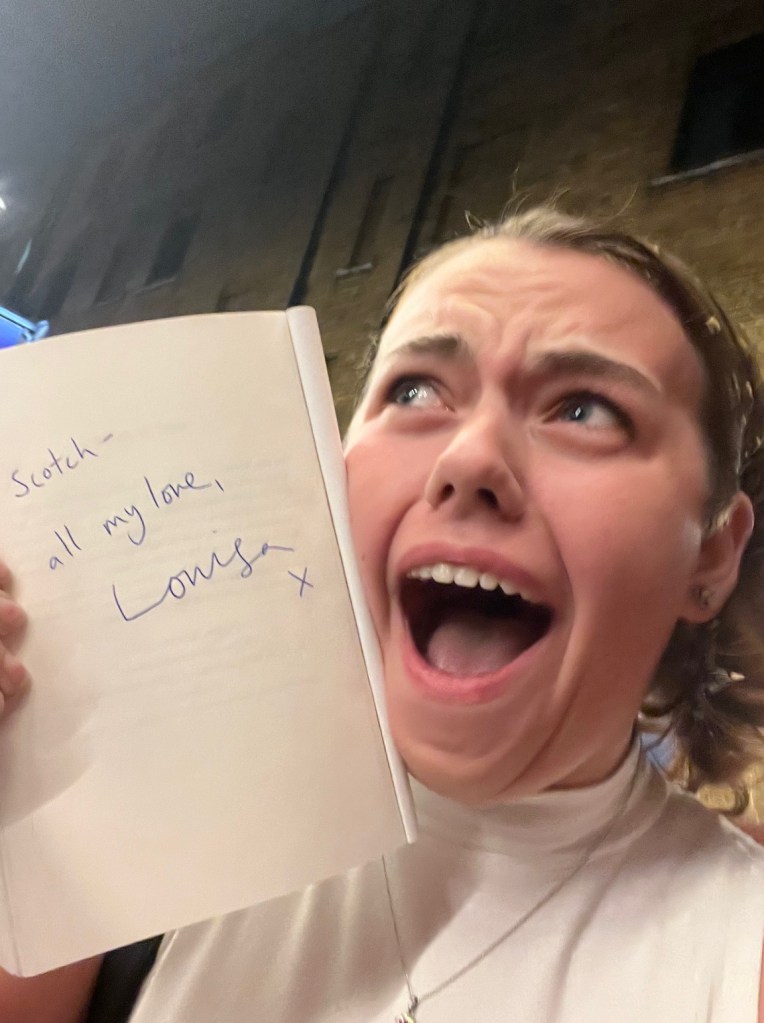
All in all, good production, but I think some elements needed to be work-shopped a bit more. I still can’t believe I met Louisa Harland!!! Ahhhhh. Best part of the night besides the final applause of the show.
It’s time for another post from your favorite blogger in the world! Aren’t you glad I’m back? Not that you would have missed me. That’s right, I know you were hiding in this statuette of a little man inside the British Museum.
Jokes aside, yesterday I did a lot of things! I went to the British Museum and toured a couple of exhibits.
After that I traveled all over London with Kaylee, and we got another wicked vegan dish from Oliver’s Falafel (10/10 by the way), followed by some more walking and gelato (from Anita London, another 10/10). We both walked for a very long time, and for a considerable distance as well. All in all, it was a very fulfilling day for me.
Following our adventure, our group saw A Long Day’s Journey Into Night written by Eugene O’Neill, which is currently showing at the Wyndham Theatre. We were tasked with writing a critique of sorts, so I hope you weren’t expecting my usual funny-haha blog post with this one. I went in with very high hopes, because the lineup of actors for that show is stunning, and I tend to have high expectations for anything that has made it to the West End. I also read this script prior to seeing it performed, so I thought I knew what to expect, and was very excited to witness it come to life; I could not have been more wrong about what would happen on that stage.
With Brian Cox and Patricia Clarkson in the lead, I felt that I was in safe hands when it came to this show. I love the script on its own, and I know both of them in their other works. I know that on their own they are wonderful actors. I was impressed by Brian’s performance and felt that he was the most alive of all of the actors, but the rest of the cast fell a little flat for me as an audience member and a lover of this play. I was not impressed by the monotone acting style of Clarkson, whose character has a strange, but very existent emotional arc over the course of the play. I felt that there was not much change from beginning to end, and it made me more disconnected from the character than I should have been, watching her on stage for three hours. Each of the actors had their moments, but I was not particularly impressed. How much of my dissatisfaction was due to actor choice or lack thereof, or directorial vision, I cannot say. I believe it was a mix of the two overall, but as I was not in the room, I feel that it is not my place to critique those portions of the production any further.
As it is, I feel that I am not entirely prepared to talk at all concerning the acting of the people on the stage. This is not because I do not have thoughts on it, but because throughout the entire runtime of the performance, I was focused all the way in on technical elements, which made it difficult to focus on the action of the play. This was partially due to the fact that this production did not agree in the slightest with the way that I saw the play initially. I tend to enter plays blind to the script as well as I can, because a lot of the time my vision for a play will interfere with what I see on stage, and disappointment takes hold. Even after letting my thoughts settle, I cannot be sure of how much of my disdain for the technical elements is based on my own ideas and how much is the actual invalidity of it. Regardless, I can say that the set and the lighting did not agree with the script in any way that I can see. I found the sound design to be wholly distracting from the aim of the play, and at multiple points I genuinely could not focus on the play due to the way that the lighting and sound designs were either overwhelming or underwhelming me.
Immediately upon the rise of the curtain I knew that the set was not what I had expected, and I grew disappointed in it over time. The script has a very elaborate description of what it should look like; in fact, upon reading it, I wondered how exactly they would plan to put this on stage. Apparently, to the set designer, Lizzie Clachan, the answer was not to put it on stage at all, which is a sentiment that I do not share. Even if the exact titles of books that were on the shelves in the script were not the same, The imagery that was lost of a performative household when Clachan decided not to put in the actual decoration of the household devastated the storytelling ability of the narrative. The only pieces of furniture that existed on the stage last night were those that were directly utilized by a cast member. While this stripped down approach is common in modern theatre, and does work very well in some instances, I do not think that it worked well here.
I also found during the show that I had no idea how the house was laid out. We see the living room, a parlor, and behind that, a room where we know leads to the kitchen on one side, then stairs and a door on the other. This much is fine, and clear; that much is prescriptive in the text. However, I found that the further into the script we got, the less clear I got on certain points. The primary one was where the front of the house was. About halfway through the script, everybody but Mary is shown going out to town. They go out of a door that is situated near the back of the set, which consistently confused me throughout the play. This is because earlier, when Jamie and James go to work on what is specifically called the front hedge, they go out of a door that is imagined on the left hand side of the stage at the front. Mary also watches them as they work, specifying again that they are working in the front, which seems to be in front of a window that makes up part of the fourth wall. This makes me wonder why the three of them were exiting out of what would be a door on the back side of the side wall of the house. I’m not sure if this is simply a misconception on my part, but I do not understand why there should be such a question over it in the first place. While this moment of inconsistency is small, it did bother me for a while that I was not sure how the house worked. It cast confusion over the entire play for me, not knowing what kind of space I was being isolated in. While the world around the house is meant to be shrouded in fog, the house should be certain.
Clachan also did the costume design, which I had no issues with. I loved Mary’s outfits and the progression of them as her grip on reality began to slip. The initial gown was beautiful, and the way that Edmund’s clothing was a mix of her clothing and his father’s was a beautiful touch, where the stage direction is impossible to meet. Similarly, Jamie is dressed like his father, but seems to be detached in costume design to the rest of the family. Overall, the costumes were nothing special for the most part, but conveyed what they needed to.
The costume design, however, was where I stopped being pleased at all with the show. Jack Knowles designed the lights for this show and looking at his resume, I had high hopes for him, because he clearly has a proper grasp on lighting design. I think that despite his prowess, this project fell short. At no point in the play did I properly see an actor’s face, other than at a singular point where every light on stage lit up, literally blinding the audience. After a few seconds wherein my eyes adjusted, as some of the lights that initially came up dimmed, I could see some of the actors’ faces for a split second. The fact that the only time I could see the actors’ faces was at the very end of the play, immediately after being blinded by an excess of light, is one of the many weak points the lighting design that I observed. That being said, I appreciate the contrast that he brought to this play, as the shadows that haunt these characters and the fog that hangs over them are a very important part of the script.
I think that regardless of the need for shadows on the stage, though, it is more pressing that the audience can see the faces of the actors. While the diction of the actors carried well in the theatre, the lack of lighting on their faces in dimmer scenes often made lines unintelligible, or would have been had I not read the script prior. The absurd amount of down lighting on the actors made it impossible to see the most important and expressive pieces of their faces, at all times other than the moment when every fixture in the theatre came up at full brightness.
One of the largest issues I had with this portion of the design was its lack of coherence with the script, which at least is consistent with the set design in that vein. It is clear to me that the lighting designer did take into account the times of day that the lighting from outside was for; it was slanted in the morning, more full at noon, and slanted in the other direction, then orangeish in the evening. At night, it was cool and nearly non-existent. However, the angles that the light came in on were not consistent with a window, but rather a lack of a wall there. Had the lighting been framed at all, I think that it would have been much more effective, but as it was, I was often distracted by the way that the lighting did not seem to be obstructed by anything, like there was simply a hall of light beyond the piano. Similarly, it is established in the script that Jamie is going to work on the front hedge, and Mary looks at him through the window that makes up the fourth wall. However, even if the light is coming in from the side of the stage, there will be a small amount of light coming through the window. It bothered me quite a bit that the front of the stage, where there was supposedly a window, was often darker than anything else. It was as if the living room was cut off from the entire world, including the rest of the house. Overall, the lighting got better over time, but I never fully enjoyed what the lighting on stage looked like. Nothing that I saw was interesting enough to weigh heavier than the confusion I felt over the lack of lighting and the odd angles it came from. While the lighting was indeed captivating in color scheme and idea, I think that the execution as a whole and the choice to bring in abstract elements nearer to the end was not a strong choice. The words of this play are the focal point, and the lighting design often overshadowed the words, or did not support them. The playwright was very precise in the script about what he wanted it to be, and I feel like in all points of design he was put to the side.
The sound design by Tom Gibbons was similarly simply either not present or too present. I feel like many elements of this play were playing the ending at the beginning, and the sound design was one of them. I understand the want to begin and end the play in foghorns, as that is literally what happens, but the specific foreboding tone of the foghorn that is picked for this show was not conducive to establishing what the initial mood of the play should be. It was my understanding that at the beginning, nobody should know that the family is going to end up in the gutter. I firmly believe that the unease caused by the noise that was played at the very beginning of the play, alongside the lack of enthusiasm by the actors playing James and Mary, did not bode well for the correct understanding of the message of the play. The foghorn is a very useful sound to use in establishing the accumulation of the fog, both outside and within the household, but I feel that its inconsistency also made it difficult to believe in practice. My only other large critique of the sound design was that during the fight choreography that occurs, which has its own issues, there were no sounds. This could be either a directorial/actor job or a sound designer job, but either way I found it extremely unbelievable that the slaps and punches in this script did not make a single noise, and this distracted me for a large amount of time following each time it occurred.
The thing that made the fight choreography questionable other than the sound design was the choreography itself. It seemed that the actors were uncomfortable with the choreography itself, or otherwise the fight director, Rachid Sabitri, did not consider the balconies when he choreographed them. There was a large, visible gap between the hand of one and the body of the other actor each time that there was a fight. They were not believable at all from the balconies, and while I am sure the stalls got a wonderful view of the violent moments, there were ways that we could have gotten a similar experience, had it been considered.
With all of these complaints, one would think that I had a terrible time. On the contrary, I really did enjoy getting to see these actors bring these characters to life. I am not sure that it was the most effective production of this play ever put on, but I did find some redeemable qualities about it, which makes it worthwhile. I think that for a student of theatre, it was a good experience, to see a production that had the makings of something wonderful but simply did not work. However, I would not recommend that others go to see this. I am glad that I saw it once, but I would not see it again.
Long Day’s Journey Into Night is a show that I was deeply looking forward to and it did not disappoint. At first, I had trouble with the acting because I could not tell if it was a character choice or not for all of Mary’s lines to feel so regular and almost monotone. However, as the play went on, it started to seem like a genius choice. This is supposed to be what a typical day in the life of this dysfunctional family looked like. If you’re expecting a lot of screaming fighting, that’s just simply not realistic. The people who have seen what this looks like firsthand, which I have, we’re able to appreciate how actually realistic it was.
My one critique is that I wish we would’ve seen more fog as the play progressed. I loved the symbolism of the fog representing the slip away from sanity in the script, and I felt like we were missing a lot of that this time. Otherwise, I was impressed by the lighting and sound design. I noticed the moment where Mr Tyrone stood on the table and turned more lights on, the dialogue took an upbeat turn and when he turned them off again, it was right back to the same negative bickering.
I don’t know that I would recommend this to someone who isn’t a regular theatre goer. I think they might call it boring simply because they don’t understand the beauty behind the theatricality. I actually am unsure of what my opinion would be had I not previously read and analyzed the script.
All in all, I love this play and think it was done beautifully. I was crying the whole way through act 2. Such an impactful message given by a talented cast and artistic director. Bravo!
Greetings, all!! I know you’ve just been aching for another fun blog post from me, but I’m afraid this one will not be it. Today I will be discussing the production of Long Day’s Journey Into Night that we saw last night at the Wyndham Theatre. Spoiler alert, I was not a fan. The show promised to be incredibly compelling. With a world class script and a stellar cast including Brian Cox and Patricia Clarkson, how could it not be? At the end of Act 1, I had hope that the rest of the show would be great because there were some beautiful moments. However, about a third of the way through Act 2, I was ready to go home. The design elements for the show left so much to be desired, the directing was not good, and the only saving grace were the actors. I think they were the only reason I was able to convince myself the show might be good at intermission. Unfortunately, in the end, even they were not enough the rescue this production from becoming a monotonous, tedious, drag. On a good note, the theatre this production was housed in was beautiful. However, the state of the building should not be one of the only things I look back on in a good light after seeing a show.
I will start by addressing the unclear, confusing, and ineffective design elements of the show. Get ready.
The lighting. Okay, the lighting for this script is incredibly important in telling the story, and I was so curious to see how it would be done. The show takes place over the course of one (very long) day, and this needs to be reflected in the design. While the lighting designer did try to convey the passage of time through moving the angle of light as the sun would move, that was about all it was good for. (And even that was done is a very jarring way.) The main problem I had with the lighting was that the actors were never well lit. At first, I could believe this was a choice. Sometimes, it can convey an effective, powerful message to have certain characters “in the dark,” so to speak. However, it was not being used specifically. All of the characters throughout the show could not be seen clearly. The lighting conveyed a mood, and while that mood fit the script at times, it also dragged the whole show down during the times when things were not as dark and hopeless. This show is not joyful, and it’s not meant to be. However, to set such a dark tone from the beginning (before things have gone far downhill) indicates the ending of the show to the audience.
The set for this show was also very plain. I have mixed feeling about this because I can understand what the designer was going for. Mary talks throughout the show about how the place has never been a home to her, so making the set rather bare plays into that idea well. However, it was a very literal, unoriginal interpretation, and I think it could have made those lines more impactful if the place did look like the home O’Neill so vividly describes in his script. For the place to appear as a home and not be one is more impactful than saying, “Oh. Yeah. This barren house with no books, decor, or life is not a home.” I understand that designers and directors like to create new interpretations of the work they read, and there are times when I encourage that. That said, when a playwright is incredibly specific about what they need or want the set to look like for a show, I think it is wrong to ignore it. They know the script better than anyone, and they know what is needed to give the story the necessary emotional impact. That becomes lost so quickly when people strip back everything the playwright wanted, and I see it almost as a disrespect to the writer to so blatantly flout their ideas as this production did.
The last design element I’m going to talk about (for this blog, at least) is the sound design. I initially thought the sound design had a lot of promise, but in the end, it was ineffective and confusing. The cues written into the show (such as the foghorn) were done well. I think it went off at appropriate times, and the volume level was enough to be noticeable without pulling attention. It was the added sound cues that drew me out. This production made use of underscoring, and the first few times it was used I liked it. I found it effective in conveying the gravity of certain moments. However, it eventually became distracting, as it was used too much, and they were using it in moments that didn’t make sense. I was confused as to why and how they were picking moments to use underscoring, and it started to feel like trying to put a movie on stage. The underscoring was a very cinematic technique, and it can be very effective in movies (and at times, on stage), but in this case, it did not translate well.
Despite all these technical shortcomings, I had hope that the show might be saved by the incredible performances of the actors. Sadly, I was wrong, and some of their performances fell flat as well. I do believe this was in part due to the direction, but some of it was simply a matter of the actors not being dropped in. Brian Cox gave the most consistent performance of the cast. There was never a moment where I didn’t believe he was the character. He responded to everything with incredible truth, and I think he had a clear vision about who his character was and what his values were. Patricia also gave an incredible performance at times, and she had some of the most impactful, heartfelt moments. However, I would have loved to see more range and change in her performance. While there were moments when she would break down, scream, or act slightly different, I never saw her hope in the beginning. Had she leaned more into the idea of Mary’s slow decline, it would have been much more interesting to watch, but she ultimately fell into the rookie mistake of playing the ending of the show from the beginning. It was like she knew all along how everything was going to go. Maybe that was a character choice, but if it was, it was not a compelling or interesting one to watch. Patricia Clarkson did excel when it comes to having heart, but I think there was not enough thought put into the arc of Mary’s story. She was able to show her incredible talent for emotional moments, but that resulted in her playing the mood of the show rather than showing us the true impact each moment and discovery had on her character. Had she not played mood, but rather allowed her emotional state to decline as the family deteriorated, her performance would have been show stopping. All that said, I’m not sure how much of Mary’s performance was a result of Patricia’s acting or the director because the director is ultimately responsible for making sure that the show has a clear arc. The director has the power to give away the ending and set mood, and if they do that ineffectively, there is only so much the actor’s can do to fix it.
Speaking of Mary, one thing that stood out to me in watching the show even more than when I read the script is the way the men use Mary as a way to ignore their own problems. All the men in the show are addicts as well. They are alcoholics, yet they act as though they have any right to talk to Mary about her addiction to morphine. They talk about how it hurts the family and draws her away from them, but they never face up to their own addiction and the harm it has done to Mary and the entire family dynamic. I do believe that is a very purposeful decision of the playwright, as he is trying to show how blame and ignoring problems eventually leads to disaster, but it was interesting to see how that came across in this production. It was perhaps one of the only good things I got out of it.
The other actors also had good moments, and Louisa Harland as Cathleen was a breath of fresh air. She was the only actor in the show that didn’t give in to the obnoxiously depressing mood. She did have the blessing of playing the character that lends themselves to that mood the least, but it still would have been easy enough for her to take everything too seriously. However, she did not do that, and her comedic timing and delivery was refreshing. Harland also found the balance of bringing a lighter energy without making a joke out of a serious situation. That balance can be hard to find, but she nailed it. She understood when to step back and let things hit harder and when it was okay to be a little goofy, and I loved it. Her performance brought a much needed levity to an otherwise weighty play.
The brothers also had great moments, but their performances impressed me the least. I felt as though Daryl McCormack as Jamie was not fully dropped in throughout the show. I’m not sure if it was because he was uncomfortable with the accent or if it was an acting or directorial choice, but his voice had little changing inflection. He was always at the same loud volume, and it never seemed to change, even when the moment would seem to dictate that it should. It felt very “actor voice” like, so I had trouble believing that he understood the character well. Laurie Kynaston had some very compelling moments as Edmund, but there were also times when he seemed to fall victim to an awareness of the audience or something that kept him from staying dropped in. There were times when he was so alive, and I was enthralled by watching his emotions play out. However, there were also moments when I caught my thoughts drifting away from the show entirely during his monologues, as I couldn’t stay in it.
In regards to the brothers, I think some of their acting troubles may have been the result of the bad and unclear direction of the show. Being less experienced that Brain and Patricia, I could see where they would struggle more to make their character come alive without a clear vision and guidance. I think the main difference in the performances of the brothers and their parents was the lack of clear values and perspective. Whether I liked Patricia’s take or not, she and Brian both had very clear visions about who their characters were and the values they held, and the brothers seemed to be lacking that.
I went into this show with so much hope. The script is incredible, and it tells a compelling story about the dangers of ignoring your own struggles for the sake of others. Each of the characters are looking for an excuse not to face their issues, but they also deliberately make them out to be nothing because they do not want to worry each other (Mary in particular does this). They each think that the others’ struggles are more important, so they hide their own to the detriment of everyone. That is an incredibly compelling story concept based on something that many people can understand and relate to. I want to be able to recommend this show to everyone because of that, but sadly, I do not think this production tells the story effectively. I would absolutely recommend that people read this play, but I would not recommend this production to anyone. I would normally argue that a show like this is simply not for everyone because of its depressing nature but that it still has immense value to watch. However, this production does not seem to capture or convey the message the story presents, as much as it does the mood. It captures only the darkness with no room for light in the form of audience revelations they can take into their own lives. If a play is going to drag on as this one did, it needs to have more of an impact on audiences. Long story short, save yourself three hours of depression in an uncomfortable seat, and just read the script if you want to know the story. This production is not worth your time, but the story is.
Hi! It is currently 9:40am London time and my legs are sore, my back is sore, and my brain is sore. Yesterday was a very long yet information filled day. We went to the Colonizer Muse- I mean the British Museum, and it was full of so much historical artifacts! If I had to pick a favorite exhibit, it would have to be the Japan or Egyptian sections. No words can describe how it feels to stand next to an object that was carved and created thousands of years ago. While it is such an indescribable feeling but there was also a sense of sadness and discomfort, at least for me. These objects were often bought or given to the British, but they were also often stolen and were refused back to the rightful owners. Exploring the museum with this thought in the back of my mind added perspective I hope that most have.
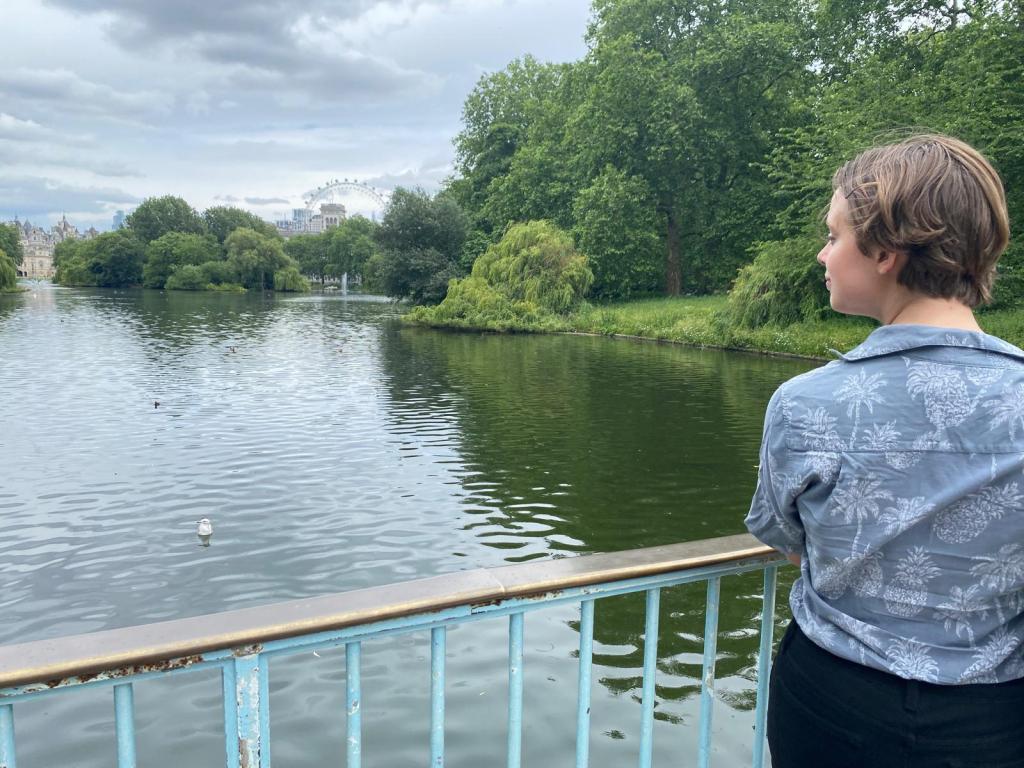
Cori and I ventured off on our own once we finished our British Museum adventure. All we knew was that we wanted to get to Oliver’s Falafel (the BEST place to get a Falafel in London, trust!) and that was the only plan. We walked and walked, and oh, we walked some more. We got our falafel fix and then decided we should get on the tube and get off on a stop we have not taken yet. We ended up at St James’ Park. It was beautiful, wild flowers a plenty, and we got gross coffee and yummy gelato! It was a much needed experience. I have been wanting to just chaotically explore London very desperately and this filled some of that!
St. James Park, which is near Buckingham Palace.Happy Kaylee being one with the ducks. Quack!Oliver’s Falafel!Anita Gelato!
Anyway, enough about me yapping about colonizers and exploring London! Let us move onto the real star of this specific blog: Long Day’s Journey Into Night. We saw this show at the Wyndham Theatre, which is a gorgeous space! We sat at the tippy top, aka the Grand Circle. The view was not particularly bad, but my eyes were terribly dry and add contacts to that mix? I could hardly see the actors facial expressions. As someone who sees shows mostly through an actor lens, this was disappointing for me because of the fact that I could not see very well.
My view from the Grand Circle aka the tippy top.
Let us dive a little deeper into what I saw.
Brian Cox, who played James Tyrone, gave a great performance. He felt the most connected and in the moment of the bunch. Louisa Harland as Cathleen provided the much needed comedic relief throughout the play. This story follows a family as they ALL grapple with addiction. This is a story I can relate to in my family as I have had family members pass away and currently still struggle with similar stories to those in this story. It is heavy, emotional, and a vicious cycle we see take place over the course of three hours. Yes, I said three hours, including a twenty minute interval. A majority of the focus is put onto the mother, Patricia Clarkson as Mary, whose addiction is to morphine. She was prescribed morphine for pain after childbirth of her son Edmund, and has struggled ever since. This portrayal of Mary felt very monotone, especially because there was no clear change in tone, pitch, and volume from her being sober at the top of the show to when she is high again. How much of this was actors interpretation and directors influence? I am not sure.
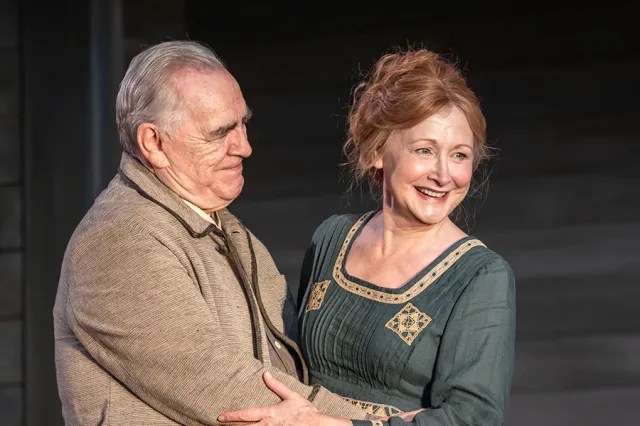
Brian Cox as James Tyrone and Patricia Clarkson as Mary Tyrone.
There were moments where everyone felt cohesive and the story felt real and palpable for me, but a majority of the time there was a general sense of disconnect. The set did not make sense to me and excluded quite a bit from the play itself, including the lighting. It was dimly lit until we were nearly blinded at the end when Mary entered again. The sound felt off a majority of the time, including when I could actually hear the underscore. When reading the script itself, it felt very film and cinematic, so to see that not translate as well to the stage was a little disappointing for me.
Brian Cox as James Tyrone, Daryl McCormack as Jamie, and Laurie Kynaston as Edmund.
Overall, would I recommend this show for someone to see? Sure. I think the director, Jeremy Herrin, could have told a closer vision to the script itself and not have made it feel so moody, but it was worth the watch and to see a version of the script up on the stage. I do feel bad for those that have not had a chance to read the script itself and instead saw this performance and lost all of the power it held through the characters. Herrin could have told a more cohesive story when guiding the actors on the stage, but maybe it was just an off night when we were there.
I would say long time no see, but that would be disingenuous. That’s right, I saw you with your little binoculars on a stick, watching me across St. James Park yesterday. Don’t even lie.
I’m smart enough to know that gosling is actually a drone, but not from the government. I know it’s you guys.
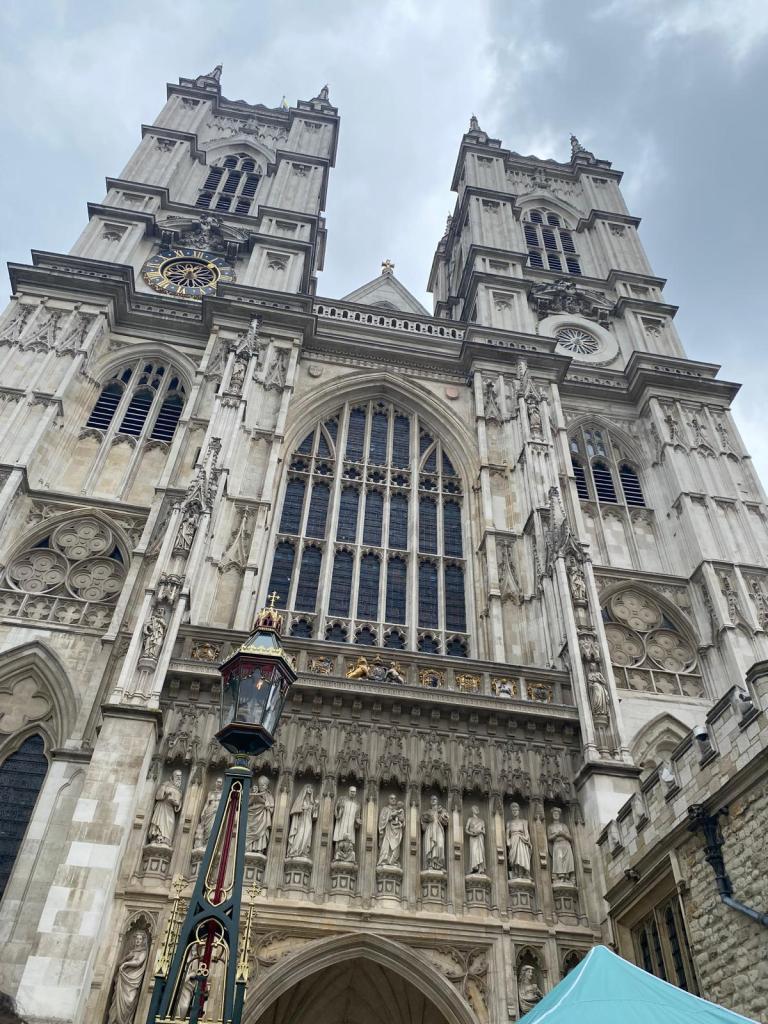
Anyway. I’m sure all of you definitely know this already, but on Monday the group went to the historic Westminster Abbey and got a tour from our guide, Molly. In both tours we’ve gone on with her, she has had a lot of wonderfully interesting things to say, though I will admit that I often cannot hear them or remember them after we’re gone. Nevertheless, I had a very enjoyable time being led around the Abbey by her.
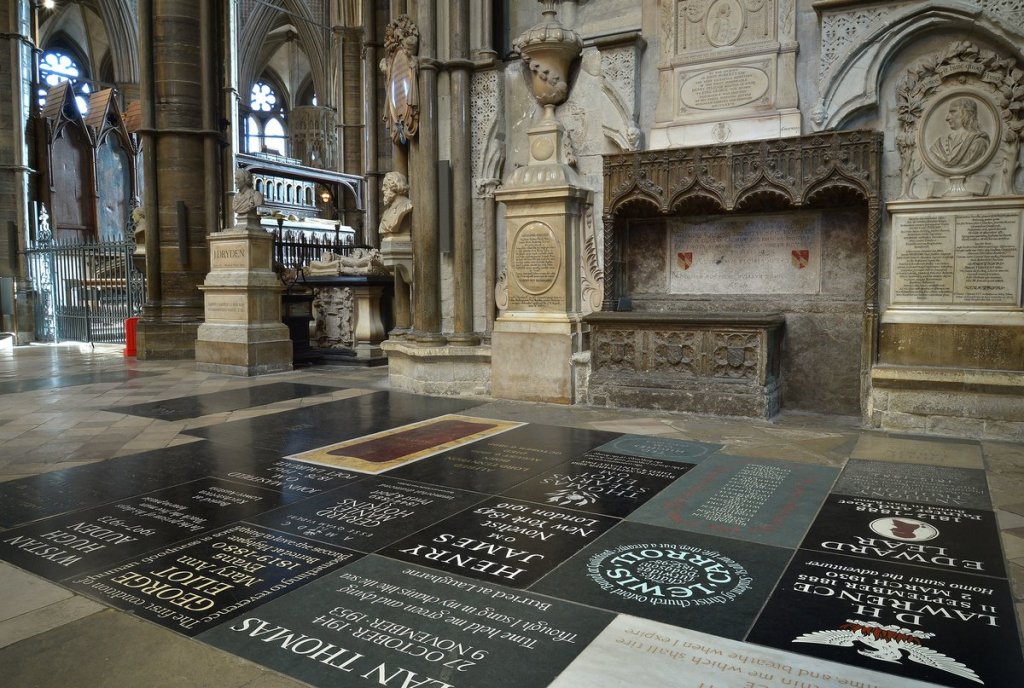
Westminster Abbey has stood for two purposes: first, it was designed to be a monastery, but later it was designated as the coronation location for monarchs, as well as their burial ground. Over time, people who have brought honor to England have been buried there as well. We saw countless plaques dedicated to the dead, both known and unknown. There were great monuments and bits of written-on stone. While we were there, we were tasked with finding some people that stood out to us, primarily in the sections that held the dedications to artists, like writers and actors. My discoveries were mainly focused in the Poets’ Corner, which is the area honoring all of the writers and musicians.
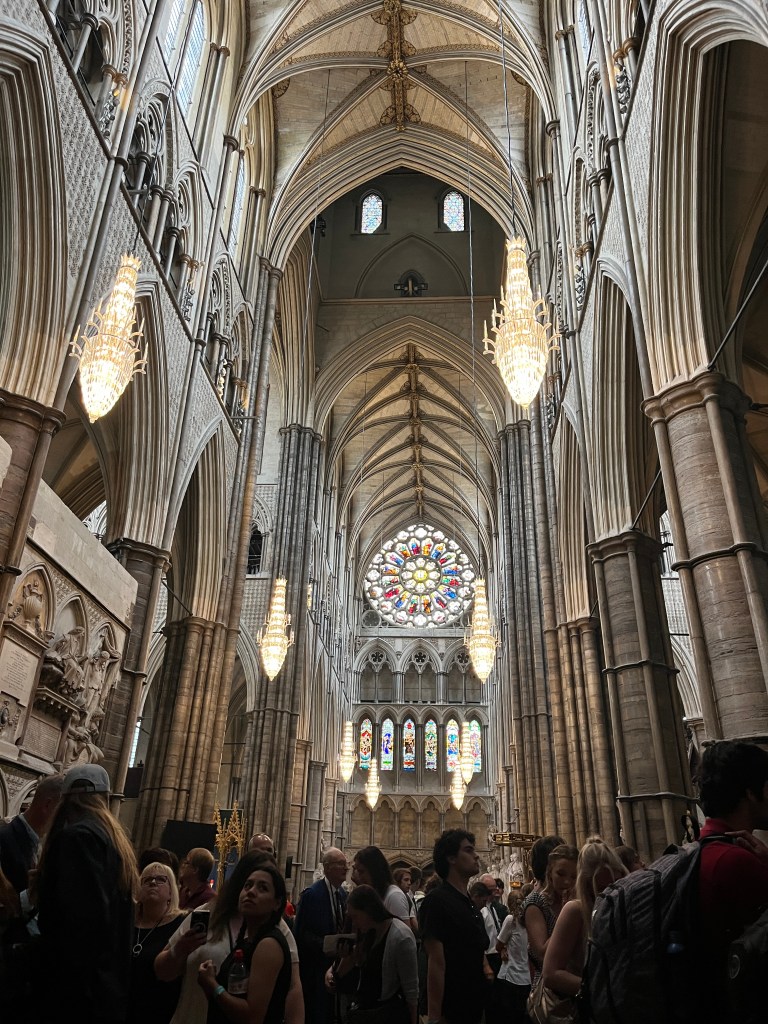
This picture of Poets’ corner is definitely ripped from the Westminster Abbey Twitter… I could have never gotten a shot this clear of people. It was almost impossible to get pictures of single plaques!
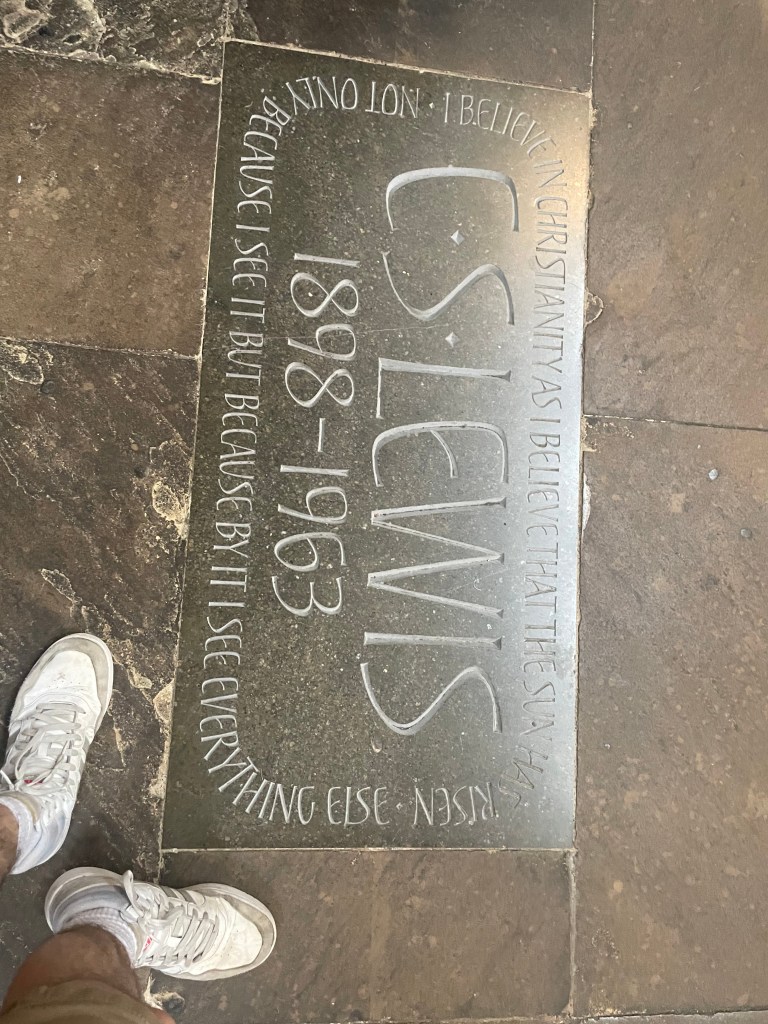
The first that I found was C.S. Lewis, writer of Narnia, who was born 29 November 1898 in Belfast, Ireland. He grew up there, but moved to England after his mother died of cancer in 1908. From there, he studied to become a writer, keeping in touch with his Irish heritage as best he could while being away from the motherland, but always expressing his distaste for the English. He found an idol in W. B. Yeats, who was looked upon in no reverence by the English. He went on to serve the British Army in the First World War, then was rejected from service in the Second. He became a chair at Cambridge University and died in that position in 1963. Upon his death, Lewis was buried at Holy Trinity Church in Headington Quarry, but is honored at the Abbey.
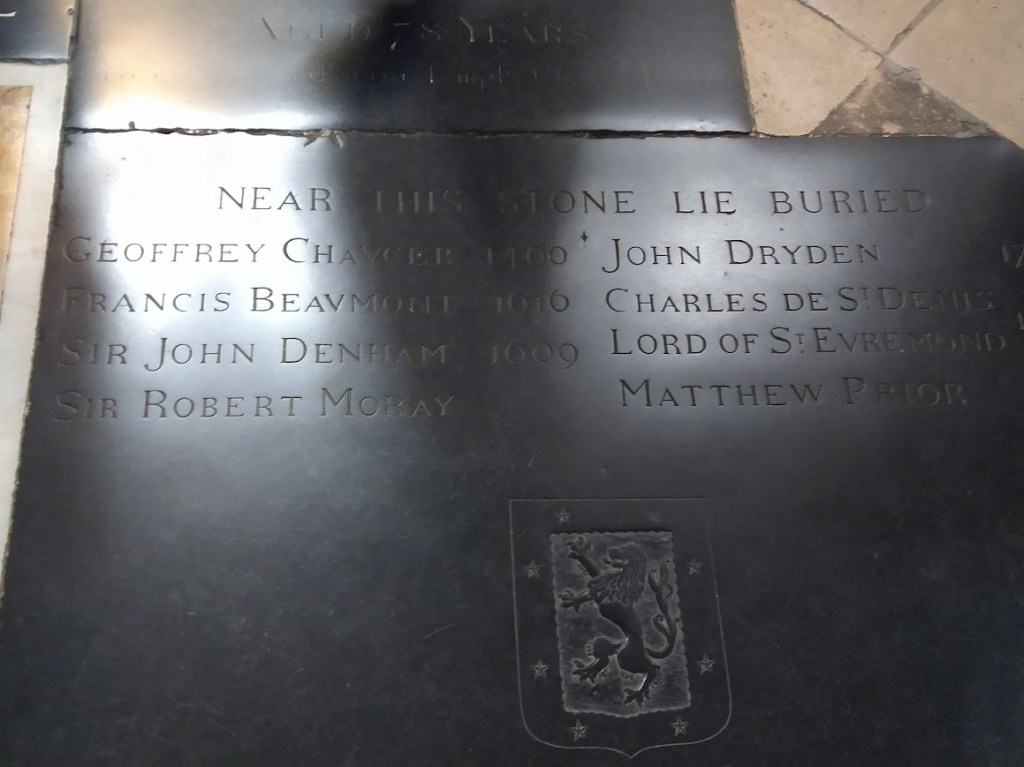
One of the dedications I found that specifically mentioned that the person was buried on the grounds of Westminster Abbey was Geoffrey Chaucer. I have only read him once, in class, but what made him stand out to me was that I remember that I found his writing in the Canterbury Tales to be shockingly modern and interesting to read. He lived from 1343-1412, which to me really asserts how long Westminster Abbey has been standing. While some of the manor has been redone in the past few centuries, a lot of the stonework is original to the building, which is very interesting to see, coming from a country that has only been here a quarter as long as this building has been standing.
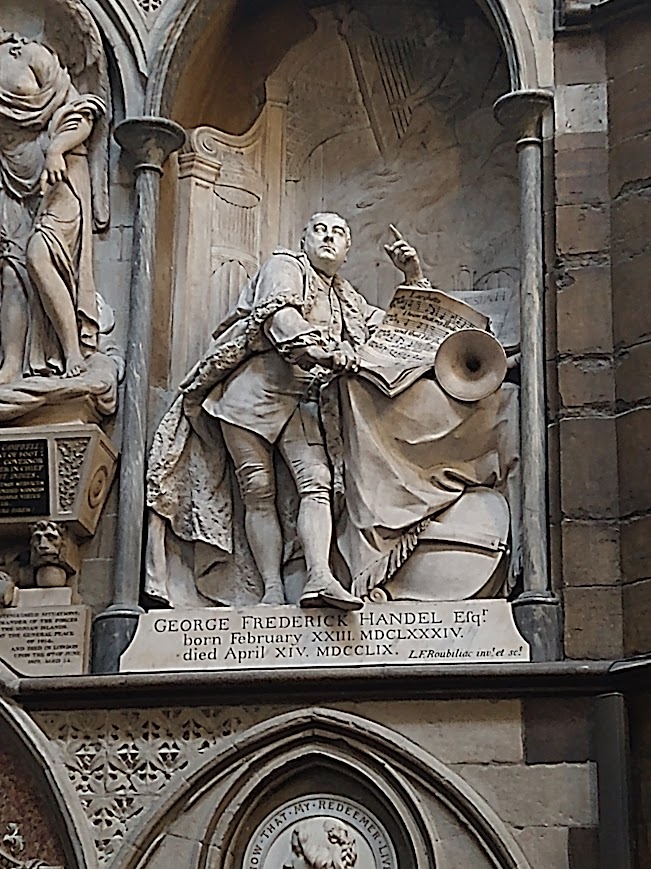
The final person who really caught my attention was George Frederic Handel, who among the musicians, was one of the few that I recognized and actually knew his work. There were many names that seemed familiar, but he was one of the few who, when I saw his name, I could picture a melody in my head. He was born in 1685 in what was then Brandenburg-Prussia. He was not born to a family that already had a foothold in music, which made it difficult for him to advance; his father was a barber-surgeon. Due to his family’s lack of high status, there are not many concrete records on his existence prior to his successful career. His father allegedly discouraged him from music, which only encouraged him more, where the little Handel would steal away to the attic to play the clavichord in the night, when his family was asleep. He moved from Hamburg to Italy, then to London in 1710, where he composed Rinaldo, one of the first Italian language operas and one of his most famous. He became a joint manager of the Queen’s Theatre at Haymarket, which is now His Majesty’s Theatre (where Andrew Lloyd Webber’s The Phantom of the Opera is currently playing), where over 25 of his operas premiered. He never married, and like Chaucer, was buried in Westminster Abbey.
I would have loved to stay and read every plaque in there, and research every name that has been lost to time. I think that places like this, with the plaques and graves of so many people are very interesting. The need to be alive after death in commemoration and honor is very human, and something that I think most of us can relate to. In those who I recognize immediately, I am very interested, but I think that those who are less remembered deserve to be thought of as well.
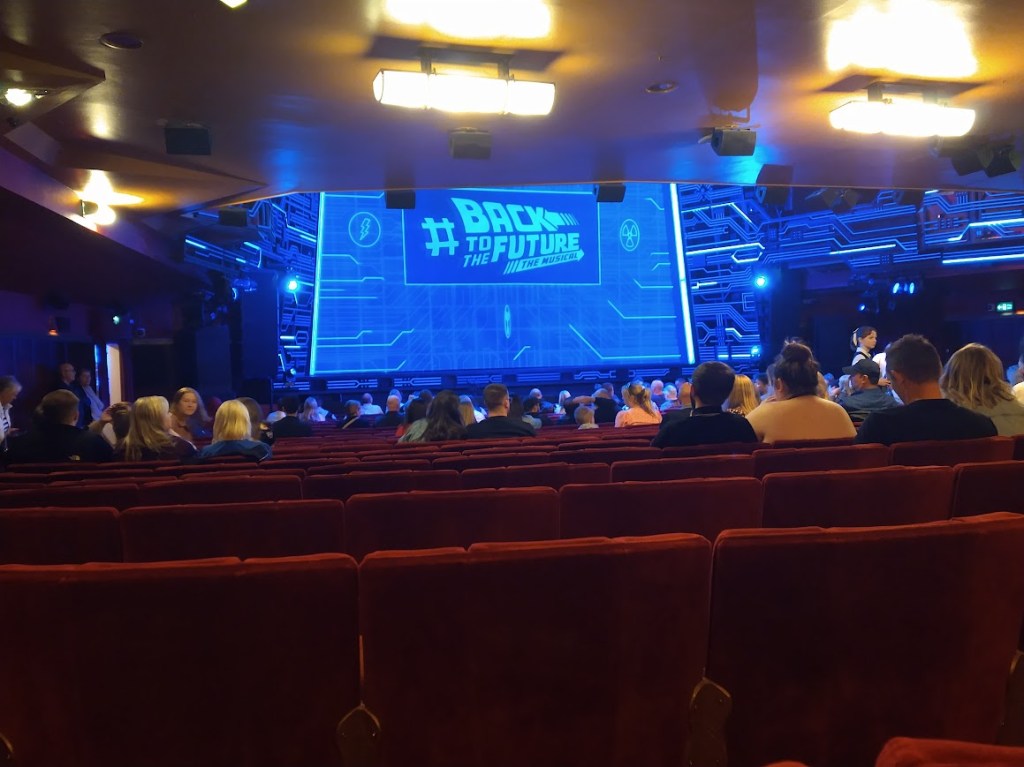
On that note, a few hours after I left the Abbey, I did go to see a little show called Back to the Future: the Musical! Even though the rest of this blog is pretty intellectual, I thought the masses ought to know this little tidbit, even if it is a bit of whiplash.
The tech was pretty much this cool the whole time. Wouldn’t have expected anything less!
I would probably rate the musical a 5/10. I could have seen the movie for less, and it probably would have been better, though I have to admit that the tech for the DeLorean was really cool. Shoutout to Courtneay Irish for summing it up better than I ever could: Back to the Future was just the movie, put on the stage, but with worse music and pretty much the coolest tech anyone could ask for. But really, I have never wanted a jukebox musical more than I want Back to the Future as a Huey Lewis jukebox musical.
You oldheads know this one, right?
Wait a minute, Doc, are you telling me this blog post is finally over?
Many of the sites that we have visited, I have heard of, but had no actual knowledge about. I thought Westminster Abbey was the Palace of Westminster, not just the church. So, to my surprise, Westminster Abby is not only a church but an iconic burial spot. Many of Britain’s national treasures are buried or honored here. Past queens or kings, famous poets, musicians, writers, and innovators are buried or commemorated all over the church.
You can walk over many of the burials or plaques, except for one. There is only one grave that is never allowed to be walked on, and it has a very interesting story.
In 1916, a Reverend of Westminster Abby, David Railton, was in France when he found a grave. He was serving as an army chaplain on the Western Front when he found the grave in a back garden at Armentieres, France. It was marked on a rough cross with the words, “A Unknown British Soldier” penciled in. He was so moved by this grave, a memorial to an unknown soldier, that represented so many of the deaths of those soldiers during that time.
Two years after World War 1, the reverend wrote to the Dean of Westminster, about his idea to make a memorial inspired by that grave. They made it happen, and he was put in Westminster to be buried alongside the Kings. After doing some research, it turns out that the unknown soldier who is buried in the church was chosen randomly out of four unknown British servicemen. They were dug up from four different battle areas: Aisne, the Somme, Arras and Ypres. After the body was chosen, the three others were left by Albert-Baupaume road, so that they could be discovered by anybody searching for bodies in the area. What I could never find out is if those who found and chose the soldier (who is now under the grave), if their family was ever informed. Or was it another operation mincemeat situation?
Another story that stood out to me, was the story of Mary, Queen of Scots. Her father died a week after she was born. So, she became queen at the age of 6 years. She had a crazy life, but what stuck with me was how she died. When she fled to England, she was accepted by Queen Elizabeth. But because many people didn’t like that Queen Elizabeth was in the throne, they were plotting to execute her, for Mary to be in the throne. It wasn’t until a confirmed plot against her, that she decided to execute Mary after she had been imprisoned for 18 years. Which I though was insane, because the Catholics really wanted her to ascend the throne, and they were plotting to kill Elizabeth.
A fun fact I learned about another famous dead person was about Charles Dickens. Who was the one of the few people I recognized by name and whose works I am familiar with. Especially with watching London Tide, a show based of his novel “Our Mutual Friends”. His name was fresh on my mind. What I thought was insane, was learning that he was buried at Westminster Abby against his will. Quite literally in his will he mentioned he did not want to be buried there, but instead next to his sister in law? But his wife didn’t care, and buried him there anyway.
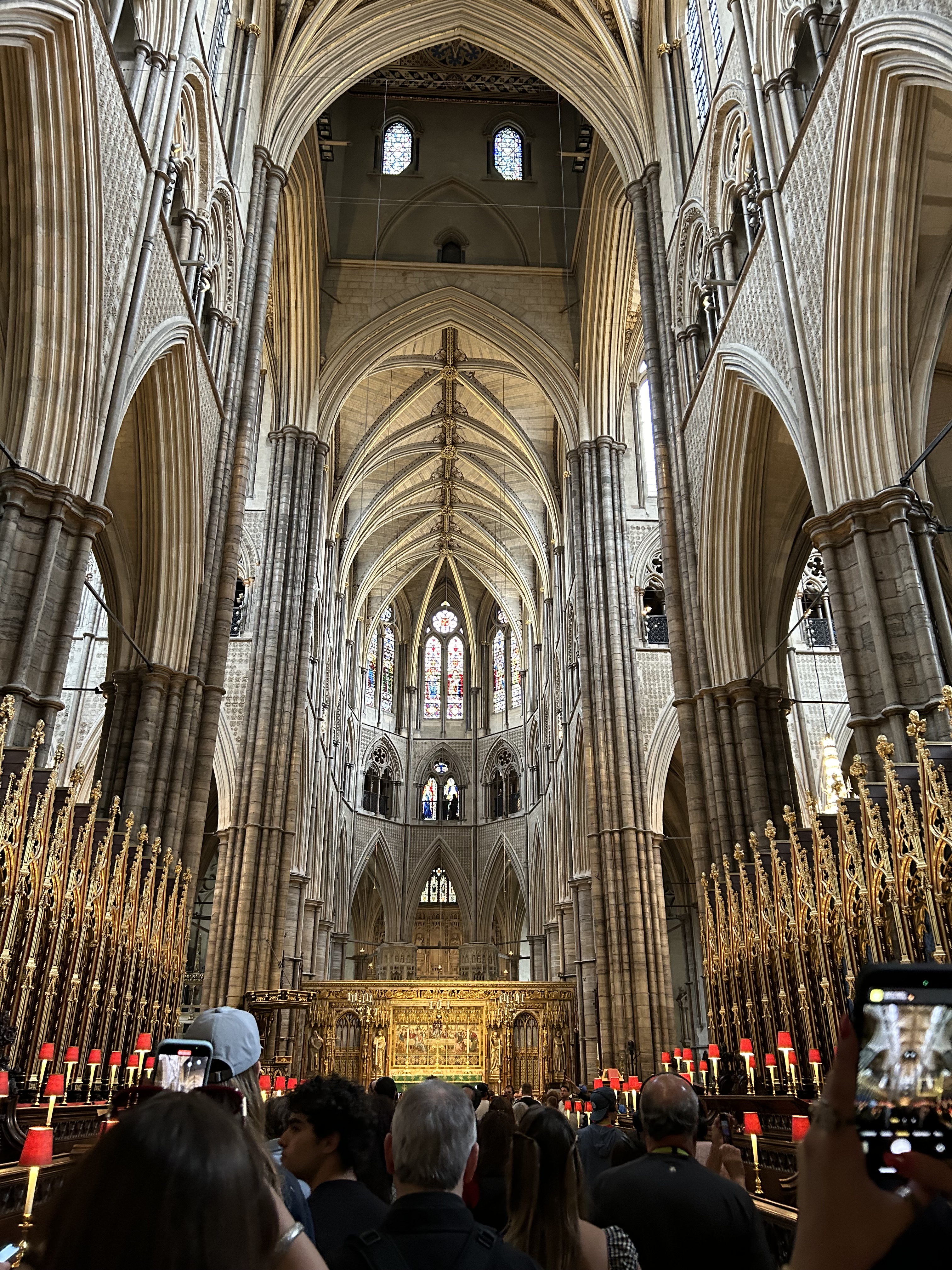
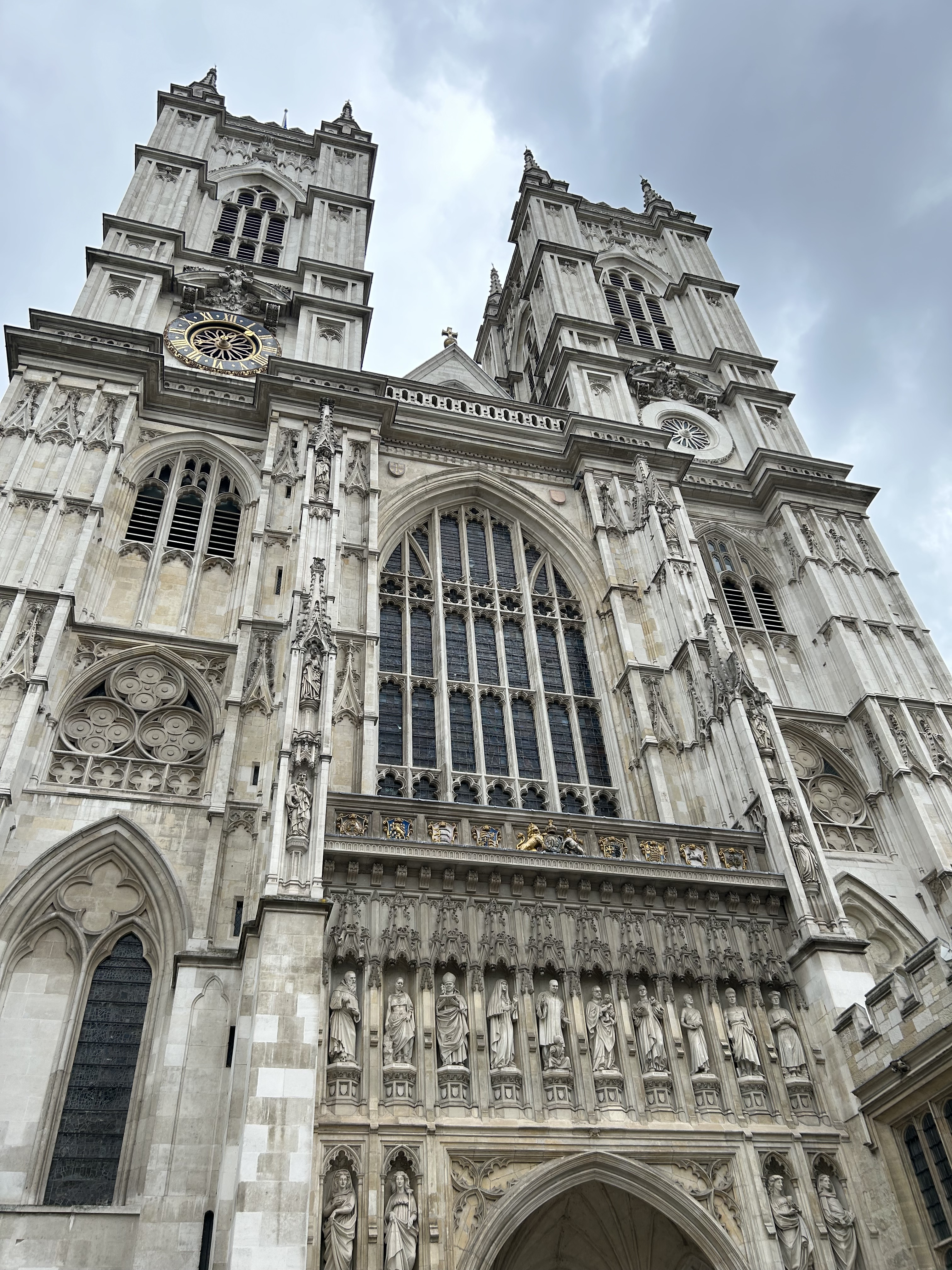
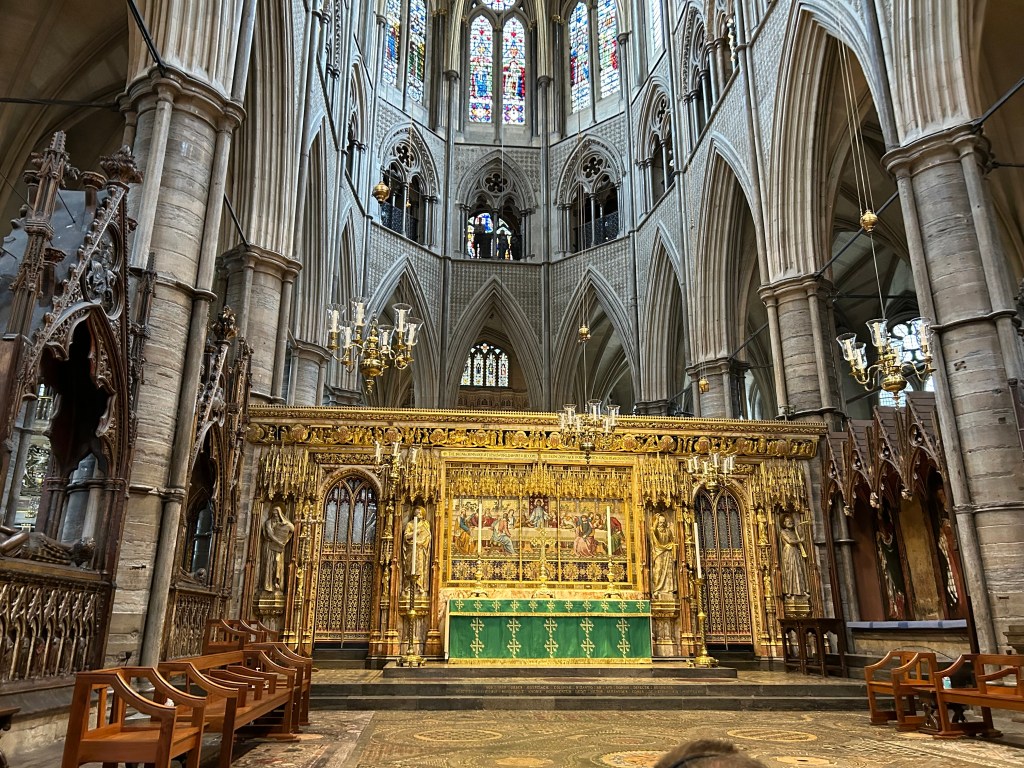
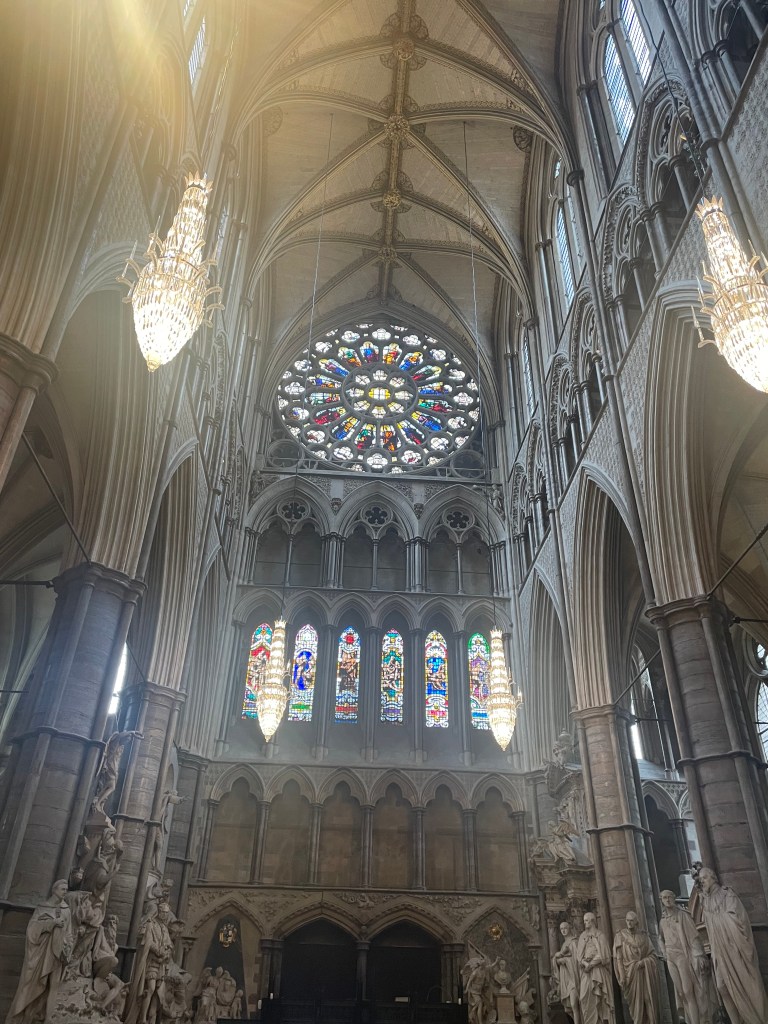
There were so many other famous names and history all over the church. What I found more amazing was the architecture within the church. I was amazed at every turn I took, every time I looked up, just how beautiful everything was.
After two weeks in London, I can finally say that I have seen all of the famous landmarks. After walking all over the city, I somehow kept missing one of the most iconic buildings in all of London: British Mcdonald’s! I also went to Westminster Abbey, but they wouldn’t let me bring a burger inside. I enjoyed walking around the Abbey and seeing all of the beautiful stone statues commemorating the different people buried under the Abbey and a few key people stood out to me.
While it isn’t as grand as Saint Paul’s Cathedral, Westminster Abbey is a beautiful building with lots of interesting architecture inside. I really enjoyed the throne room’s knight statues with their colorful flags and animal statues representing their family crests. It felt like I was walking in an elaborate historic painting like that scene in Mary Poppins where they jump into the chalk drawings! It was interesting to see the monuments for people of ages past in a room dedicated to bringing in the future.
The most surprising thing about the Abbey was how many famous English people are buried underneath it. I didn’t know anything about Westminster Abbey until we went, so it was surprising to me how many graves and memorials were present throughout the building. My favorite grave was that of the Unknown Soldier. This memorial is known as the most important one in all of the Abbey because it represents all of the soldiers that fought and died serving the country and stands as a placeholder for anyone who has lost a loved one. While the soldier’s identity is unknown, they are celebrated every day for their valiance in the war.
Some other notable graves included Stephen Hawking and Lewis Carroll. Hawking was located in the “science corner” next to Sir Issac Newton and Charles Darwin. His grave has a swirling image of a black hole to commemorate his discovery. Lewis Carroll is located in the “poet’s corner” in between several other plaques. His plaque was noticeably smaller, but his memory is preserved well as one of his famous quotes surrounds his name in a circle: “Is all our life then but a dream?” His body is buried somewhere else, like Shakespeare, but unlike Shakespeare, he did not put a curse on his actual grave.
Overall, this place was a very cool experience and even though the gift shop was very overpriced, I understand why this is such an important landmark in London.
Last night I saw Back to the Future, which isn’t what I’m talking about today but they had a great slushie machine so it’s worth mentioning. No, what I’m talking about is the more impressive structurally and generally more historically significant thing I did which was visit Westminster Abbey. Perhaps the most stunning site we’ve seen from an architectural standpoint, Westminster Abbey is bursting with history including, but not limited to, a large number of buried literary and dramatic artists. To go through all of them would take thousands of words that I simply don’t have. Instead, I’ve selected the three that stood out to me the most personally.
First, the author CS Lewis was the very first author I took note of during our tour. With a small plaque off to the side, almost hidden next to a pillar, Lewis is remembered, and likely placed there, for his writing of the famous children’s books in the Narnia series. He is actually buried on site there with the quote, “I believe in Christianity as I believe that the sun has risen, not only because I see it but because by it I see everything.” Next, another Lewis commemorated there is Lewis Carrol, another writer of children’s books this time famous for his novel Alice in Wonderland and his contributions to poetry. While he isn’t buried on site, his plaque reads, “Is all our life, then, but a dream,” very fitting considering his most famous work. Finally, Buried there against his will is Charles Dickens. Known for Oliver Twist, A Christmas Carol, and many others his plaque is one of the biggest. While very deserved one must find something immoral about his placement there considering he explicitly said he didn’t want to be buried there which the queen, at the time, disagreed with so much she went against his wishes.
Overall, Westminster Abbey was very intresting and architecturally breathtaking. I’m very happy I got the chance to see it before leaving.









 Theatre in London U of A