Peace Comes At Last

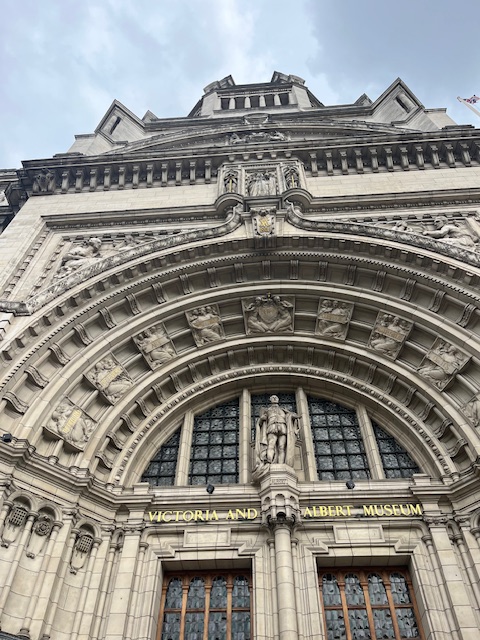
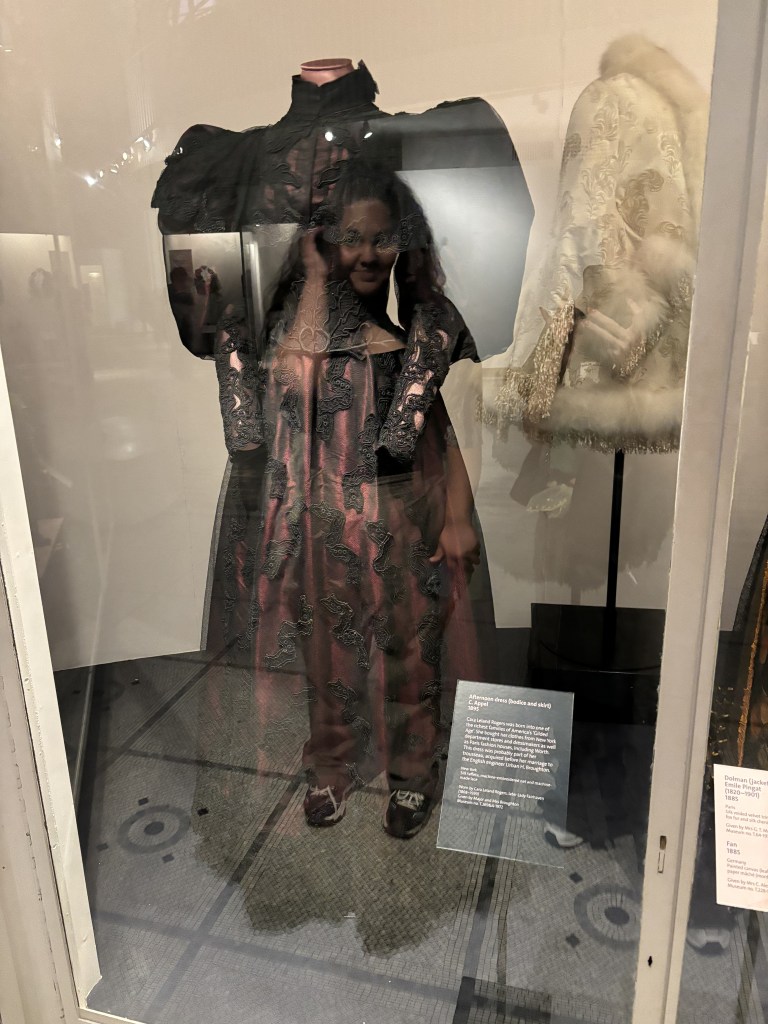
The Victoria and Albert Museum knew that our insane group of theatre kids (and Shawn, Courtneay, Susan, Tim and Jason) were coming, so they decided to go ahead and close down their theatre exhibit. This wasn’t the end of the world, however, because this museum has a substantial amount of art and history to pick apart. Luckily, we still got to see (most) of the fashion exhibit, and some other cool things.

On my trek to the toilet, after examining all of the iconic fashion pieces, a specific sculpture caught my eye. It was a woman, sculpted in white marble, lying on a chaise lounge and looking down at a piece of paper.

She is endowed in a robe, vividly spilling over the front of the sofa, with wrinkles that look almost tangible.

Lawrence Macdonald created this piece in monument to Emily Georgiana, Countess of Winchilsea. In a neo-classical style, this sculpture shows the Countess draped across the bed, similar to Canova’s portrait of Pauline Bonaparte.

What initially drew my attention was the poetry engraved on the sides of the sculpture.

On stanza’s three and four, it reads:

“All my life coldly and sadly

the days have gone by.

I who dreamed wildly and madly

am happy to die.

Long since my heart has been breaking

its pain is past.

A time has been set to its aching

peace comes at last.”

Emily Georgiana died on July 10th, 1848 at the age of 39.

She fell very ill and had no hope for survival. Without the privilege of modern medicine, Emily was forced to come to terms with her inevitable death, which became an escape from the endless suffering she endured.

Some of the shows we have studied have maintained this theme of death as an escape. A resolution. A conclusion to a monotonous chapter of life.

What does it mean to wish for an end? How much pain brings a person to wish for nothing?

This inscription, and the circumstance of the muse for which the sculpture was created, reminded me of Edmund’s character in “Long Day’s Journey into Night.” Plagued with consumption, his body fought and tortured itself day after day. Fighting sickness with no support system, Edmund’s mind fled to poetry and translated his misery into words. One quote that stuck out to me in his soliloquy is:

“I was set free! I dissolved in the sea, became white sails and flying spray, became beauty and rhythm…I belonged, without past or future, within peace and unity and a wild joy, within something greater than my own life, or the life of man, to life itself!”

Edmund describes the feeling of becoming something separate to life, dissolving into a place with no timeline, only joy. It seems as though the place Edmund is talking about is death itself, an escape from the pain he feels every day.

When looking at the sculpture of Emily Georgiana, the narrative of her welcoming death reminded me of how it must have felt for Edmund Tyrone to feel hopeless in getting treatment for his illness.

This passage also reminded me of the main character in “Bluets.” The playwright described their overwhelming desire to end the pain they were in– death seemed like the only escape. While grim, I think that this is a compelling and timeless feeling that has been allowed to emerge through art.

On a happier note, after visiting the Victoria and Albert Museum, I visited the Natural History Museum (for free) and was reminded how the absurdity of human evolution. We are so unique, yet unoriginal, as a species.

And our species has evolved to allow us to tell stories in costumes, under lights, and against imaginary settings.

The gift of theatre is so wonderful!

Goodbye, city of London,

xoxo Homo sapien girl
A Touristy Breath of Fresh Air

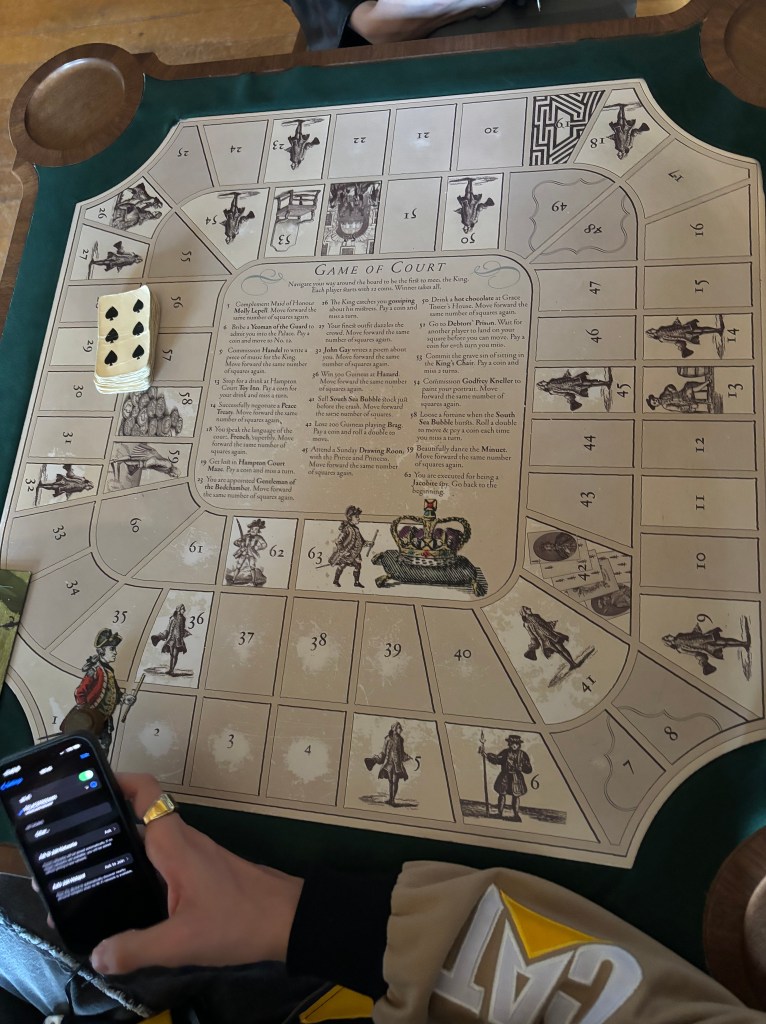
Walking through Hampton Court Palace, I felt as if I was walking through the main attractions of three separate towns at once. From the entrance’s “Ye Olde Township” nature, to the decorum and luxury of the palace’s interior, to the sprawling and beautiful gardens that surrounded it all, it was a strangely all-encompassing site to explore. 

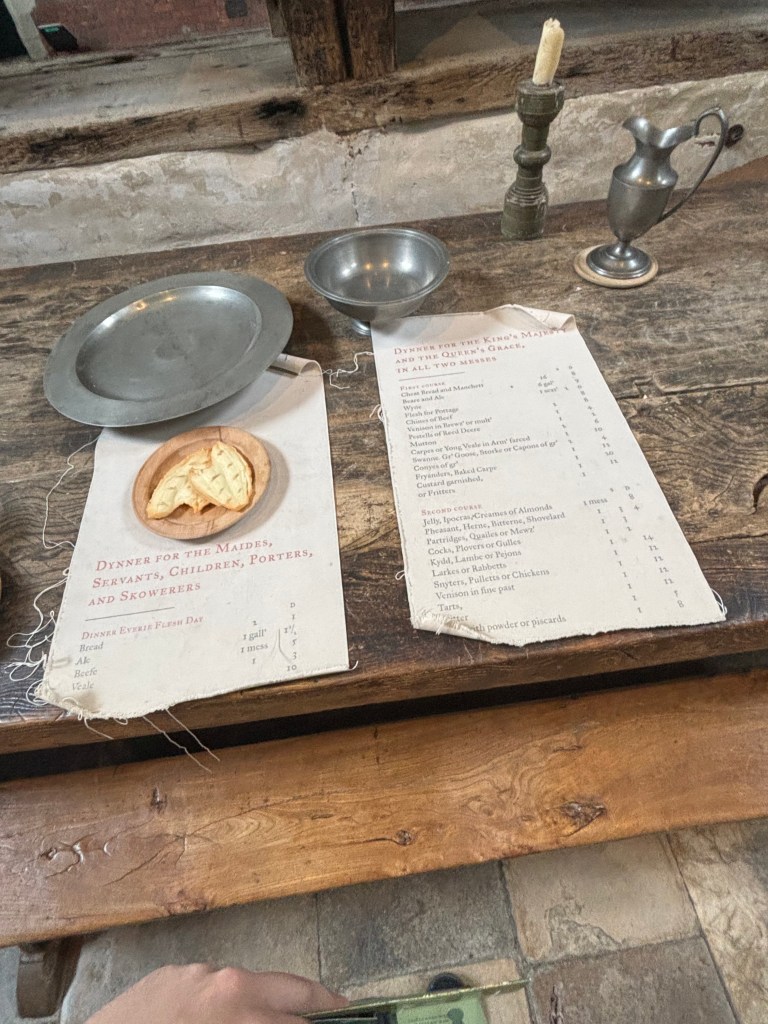
Starting from the entrance, it felt like walking through a recreation of an old medieval castle town, despite just being the kitchens. The narrow cobblestone alleyways and the decorative wheelbarrows filled with bags of grains helped to create the medieval living atmosphere, while pictures of actors in time-appropriate garb put up in the windows of buildings and walkways made the location feel like a vaguely and unintentionally scary tourist-trap. Walking through the kitchens kept this recreation feeling at a maximum, with the walls covered in writing and images depicting the kinds of meals that would have been served in the palace and the ways they were prepared or laid out on the table. It had tons of prop foods and decorative cookware placed around to help set the scene, and all in all it made it a very informative, if somewhat inauthentic, display to walk through. 

The actual palace kept this exhibition design, however walking through it felt more like a beautifully built museum than a touristy recreation. The architecture’s ornate design and exquisite color palette and the designs of the garden and fountain areas around the interior of the palace were truly something to behold, and seemed befitting of a royal palace. The church in particular was an awe-inspiring sight to behold, with its intricate ceiling showing the stars in the night sky and the overall sense of grandeur within the room giving it this air of divinity that made me scared to make a sound for fear of committing an act of disrespect. Besides the architectural styles of the palace being something to behold, the structure also held a number of artworks and artifacts belonging to the royal collections of Henry VIII as well as William and Mary. The palace held writings of and about Henry VIII’s wives, large pieces of religious artwork, two out of the nine pieces of Caesar’s Triumph (the first six of which are at the National Gallery, and the last one I have no idea where it is because I have not seen it), intricately folded dinner towels, examples of clothing styles that would have been worn around the palace, and even some tables in the Drawing Room dedicated to different (kind of terrible seeming) board and card games. 

The most impressive part, and the part that I wish I had spent more time in, of Hampton Court Palace to me was the garden. After exploring the palace in its entirety, I exited the back to see a sprawling expanse, inhabited by trees, statues, fountains, and ducks. Walking through the gardens was very refreshing, especially after having spent most of the time in London either walking through the streets with tall yet skinny buildings towering above me and slightly polluting the air or inside of surprisingly cramped museums and theaters. The openness and natural beauty of the gardens was (quite literally) a breath of fresh air for me, and felt incredibly nice. The gardens were also home to many different little walking paths, with its own greek/roman inspired statues dotting the paths or little courtyards hidden between massive hedge walls. I know that I was unable to explore the whole area, as while leaving I saw signs for cafes and a hedge maze far past the extent of where I went, but the area that I did see was still truly breathtaking.

Overall, Hampton Court Palace was an incredible site to visit, giving more insight into the daily lives of past royals, and I hope I can return one day to find my way through that hedge maze.

Feast Fit for a Servant
Tasted Like it Too
I Think Elliot Won This in like One or Two Rolls

Victoria and Albert Museum

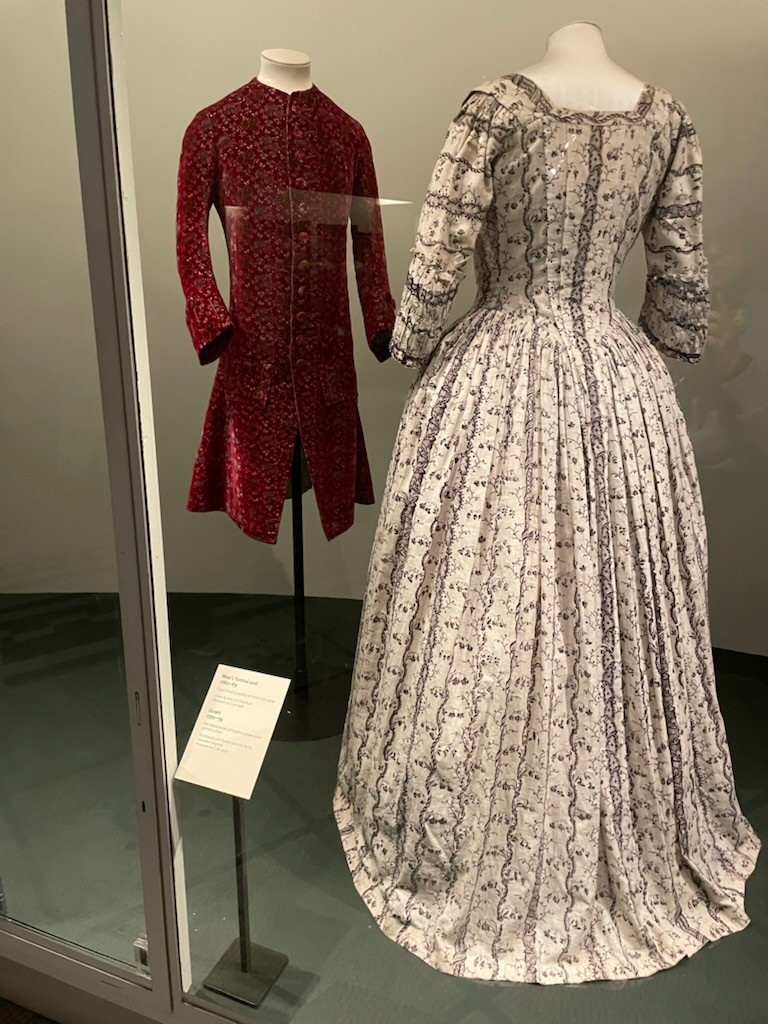
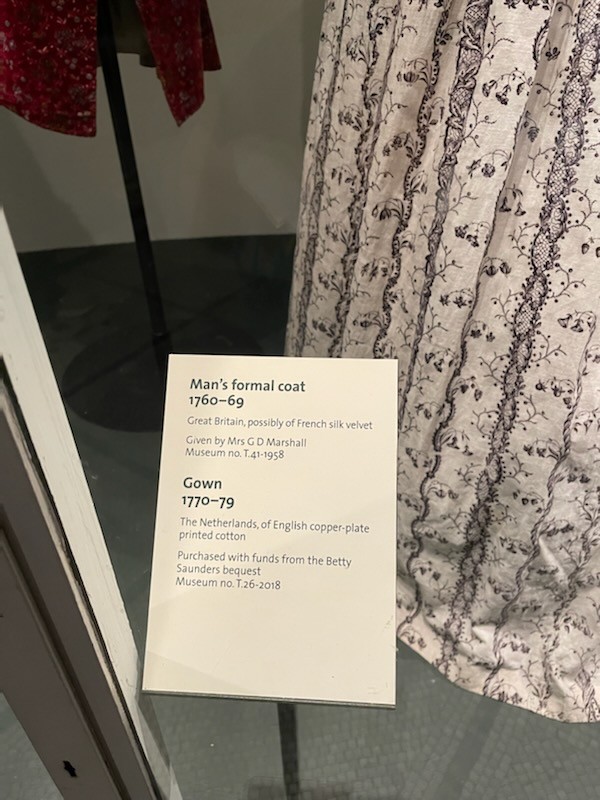
The Victoria and Albert Museum was so amazing, and I loved looking around and seeing and learning about all the artifacts from the different time periods and places. I’ve decided to talk about two articles of clothing that I found in the fashion gallery. I know I’m only supposed to talk about one item, but the clothes were displayed in the same case and they shared one information plaque.

When I first saw these items, I was instantly reminded of Hamilton and the costumes the actors were wearing. Both the men’s coat and the gown looked very similar to the cast costumes, so I decided to look up what time period Hamilton was set in. I found out that the costumes and the artifacts represented about the same time. Hamilton was set between 1776 – 1804 and the coat and gown were from 1760 – 1769 and 1770 – 1779 respectively. The coat in the museum was a little different from the one in the show. The museum coat had a noticeably longer torso compared to the costume coats. I think this difference in length is due to the seven-year gap between the two time periods. The difference in length could also be attributed to the fact that the artifact comes from Great Britain and Hamiton showed fashion from an American point of view. Another reason could be that the costume coats had to be shortened to allow for the actors to move better, especially while they are dancing. In the show the coat was worn by Aaron Burr and General Washington before and during the war. More cast members wore the coat after the war, playing as members of the cabinet. These men were sophisticated, and had power and responsibility, and I could see each of them wearing this French Silk Velvet Coat. The gown looked very similar to the dresses the Schuyler sisters were wearing. This is probably because the time the gown was from was closer to the time Hamilton was set and actually their time frames overlap by three years. Just like the coat, the gown looked to have been worn by a woman from a high status class and that’s how the Schuyler sisters were portrayed in the show.

I think that the clothes from the museum reflect how the world of play uses costumes to influence the mood and audience.  The gowns in the show were brightly colored but didn’t really have any patterns, however the gown from the museum was white with a detailed dark blue floral pattern, it reminded me of a teacup. I feel this is an important difference because it shows how Hamilton took some creative liberties and had more fun with the color to lift the mood and make the play less serious. The color of the dresses was also used to differentiate between the sisters.  Each sister had a distinct color.  The intricate patterns on the dress would not have been of use to the play, because the audience was too far away to appreciate the details.

Blue at the VA.

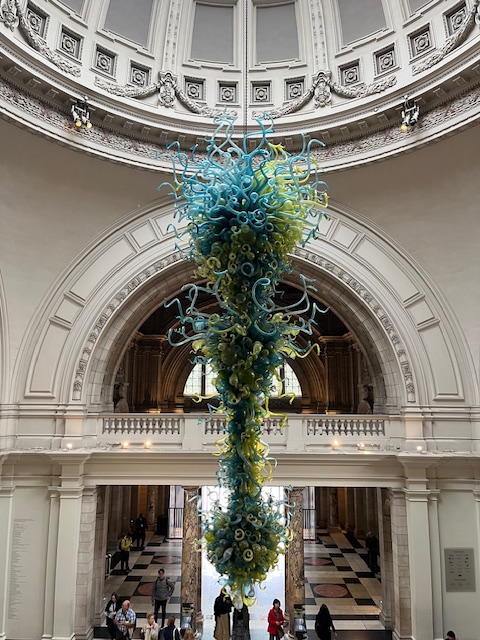
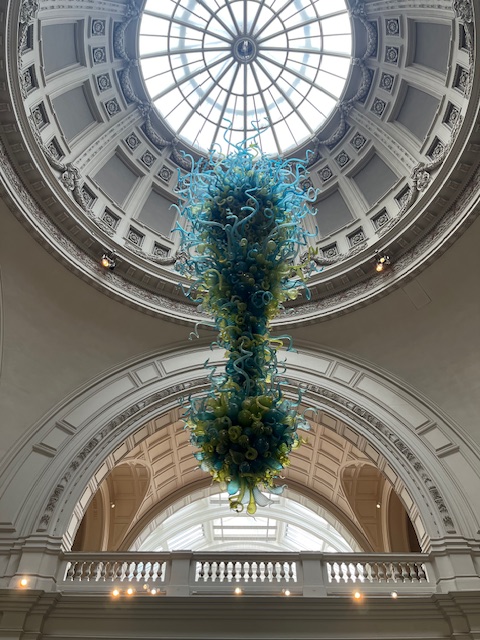
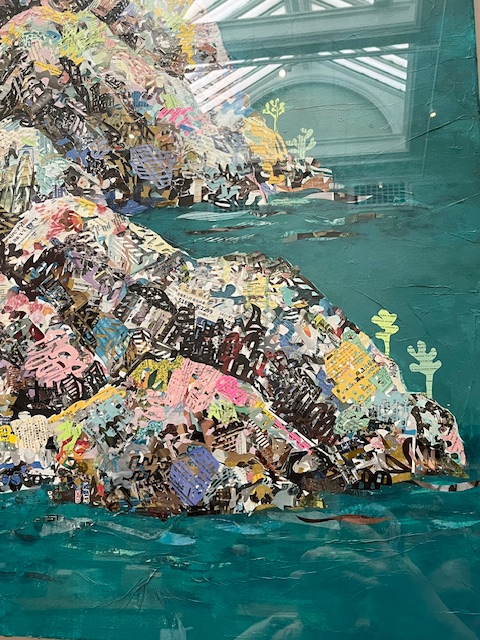
I thought about what I wanted to write about in this blog post, and in attempting to relate my experience to theatre I went on a scavenger hunt at the Victoria and Albert Museum. I did what the character from Bluets did in several scenes when strolling the museum. Walking through museums and art galleries, I searched for blue. I found a piece that was infiltrated by a few shades of green. Hanging in the main entrance was a phallic glass art piece suspended over the front desk, befitting the Bluets as the show was about sexuality and intimacy in the midst of heartbreak. Chaotic, engaging, and twisted, this piece of art made me recollect all of these themes and actions of the experience. It was extremely modern and full of life, just like Bluets. I think hanging a work of art like that at the entrance of the museum sets the tone of the space. A mix of art and history, modern and old, artifact and revolutionary. It is a distinguishing of the museum and the sign of a well-curated place. 

The Bluets has been on my mind since we saw that amazing work of live cinema. The metaphor of the illusion and obsession for the color blue to mask pain, grief, and longing is so powerful and creative. We each have to heal in our own ways, it is unrealistic to say pain truly and completely heals with time. It takes a bit of effort every day, at least at the start, to try moving on. Degrees of distraction and forgetting are required. Especially when it comes to breakups, the grief sets in as the reality and nature of the relationship become apparent. The infatuation and image of love and what it felt like to be with them falls to the floor. Everything you did and became for them, little changes of mannerisms or way of dressing finally fall away. It slowly puddles and oozes on the ground, and all you are left with is yourself. Wholistically. You evolve and change because you can’t really return to the person you were before this lived experience. Because you learned. So you’re just there, feeling heartbroken. Maybe you feel lied to, maybe you feel guilty, maybe you feel proud, or maybe you feel cleaner or lighter. Maybe you’re numb. There’s this feeling of sickness that settles in as well, you’re sick of dreaming about them, or feeling horny for them, or missing them, or having them creep back into your thoughts. You just have a moment where you want to stop feeling anything at all for them, you’re sick of caring and wish to feel sweet indifference. Bluets encaptured this process and so much more. The realism of it all was astounding as we watched our character go through a very relatable process. The character could look like anyone or be any gender or age. All three of the actors portraying the same person were able to completely separate their identities to play this part. This forced the audience to focus on the actions and everything surrounding the character, instead of the character themself.

The work was perfectly adapted to live entertainment. Live cinema was the way to go, as the camera was able to focus and condense this story. It added these interesting blinders to cue the audience on what the director and writer wanted them to see. To see it under the same lens and in the same light. Lighting, tech, props, and costumes were crucial to indicate the passing of time over months and years. And with no intermission, the audience was locked under a trance and spell. The audience had to endure the life of this character, they didn’t get a break or time to process. This added another layer of realism, as we don’t get to take a break from our lives and situations. We are stuck in these bodies, in these environments, in this century.

 The escapism that was found, was through scenes with blue. When displaying the collection of blue things, the lighting changed and the dialogue became softer. We could find solace and relief in these moments, the same way the character did. It made us understand what I had previously thought to be a sick and ridiculous thing, because how could one possibly fall in love with a color? Feel intimate, seen, loved, or released, from merely a color?

Who needs the theatre exhibit anyway

The answer is me^ I was really excited about it but whatever.

The Victorian Albert museum was beautiful! I also just might be bias because we spent the most time in the fashion section and I am a sucker for anything “old” fashion related.

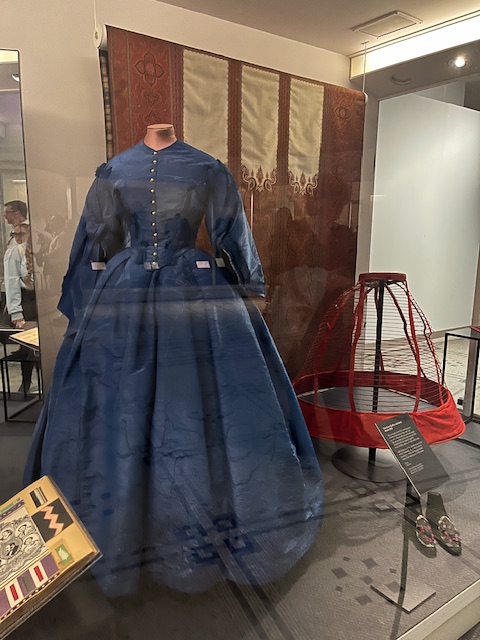
The thing I am talking about was one of the dresses

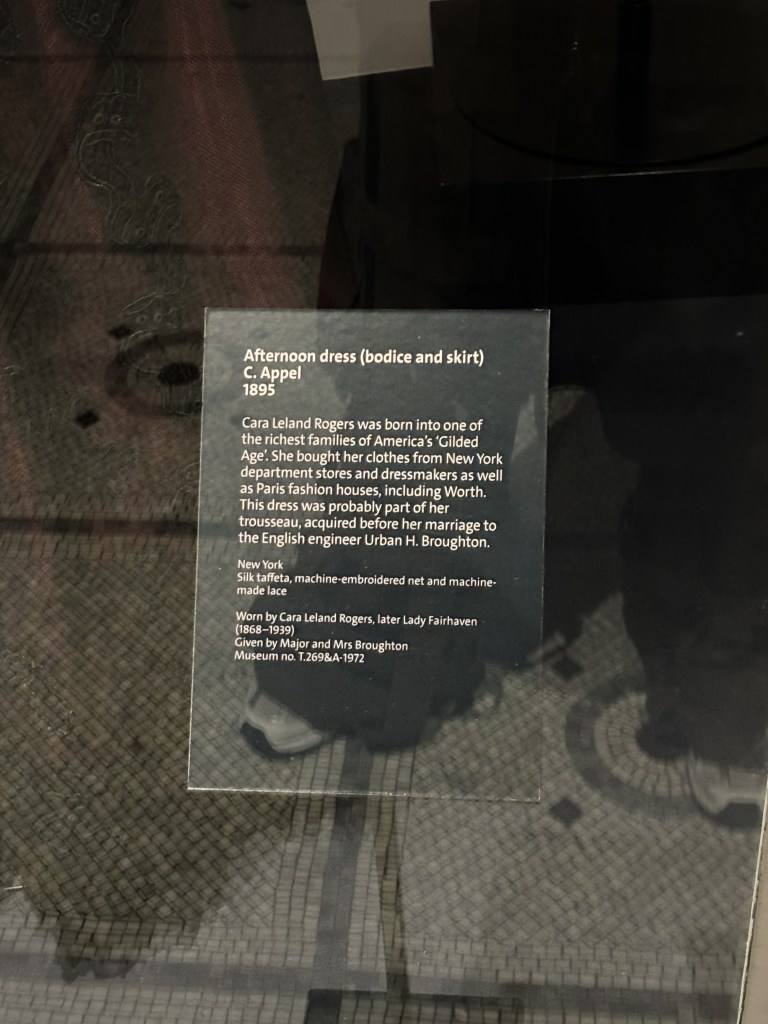
Not only was I just very in love with the design of this dress ( I know the picture is more belinda that the dress oops) but I liked that I got to learn a little about the girl that wore it. It also reminded me of royalty in classical plays such as Shakespeare’s plays. It’s funny because it reminds me kind of of Claudios costume from Much Ado, with the poofy sleeves ( if I’m remembering it right).
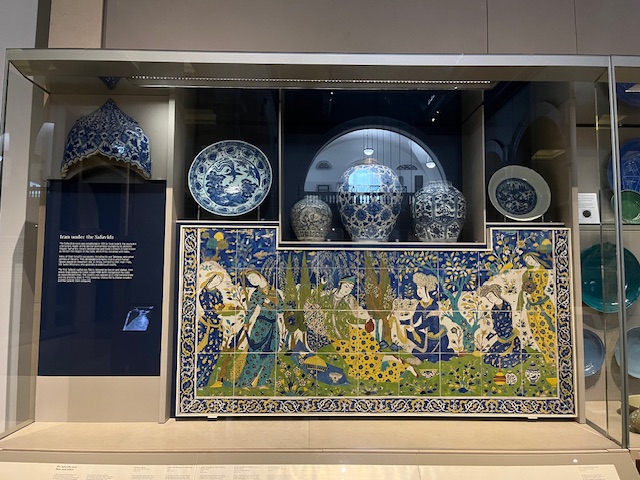
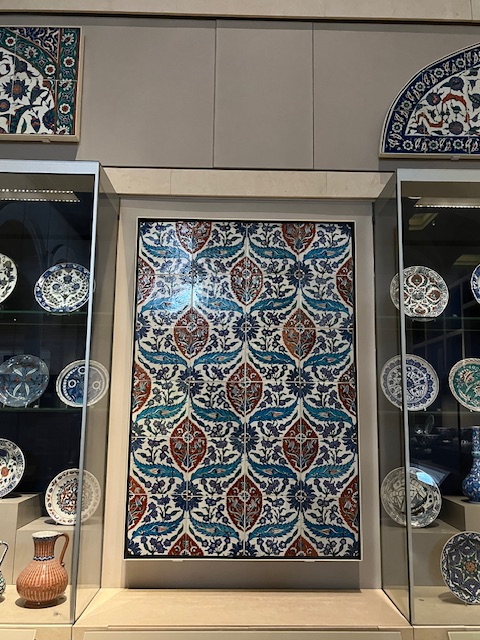
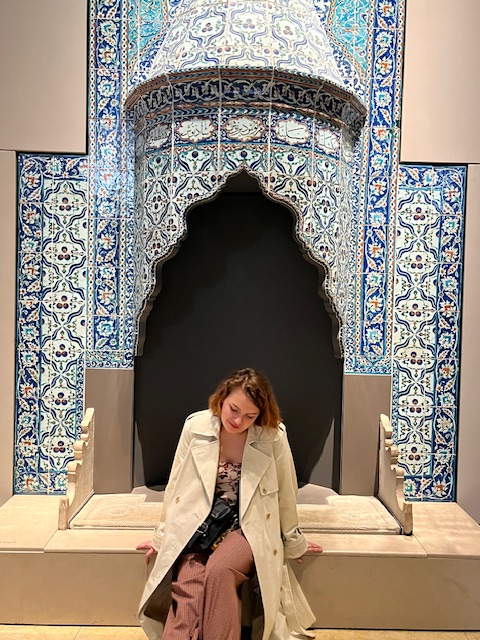
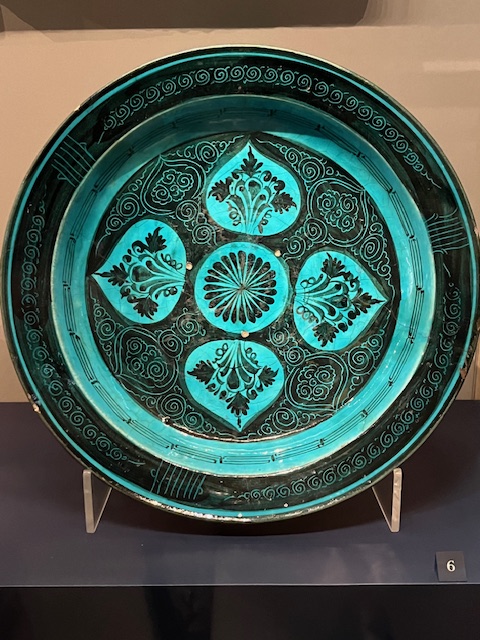
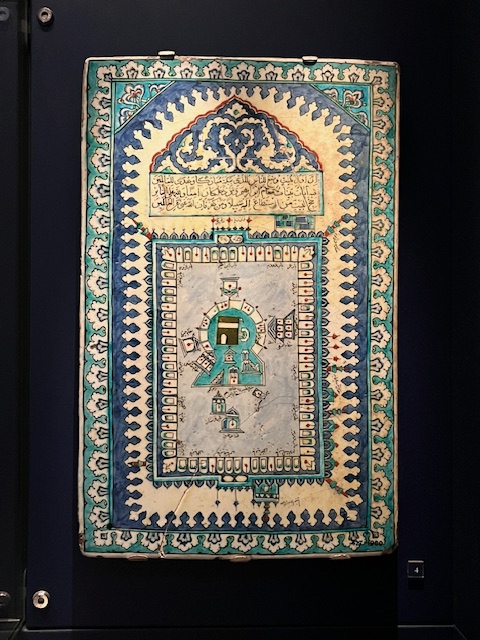
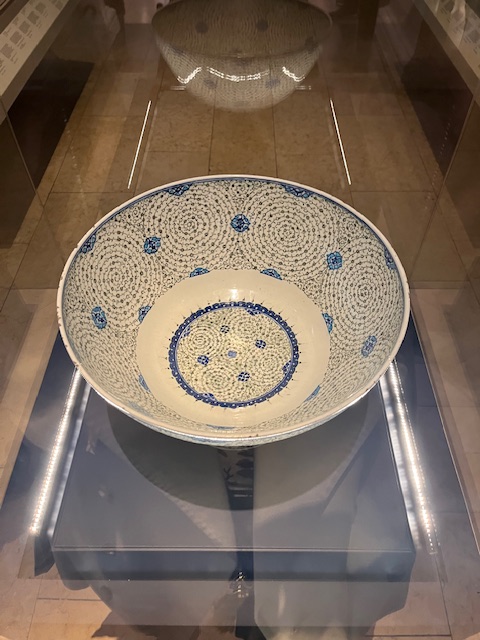
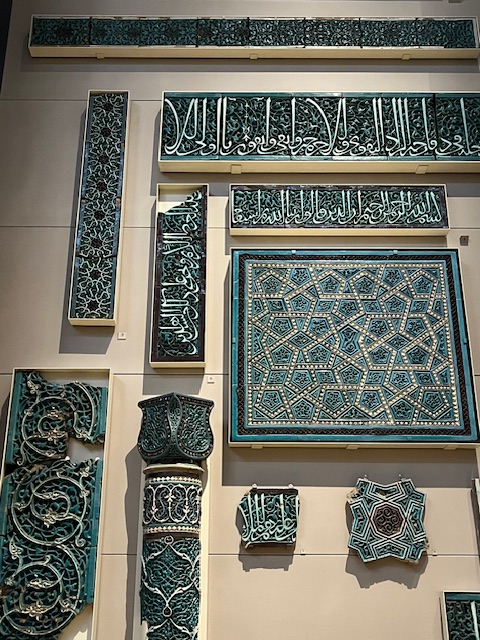
The museum had some lovely pieces from islamic history as well that I really enjoyed, the colors in the paintings that they would put over tombstones were so vibrant and bright. They also had a couple rugs in the same room that were HUGE and so beautiful, would love to have one in my house:)

OVerall the museum was very impressive and one of the best gift shops I’ve seen so far! I know you probably don’t want to read about the gift shop but we unfortunately didn’t get to stay super long due to the inability to keep our eyes open from a lack of sleep, so I’m discussing the parts I saw!

Back on topic though, I think a lot of the dresses resembled the old timey dresses we think of when we think of Shakespeare. The slim waist and giant poofy bottom of the dresses was something I honestly wish we still did.

Overall I thought it was beautiful from what I saw and really enjoyed getting to learn more about fashion in the times before I was alive !

Fringy

Fringe theatre is not to be overlooked!

We went and watched Bluets and I was so so impressed.

The actors were amazing I did not dislike any of them! They all had different elements that they added to the story even though they were all playing the same person. I also liked that the guy was included even though the narrator was a women (I believe). He was very very good I really enjoyed how much was happening in his head but how little was happening on his face. You really could tell that he was in it and I feel like I could read his thoughts. The girl in the middle (forgive me for not knowing names) was also so so good! I could tell how locked in she was the entire time, I feel like I never saw a slip of character once from her and my eyes were drawn to her. The girl on the right was also so good, she added a deeperness to the character I don’t know how to explain.

The production of this show was actually crazy. The use of TVs was to die for! It was so creative I really could not stop trying to pick out every little detail of what they were doing. Props to the stage hand that was switching everything around, she deserves her own standing ovation.

Truly though I was SO impressed by all of the thought that went into this show, the actors were moving so fast and so precisely to get all the right shots on camera while also delivering to the audience an in person show. So cool, I think that cameras in theatre are becoming more and more of a thing, Romeo and Juliet did that as well.

The story was kind of confusing to me, not going to lie I was super tired during it so didn’t follow it as well as I probably would have if I wasn’t so tired. But from what I did gather I thought it was very moving. It approached the topic a lot more differently than I was expecting which I really liked, the writing was so good.

Overall I was super impressed.

I’m Bluets, Da Ba Dee Da Ba Di

Yo listen up, here’s a blog post about a show called Bluets by Margaret Perry and all day and all night (for 80 minutes) everything they see is just blue, like them, inside and outside. Parody lyrics aside, I was captivated by this show. This wonderful amalgamation of film and theatre is a very unique experience that I think can only be appreciated as a fringe production. The story is so intimate and the character portrayed is so real that I felt myself transcending the theatre space and living in the blue reality of this struggling woman. I know I say this a lot, but I was blown away by this play. 

The technical elements of the show were absolutely fascinating. They used a blending of film and theatre by having live actors stationed in front of changing screens that would take the character to different locations when broadcasted live on the giant screen above the stage. The actors also used various props handed to them seamlessly by stage hands to influence the scene. It took me a while for my brain to adjust between watching the actors and watching the live movie above them, but once I got the hang of the situation, I locked in and it was great. The cast was also very interesting because the play itself only has one character, but there are three actors. These actors share the same clothes, make the same movements, have the same inflections, and yet all of them bring a whole new side of this one character to life. It is also representative to me of how blue is a universal human experience that anyone can go through.

I have been trying to find words that will capture the essence of the play and the pure soul displayed onstage, and although it seems a bit cliche and obvious, all I can think of is blue. This play is about a blue woman living in the blue world with a deep, unconditional obsession and love of the color blue. Blue makes sense to her when nothing else does. Because it is adapted from an autobiographical book of poetry and lyric, the script is told from first person through the eyes of the author, but it is addressed to us, the audience, who sometimes represent the character’s former lover. A phrase repeated a lot throughout the show is “the last time I saw you” referring to the last time she saw her lover. This is brought up more and more throughout the play as her feelings about the situation and its reality are revealed. 

I usually prefer comedies to dramas. I find it easier to laugh at the tragedy of the world rather than live in it for 80 minutes, but it is important to go outside of my comfort zone. If I only see things that will make me feel happy, I will miss out on a beautiful, somber color. Bluets gave me a new perspective on the world that I had never put to words before. It is ok to feel blue as long as you remember to “look up.” These final words hit me hard and provided the perfect melancholy ending to this wonderful production. After everything we see this character go through, it is a reminder to the character, and to the audience that she always has the ability to take solace in her favorite color by looking up at the sky. 

As Eiffel 65 once sang “Blue are the words I say / And what I think / Blue are the feelings / That live inside me.” It is plays like Bluets that remind me to keep pushing the boundaries of theatre as a way of forming a meaningful connection with the audience and sharing a beautiful message. I am blue, da ba dee da ba di.

Cheers!

Playing Director and Costume Designer: Victoria and Albert Museum!

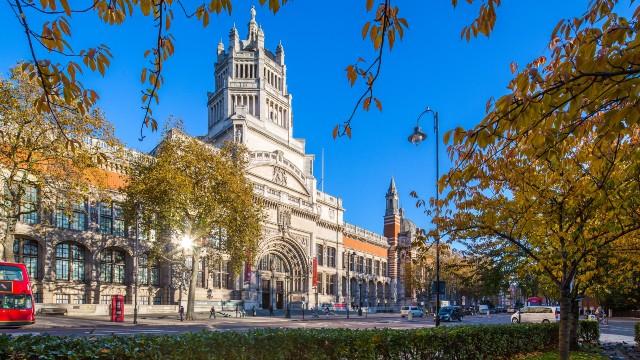
We are not going to talk about how I will no longer be in this beautiful city in a few days, okay? Instead, let us focus our attention on today’s blog prompt and location. We visited the Victoria and Albert Museum. We were supposed to go through the theatre exhibit, but it was closed. However, we were incredibly brave and kept going along. You should be proud of us! Our task at hand was to find an artifact and relate it back to a play and/or show we have seen. This could be as loose as we wanted, so tighten your corset and let’s get started.

Victoria and Albert Museum.

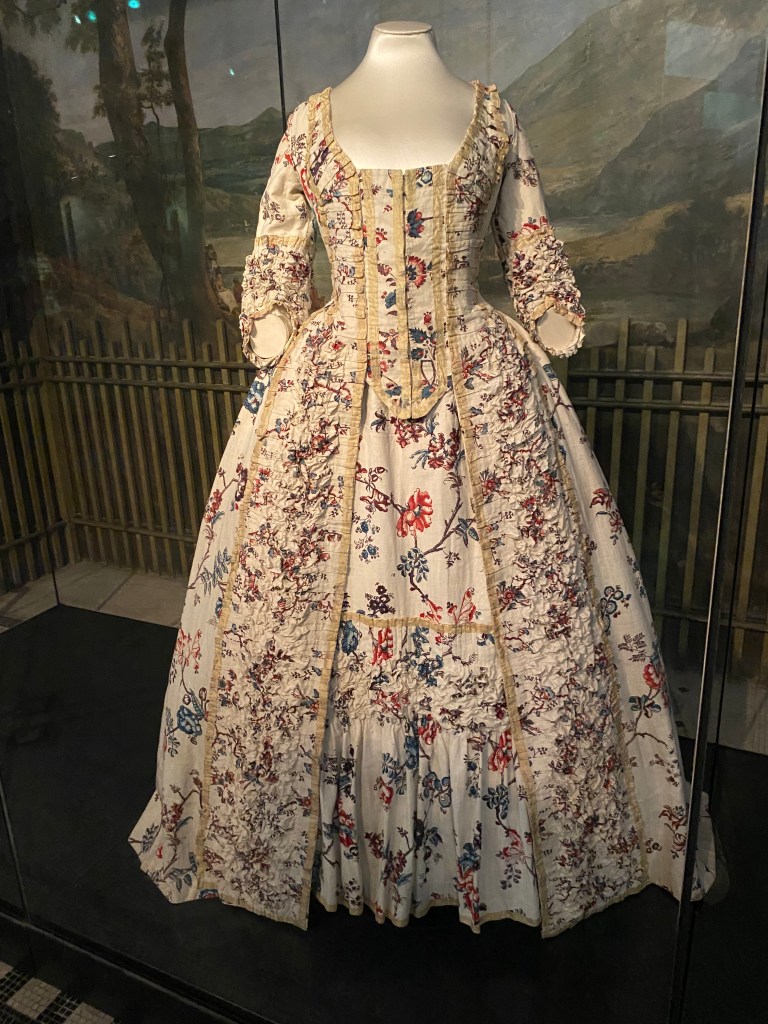
When I walked into the fashion exhibit, I noticed this absolutely stunnin’ dress and I immediately thought of Beatrice in Much Ado About Nothing. The main color is an off-white cream and there are floral designs that are blue, red, and brown all over the dress. The floral designed are printed onto the dress according to the information plaque. I got to see Shakespeare’s Globe and their costume design with the characters, which was incredible. While this looks nothing that would have been in the play if it was set in the original setting, which was during the Italian Wars (1494-1559), the colors and earthy feel reminded me of Beatrice specifically.

Robe a la française 1760-69, altered 1775-80.

Let’s say that this could be used as a costume piece for Beatrice in a production of Much Ado About Nothing. The dress was estimated of being created between 1760-1769 but the sleeves were altered 10 years after it was originally created. This would mean that it would be worn in the late 1770s or early 1780s. In order to change the time period yet still have the historical context of the Italian Wars loosely mentioned in the show, I figured setting the play during the end of the 4th Anglo-Dutch War from 1780-1783 would make sense. Is this idea a little over the top? Maybe, but I wanted to make sure that the context made some sort of sense and was somewhat accurate, even if that would be debatable.

Well. We leave London in less than 24 hours and head off to Stratford-upon-Avon to finish up our study abroad trip. This is all so bittersweet…

See you soon.

12. Six Nickels for Pantslessness!

You all are very dedicated stalkers. While I don’t exactly being observed this much I suppose I have to commend your efforts at the very least. You’re still here, always lurking in the periphery… or just reading the blog posts that I’m purposely putting publicly on the great wide web for adoring fans like you to read.

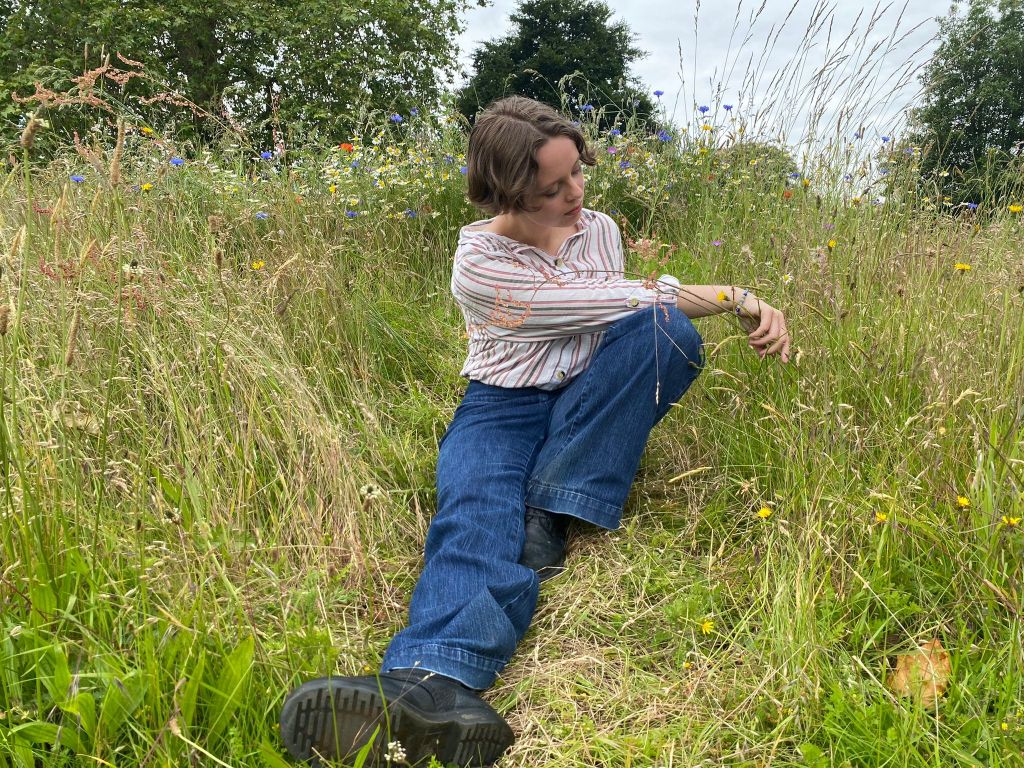
Me at Kew Gardens yesterday! That grass is so interesting, isn’t it???

As it happens, I’m writing today about a synonym of “periphery;” while in London, I was tasked with going to see at least one fringe theatre piece and writing about it. Since being here, I have actually seen three fringe shows: one with the group and two of my own accord. 

The most recent show I saw was last night, where I watched Bluets at the Royal Court Theatre, which was a rather avant-garde piece about “depression and desire, pleasure and pain, and a person possessed by a lifelong obsession with the color blue.” I did not very much enjoy the experience as I was having it, despite recognizing that it was a valuable piece of theatre. After sleeping on it, however, I find that it is growing on me. I appreciated the production value of it immediately. It was produced through onstage videography of the three actors utilizing three screens and many cameras to create an ever-changing video account of the poetic script. Overall, the book was what put me off, due to how dense it was. The poetry itself felt too heady for me upon first watch, but now that I have sat with it, I wonder if it would be more digestible and effective after a second go-round.

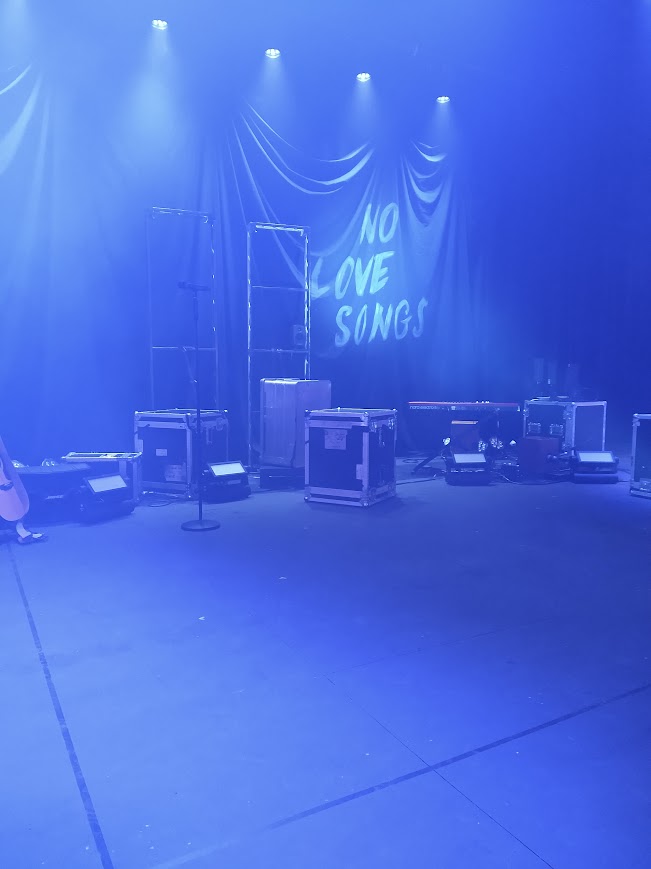
Before that, I saw No Love Songs at Southwark Playhouse with my roommates. I was less opinionated on this piece, and I remain so. No Love Songs is the love story of the two people who wrote it, from first meeting through their struggle for monetary gain and raising a child in a world that isn’t built for a working household, all the way up to their divorce and hesitantly rekindling relationship. One conviction that I hold about it is that this story is unique, and it deserves to be told. However, I was not a huge fan of the writing style of this one either. The performances by both actors felt extremely authentic and I loved the characters’ depth, which is ultimately what the piece is about. My main qualm with it is that the manner of telling the story took me out of the narrative at times as the script demanded that the characters continually address the audience between and during choppy flashback scenes. I really enjoyed the experience of seeing this one as well, and I think that it was valuable to me, to be able to see a production that was of such a comparatively lower production cost. While the equipment they had was expensive, it was very minimal, whereas a show like Bluets and the West End shows we have been seeing are far more extravagant in design.

Our view of the stage!
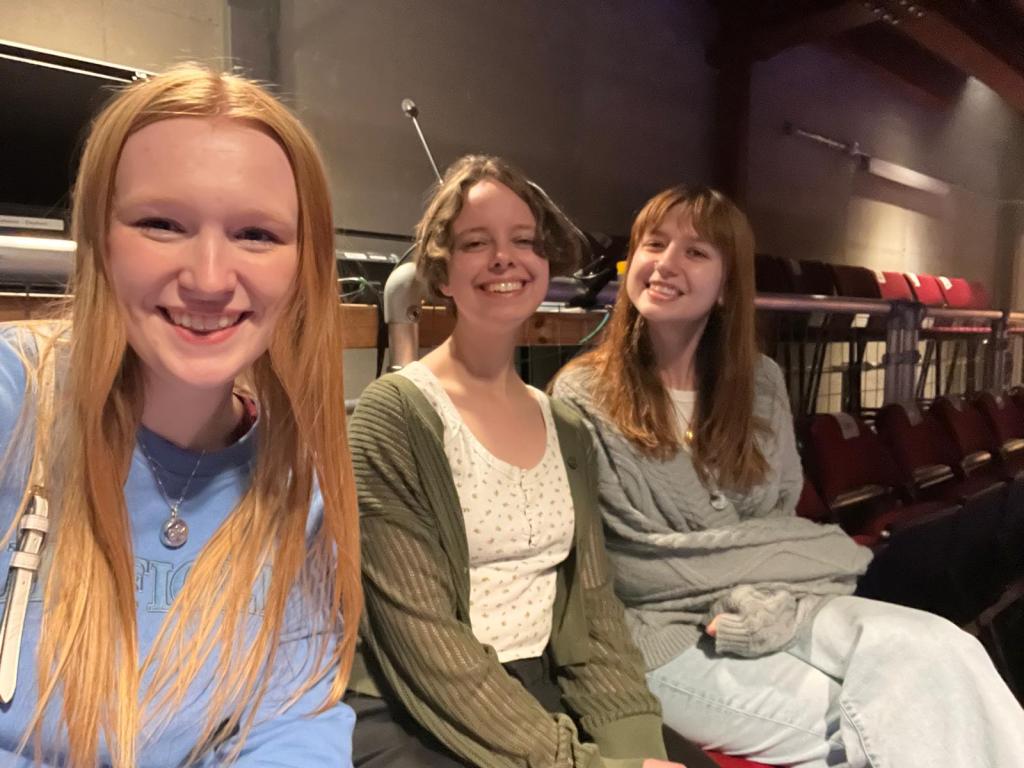
And a cute lil selfie of the three of us before we got our seats upgraded to the front row!

The show that was probably my favorite out of all of them was the first fringe show I saw, which was Sophie’s Surprise 29th at Underbelly Boulevard. I went in not knowing what to expect; Kaylee, Emma, and I were all eating lunch at Temple of Seitan, realized we had time to see a show that night, and I began to scroll TodayTix. I found a title I hadn’t noticed before, then asked if they wanted to see it, immediately buying tickets for it. We all went in completely blind and were very pleasantly surprised by its premise: a cabaret-style circus show based around the idea that it was one of the audience members’ birthday. While it had a loose storyline, it was mostly based in the different acts put on by the members of the cast, including aerial silks, hoops, roller skating tricks, and stand up comedy by a guy in his birthday suit. If I had a nickel for the number of individual buttcheeks I’ve seen in the name of theatre in the past two months, I would have at least six nickels, which isn’t a lot, but it’s weird that it’s happened that many times. The show was hilarious, awe-inspiring, and utterly surprising. I’ve never seen anything like it, but I would love to go again if I could.

Blurry pre-show candid…gotta love ’em!
We even got to meet the cast afterward!

I really wish that there was more accessible and available fringe theatre in the United States. There are fringe theatres, but there are not nearly as many, and they are certainly not as well advertised as they are here. However, the fringe shows I’ve seen are some of the most inspiring and interesting pieces of theatre I have seen in a while. Being able to compare the different levels of professional theatre, as well as see the in-between theatre: not West End or Broadway, but more advanced than a college production.

We’re so near the end I’m actively denying it. More to come!
CW

The flying carpet

The V&A museum was so fascinating! I’m sad that we didn’t get to see the theatre exhibit but I still found myself with a lot to look at and absorb. The fashion exhibit was so cool and covered a lot of time periods and various styles of fashion. I saw Christmas Dior’s name mentioned a few times which made me smile because the Dior museum was one of the main highlights of my time in Paris, France. 

I wandered into the next room and my attention was immediately fixed on the ginormous rug on display in the middle of the room. It was covered by a ginormous glass box and then there was rope around it so no one could stand too close. It’s so old and fragile too that they only put light on it every thirty minutes for ten minutes. It was apparently a shrine made out of love for Shah Tahsap’s ancestor. 

A ginormous rug with this much wealth and importance behind it reminded me of King Lear. The king was very selfish and vain. And not only can I see him owning something lavish like this, but so can see him putting a damn glass box over it so no one can enjoy it but him. 

The deep red of the carpet adorned with beige and yellow accents are colors that pop into my mind when I imagine King Lear on a stage. Those are colors I associate with royalty, and I back up that logic with what I’ve seen preserved in museums and places like Hampton Court Palace. I’ve seen a lot of deep reds and yellows throughout royal costumes and bedding and even paint colors on the walls.

I enjoyed my time there, it was a good way to end our time in London. 

Cheers!