Seeing Fringe Theatre

A few days ago, I went to go see the musical How to Succeed in Business Without Really Trying with the study abroad group. It was my favorite show I’ve seen so far in London!

How to Succeed in Business Without Really Trying is a 1961 award winning Broadway musical created by Frank Loesser, and a book written by Abe Burrows. The musical follows an ambitious and optimistic young man named J. Pierrepont Finch who receives help climbing the corporate ladder with a book called How to Succeed in Business Without Really Trying. J. Pierrepont Finch went from being a simple window washer to the chairman of the board of the World Wide Wicket Company, and a happily married man within a matter of months. The original production of How to Succeed in Business Without Really Trying opened on October 14th in the year 1967 at the 46th Street Theatre in New York City. It received thousands of positive reviews from the people, and the show went on to earn seven Tony Awards, Pulitzer Prize for Drama, and the New York Drama Critics’ Circle award. The show ran on Broadway for four years and performed 1,417 shows until its closing on March 6th in the year 1965.

There was a revival of How to Succeed in Business Without Really Trying in 1995 at the same theatre as the original production. The show ran for 548 performances. There was another revival of the show to celebrate its 50th year anniversary. It opened on March 27th in the year 2011, and it starred the famous actor Daniel Radcliffe as J. Pierrepont Finch. It ran for 473 performances.

I absolutely loved this production of How to Succeed in Business Without Really Trying. It was the most fun I’ve had while seeing a show in London. I never stopped smiling. It was incredibly entertaining, and the set was so creative. The Southwark Playhouse was more of a Fringe theatre instead of a West End Theatre and you could tell by the set. The stage was small, but I liked the way the actors used the space they had. The acting was amazing, and you could tell that every single actor was having fun on stage. It was nice that we were able to talk to some of the actors after that show and walk with them to the tube station. The only thing that I didn’t like about the show was that in the beginning, I couldn’t tell if J. Pierrepont Finch liked Rosemary Pilkington or not. Yes, he seemed awkward and nonchalant towards her but, I thought it was because he wasn’t interested in her. It wasn’t until the song, Rosemary, was when I knew that he was in love with her. Other than that, I thoroughly enjoyed the show. I now have a new favorite musical!  

Hirschy Highlight: I love me some Fringe… in every form of the word.

I had always known Fringe as either an excuse for bangs to cover a big forehead or an amazing sci-fi television show produced by Bad Robot. But I had always assumed Fringe Theatre meant a very small or intimate theatre. While being in London, I learned that can be the case but it has more to do with location than size.

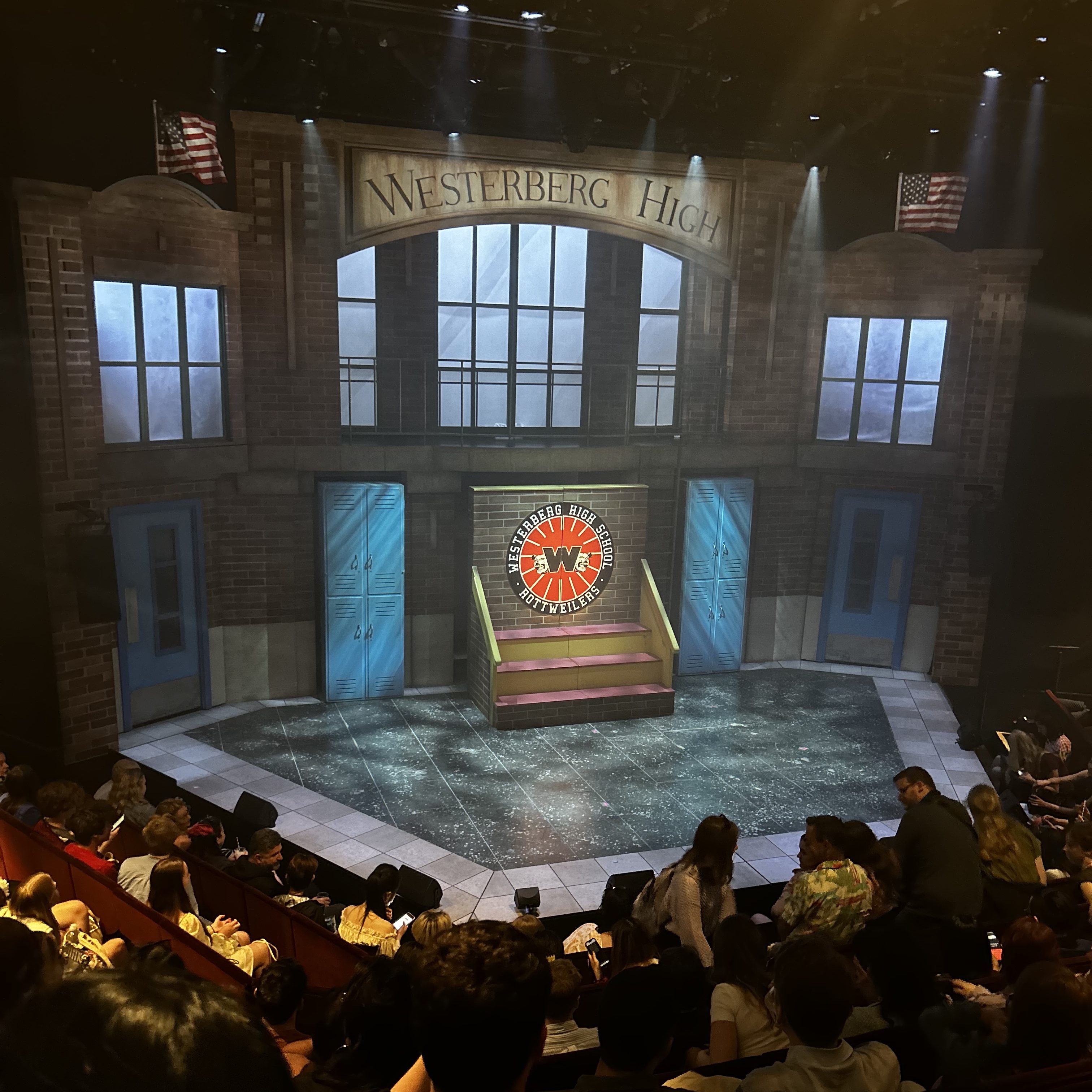
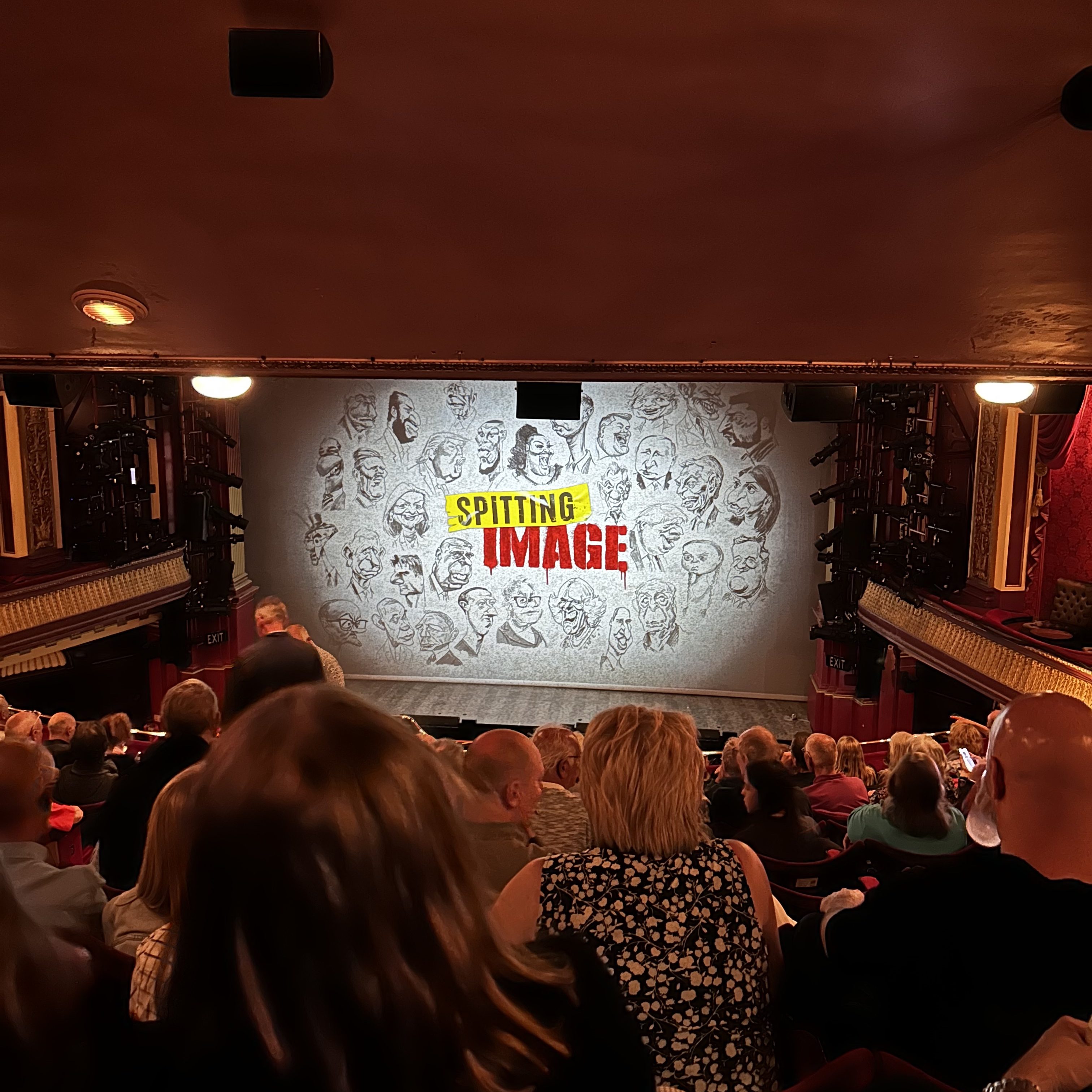
I saw Heathers, which is considered a West End show, in a venue that has around 300 seats. While the theatre felt very intimate with the insane incline, which allowed a smaller distance between the front and back row, the show is not considered a fringe show. Funnily enough, Idiots Assemble: Spitting Image is a fringe show even though the theatre has over 1000 seats.

I have found, though, that just because a show is a fringe show, does not mean it’s any worse than a show on the West End. I personally thought some cast members of Heathers could have been cast differently or at least given more direction for their characters. Meanwhile, the absolute insanity that came with the skills required for Idiots Assemble astounded me. The cast members had blank faces but still created a very believable performance as the character they were portraying through a puppet! (That may be a very confusing sentence but just google the show, and it may make a little more sense.) No cast member spoke lines; they just performed the staging, following along with a recording of the voice actors. That is what shocked me the most. There was no room for error. Every puppet, every cast member, and every piece of choreography was perfectly placed in time with the pre-recorded track. It was very similar to The Burnt City by Punchdrunk in the talent of knowing cues.

As for How To Succeed In Business Without Really Trying, I have some opinions. I think the cast did an amazing job with the script they were given. They each found a lot of humor in the script that I know was not written. They also did a fantastic job adapting to the gender-bended roles. I do think the show itself is very outdated and created a small problem with the gender-bending. The roles themselves, I think would have been more interesting if the characters were gender bent, not just the actors playing them. But, after talking it over, I realize how many licensing issues that would have caused and I understand why they didn’t do that. But, the lead being cast as a female, but the character being a man didn’t change anything, which may have been the point. But, based on the poster that had the show advertised, I hoped the character itself became a woman so I could see the change in the dynamic of a woman trying to succeed in business which is a male-dominated field.

I do think it is very interesting how very popular or well-seasoned actors/celebrities can be cast in fringe shows! I love that it is a possibility because it allows people who may not get the chance to see the more popular shows to experience an actor that they may have encountered online (Ralph Fiennes in whatever show Shawn talked about – UGH I WISH). In HTSIBWRT, Tracie Bennet was cast as J.B. Biggley, the main businessman who was in charge of the whole business. I had never heard of them before, but I came to find out that they have had an extensive career! I was told to watch a video of them singing Somewhere Over the Rainbow as Judy Garland and let me just say… you should too. I would have never experienced an actor with that kind of resume and background without the fringe opportunity. That’s what I love about fringe, well that and it frames my face.

The Feats of Fringe Theatre

During our study abroad trip in London, we students have had the opportunity to view various kinds of theatre productions. One type of theatre that we have viewed is known as fringe theatre. Fringe theatre is theatre that is produced outside of the main theatre institutions, and that is often small-scale and non-traditional in style or subject matter. The second play that we viewed is actually in the category of fringe theatre. The play was called Jules and Jim and was performed at the Jermyn Street Theatre.

Jules and Jim tells of a love triangle. Jules (Samuel Collings), an Austrian writer, moves to Paris and through a shared love of the arts becomes close friends with Frenchman Jim (Alex Mugnaioni). This friendship is so close that it is suggested more than once that they may even be more than friends. On a trip to Greece, they become transfixed by a statue of a goddess, in particular her smile. So, when Jules meets Kath (Patricia Allison) and sees that same smile on her face, it is love at first sight. Unfortunately, Jim feels the same way. Over three decades and through World War I, the three remain connected in a triangle of friendship and romance.

I really enjoyed how the production crew of this performance did not try to do too much. It reminded me that in theatre, sometimes less is more. We don’t always have to show the audience every little thing. Sometimes we can even end up showing them too much. I enjoyed the lack of an official set or props. The play production truly left so much up to the imagination of its audience. This play sets out to captivate its audience with the close proximity between the seats and the stage and they succeed at doing just that in my opinion. I found myself not really needing a set. The actors used the space around them and the few props they had such as tables and chairs in such a creative way that I wasn’t pulled out of the story even once. Okay, that’s a bit of a stretch. I found it a little silly at one point when they showed Kath swimming by having her go behind a glass tank/window filled with bubbling water. It kind of felt like just an excuse to show off that this low budget theatre could afford such a cool technical device. Nevertheless, I still felt so enthralled by the romance and the telling of this beautiful story because of the how close I was to the actors. I could see every furrowed brow of concern or every wrinkle in a frightened forehead. I found it easier to pay attention to the story and become more connected with the story.

Besides seeing Les Mis, this is the only play that has made me cry on this trip. I thought the acting was superb; they really made the characters feel like real people to me. I was so close to the set, that I felt like I was just a ghost on the stage watching all of the drama unfold before me with no way to stop it. The actress who played Kath did a terrific job at making me despise her character, but also understand her plight. Kath can be very selfish, but it is very clear that as a woman in her time, she simply just wants to have control over her own life. I also really liked the actor who played Jim because I felt like he really brought the chemistry between him and Kath to life. He did things like play with the broken string from her pants that just showed that he was in love with her. The way he looked at her felt so real and raw. I almost got butterflies just by the way he would gaze at her or lean his head down, longing to kiss her. The tension between the two actors was so beautiful, yet tragic to see.

I think my favorite thing besides how close we were to the stage was the transitions between scenes. The production used lighting and sounds to transition from scene to scene in such a unique way. It made the play flow so smoothly and each scene fell into the next perfectly like dominos.

I was surprised by how much this play emotionally moved me, but then again, I am a sucker for a good romance. I am so happy that this production is making tremendous feats in fringe theatre by captivating its audience up-close. While, I can’t look up at a ceiling covered in naked angel baby butts holding trumpets in the heavens or have my bag checked by a security guard who didn’t actually look to see if I had a knife, my experience with fringe theatre may be better than any of the experiences I have had at the high end ones. The intimate audiences, the nontraditional theatre elements, and the creative liberty–fringe theatre just does something that main institutions can’t emulate. Dare I say fringe theatre is the finest of all theatre?

Fringe Theatre – The Good and The Bad

*I feel like I should begin with a warning, this blog is very long, but I had so many thoughts I wanted to share so I wrote them all. Enjoy!*

West End shows are very fun to see, with their big budgets and overwhelming spectacle, but sometimes you want a break from that world of theatre, when you’re craving maybe a more intimate experience or an experimental show, and that is where fringe comes into play. Fringe theatre is nowhere near the spectacle of the west end, it is theatre produced by passionate artists who are coming together to share their work in oftentimes a small space with a low budget. I have now seen a handful of fringe shows, and before going into the specifics I can safely say that I love fringe theatre. It allows you to see things that would just never make it in big budget shows. It gives theatre artists the freedom to create, and I think it is a beautiful thing. That being said, the results are not always beautiful, and sometimes are far from it.

The first fringe show I saw on this trip was Jules and Jim, a play about friendship and a love triangle that spans decades, all of which ultimately ends in tragedy. When we walked into the theatre we saw probably no more than 50 seats, and the signs to the toilets pointed to an onstage entrance. When I sat down in my seat in the second row I was only a few feet away from the stage, and I knew this show was going to be an intimate one. For me it did not disappoint, the close proximity we had with the actors combined with the fact that the story was told in a narrative way often directly to the audience made me feel a much stronger connection to the characters than I would have if it had been produced at the National Theatre. There were several times I would make eye contact with the actors as they delivered their narration directly to us, and it was amazing. Also, being that close allowed us to see things you never would be able to from 50 feet away, like when the actor playing Jim picked a loose thread off of the actress playing Catherine, playing with it between his fingers before dropping it on the ground. Some of us stage doored after the show and when we saw them we brought up that moment, which both of them completely didn’t realize they did, but it’s the small, improvised moments like that that make a show come to life for me, and the fringe allowed me to see it. 

Recently, we saw another fringe show, this time it was a production of How to Succeed in Business Without Really Trying done by the Southwark Playhouse theatre company. This is surprisingly the second show I’ve seen from this company, the first one being a shockingly beautiful production of The Curious Case of Benjamin Button, a musical adaptation of the movie, and this show was far from the moving piece of theatre that either Benjamin Button or Jules and Jim were. Once again the theatre was fairly small, significantly bigger than Jules and Jim’s theatre but still small, so there was some intimacy to the experience. There were also some interesting things being done with the lighting, where the designer was able to utilize a relatively sparse rig to create some dynamic and picturesque looks. Unfortunately that is where my praises for the show end. First and foremost I think that HTSIBWRT is just a bad play. It’s an outdated comedy that feels like it was supposed to be satirical but does not land that way, the music is subpar for the most part, and the story doesn’t really make much sense and in my opinion was not nearly entertaining enough to make up for it. But all that is criticism of the source material and not this production, so let me move on to that. The performances in the show all felt overacted to me, and some of them felt completely unmotivated (a common theme I found in this production). For instance I could never understand why the lead was doing what they were doing, and whether that’s more of a lack of developed character writing or a lack of developed character work on the actors part I am not sure, but either way I was not enjoying it. Furthermore, the movement of every performer felt so theatrical that it was actively cartoonish, they were moving as if they were performing at the Super Bowl halftime show with no camera feed, and the people in the nosebleeds needed to still make out what was happening. Except we were 15 feet away so it all felt far too big. The singing was not bad, but the music was so uninteresting to me that it was not enough to save the show in my opinion. Oh and I guess I do have one other compliment, they did have some of the best American accents I’ve heard in a show here in London, but to be fair Newsies and Heathers did not set the bar high for that one.

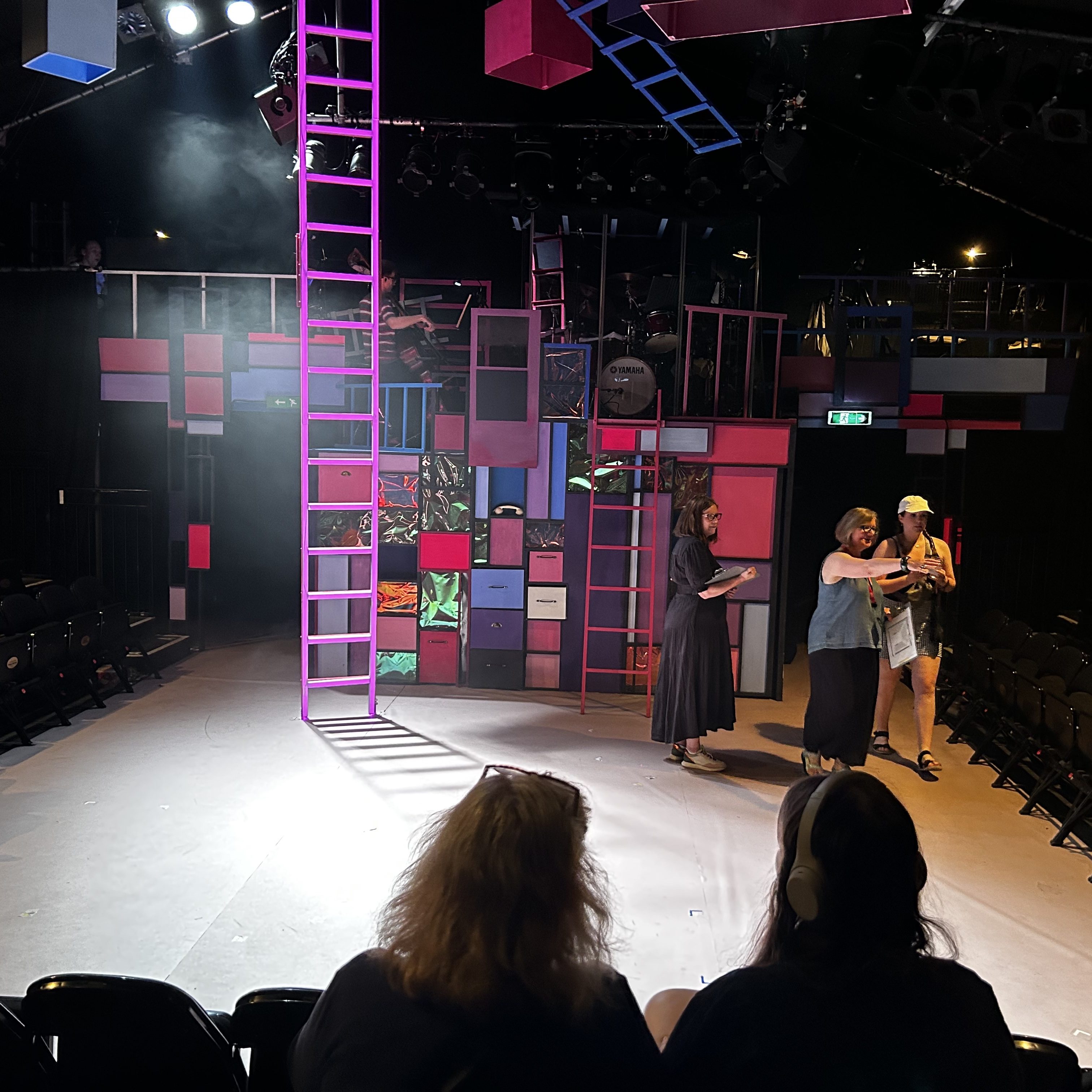
So, normally in a show where I don’t enjoy the script or the performances I can usually find comfort and entertainment in the tech: but not this time. Yes I thought the lighting was good for the most part, but every other aspect of the design I also very much did not enjoy. The set design initially interested me, with its colorful boxes and the big ladder as its focal point. But pretty much instantly after the show started I began to pick it apart in my head. The whole thing felt like it was thoughtless abstraction for the sake of abstraction. The massive ladder that acted as a big led light bar was a metaphor so obvious that I couldn’t take it seriously (and it was criminally underutilized in the blocking). Now to be fair there was an opening in the set to create an elevator, and there were cool moments where ladders were used to make other furniture like conference tables that I thought were good choices. But still, overall it felt unmotivated and seemed like it was “Design” rather than design.

I don’t have nearly as much to say about the costumes, other than the simple fact that I thought they were very not good. For example, there’s a whole song about a pretty Parisian dress that Rosemary is going to wear to get Finch’s attention, and then it turns out everyone wore that dress. So you’d imagine this dress would look beautiful right? Wrong. It was so horrendous that I can only assume it was supposed to be comedy, but given the rest of the show I just don’t feel like it was. Anyways, I will move on from costumes now as I don’t know enough about the discipline to truly critique it. Instead I will briefly talk about my main specialty, sound.

To put it simply, this show sounded bad. Not the music (though I’m not a fan of the compositions), not the singing, but the mixing itself. And to be fair to the poor audio engineer who has to experience this every night, the space looks like an acoustical nightmare. Having just come off of being the engineer for a musical, they are not fun and not easy to do at all. So to have to mix not only a moderately sized cast but also a whole live orchestra, all in a small and weirdly shaped space, feels like it would have to be its own circle of hell to do. I hope he is getting paid well. 

If it’s not clear enough yet, I really did not like this show. I believe I can honestly say it is the worst piece of theatre I have ever seen, but that’s the gamble with fringe theatre, and I kinda love that about it. All of this being said I’m very glad I saw HTSIBWRT, because during this trip I have liked a majority of what we have seen, and I was beginning to worry that I didn’t have a critique in me and was just mindlessly enjoying theatre. But this show assured me that I am capable of hating theatre, and it really gave me a better appreciation for all the good theatre I’ve seen, so I thank it for that.

This has been a very long blog post so I will end it now, I just had a lot to say. Thank you for reading through it if you got this far.
Fringe Theatre: Fury and Elysium

I saw Fury and Elysium at The Other Palace tonight and let me just fast forward to the second act before I even begin to delve into anything else. The play is set in Berlin, Germany and is centered around these queer Jewish artists and revolutionaries of their time. The second act begins with all the house lights still up and one of our main characters “The Writer” walks onstage. She stares menacingly at all of us. Everyone continues to talk, and she is still looking. Turning her head back and forth to make sure she is surveying everyone in that audience. After a while I realized what was going on; because why is everyone still talking when we have an actor on the stage? I begin to laugh to myself and then myself and “The Writer ” make long eye contact. I smile and she smirks. Everyone around us is still talking and the house lights are still on. This continued for what I imagined was five minutes, but it felt like fifteen. No one would be quiet, barely anyone looked at her, and it took an awfully long time to only hear a couple whisper to one another in the audience. I believe this was done to show how a woman’s presence is not as effective to silence a room as a man’s ability would be and is or a switch of a light cue to tell us to turn everything off. It was baffling. And comedic and so good, oh my goodness, it was so good. The play got us. The audience got- got!! This was probably the coolest part of the show to me, and I am so glad this is how the director chose to continue the play after intermission.  

To circle back though, this play follows the lives of these queer women in Berlin in between the two World Wars. There is The Writer, The Dada, The Madam, The Dancer, The Socialist, and The Drag King. All characters have a solo song that explains their story and why they must fight for their liberation, and each depicts a certain struggle that most women deal with in their lifetime. Abortion, supporting family but expecting to be married, sexual freedom, discontentment with society and politics, and even the dealing with an anti- semitic community. The show, although the story telling was a bit confusing at times, truly was a vignette play that had dance numbers that seamlessly transitioned one story to the next. The first song we get to hear is a story of hope from “The Writer” and how Berlin is her home. She describes how she is going to conquer this new city she has traveled to and make it her oyster. The penultimate song of the show is from the same character crying out to Berlin to let this still be her home, but alas the song ends with her taking a train ride somewhere she does not know.  

This show felt very similar to what I imagine Cabaret is. They entertain you with the sex and glamour in the first act and by the second act it is when you begin to hear the bellowing songs that are less hopeful than before. “The Dancer’s” song was my most favorite. She kept singing a very sensuous chorus that revolved around her and what she could provide to those that have fetishes and who wish to rent her for the night. She then has a beautiful dance number in the middle of her song and by the end of the choreography she walks through the audience to the bar, has a glass of water, and then sighs heavily and saunters herself back to the stage. She then begins the same chorus again with the final 2 verses changed to be much sadder and degrading to what she felt invigorated in before. She loves dancing and the dancing her clients want her to do is not satisfying for her soul anymore. Her 3rd and final lover left her, and she now performs the dance number again but does so in a more morbid and frantic tone.  

From what I understood about this play (and it ending with the cabaret style club being bombed by the Germans), it was about what liberating freedom can do for someone. How living moment to moment is all we can do. Society will always beat you down and hate you, so why even bother giving them a glimpse into your life? Certain characters would continually say they are not political and then go on and make a very politically charged statement. “The Dada” explains that nothing is supposed to make sense, and everything does not matter. A very genuine artist’s cry, ha-ha. But what I gained from this musical was even though these women were living through the harshest of times; they said fuck it. And were themselves. And they died happy; regardless of how society treated them. Regardless of how their friends treated them, or even how their fellow cabaret girls treated them, all were content in themselves and seeing that type of strength come from six femme presenting people onstage was really something special for me.  

3

Three is a magic number according to the great Schoolhouse Rock. I am inclined to agree with the educational musical shorts. Three is also the number of shows I have seen in London that constitute as Fringe Theatre. As of the writing of this blog post, I have seen thirteen plays in total which means just under a quarter of these performances are fringe shows.

Fringe Theatre performances are your off (off) Broadway level of shows: professional on smaller budgets and smaller stages. In order of viewing, I have seen Jules and Jim, The Curious Case of Benjamin Button, and How to Succeed in Business without really trying. The latter two were put on by the same theatre company, Southwark Playhouse, which, based on the quality of the performances is quite astounding.

“Benjamin Button” is easily in my top three for this trip while “How to Succeed” is duking it out with Dancing at Lughnasa for (un)lucky number thirteen. Granted the two shows are really only similar in that they are both musicals; however, I am astonished that this small theatre company provided me with two drastically different experiences.

Benjamin Button is a show I would recommend to anyone. I still think the actual story of a man who ages backwards is silly bordering on stupid, yet I cannot help but be absolutely in love with what I got to watch. The songs were magnificent. There was excellent blocking, and they used their space efficiently. The entire twelve-person ensemble was amazing. Due to the nature of the show, the actors double as the band. They play instruments, sing, and move in expert coordination all at once. All this to praise the incredible cast. I could not help but tear up in the end. It is a unique play that somehow pulled off what few others could. I will say as much as I did love Benjamin Button part of the reason it worked was the theatre it was in. I believe I would have been taken out of the play if the theatre had been bigger and therefore myself farther away.

Next up from Southwark Playhouse: How to Succeed in Business.The show is no new kid on the block when it comes to theatre. It first appeared on Broadway in 1961, and the story showed it. Southwark Playhouse’s version utilized a reduced cast. The stage was incredibly small, but I think how they used that space is one of the few things I enjoyed. I think the actors were good actors, I just also think I would have perhaps enjoyed the show more if the casting was shaken up differently. Southwark tried to make a statement by casting a woman in the lead role and a man as the love-interests. Although, the characters remained Mr. J. Pierrepoint Finch and Rosemary. It was a casting choice that fell flat for me especially since it hurt the musical. These two parts were written with specific vocal ranges in mind, and these actors did not have the vocal ranges to sing all their parts. Not to say they were bad singers, just to say they could not physically perform the material. It is also a very dated script. I do not typically look at entertainment as if it was written in 2023, but the rampant workplace sexual harassment and sexism is just very hard to ignore. This staging did not sweep me away from these discrepancies with the musical numbers. The lightning had some cool effects but also cast some horrible shadows. I felt as if actors were missing their marks for the spotlight particularly when they moved downstage to the left corner. It almost felt like a complete waste of my time aside from the banger of a final number. I think I would have enjoyed this in a bigger budget West End/Broadway setting especially if I was more charmed by the leads.

To wrap up Fringe, I will shortly mention Jules and Jim. We extensively hashed out our opinions about this early on in the trip (it was the second play we saw) sitting in a park by Buckingham Palace. For me, Jules and Jim was an experience I enjoyed even if I am still not sure how I truly feel about the play. There were probably somewhere around fifty seats in the theatre and at most thirty people in attendance the night we went. The play perfectly played to this kind of set up. Most of the play consisted of monologues from the characters Jules and Jim to the audience. The problem was the wildcard Cath. While kind of enjoyable to watch, there was no true redeeming quality to the character which is mainly why I struggle to formulate an opinion on the show as a whole. Overall, I enjoyed the show, but do not think I would recommend it to others.

Fringe theatre is as mixed a bag as any other professional theatre. Ultimately, it mostly comes down to the opinions of individuals. Fringe theatre often brings intimacy to theatre which can be a wonderful experience with the right script. For our group, opinions were split on both Jules and Jim as well as How to Succeed. Yet only one person who attended Benjamin Button did not enjoy it thoroughly. You can find some real gems in Fringe theatre if you look, or you can find some duds. But then again, that is true of even the highly funded West End productions. Budget and theatre size are the only markers of Fringe Theatre.

It Was Still the Brotherhood of Man

I think that fringe theatre is a bit ill-defined. Is a show fringe because of the intimacy of the space? How close the viewer is to the actor? Then is Punch Drunk: Sleep No More fringe? They literally touched the audience. Is a show fringe because of the budget? Is it fringe if it is Indy and underground? Then why wasn’t any show we saw at the globe fringe? Everyone knows A Midsummer Night’s Dream but it seemed like it did not cost a lot to put on. How about when lie five people came into my room to watch Paddington? I spent no more on that and it was a small audience. I guess I don’t really get what fringe is and it is just something I have to play by ear and feel in my heart of hearts. 

How to Succeed in Business Without Really Trying was a very interesting show, to say the least. The show follows a young man as he works his way up the corporate ladder by reading a book that details exactly what he is doing. The young man falls in love but does not let love stand in the way of his career–much to the chagrin of his pursuer whom he constantly puts aside.–the young man is effectively a cunning silver-tongued cheat who makes the title of the show come to fruition over and over again. 

This show could never be made today. Luckily it wasn’t. It was made years and years ago and it shows. This production attempts to make up for the sexism and stereotypes by casting gender swaps of several of the leads. The young man and his lover were gender-swapped, as well as the big businessman being cast as a woman. Now all of that being said they did not change the script at all. They were simply played by women/men. It was still the Brotherhood of Man. The show could have gone further in its casting choices. Instead of just a few people being gender-swapped, they should have just had that be part of the world. Their desired effect of “we are all the same” did not land with this cast. They were still cartoonishly sexist. 

This show was in a very small room with a very small audience but what I think made it truly fringe was the lack of AC. It was so hot in that theatre (and I don’t get hot.) I could see each actor glistening with sweat. I felt a mild kinship with the actors as we all suffered through the insane temperatures of the theatre. Maybe that’s what fringe is…everyone suffering the consequences of a small theatre. 

Also, I did not know that one Family Guy song was a parody of this show. 

Finest Fringe

Whilst being in London, I have seen many different kinds of theater ranging from musicals to murder mystery to comedy and beyond. These shows all fell in the range of large West End productions to Fringe theater. Fringe theater is small scale theater that is generally non traditional. Since being on this trip, I have seen a total of four fringe shows including Jim and Jules, The Curious Case of Benjamin Button, Glory Ride, and How to Succeed in Business Without Really Trying.

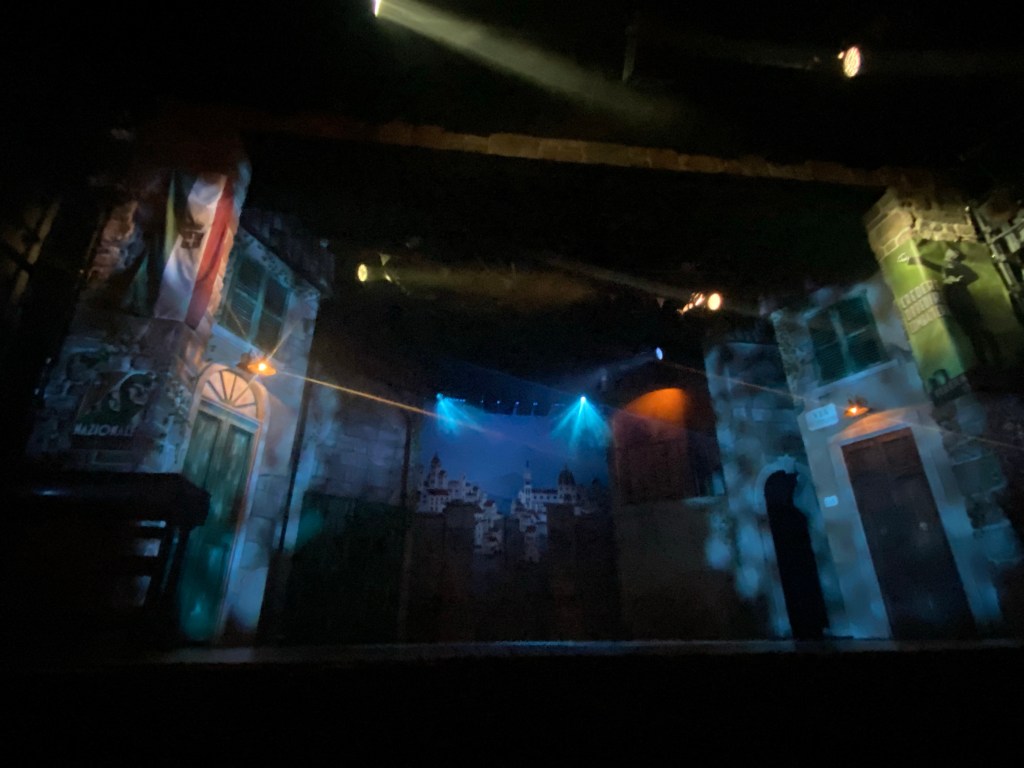
Glory Ride stage

I want to specifically write about Glory Ride because it was a small theater that showcased how they could make a big impact on a seemingly little budget. The whole storyline was based on the true story of an Italian cyclist name Gino Bartali. Gino spent his life cycling and competing in races when he caught the attention of the Italian team for the Tour de France whose coach was a blackshirt. The blackshirts were army members under the control of Mussolini during WWII. Gino won the Tour de France and became an idol for many people in Italy. Gino eventually used his position of power to make 53 trips on his bike taking edited passports to people in order to help them escape the country.

There were a few technical aspects that the play utilized including the use of a functioning bike and projections. The projections were used to make a connection between the present story being told and it’s historical background. They not only displayed dates and facts with the projections, but there was also a point in the show where they showed clips of Gino Bartali’s actual races. The videos of the races worked to convey that sense of connection to the past, but the projected dates and times were a little cheesy. They same point could have been made if they had managed to slip a line into the play saying the date.

Gino Bartali

It was also creative how they implemented a working bike into the show. The bike was ridden across the stage, and there were moments when the bike was made stationary so that it could be used in racing scenarios. Both of these aspects of the bike made it easier to connect the main character to his role as a cyclist instead of the bike being seen as “just a prop.”

Overall, the musical was working to tell the story of a humble historical figure through an emotional and inspiring narrative. While some of the plot points were jumpy, the production was successful in completing its main goal. It fits in well with a quote from Bartali himself. “The good you do, but you do not talk about it. Certain medals hang on your soul, not on your jacket.”

Thanks for reading, and I’ll see you next time ❤

6/14: How to (somewhat) Succeed at Fringe Theatre

I was originally going to talk about The Murder at Haveshame Manor, which is a play I saw that went horribly wrong, but that actually happened to us during The Mousetrap… So, I figured I would talk about How To Succeed In Business Without Really Trying instead. I had worked on this show before, so I was familiar with many of the aspects, and may have come into the show with higher expectations than I should have. To start, I very much enjoyed the group dance number choreography. The ensemble of actors, one of whom was actually the dance captain for the show, utilized the space they were in very well. During the large numbers, while it did feel a little bit condensed because of the size of the theatre, the actors were very well coordinated and there wasn’t any one person in the ensemble who was falling behind or not in sync with the rest of the group and I particular thought that the actor who played the nephew did a phenomenal job. Overall, the dance captain was very successful in achieving an entertaining spectacle during the dance numbers.

One aspect that I was disappointed by was the gender swapped casting. Instead of fully committing to the idea, there were only three, or so, characters who had been gender swapped, and because of this, it felt more like wasted potential than anything. Alex was talking about gender swapping the secretaries to be hot guys, and I think that would have been hilarious! However, with the swapped roles, they did not even change the key of the songs, and the lead actor particularly seemed to struggle with the low notes. It was hard for me to hear some of her lines in songs and that nearly ruined them for me. I found the acting to be okay and after I while, the Nephew’s bad American accent clicked with me and I found it funny rather than annoying, like I did at the start. Also, I think stunt casting is stupid in general, but regarding the lady who play J.B. Bigby, while she had an excellent stage presence, I don’t think that the choices she made were very good. There were specific moments, like Bigby being extremely jittery when interacting with his secretary, that seemed nearly identical to past Broadway productions that I (may or may not) have seen on Youtube and it felt like the audience was laughing at unfunny choices that she made, simply because they knew who she was. I am sure that she is a great actor, but I don’t think that this role suited her (business pun haha) very well. I am realizing that I have been very negative about the show, but I did have a good time. Oh… one more negative; the script drags in the first act and rushes in the second, but that was not the fault of the production. In general, I think the show succeeded in being entertaining, but it failed at its greater themes about gender relations and simply left me wanting more.

I wrote the wrong post, but it’s ok because I am the birthday boy

Yesterday was my birthday (yay!), and we kicked it off with a very interesting visit to Westminster Abbey. A grand cathedral that houses the graves of many well known individuals ranging from Shakespeare himself to Nelson Mandela. I would like to briefly talk about three of the people who were buried within Westminster. Of course I have to talk about the bard first, and there is some fun info too. Shakespeare is actually not buried in Westminster, but many people have called for him to be moved there. His actual body is buried within his hometown in Stratford Upon Avon, and, despite many people’s request, it hasn’t been touched since its original burial. Westminster acts instead as a memorial for the playwright. It gives him the recognition he earned, and adds a bit more flattery to his deceased name. To my suprise, another person buried within Westminster (for real this time) was Sir Issac Newton. He was a physicist and mathematician known for his work on the laws of motion, gravitation, classical mechanics, calculus, planetary motion, optics and more. I was just shocked because I have heard so much about the man, but I have never even stopped to consider where he died. His grave forever reminds us of the world we live in and the rules that always apply. I was also a little surprised because, along with Shakespeare, both were laying with giants. The whole cathedral was filled with dead kings, queens, saints, and cardinals, and here they were, just a poet and a scientist. Lastly, for the same reason as the last two, I found Charles Dickenson’s burial to be incredibly fascinating. An author of such talent is sleeping with men and women that started wars. All three of these men give proof to the power of art, science, and overall thinking. We can change the world, move hearts, and inspire people with more than just the power of a nation. We can use our words, writing, and ideas to create an influential masterpiece. I don’t know what I’m gonna do with my life, but I hope it causes me to be buried with President Barack Obama.