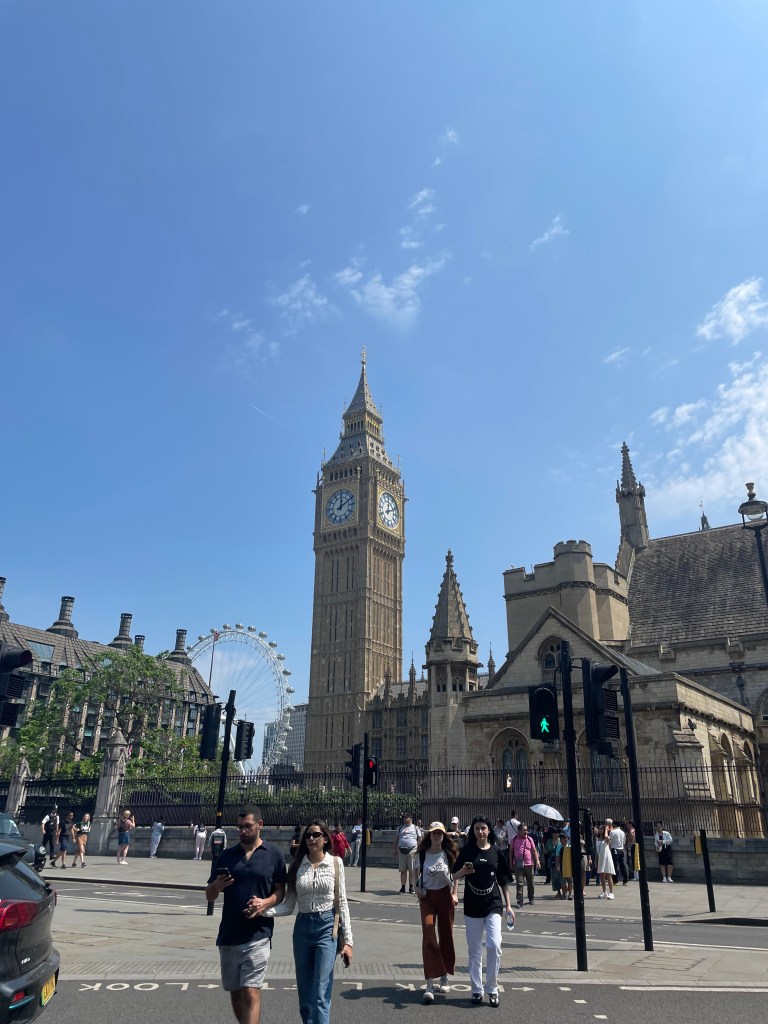
First off, I would like to say I have long been fooled about Westminster Abbey. The famous church where the United Kingdom crowns their monarchs is not the building adjacent to Elizabeth Tower (the iconic fancy tower with the clock which most of us incorrectly refer to as Big Ben). Parliament sits next to the clock tower and major London landmark. Westminster Abbey is actually north. Not drastically removed, mind you, I believe I crossed a singular street and then had to do a very short walk. Still! I feel I have been misled; although, I don’t really know why as I had never been informed incorrectly or really at all.
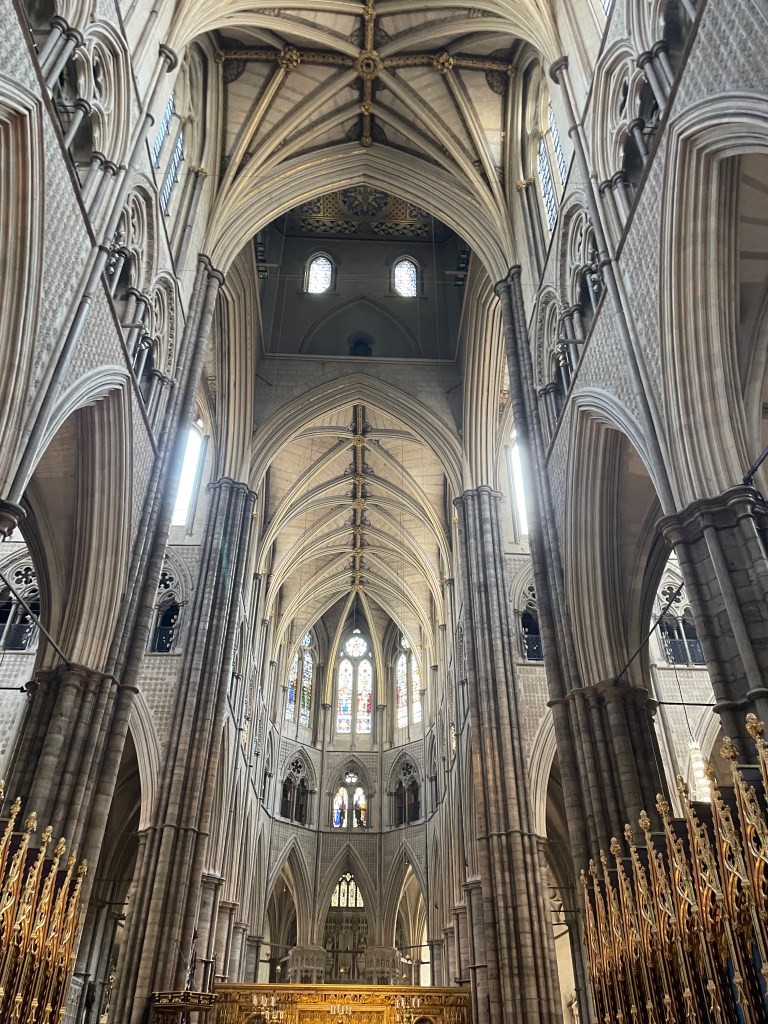
Anyway, Westminster is rather impressive. From the outside, you can see a large circular beautiful stained-glass window. What is standing today is largely the gothic style of architecture (my architecture major roommate, Madison, has informed me that it is perpendicular gothic to be exact). You can tell this very clearly by the flying buttresses and many pointy decorative choices. While it is quite impressive, the building seems like it wants you to think it is impressive. Gothic architecture often seems to be a blending of creative structural choices and showing off; Westminster is no different.
Overall, despite the beauty of the church, I was a bit…well, I know you can be overwhelmed, and you can be underwhelmed, but since I am in Europe, I think I can just be whelmed, so I’ll go with that.
I may have had a more pleasant experience if I had gotten to do a self-paced audio tour. No hate to our tour guide Molly, I have just loved walking around with an audio tour since I toured mansions in the Northeastern US with them. There is also the problem that accompanies every major tourist attraction: people. I felt rushed or like I could not see what I wanted to see because of all the other people who wanted to see the same things.
Today, Westminster Abbey is a functioning church aside from being a major tourist and school trip draw. Notable events for us modern folk include William and Kate getting married at this church in 2011. Just over a month ago, on May 6, King Charles III was the fortieth monarch crowned at Westminster. William the Conquer was the first British ruler to be crowned at the site with this coronation occurring Christmas day 1066 (a fact that has taken residence in my brain since 3rd grade).
There was first a Christian congregation on the site of Westminster around 960 AD. King Edward, now known as St. Edward the Confessor, wanted to build a palace on the bank of the Thames in the 1040s. Since there was a monastery close by, he decided to enlarge it and turn it into a full church in honor of (St.) Peter the Apostle. To distinguish the church from the eastminster (St. Paul’s Cathedral), the church was dubbed Westminster. The Pyx chamber and supports of the undercroft are the only surviving features of Edward’s Westminster. What stands today was built during the 13th century.
Part of the purpose of Westminster was to be the royal burial site, and while many are buried at the church, the last monarch to be buried here was George II in 1760. After George II, monarchs started being buried at Windsor. Westminster was also opened up as a burial for commoners. Important Brits who are not actually buried at Westminster have memorials there. Shakespeare somewhat famously refused to be buried at Westminster; he is instead buried at the church he was baptized at in Straford-upon-Avon, and there is a curse on the grave if anyone should try to move the body.
Authors such as Lewis Carroll and George Eliot are also only commemorated instead of buried at Westminster. I mention these two together as they are known by pen names. Their legal names were Charles Lutwidge Dodgson and Mary Ann Evans, respectively. Carroll has gone down in history as the creator of Alice and the mysterious and fantastical Wonderland. However, he was also a Mathematics tutor at Christ Church, a college of Oxford University, and a pioneer in photography. Eliot wrote seven books and is considered one of the leading female authors of the Victorian age.
Both are commemorated in Poet’s Corner. The first to be buried in this section of Westminster was Geoffrey Chaucer (Canterbury Tales). Two other notable men buried in this section are Charles Dickens and Rudyard Kipling.
Interesting, Mary I (Catholic and namesake of the tomato-based alcohol cocktail) and Elizabeth I (Protestant and alleged virgin) are entombed together. The two are the daughters of Henry VIII and half-sisters. Mary once imprisoned her sister in the Tower of London to discourage Elizabeth’s supporters and therefore better secure her throne. Mary is assumed to have died of cancer leaving the throne to Elizabeth and the country to the Protestants. There are three theories of why Elizabeth died: an illness, blood poising due to her makeup that was classified as a poison in the 1630s, or because she refused to remove her coronation ring which had grown into her skin. The inscription on Elizabeth’s tomb translates to “Partners in throne and grave, here we sleep Elizabeth and Mary, sisters in the hope of the Resurrection.”
After Elizabeth I died, the throne went to James I of England and VI of Scotland. He had his mother, Mary Queen of Scots, moved to Westminster Abbey. Mary was executed by her cousin Elizabeth and now forever lies across the hall from the other queen.
There are Prime Ministers interred at this church although you will not find the great Winston Churchill. Churchill did not want to be buried among men he would not even have a smoke with and instead only has a memorial. Another notable WWII era politician is memorialized at Westminster, but this one is not British. The UK government memorialized FDR in their historic abbey for being a friend of freedom and Britian.
So there it is, Westminster Abbey, a place that celebrates the renewal of a country and the end of the perceived greats.


 Theatre in London U of A
How amazing so glad you got to do this
LikeLike
How amazing so glad you got to do this
LikeLike
Great Job, Alyse!
LikeLike