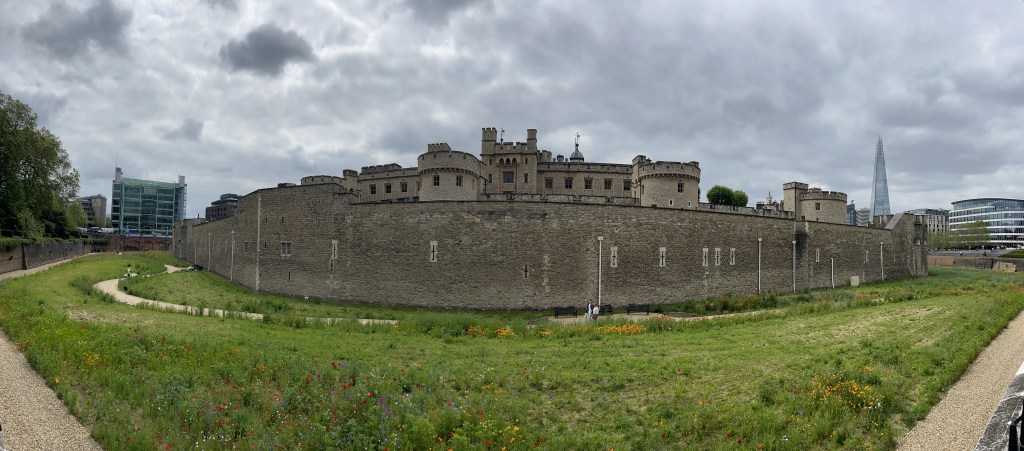
The Tower of London is, surprisingly, not a tower. It is a castle! Or at least, that’s what I say it is. I thought the Tower of London was just one tall building when in reality, it is a whole establishment. I learned a lot about the Tower of London while walking around and was even treated like royalty at one point (details on that later).
The first prisoners I saw when walking into the grounds were the ravens. They were in cages, and those that weren’t had little red tags on their legs. There is a legend established by Charles II that if all six resident ravens (the imprisoned/caged ones) fly away, the monarchy will fall. So, they have caged them to prevent that from happening. Interestingly, ravens aren’t the only animals that inhabited the Tower of London either.
Lions, monkeys, an ostrich (r.i.p.), and even a polar bear once lived in the Tower of London. During King Henry III’s rule, gifted animals inspired him to create a zoo within the grounds. This led to many animals inhabiting the area, including a polar bear that was chained to the River Thames so it could swim and hunt fish. The zoo was open to the public in the mid-1800s. This led, unfortunately, to the closing of the monkey exhibit after one monkey attacked a boy. Additionally, the ostrich (r.i.p.) died after one visitor believed birds ate iron and fed it a long nail.
Other than animals, there were humans that were imprisoned as well. Richer and more respectable prisoners were given more hospitality and better treatment than those who were suspected or convicted of treason. By the Tudor period, starting in 1485, the Tower of London was the most established state prison in the country. One of the most famous, however, one that probably everyone is going to write about, is Princess Elizabeth, who was imprisoned by her half-sister, Queen “Bloody” Mary I. Famously, Princess Elizabeth was the daughter of Anne Boleyn, one of King Henry VIII’s wives, another prisoner of the Tower of London. Princess Elizabeth was eventually released, but was held until the day of her mother’s execution.
The Tower of London itself was extremely beautiful in terms of architecture, but tragically haunting in it’s history to me. I would have loved to see the crown jewels, but the line was painfully too long, so alas, I will settle for the forbidden photographs some people in the group took. I witnessed a lot of children running around and even had food thrown at me by a few children from a tour group – when in London.
I do wish I could have seen the crown jewels, but as it is just jewelry, I felt that seeing the architecture and learning about the history was more important to me. I did see many character demonstrations as there were employees of the Tower of London dressed in costumes in the time period of their stories.
At one point, on my way up to the top of a staircase to a corner of the castle, a group of people were listening to a “soldier” of the royal guard. I’m not sure of the details he was telling, but I know the group was invested. When I got to the top of the stairs, I realized the group and the guard were looking at me. I waved and said, “Hello.” He said something back, but I couldn’t hear him, so I responded, “What?” This he replied, “Carry on, your Majesty.” I then waved and said, “Thank you, thank you.” Everyone laughed. I smiled. And I will never be the same again.

 Theatre in London U of A
Thank you!
LikeLike