
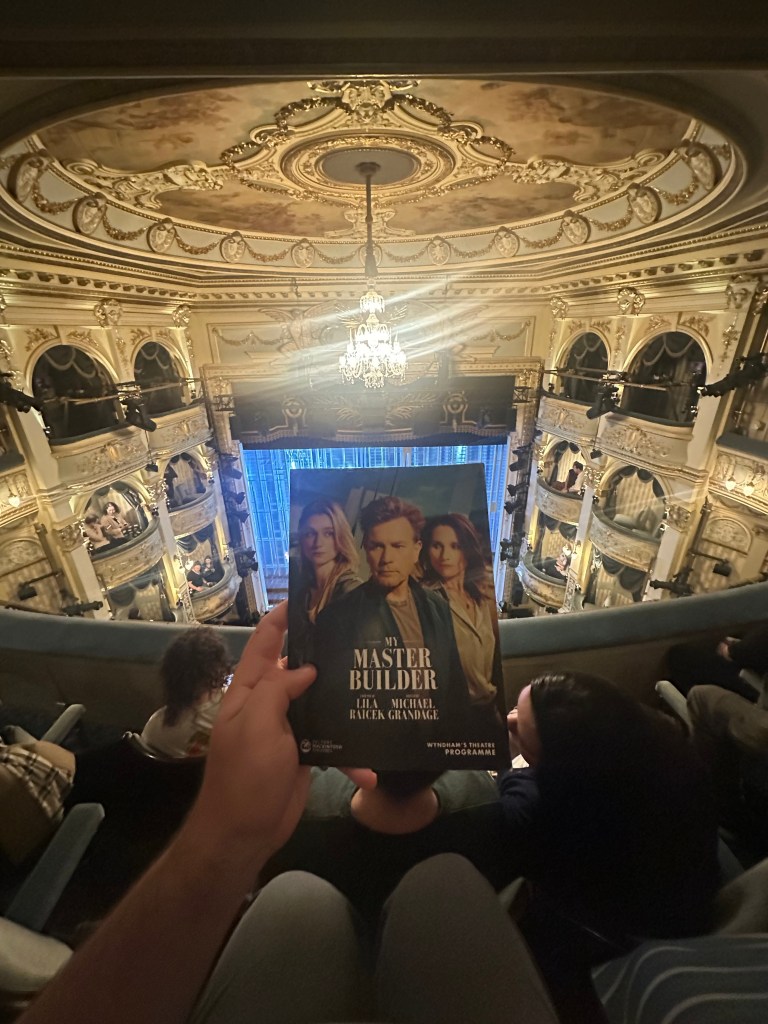
I’ve always loved the prequel Star Wars movies. Sure, they have some flaws, some less than great performances and script choices… Jar Jar Binks. But there was some good in there too! To me, one of those main highlights was Ewan McGregor and his portrayal of a young Obi-Wan Kenobi. When I heard that we’d be able to see McGregor on stage on THE WEST END, I was ecstatic. On top of that, I had never seen or read Ibsen before, but was excited to finally get to see, even an abridged, version of his work. As can be seen by the picture beside this text, I was excited enough to buy a playbill before even sitting down. For reference, the only other play for which I bought a playbill in advance was Cabaret. Suffice it to say, expectations were quite high. Even if the play sucked, I would get to see one of my favorite actors, who would surely be a highlight of the play, and maybe even meet him after (I even found the stage door in advance).

To be blunt, the proceeding play was one of the most boring and frankly just un-artistic pieces of theatre I’ve ever seen. The selfie here was the actual reaction image I sent my family at intermission. I will expand on what aspects caused that reaction, however, I’d like to start on some more positive notes.
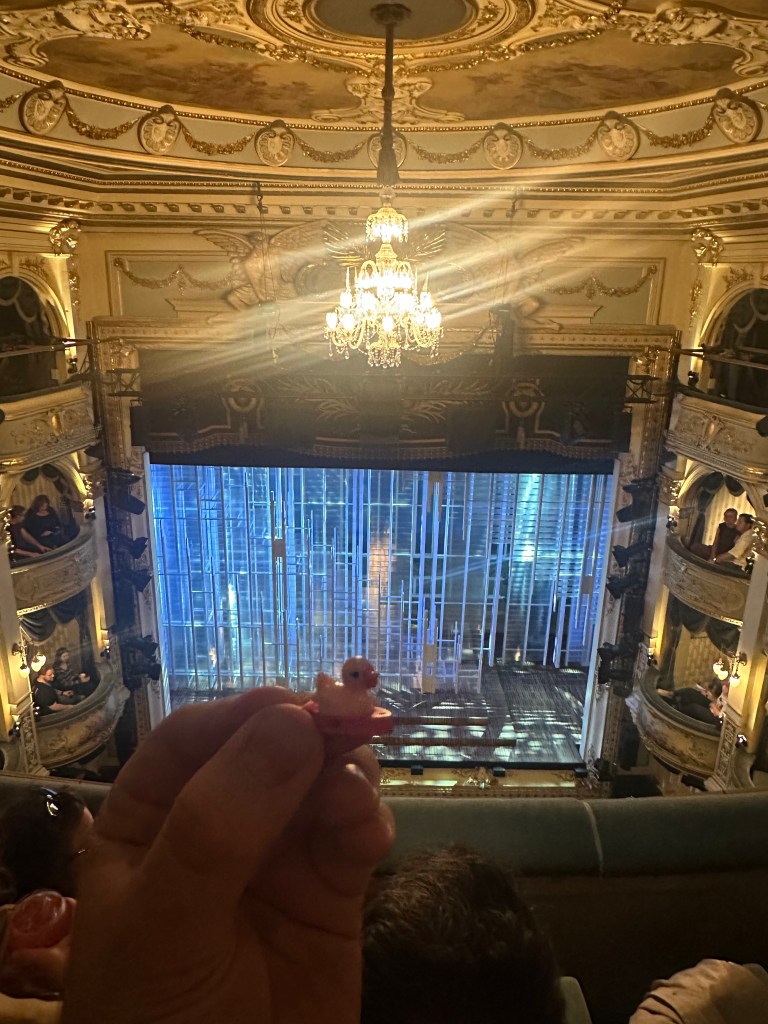
I thought the set was really phenomenal. Being the “master builder,” McGregor’s character is an architect with a new big project. This project is a refurbished church made into a center for art (all largely a conception from this new play and not Ibsen’s original). This production shows the project through a large crystalline staircase of sorts. This shift from the more brutalist towers by the original Henrik (main character of “The Master Builder”) to the modern and artistic McGregor’s Henry (“My Master Builder”) felt like a natural way of bringing it to “now.” The other set – Henry’s home – was a perfectly great looking modern home that felt fit to be the home of an architect.

I found the costumes largely fitting to the characters. Elizabeth Debicki’s character had a silver dress in the second act that felt accurate to Henry’s view of her, being his glowing beacon in a way. The rest were very nice, the protegee, Ragnar, having one of my favorites with a colorful outfit in the first act. I believe the costuming for Ewan McGregor’s Henry was much too casual. I thought perhaps at the party of the second act he would come out with something very refined to challenge the other characters and show some of his ego (a prominent aspect of the original). As matched the rest of the productions portrayal of Henry, his costumes never lived up to expectations. With this, we move on from positive notes and more onto my main thoughts of the play.

A question that might be coming to mind is “Why the change to ‘My Master Builder’ from the original?” This question was certainly on my own mind before watching it. That name change is one of many shifts that to me signify the way this playwright really dulled down the original story. In Ibsen’s play, Henrik was known for being a great architect. HIs continued ambition despite all else, even the death of his own children, is what makes the character who he is. This ambition is also what kills him, as he climbs his own tower and falls from the top. In the original, this death is also slightly ambiguous, possibly an accident caused by his vertigo or a suicide caused by the pressures surrounding him. Like his death, many past events in the lives of the characters feeling towards each other are somewhat shrouded in ambiguity. Henrik seems to almost have some jealousy towards his own protege, while his relationships with the women in his life are largely manipulative in nature. One of these women are even the one to coax him into climbing his tower. Altogether, though the original script is not perfect, it has many aspects that make it a complex and thoughtful take on the story of a flawed man.
My Master Builder puts an emphasis on the “My” above most all else. The story and Henry (this play’s Henrik) are defined almost solely by his relationship with the women in his life. These two women are his wife Elena and his former student, Mathilde. While the original play is told over an extended period of time, this story is told in one night. In it, the plot (if one could call it that) is largely taken over by scenes of Henrik arguing with Elena and then immediately fawning over Mathilde. Other than a few short mentions, this text keeps none of Henrik’s original focus on architecture and his ambition.Instead his only goal seems to be to rekindle his relationship with his student he had an affair with while he was a professor at a university. Except, he also makes no choices or moves towards achieving any goals, just talking aimlessly about the past. Henry’s death is also made into a complete accident as he falls after fireworks set off his vertigo after he climbed his crystal building as a show of love to Mathilde. Additionally, the playwright made the death of Henry’s son clearly and totally his own fault. Henry’s relationship with his protegee/apprentice is nonexistent as that character’s entire purpose was to be sleeping with Elena’s assistant, Kaia, and then have the wife hit on him. As I hope these details have shown, the plot and character relationships of the original hardly survived the shift.
I would love to use some fancy words and analysis to describe the dialogue, but as the playwright seemed to lack any tact or knowledge of human speech, I’ll match their wit. Each character said exactly what they were thinking and what they wanted. The dialogue lacked any color and not just in the sense that it was dry, just that the characters seemed to have no internal thought to allow for them to converse with each other with any complexity. This was also likely due to the lacking performances of the TV-famous leads.
Perhaps if I were a few feet away from their faces, the performances of Ewan McGregor and Elizabeth Debicki (as Mathilde) would have felt somewhat human. However, from the upper section where only dialogue and body movements are seen, both seemed quite lacking. The way the lines were said sounded like a first reading, pre-analysis, by two actors who got drunk the night before and forgot to pre-read the script so they are underprepared and hungover. The rest of the performances really weren’t bad, Kate Fleetwood had a real energy and grief to her performance as the somewhat unstable wife. The protegee and assistant both kept me engaged in their scenes and were quite entertaining. They were only held back by the script. Truly McGregor and Debicki were the weak links.
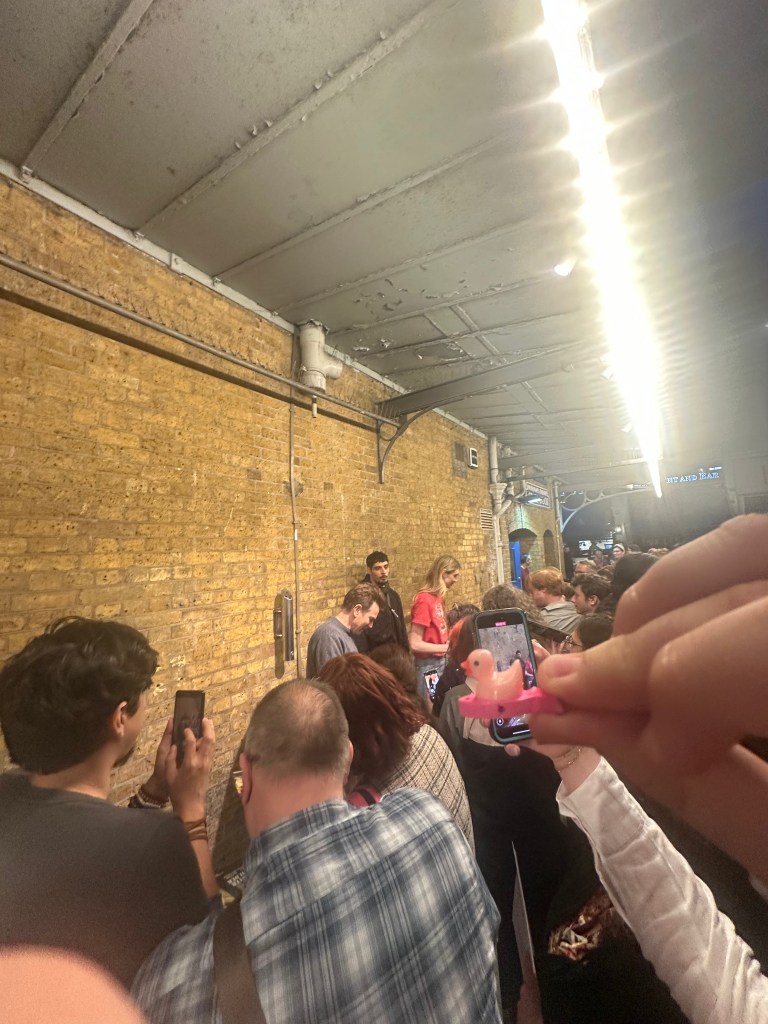
My biggest excitement was that, no matter how the play was, Ewan McGregor would be the highlight. I was let down. The stage door experience was also quite unpleasant, McGregor signed a very limited number of things and left quickly, though the crowd was (for a roped off stage door) not very big. The main pleasant part ended up being talking to the actress who played the assistant who was super pleasant. Then, a few of us stayed to discuss the show with a few Londoners at the stage door. This ended up being the perfect cap to the evening as they had the exact same thought that our group and I and Squirt had. A thought I’ll end this review off with – “What the hell?”
 Theatre in London U of A