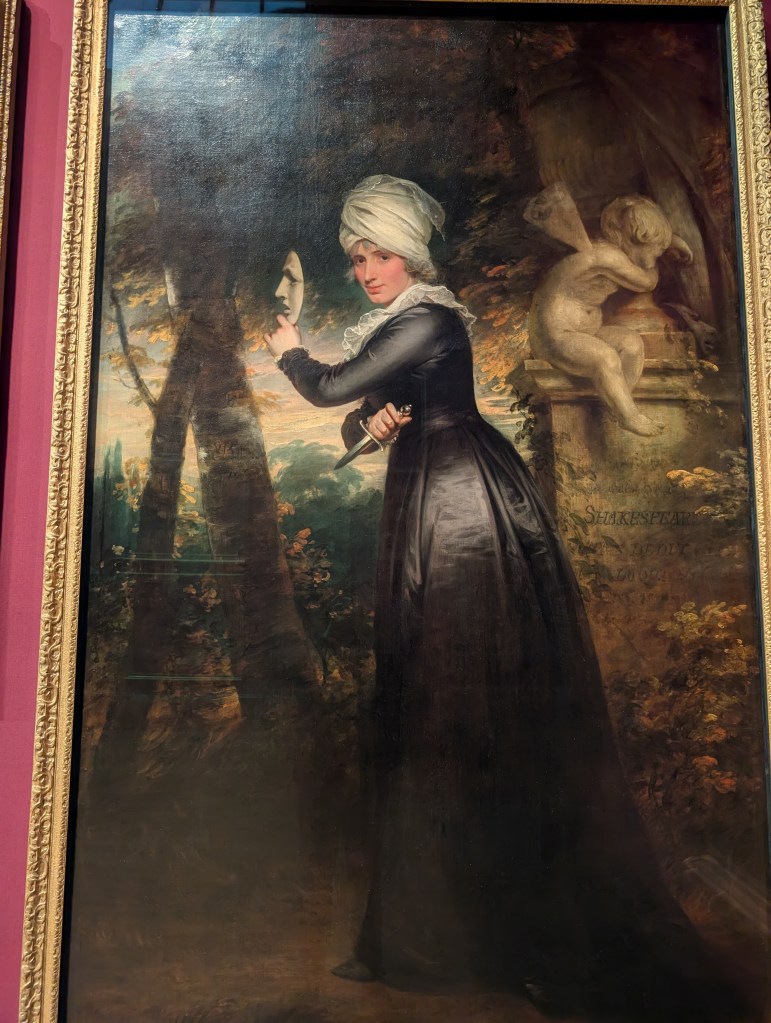
When I visited the National Portrait Gallery in London, looking for an artwork to write about, nothing caught my eyes at first. While many of the paintings were very beautiful, and I could see their masterful creation, the nobles and knights just blended together as I walked through the museum. That was, until I walked into a room and the first piece I saw jumped out at me and I immediately knew I had to write about it. The piece I saw was titled Mrs Siddons with the Emblems of Tragedy by artist William Beechey. Compared to the rest of the portraits, which consisted mainly of the sitter looking forward, Sarah Siddons’s body which faced away, and arms wielding a mask and dagger was so much more intriguing. It felt so mysterious and fascinating, in a way that no other portrait made me feel.
The mask in one hand, being raised up to her face, and the dagger in the other immediately made me think that she was an actress, and my thoughts were confirmed upon reading the brief description of the portrait provided “This leading actor holds the emblems of tragedy – a mask and a dagger”. Researching Siddons further revealed that she had been dubbed “tragedy personified” and was most famous for her portrayal of Lady Macbeth. This is further reflected in her black dress, which almost merges with the shadows beneath her.
In fact, much of the portrait is cloaked in darkness, both above and below her. The remaining colors are mostly drab, emphasizing the feeling of sorrow. The little light that is present serves to highlight her face, and her props, drawing the eye to the most important elements of the portrait. This lack of light in color helped to make the portrait further stand out to me, as it contrasted with the vibrancy of the other portraits in the room. Many of the other paintings also consisted of just the upper body, so seeing Sarah Siddons in full was again unique. Her posture was also different to the other paintings I saw. Many of them had the sitter facing directly forward, yet Siddons’s body was turned to the side, with her head twisted to look forward. This gave it much more mystique, and made it feel much more dynamic, and I almost felt like she was plotting.
The background of the portrait was that of a forest. However, there was one element that stood out, elevating the painting as a whole. Behind Siddons there is a stone angel crying over a gravestone or monument. On that stone reads the name “Shakespeare”. This connects Siddons with her most famous role of Lady Macbeth, a character from one of Shakespeare’s most well-known tragedies. It also raises many questions, is she there to honor the man who wrote so many of the plays she acted in? Why is there a monument to William Shakespeare in the woods? The questions go unanswered, adding to the tragic atmosphere of the portrait.
If I could step into the portrait, I imagine that it would feel quite somber. The air feels cool and bitter as it mournfully blows through the trees. The sounds of wildlife I expect from the forest aren’t there, leaving an uneasy silence. This silence is broken as Siddons begins to speak, reciting one of Lady Macbeth’s monologues, becoming “tragedy personified”.
-Jack Duncan
 Theatre in London U of A