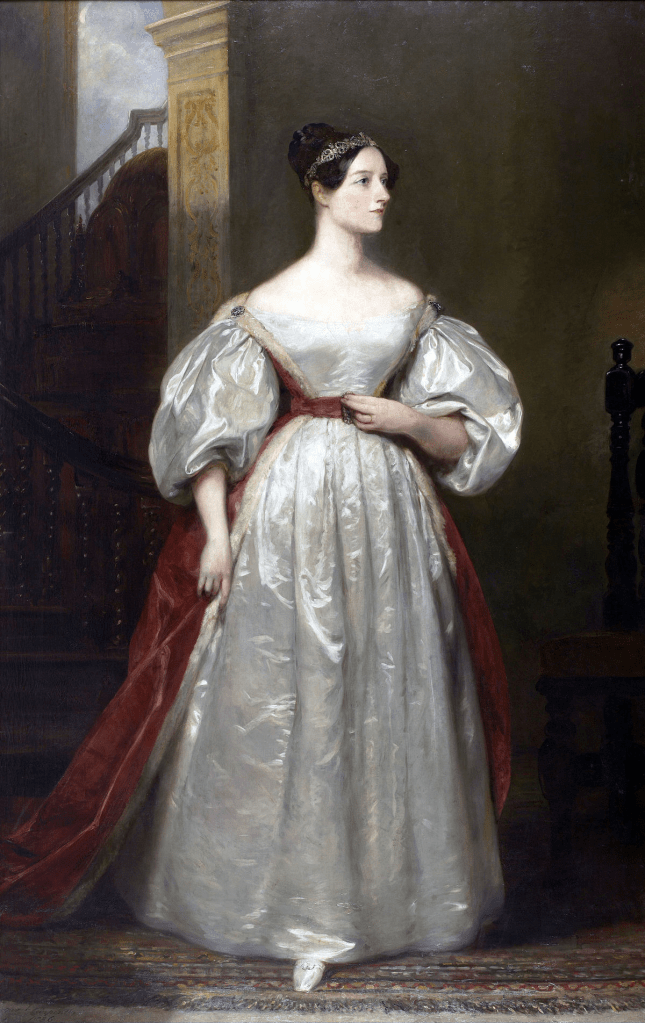
This portrait of Ada Lovelace was painted by Margaret Sarah Carpenter in 1836. She was born in 1815 with the name Augusta Ada Byron – the only child of Lord Byron with his wife Anne Isabella Milbanke (Lord Byron had many other children out of wedlock). Lord Byron left her mother only a month after she was born. Throughout her childhood, Milbanke encouraged her daughter’s interest in mathematics. Ada married William King in 1835, who was made Earl of Lovelace. This is where we get the name by which she is known today, Ada Lovelace.
Lovelace is widely considered to be the first computer programmer. She worked closely with Charles Babbage on his Analytical Engine, which is thought of today as the first programmable computer. Lovelace was the first to consider tasks outside of computation for this device, setting her ahead of any other person in the field at the time. Babbage dubbed her as the “Enchantress of Numbers,” and she herself described her approach as a “poetical science,” which further reinforces the ways in which she approached science and mathematics differently than her contemporaries.
This painting, however, was done a year before the first concept of the Analytical Engine, which was described in 1837. She was already working closely with Babbage at the time and had been married just a year prior, yet these facts of her life are not what dominate this capture of Lovelace. There is a thin wedding band around her finger that, from afar, almost becomes invisible. There is nothing that ties her to her work at all. This portrait to me is a clear representation of the way in which women view women.
Lovelace stands elegantly centered in the painting. Behind her you can see a grand spiral staircase half hidden behind a wall, and under her feet lies a carpet. It is clear that this is a place of wealth – the wall has ornate carvings, and the pattern on the carpet is reminiscent of the most expensive Persian carpets. However, all of this is put to the background, painted in dark shades that nearly disappear when looking at the true subject of this portrait.
Lovelace appears to be glowing in a white satiny dress with red and lace details adorning the sides and waistband. It gives the impression that she herself is the source of light in this room. She is incredibly feminine with her hair done in an updo with a tiara, and her white shoe is decorated with a small white bow. Lovelace looks elegantly off to her left, her eyes seeing something that we will never get to see. Perhaps it was her husband. Or her cat. Or one of her many notebooks. I think it was something bigger than all of these options – I choose to believe that she is looking towards the future, towards something that only she knows is possible.
This portrait makes you want to jump into it to know more. The STEM nerd inside of me wants to pick her brain about all things mathematical and scientific. The artistic nerd inside of me wants to know what she spends her days thinking about, what it is to be a badass (excuse my French) woman in a time when women weren’t supposed to be that way. I want to know the way her dress feels and put my bare feet on the carpet with her. Mostly, I just want to get to know her in the way that women have the privilege to know other women. I want to see her the way that Margaret Sarah Carpenter did all those years ago. Not just as this snapshot, but as the whole human that lives within.
 Theatre in London U of A