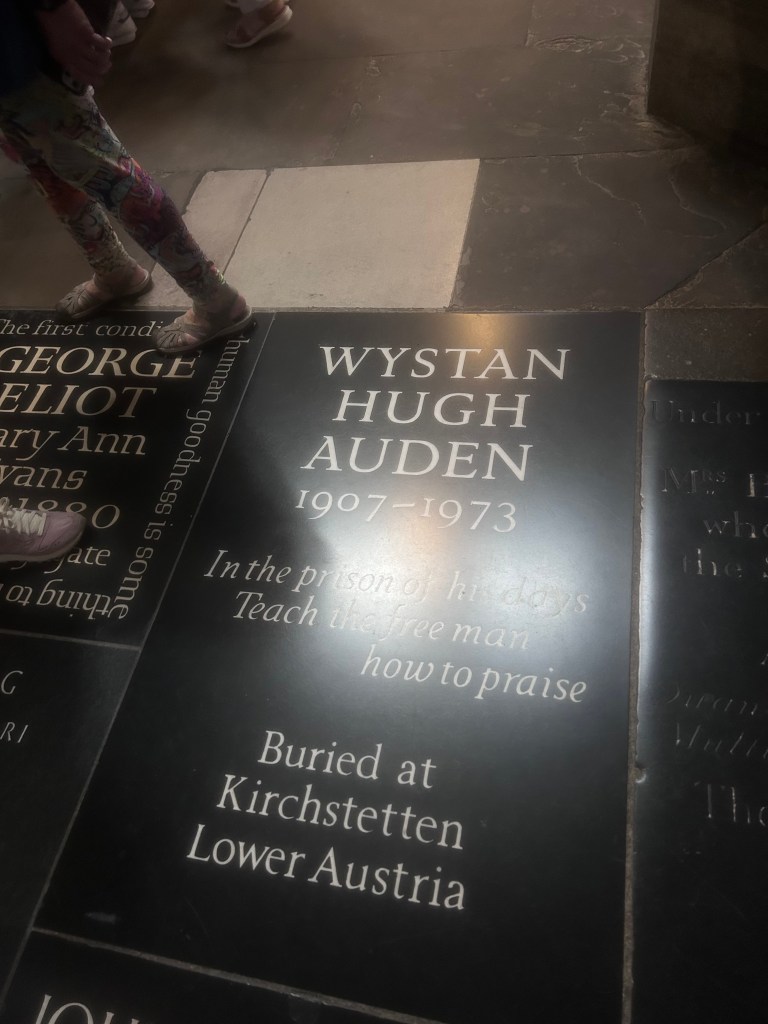
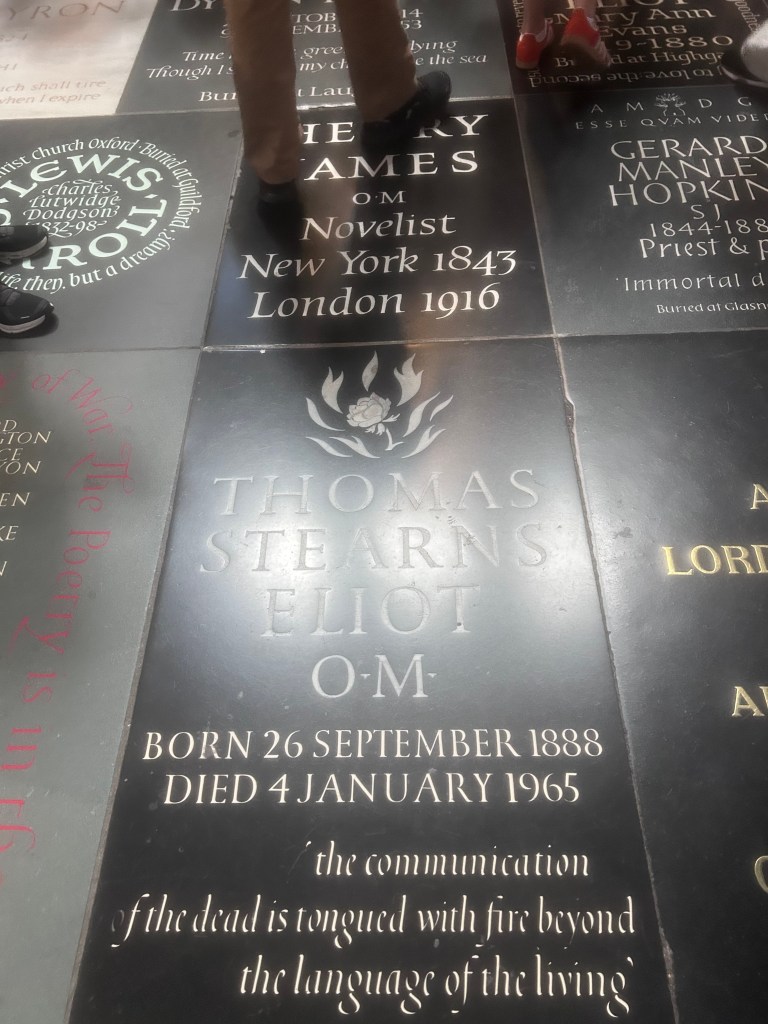
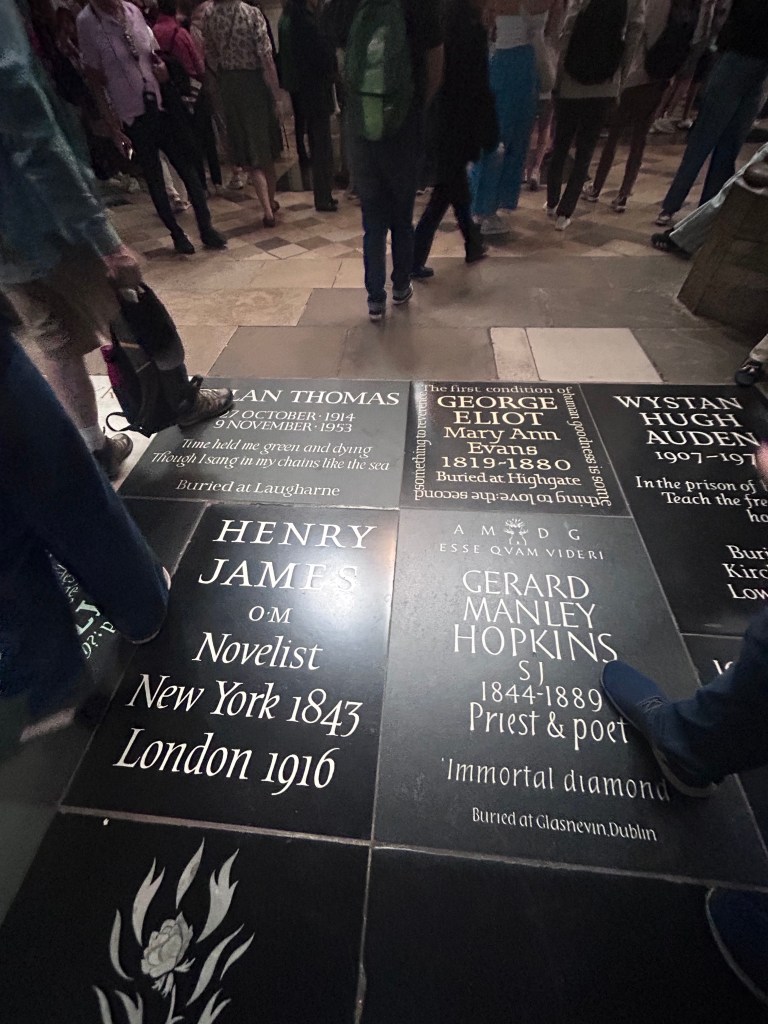
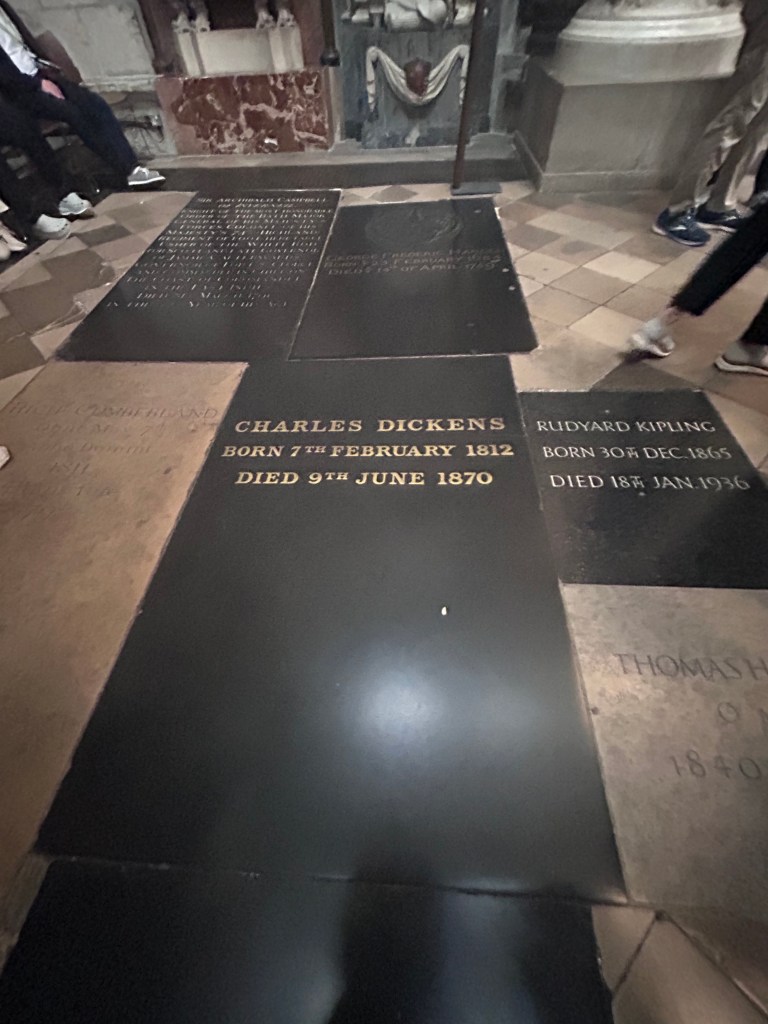
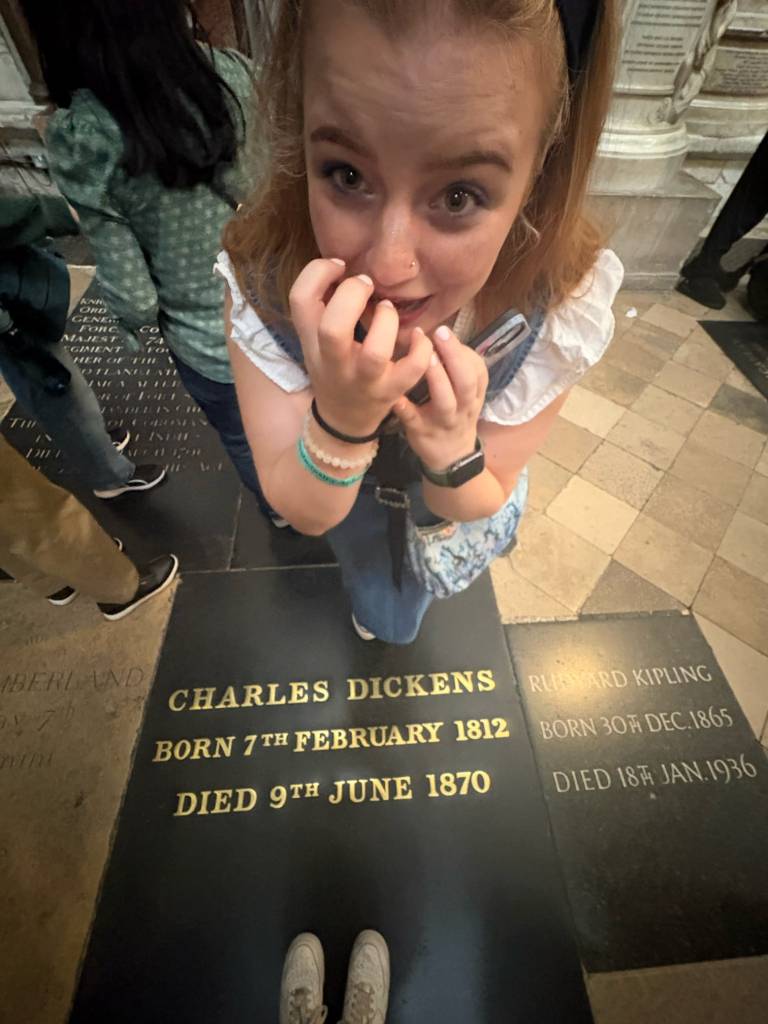
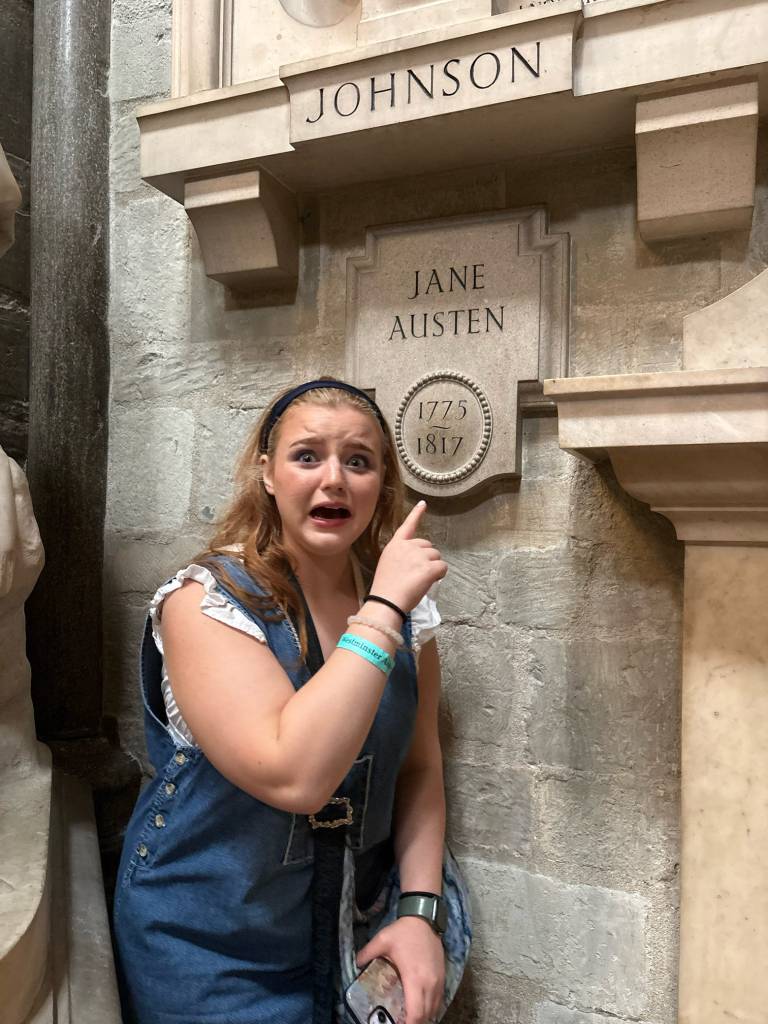
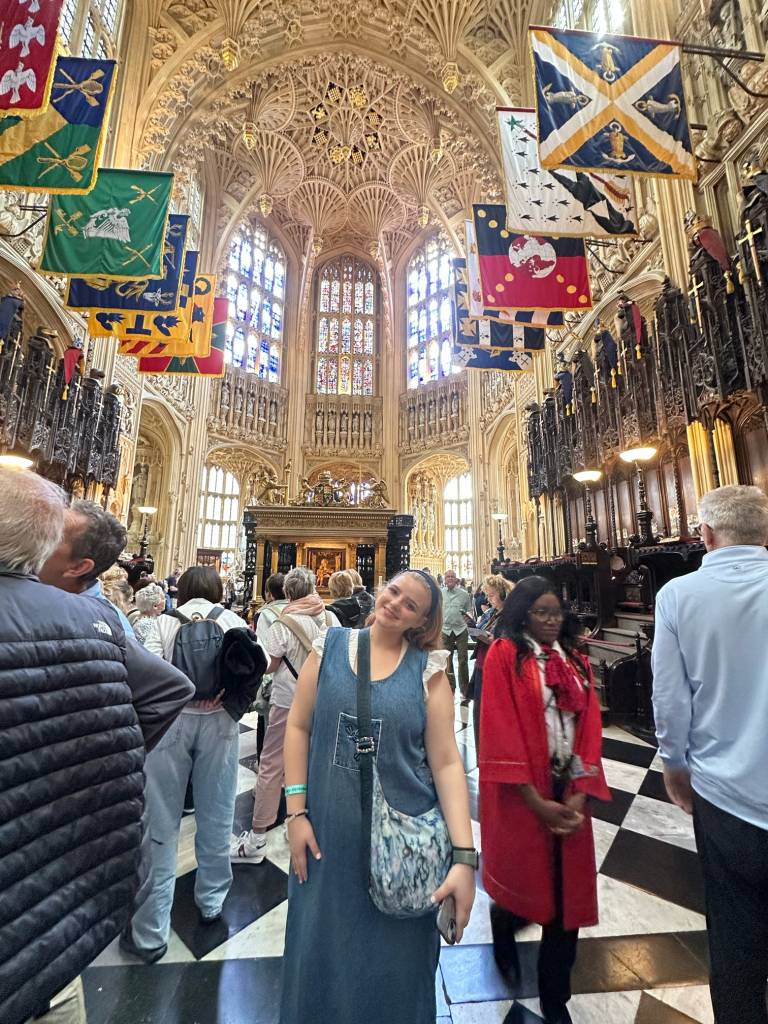
Some of the world’s most prolific writers are buried and/or memorialized within Westminster Abbey. Some of these graves and monuments include Mary Ann Evans/ George Eliot, Henry James, Lord Byron, the Brontë sisters, Rudyard Kipling, Mary and Percy Shelly, W.H. Auden, Jane Austen, T.S. Eliot, and Charles Dickens. Obviously, because I’m such a chill person all the time, I was completely fine and normal about some of my favorite writers being there (this is sarcasm btw).
The actual grave of Charles Dickens was probably the monument that struck me the most. Known for his advocacy for the poor and his serial style stories, this 19th century writer was born on February 7, 1812. From an early age, Dickens had a complex relationship with poverty. His father, who had made poor financial decisions, was arrested for his debt, and Dickens’s entire family (excluding himself) was thrown into prison. At 12, Charles became responsible for correcting his father’s debt and was put to work at Warren’s Blacking Company. The trauma experienced during this time inspired Dickens’s activism, particularly towards poor children, and inspired/ can be found in some of his most well known books: David Copperfield, Great Expectations, and even A Christmas Carol. Unlike most writers who do not become popular until after their deaths, Dickens’s rise to fame began in 1836 with his series Sketches by Boz. His success really kicked off with The Pickwick Papers, a novel that was separated into short, illustrated monthly installments. Charles soon became a revolutionary of the serial publishing style. After much traveling and many books, Dickens died of a stroke on June 9, 1870 at the age of 58.
While they are buried elsewhere, the memorials of T.S. Eliot and Jane Austen were also very impactful for me. Thomas Sterns Eliot was born 18 years after the death of Dickens on September 26, 1888. He was well educated, attending institutions such as Harvard University and Oxford University. It was at these universities Eliot began to write and publish his poetry. There are three distinct periods of T.S. Eliot’s writings: his undergraduate and postgraduate studies (“The Love Songs of J. Alfred Prufrock” 1911), World War I and his marriage (“The Waste Land” 1922), and the rise of Nazism and financial despair (Four Quartets 1943). Eliot died in 1965. Jane Austen was born in 1775 to a large family of ten. Unlike many women of the time, Austen was educated and given unrestricted access to her father’s library. From the age of 11, Jane began writing and creating stories. However, it was not until she moved to Bath that she began crafting her first novels Pride and Prejudice, Sense and Sensibility, and Northanger Abbey. It was not until after her death in July 18, 1817 that her works were finally published.
Dickens- https://www.victorianweb.org/authors/dickens/dickensbio1.html
Eliot- https://www.poetryfoundation.org/poets/t-s-eliot
Austen- https://janeaustens.house/jane-austen/jane-austen-a-life/


(holding space for Westminster Abbey)
 Theatre in London U of A