The Curious Case of Benjamin Button was a wonderful musical. The acting was superb, the music was amazing, and it was so emotional that I spent the rest of the evening reflecting on it. What it wasn’t, however, was a good adaptation of the original short story by F. Scott Fitzgerald, and that was the key to its success. In fact, other than the name of the main character and the general premise of someone who is born old and ages backwards, almost nothing was the same.
Firstly, instead of starting in 1860s Baltimore, it begins in a small fishing town in Cornwall during the early 20th century. In my experience, many shows I’ve watched which change the setting do so in a way which does not better the show and only serves as an easy way to make it stand out from other productions. Thankfully this was not one of them, and the difference in time and place were used masterfully to tell a unique story that wouldn’t be as effective if set elsewhere. The village itself had a personality, and its much smaller size gave the musical a more intimate feeling, everyone knowing everyone else. Additionally, being a fishing village gave it a connection with the sea, which became a major theme throughout the show. It being set more recently meant the show was able to use more well-known historical events and changes in technology to give the audience a better sense of the passage of time.
Secondly, the characters were also heavily altered. There was a whole new ensemble of characters, which, unlike in the original, all had their own names, personalities, and goals. They were also present throughout the whole show, and the contrast between their aging and Bejamin’s growing younger was a powerful way to show the passing of time and reinforce the differences between a “normal” life and one like Benjamin’s. The show also did a fantastic job showing female characters (in a non-misogynistic way), which was of the originals biggest flaws. This was especially evident with Benjamin’s wife Elowen (named Hildegarde in the short story. Instead of being reduced to “nagging wife”, she had an actual personality, and we got to see her and Benjamin’s interactions. She was a very sympathetic character, and Benjamin’s treatment of her, both good and bad, also helped to make him feel much more like a real person rather than a concept.
Lastly, the plot itself was heavily revised. It was more tragic and intense, eliciting a heavy emotional response from the audience, unlike the rather dry, almost vignette style storytelling of the original. A change like this was necessary for the show to be able to succeed theatrically, which it of course did. Whereas the original was mostly “what would the life of someone who aged backwards look like”, the musical focused on how that would actually affect the feelings of that person, and the feelings of those around them. It was much more humanizing, speaking to me personally, making me think about myself and aging, in a way that the original simply didn’t.
Even as I am writing this blog post I’m still not done reflecting on the show. I want to simultaneously see it again and push it out of my mind entirely. I was slightly skeptical of the show at first, unsure how they were going to turn the original short story into a musical. The show then proceeded to rip that skepticism away and make me feel foolish for ever doubting it. If you ever get the chance, I highly recommend that you see it, and please don’t be mad at me if you do. Anyways, this has been the third of my travel blogs, goodnight, morning, or afternoon, and I hope you’ll read the next one.
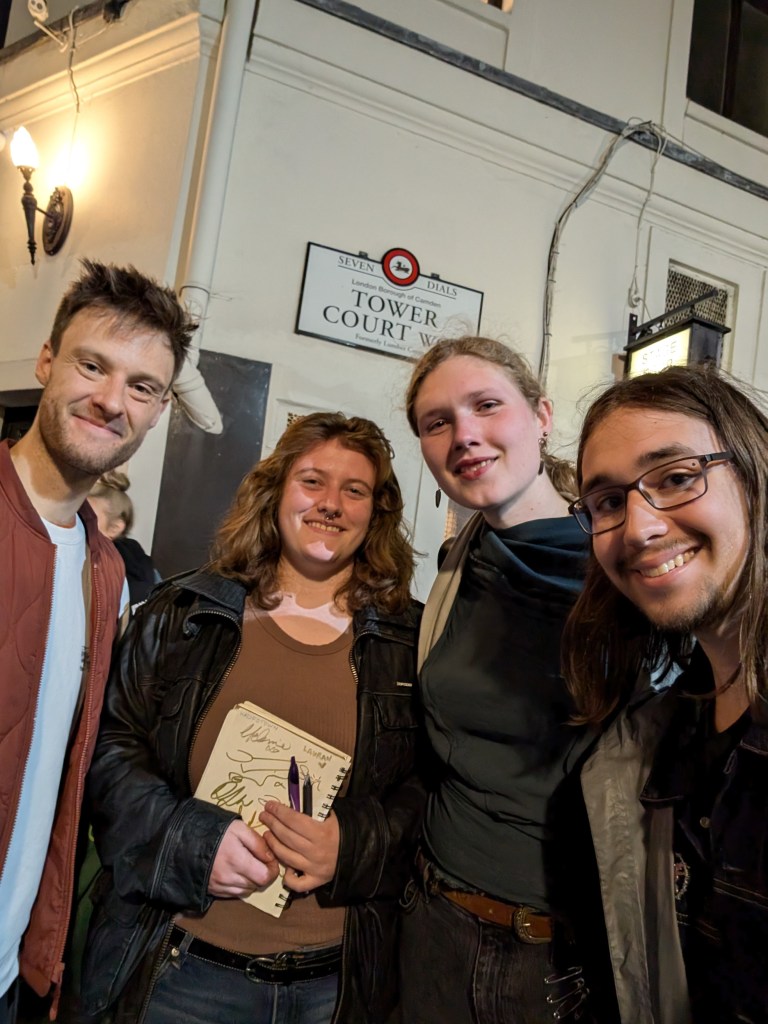
Us with the actor who played Benjamin
-Jack Duncan
 Theatre in London U of A