What’s up, strangers? The clock grows ever closer to midnight, which means that soon enough you’ll have to hear the stories from this trip from my mouth and not just my blogs. Scary, right? Soon enough I’ll be on the 4000 mile journey to turn back into a pumpkin.
Until then, there’s still plenty to do in Stratford-Upon-Avon. Well, that’s disingenuous; there’s some things to do in Stratford, and I am going to do all of them because there really isn’t much to do here. It is a very quiet, small town, which is somewhat refreshing, but I miss the city more than I could ever convey. I’ve already had enough of small towns in my life; I’ve found that I like to live life in the fast lane. But for now, we’re taking it slow. Winding down.
Last night, we saw King Lear which is currently running at the Royal Shakespeare Company’s The Other Place theatre. The twist: the entire thing was put on in somewhere over 90 minutes, in Ukrainian, without surtitling. The most context for the story that the average theatregoer has is the description of the story on the back of the free program, which is skillfully pared down from the original script. Considering that nobody on the trip speaks a lick of Ukrainian, this show was a trip. It’s pretty startling when the only words you can understand in a play are the words “yes,” “crown,” and your legal name.
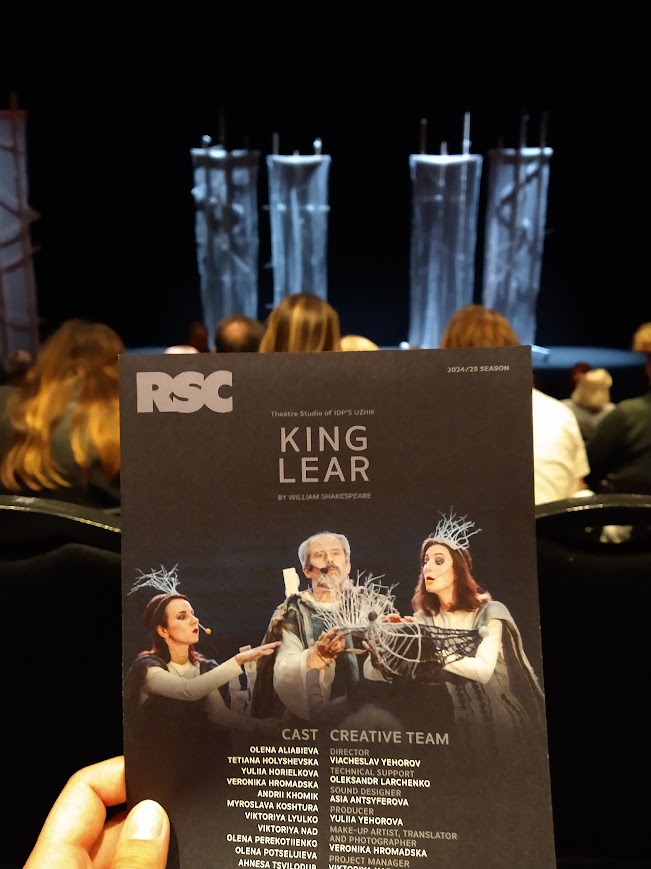
It was very interesting to see, and I think that seeing this show is a testament to how much proper acting matters. Usually the words of a script can speak for themselves, and give the audience some idea of what a character is. When that is done away with, the audience is left only with the action of the characters to understand what is going on, which becomes difficult with non-professional actors. An interesting and important part of this show is that none of the people acting in it were professionals–this show was a passion project by people who previously had almost nothing to do with theatre. This lends itself to the heartfelt nature of the piece, but does take away from understanding in the English audience, which is, decidedly, the target audience for a show put on in the UK. I could be wrong, but I assume that the majority, if not all, of the people in that audience could not understand the dialogue. This puts much more pressure on the actors to be practiced and know how to portray their characters in an effective manner.
The production was not given surtitles due to a want to present the story in the most authentic way possible, meaning that it was performed in its original condition. While I respect this idea, I do not think that it was necessarily an effective choice. Movement pieces are very often effective ways of telling a story, but they rely heavily on the confidence that the actors can convey what is going on solely in their actions; the actors in this production were very clearly playing character rather than action, which made it difficult to follow a lot of the time. The actress who played the Fool was the only one I could follow a majority of the time. Despite having read the Shakespearean version of the script, and having discussed it in class, I was constantly questioning what part of the plot we were in at the moment.
As it was, I spent the entire time feeling like I was in a listening test in a language class for a chapter I didn’t study for. After the show, Shawn asked me to describe the show in one word. I asked if I could potentially have more words, because as someone can probably see, I have a lot of words to say about this piece. But he gave me one. The word I used to describe this piece was “overwhelming;” and it was overwhelming in more than one way. The emotional content and context of it within the modern world is heavy alone. But that combined with the amateur and confusing acting, alongside the overall too-loud sound design and many occurrences of strobing lights gave me a headache within the first third of the play. The show did not have the emotional resonance with me that it should have, and I think that a lot of that is due to the lack of dialogical context.
Even if I did not enjoy the production, I think that it was a valuable experience. Like I’ve said before, seeing theatre in any context, good or bad, is useful to the theatremaker. It teaches you what you like and what you don’t like; it shows you what works and what doesn’t.
One more post to go!
CW
 Theatre in London U of A