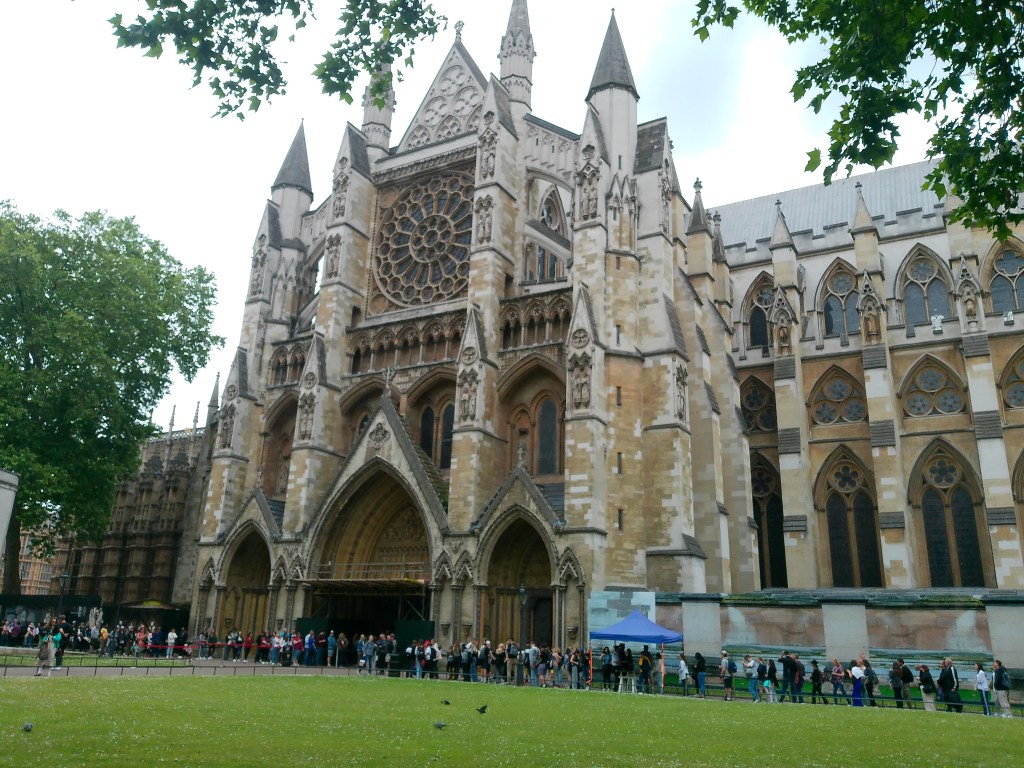
We took a time machine back to the 13th century and visited Westminster Abbey today and discovered that it is quite a hotspot for dead people. As a time capsule in British history, Westminster Abbey is holding grounds of Royal Coronations since 1066, as well as a plethora of memorials and tombs of influential people in history.
Before walking into the cathedral, we saw the Pyx chamber, one of the oldest parts of the Abbey. Built around 1070, this small chamber is underneath the monk’s room. Pyx was preserved and made a valuable piece of history in the 12th and 13th centuries. The floors still hold remnants of the same medieval tiles from when it was first built. In the center of the room is a crucifix, which creates a focal point that dictates the room’s purpose– to worship. The minimalism of the room was unexpected but respectable and interesting.
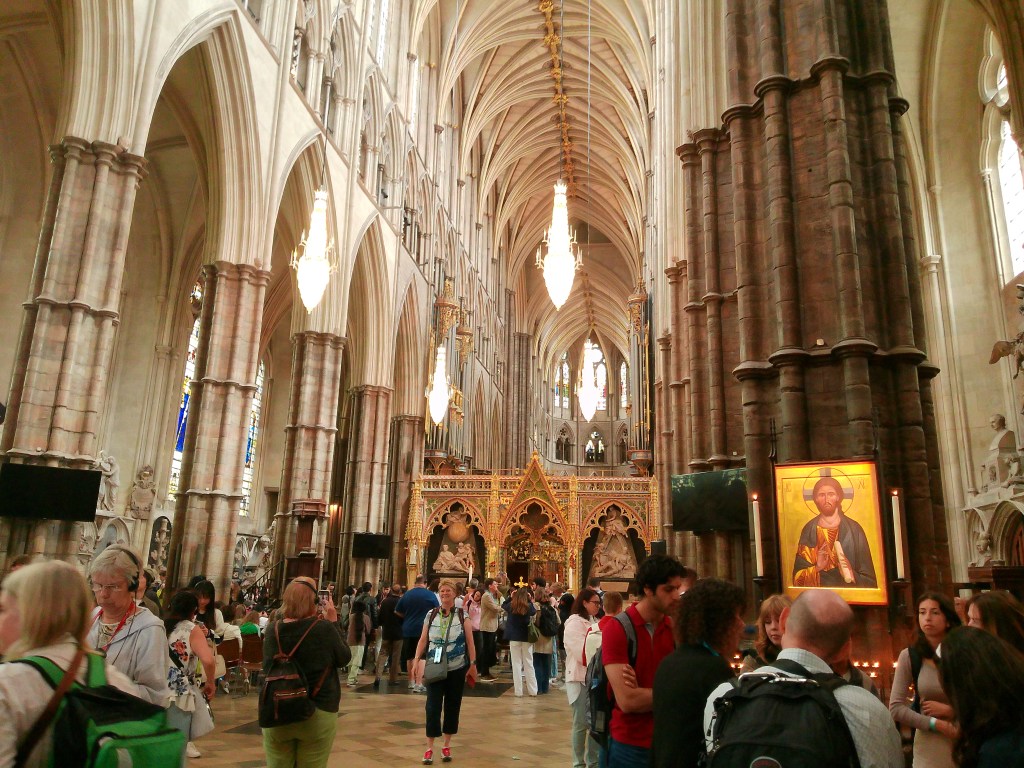
Walking into the Abbey, I got struck by the fabulous vaulting on the ceilings that seemed to almost create a rich pavilion that you feel like you could almost float on. Adorned with intricate details and gold ornaments, the main room of the Abbey embodies Early English architecture and represents the lavishness of wealthy royalty.
I loved the Lady Chapel, which was added by Henry VII in the early 1500s. Its large, eggshell vaulted roof looks different than the rest of the Abbey and is discreetly constructed. All of the arches fit and wrap around each other in a sophisticated and beautiful way which can be admired for its class and elegance. The stall seats have the flags and emblems of the knights that are in position currently– their emblems, whether that be a dolphin or a dragon, represent something unique about them. When a knight dies, their flag and emblem are taken down and remain vacant until another knight will fill their position.
Apart from the breathtaking architecture, Westminster Abbey holds a heavier purpose than just showing the talent of artists, builders, and architects– it serves to commemorate influential people to the culture and history of Great Britian, and the world alike.
A unique memorial/burial is the grave of the Unknown Warrior. During the First World War, Reverend David Railton discovered a grave in France with the words, “An Unknown British Soldier,” scribbled on it. He contacted Herbert Ryle, the Dean of Westminster, about putting together a memorial for these strong, yet unknown men. British servicemen searched and found an unknown fallen soldier to place in the chapel in 1920. King George V unveiled this coffin and had a service to commemorate the burial, and the grave still resides in Westminster Abbey, surrounded by red flowers. This burial is meant to represent the many men who gave their lives to their country during this war, and for the rest of history, and conveys a strong message that all lives deserve to be recognized, regardless of rank or circumstance.
Nestled in the poet’s corner of Westminster Abbey lies the great Charles Dickens. Being one of the most influential writers of the 19th century, Dickens is highly acclaimed and has held precedence in English literature since the 1800s. You may recognize some silly little books he wrote like, “Oliver Twist,” “A Christmas Carol,” and….(wink wink)….”Our Mutual Friend.” Charles Dickens was so honored that Queen Victoria demanded that he be buried in Westminster Abbey, even though he wanted to be buried in Highgate with his family.
Lewis Carroll, (really Charles Dodgson), was a man of many talents who was most known for his literary works during the 1800s. Have you ever heard about this girl named Alice who falls down a hole and meets a crazy bunny and a creepy cat? Yeah, he was that guy. He’s also buried in Westminster Abbey! I walked over him today, as well.
Aside from time traveling to the 13th century at Westminster Abbey, I also traveled back to 1985 watching “Back to the Future.” How did they get the car to do that?
Also, Freud would love that musical.
Toodles!
xoxo Gossip Girl
the Fritz
 Theatre in London U of A