


As soon as the production ended and the lights dimmed to complete darkness, this author jumped from their seat to reward London Tide with a standing ovation and applause. Tears poured from my eyes countless times as this compelling and prolific tale captured the heart and soul of Dicken’s Our Mutual Friend with a fabulous modern artistic retelling. Purpose and visibility are given to meaningful heartfelt themes that are still so very relevant to our society just as much as they were in Dicken’s time. An incredible feat was accomplished by the storytelling of tonight by the writers, directors, actors, band, and set crew of London Tide.
The Lighting
The moving lights created the dazzling surface of the river surface. Actors could grab hold of their bars and physically rise up. The lights could also sink so low that the actors could be lost in the sea.
The changes and small shifts between hues of cerulean, cobalt, aquamarine, teal, vermillion, and amber altered the tones of each scene passionately.
The backlit background created a focus on the characters and their lived experiences instead of trying to dazzle the audience with maximalist sets. Lines were often incorporated to help the navigate the audience of what the set looked like in the minds of the actors, which was enriching and fun to watch. Eerie silhouettes of characters and their profiles created haunting effects that allowed for truth and ghosts to never truly die until the fog dissipated. Remembrance and honesty would prevail in this tale once all had been revealed and set right.
The Set
The moving floor and ceiling was fascinating to watch as characters went through moments of unsteadiness, change, or suffocating claustrophobia.
The pillars on the outside replicated old planks and posts of a dock. The posts were scattered and used clustered to the wings of the stage like a gradient, where the actors could slowly, chaotically, or meaningfully exit and enter scenes.
Uses very few props and recycles them throughout the story to create entirely new props and scenes. Genius things like driftwood planks as imaginative ships. Chairs and tables are used as beds and slums.
The open floor design of the set creates an open invitation to each viewer to use imagination and interact with the scene within one’s own mind. The view to the very back of the stage, backlit with diffused LEDs and a screen while overlaid with a clear tarp creatively illuminates movement and gives the illusion of water. A similar smaller clear tarp is used during a scene depicting drowning and suffocation and connects its imitation of the currents in the Thames perfectly.
Creatively, the orchestra pit was used to depict a bank of the river, as actors fell in and out of the Thames.
Costumes are symbolic and show epic parallels between the characters, their tragedies, and their successes. Bella handed her dress of stained reputation and tragedy to Lizzie at the news of the death of Lizzie’s accused father.
We see shoes and lack thereof and the actors interact vulnerably and intimately with the water and its edge.
The Music
The live band on stage allowed for flexibility of delivery for the actors and fluidity of the show. Not to mention it sounded amazing and the drums, guitar, and piano floated a melancholy tune throughout the production. The deep rich sound of the beating of the drum and the soft lilts and falls on the keys enriched the atmosphere beyond what words can express.
This production did well to experiment with each song or ballad. Some felt almost punk or rock in nature compared to some that sounded classical or soulful.
Other critics have called this production, incorrectly, a musical. However, this production is closer to a play with ballads that expertly progress the plot.PJ Harvey has such a wonderful sense of voice. Each ballad is tailored to the character’s energy and interacts with what had happened in the scene before. There were not too many or too few songs as each was sung with purpose and incredible voice.
The Plot
The plot device of the river to represent the controlled environment of London society is genius. In the river, the characters are swimming in water made from the intersectionality of societal issues, such as poverty, sexism, money, life, death, love, hate, despair, suffering, and grief. When characters fall, they are taken into this river by these forces. This allegory expertly depicts the experience of surviving in London as a lower or middle-class.
The ending of Lizzie taking control of her destiny instead of surrendering the freedom of her future to the love interest Eugene was well done as well. It was satisfying, progressive, and profound.
The Acting
Each member of the cast had very memorable moments of delivery and bluntness that added to each scene. There was a clear pattern of triumph. Life and death, relief and sorrow, and comedy and tragedy brought waves of soul-piercing rushes of emotion. The audience engagement was especially notable. Many laughs, oohs, sighs, and a few sobbing gasps could be heard echoing through the Stalls. The kiss shared between Bella Maclean and Tom Mothersdale playing Bella Wilfer and John Rockesmith was particularly a moment that brought tears to this author’s eyes and many of my fellow audience.
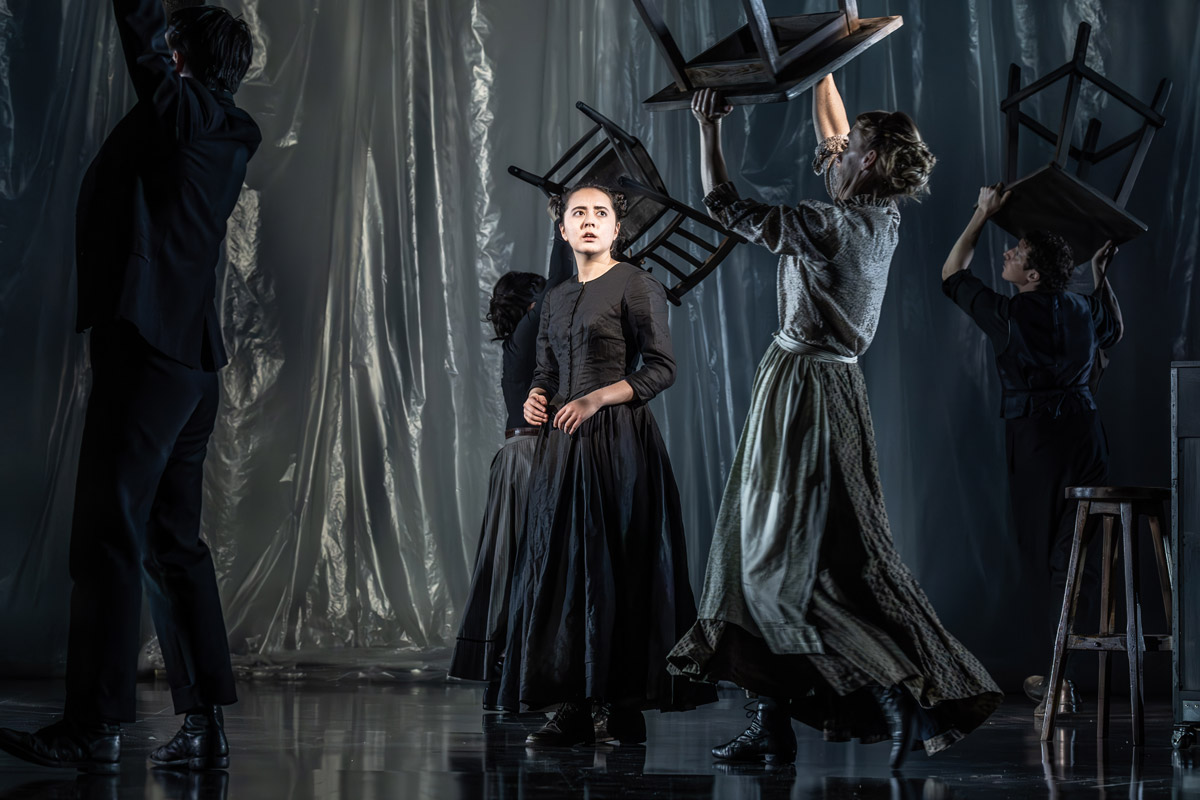
Dance and movement change scenes with ease and naturally progress the plot. The chorus was able to grab and change each scene with a shift of a chair or a flourishment of floating a table away. The actors did a fantastic job of moving throughout the play without jarring motions as if they really were sinking or floating throughout the heaviness of the water that entraps them in this tale of the Thames. As rumors or details are shared about a character, that character will move hauntingly behind the scenes as it progresses. This only increased the intimacy and insight we have with each person on set.
The use of the actors to narrate themselves is very well done and creative. For so many important characters and plots happening at once, each was easy to follow with the asides and anecdotes of the characters.
The feminist asides were expertly written into the play. Several lines concerning women not having to apologize or be responsible for the acts of men of power imposed on women were crucial to portraying this story sensitively in the 21st century.
If I haven’t been able to see this production first hand, I would have thrown myself in the river Thames.
 Theatre in London U of A