Inside Westminster Abbey it was interesting to notice who was the most important of these famous legends and who was buried there out of not pity, but let’s say, sympathetic respect. You can tell the names in the large room are the most important of the B list historical figures, the names that had their own rooms and tombs were the A listers, and the C list as you enter the church consisted mostly of religious figures and monks. Even in death we all hold varying values to those we leave behind… funny. I kept asking myself why it mattered so much for these people to be buried here, especially when most of whom are buried did not care or wished not to be buried there. Cause in today’s times, yeah, it makes sense, a place you can go to see all these historical and important graves, but back then? Seems like a resting place for the rich and I truly do not care to give that type of reverence to skin and bones. Especially when the souls of the people that lived inside these skin and bones were horrid aristocrats. But I digress…
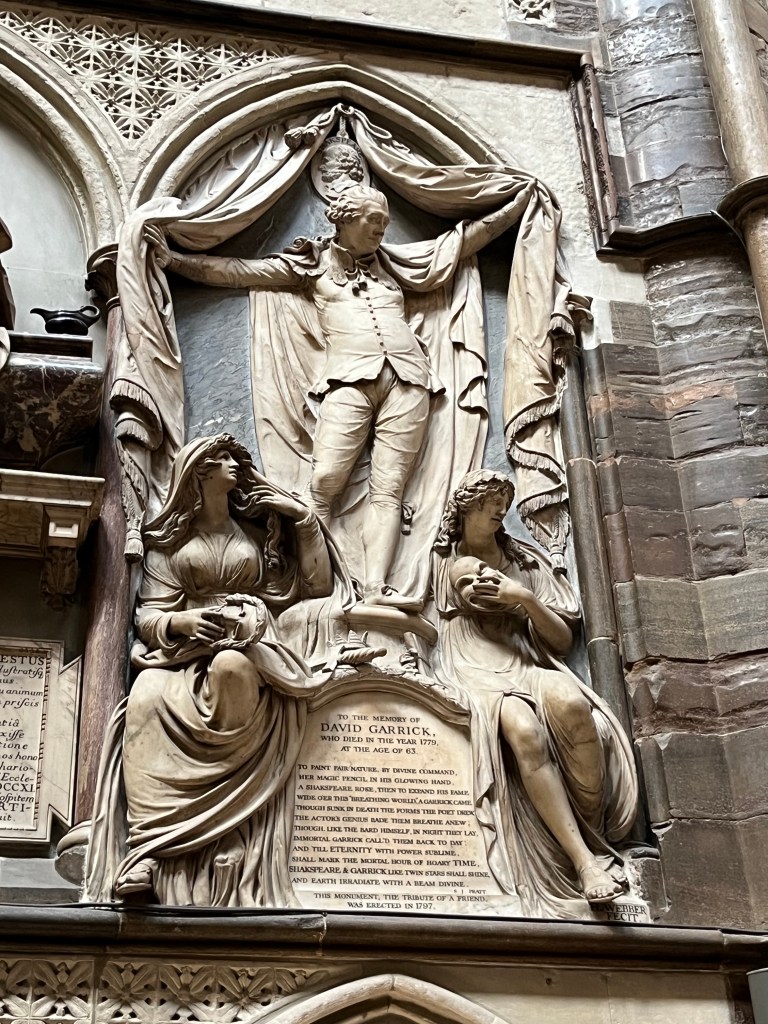
The most fascinating memorial inside the large room to me was David Garrick’s. His plaque on the wall showcased himself emerging flamboyantly from a set of stage curtains and two of his wenches holding the classic theatre masks. Above David’s head there is also a smaller plaque that looks like a coin if William Shakespeare was the printed head. David was born in Hereford, France in 1717 and died in London in 1779. What I find interesting about David Garrick specifically is his tenacity for the art form of theatre. Reading his bio I learned that he lived the young actor’s lifestyle. He did theatre in high school and then moved to the big city of London to chase his dreams but also have a nine to five as a wine merchant so he could support himself during the trial years. Very similar to the classic bartender/server actor life we all know today. David saw his first live play in London at the Drury Lane Theatre and was instantly hooked. He auditioned for Drury Lane and was rejected. Twice. He then went to a smaller theatre named Goodman’s Field Theatre and played several small roles in his time there. This finally brought on the attention of some Drury Lane folk and finally he was offered a job by his dream theatre. And then… his big breakthrough. King Richard III. His acting was monumental during the 18th century. David Garrick essentially changed the game with his acting style and debonair way. He was also a Shakespeare fan boy. He constructed a temple to Shakespeare comprised with multiple Shakespeare memorabilia and his poems. He even put on a Shakespeare festival called The Jubilee that was received very well by audiences, and they put on over ninety plays during that festival’s duration.
The second grave I noticed was the grave of the “Unknown Warrior”. I thought this was quite cool because although this is a place to bury the smart, inquisitive, and rich; someone had enough of a heart to decide they need something to commemorate all the allied souls that were lost during WWI. Although small, it is still so powerful. I found it quite interesting too that this is the one grave you are not supposed to stand on. I suppose it is because of how much generational trauma comes with the World Wars and the people that live in London. I enjoy the purity of this gesture and the respect the aristocrats had for these young men that gave their lives to their country.
Lastly, Stephen Hawking, I believe, was the newest grave I saw inside the walls of Westminster Abbey. Stephen Hawking was born in Oxford in 1942 and died in Cambridge in 2018. Stephen Hawking was a madman with a plan. His brain is what solely got him into the Fellows of the Royal Society and what allowed him to be buried in such a prestigious place. His contributions to science and mathematics were proud accomplishments for the English and they welcomed his abilities into their circle of the mad fairly quickly as he progressed early on in his life and showed promise in his future.
 Theatre in London U of A