June 6: While this was supposed to be our tour of Westminster Abbey, also known as the place with the iconic clock tower, this excursion was postponed. In lieu of this iconic London iconography, I took a trip to a different famous London landmark: Tower Bridge. The two sky bridges that connect the recognizable towers of this bridge have both been updated to include stretches of glass floors. It is incredible to be able to look down at the cars crossing the Thames River roughly 33 meters below (110 feet in American).
As a group, we collected to go see “2:22 A Ghost Story” in Piccadilly Circus. This may just be my favorite thing I’ve seen in London. The play left me feeling exhilarated! Plus, I got the cast’s autographs, including Sophia Bush (One Tree Hill and Chicago PD). This play felt like a bridging of traditional and modern theatre. There was a full set intricately creating an open floor plan living room/kitchen. In between scenes, a dramatic scream would play, the lights would cut, and you could see stage hands cleaning the set for the next scene.
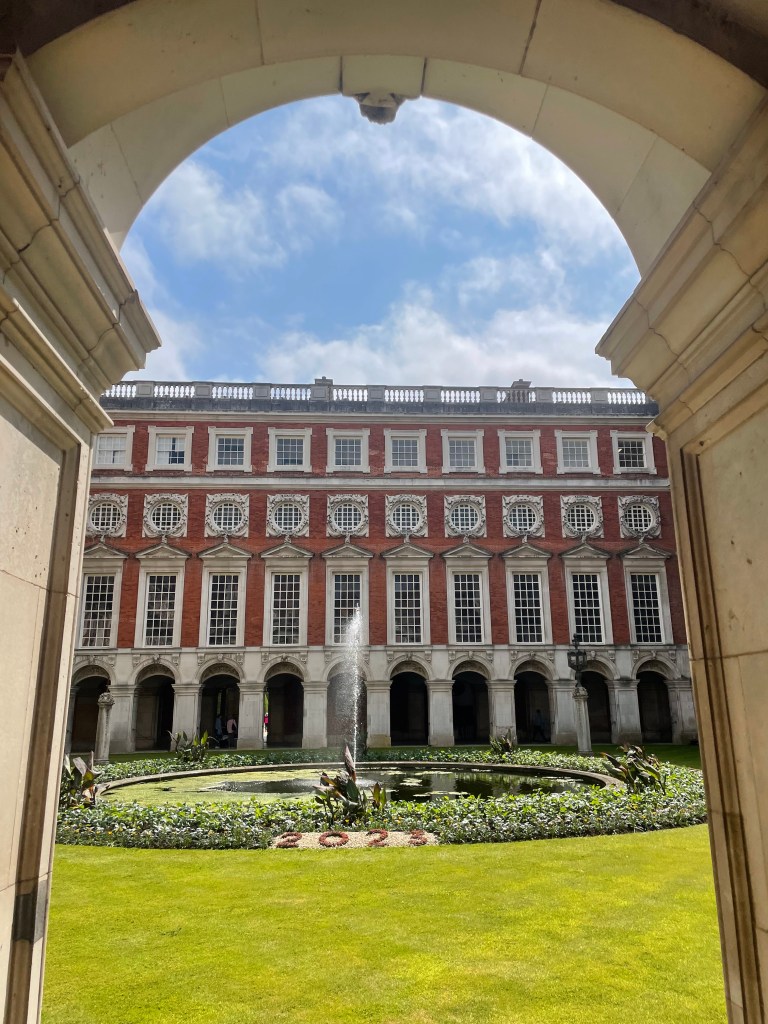
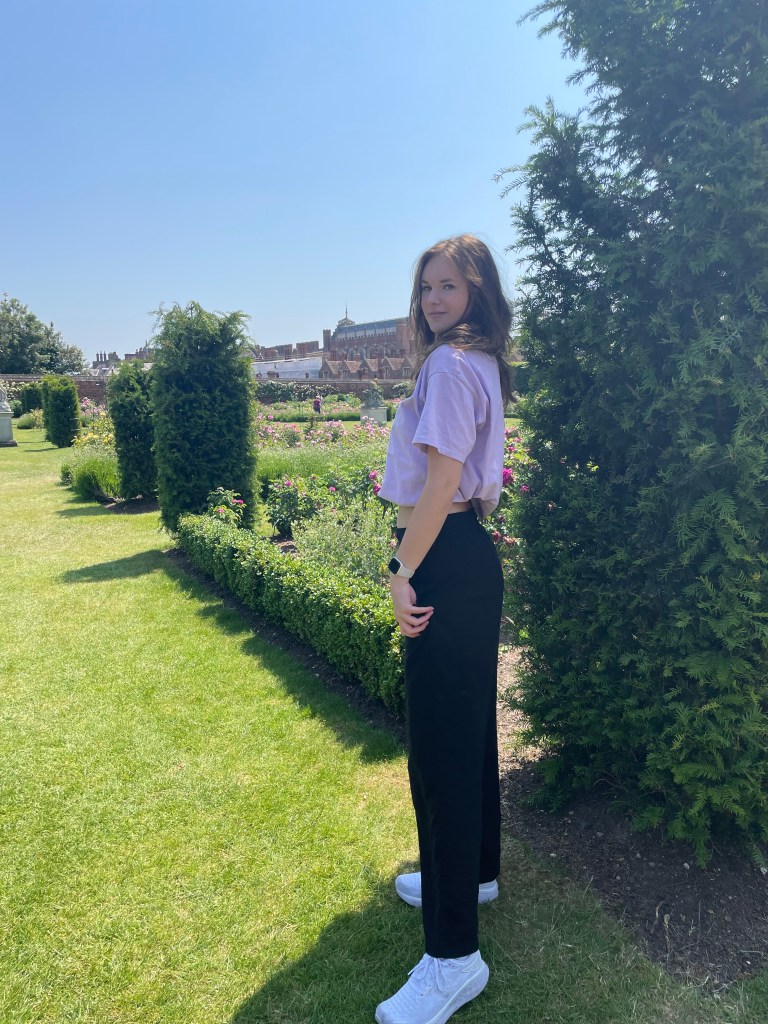
June 7 (a.k.a. one month from my nineteenth birthday) brought another day trip. We ventured out of London to Hampton Court Palace. The Palace was first used by Henry VIII after taking it from a duke he had a falling out with. Henry VIII redid the Great Hall in honor of his second wife Anne Boleyn. There are beautiful gardens throughout the grounds including a courtyard fountain which had been landscaped for the recent coronation of Charles III. My favorite room was off of this courtyard: the chocolate kitchen. I don’t remember if it was James I or II but one of the King James had a special kitchen for chocolate which was a special drink for the aristocracy of their day. And may I just say, I definitely approve of a special chocolate kitchen.
The palace has two distinctive architecture styles. The older part of the palace, the kitchens, Henry VIII’s apartments, and the chapel, was constructed during the Tudor period. During William and Mary’s reign, they had plans to demolish Hampton Court Palace to build a new palace. However, there was not enough money so they had to settle for only redoing parts of the palace. Inside, there is another distinct style: Georgian. William and Mary were succeeded by Mary’s younger sister Anne, but sadly none of Anne’s children survived to adulthood. To find the next monarchy, high powered men went digging in the family tree desperate to find some worthy Protestants. The Hanovers (i.e. George I and II and III (this last one is the one in Hamilton)) were invited over from Germany to take the thrown. George I and his son George II with his wife Queen Caroline would reside in Hampton Court. George II was the last monarch to reside in Hampton Court. It is kind of crazy to think that this grand palace was last used by the monarch before the Revolutionary War.
Hampton Court Palace was first opened to the public by Queen Victoria in the 1800s. Over the last (almost) two hundred years, the English government has been working to restore the palace and the artifacts stored inside. There is a tactile workshop on the site that works of refurbishing items like the beds; they work to keep diligent notes on their restoration efforts so that others will be able to restore them in another fifty years preserving history for years to come.
A cool thing that I got to see is the Self-Portrait of Artemisia Gentileschi. It hangs in the art gallery near the Georgian apartments. I learned about Artemisia and studied this painting in my art history class.
I loved getting to walk through on the audio tour. One of the most shocking facts I learned is that Katherine Howard (the Katherine who lost her head) was not even twenty-one when she died. Katherine was the fifth and youngest wife of Henry VIII. While I knew the rough story of the six wives of Henry VIII (shout out to the catchy pattern and of course SIX), I had no idea that Katherine Howard was so young when she became queen.
I think it would have been quite intimidating to be at court in front of any of these monarchs. Despite England being a constitutional monarchy, the kings were still able to exercise the tempers to a great extent. It would be cool to roam the palace when it was inhabited in history but while the monarchs were away. Although, maybe during the 18th century for sanitation reasons.

 Theatre in London U of A