
Yesterday, on June 3rd, I spent the day viewing famous and beautiful art in the National Gallery in London. This was the only thing our group had on the agenda so it was a very relaxed day. Once our group was free for the rest of the day, a bunch of us decided to enjoy a picnic in Russel Square park which is right by our hotel. We had pizza and sushi and even held a talent show. Afterwards, ten of us walked to the British Museum to celebrate Alyssa’s birthday with Afternoon Tea. We ate in the upstairs parlor of the Museum and drank delicious Earl Grey tea with clotted cream and scones. It was such a great day to enjoy London traditions such as the many museums and galleries they have to offer, and of course tea time.
I cannot believe all of the famous art works that I finally got to see in person. It is one thing to see Vincent’ Van Gogh’s famous Sunflower painting be discussed in art class or to see a picture of Monet’s Water Lillies on the internet, but to see it in person is a feeling so surreal and invigorating.
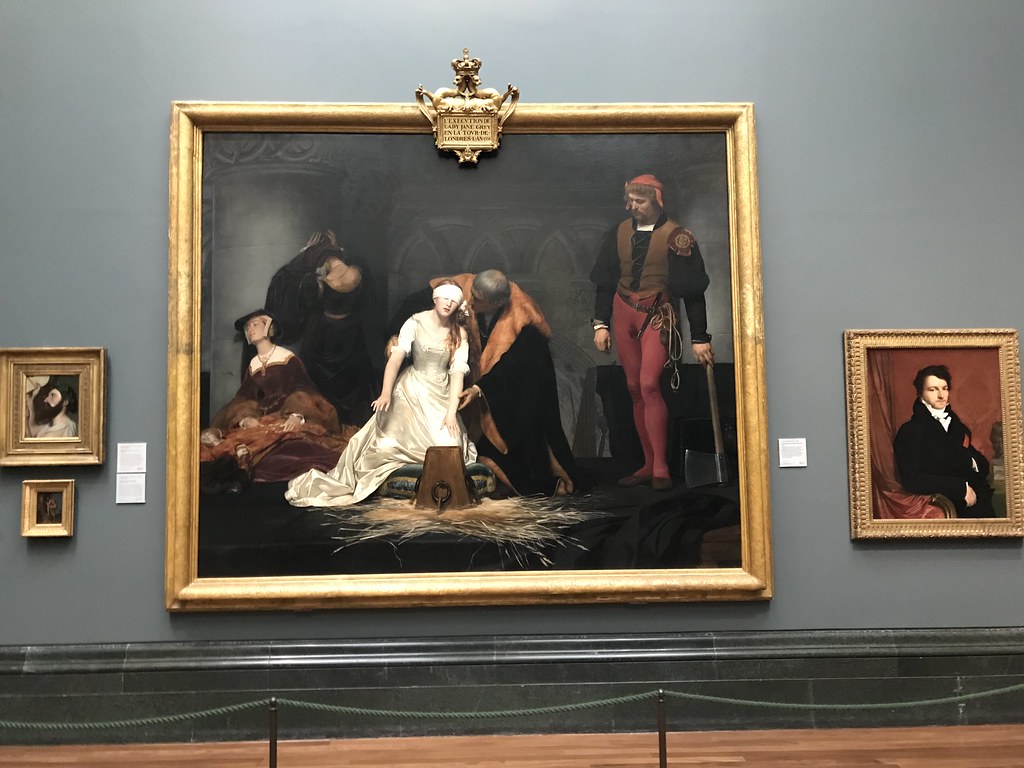
The most exciting moment of my day however was viewing the famous painting of Lady Jane Grey’s Execution. The Execution of Lady Jane Grey was painted in 1833 by Paul Delaroche. Lady Jane Grey reigned as queen at the age of fifteen for only nine days in 1553 until disposed by supporters of the Catholic Queen Mary. Many may recall in a previous blog post of mine that she was beheaded in the Tower of London. The French painter, Delaroche was famous for his scenes of British royalty, especially those who were doomed or dying.
As I made my way into a giant hall to see the painting displayed in a gigantic frame that took up the entire wall, I sat at the bench that laid in front of it. The painting depicts the moment that Jane, blindfolded, is being assisted to lay her head upon the block for the executioner. Many may remember as I mentioned in a previous blog post, that Lady Jane Grey was executed in the Tower of London. While imprisoned in the Tower, Jane was attended by ladies in waiting, one of whom was the nursemaid of her infancy. Two ladies in waiting are depicted in the painting, showing their grief at the event which is about to take place.
I stared at the painting with both awe and sadness for a good ten to fifteen minutes, until I approached the image more closely to study smaller details that I may have overlooked from far away. As I studied the painting, I began to make connections between it and a previous painting I had viewed in another room which is called The Dead Christ Mourned, painted by Italian painter, Annibale Carracci in 1604.
The painting shows the dead body of Christ laid out in a white loincloth, with his legs on a white shroud and his head resting in the lap of his mother, the Virgin Mary, in her characteristic blue robe; overcome with emotion, she has fainted. The mother and son are accompanied by three other figures. Mary Magdalene, with red hair, is kneeling to the right, wearing a red robe and elaborately embroidered yellow cloak, with her hands raised in anguish. They are accompanied by an older woman, standing in a dark green robe to the rear, reaching out towards a younger woman in green, blue and red who is kneeling behind the Virgin Mary to support her.
One of the main similarities that I detected between the painting of Lady Jane Grey and Jesus Christ is that they share themes of innocence, death, and mourning. Even the main subjects of each painting are depicted similarly. Both Jesus and Lady Jane are wearing white to represent their innocence and purity. They also share the similarity of being prominent figures of history. Jesus Christ a king has been crucified; Lady Jane, a queen is about to be executed. Both figures in the paintings revolve around the idea of death.
Not only are there similarities between the main subject of each painting, but also between other background figures. Jesus and Lady Jane are mourned by women in each of their paintings. Jesus’s mother has fainted just as Jane’s lady in waiting has. There is a deep sense of grief in both the women. Jane’s lady in waiting holds Jane’s necklace in her lap, grasping onto the last thing she has left of someone who is like her own child. Mary holds Jesus in her lap, unable to let go of her grief and her son. The other lady in waiting is so distraught much like the other women in the painting of Jesus. Unlike the other women in The Dead Christ Mourned, this lady in waiting’s face is not revealed for she is so stricken with grief that her face is turned against the wall with her head tilt downward to reveal her exposed neck. Having her neck exposed reminds viewers of the inevitable fate of Lady Jane Grey to be beheaded. The three concerned women in the painting of Jesus have halos around their heads to remind viewers of the fate of Jesus who rises again in three days. It was interesting to see how other background figures served as symbolic representation in the paintings in such similar ways.
Both paintings emotionally moved me, giving me similar and different feelings about the pieces. I think these paintings depict grief very well. I loved making the connections between the two and digging deeper to see how small details could symbolize significant meaning for the paintings. I think what really stirs my heart about these paintings is that they don’t just show grief, they show the mourning of child loss. Both the Virgin Mary and the lady in waiting who had been with Jane since infancy must have felt tremendous grief witnessing someone they cared for be executed. Their fainted and distraught faces being practically identical in expression shows that the loss of motherhood is a universal feeling that many in the world have experienced regardless of their good works or their royal status. It can go without being said that both painters, Paul Delaroche, and Annibale Carracci have beautifully depicted the masterpiece of mourning.
 Theatre in London U of A