
Yesterday, our group had the opportunity to visit the Tate Modern Museum to enjoy the different galleries of modern art. Although, I must say, I did not particularly enjoy it. This is not to say that I think all modern art is bad. I found a few pieces of art that made me feel things as I walked throughout the museum. The most I felt throughout the museum was simply just confusion and frustration. Now, the modern art junkies might say that’s something–that it made me feel anything at all. However, I don’t know if I can constitute a work of art as good if it does not elevate my thinking or emotions and provide me with thoughtful clarity about the world’s problems. There was one work of art that was simply a white blank canvas with two white blobs of paint protruding from the surface. I just don’t understand how that says anything to a viewer. I shouldn’t have to read the artist’s long backstory to finally say to myself, “Okay, I get it now.” Even with the explanation next to the art, I still found myself completely lost on how the art correlated with its story.
Despite all of this, I still tried to search for something in the museum that would move me, something I could connect with easily. I was able to find that with two particular works of art. The first piece of art that really moved me was a work of art called I am the curator of my own misery by Douglas Gordon. I think I love it so much because I am a writer; I identify with words. This piece of art is very simple and I think that is why I also like it. It doesn’t try to overcomplicate a universal feeling. I think that the fact that it isn’t over complicated is fitting because this artwork is specifically speaking on how we as humans overcomplicate our lives, thus creating misery for ourselves that wasn’t there before. We tend to create more problems for ourselves. Sometimes we see the glass half empty rather than half full, thus our lives appear to be more miserable to us. Because we tend to let our negative emotions take over, we create unnecessary negativity. I really liked the way the words were written in this artwork. It was made to appear as if it were written in blue ink. There are even blue ink pens that lay on the ground below the work of art. I really liked the inclusion of the pen because it serves a a reminder that we are the dictator of how are story is written, not our emotions. We are responsible for creating our own happiness. Happiness is not a state of being that is handed to us, but the harvesting of the good things that we ourselves have cultivated from once empty soil. Overall, I really liked this piece.
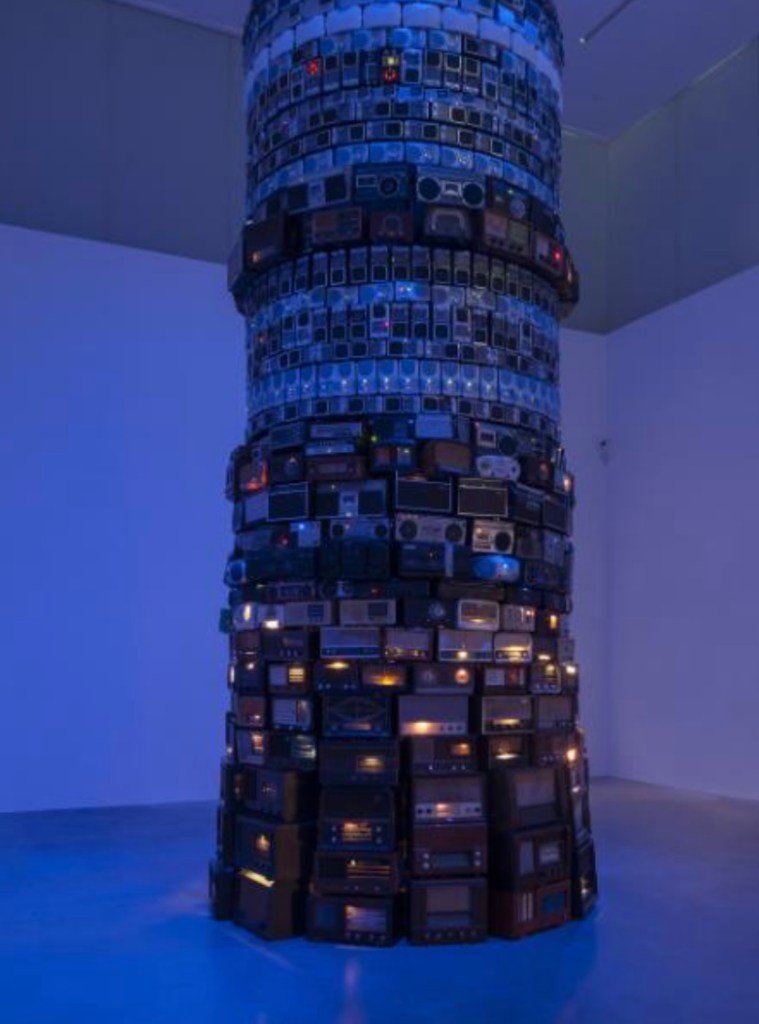
Another work of art that I enjoyed was a large-scale sculptural installation called Babel by Cildo Meireles. This work of art takes the form of a circular tower made from hundreds of second-hand analogue radios that the artist has stacked in layers. The radios are tuned to a multitude of different stations and are adjusted to the minimum volume at which they are audible. Nevertheless, they compete with each other, and create a cacophony of low, continuous sound, resulting in inaccessible information, voices, or music. I really enjoyed this piece of art because I loved how it incorporated sound into art. It seemed as if all the voices and sounds coming from the radio speakers were trying to tell me something important, but nothing could be misunderstood. I felt that this piece spoke on miscommunication in the most well-communicated way possible. Unlike my experience with viewing other art works within the museum, this piece didn’t feel mistranslated despite the fact that its very theme is about misinterpretation. I also really enjoyed the visual effects of the piece. I loved the biblical allusion to the tower of babel. I loved how this sculpture stood over me so giantly and how the radio lights glowed in the dark. The darkness added to the feeling of perplexity, the same feeling one feels when lost in the night. Overall, this piece had a lot of depth and clarity that many art works in the building did not seem to have, at least not in my eyes.
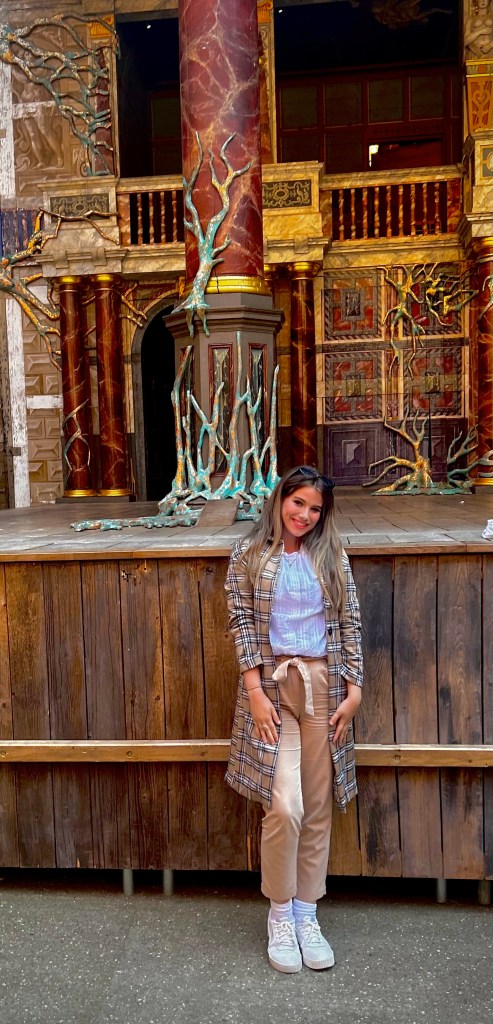
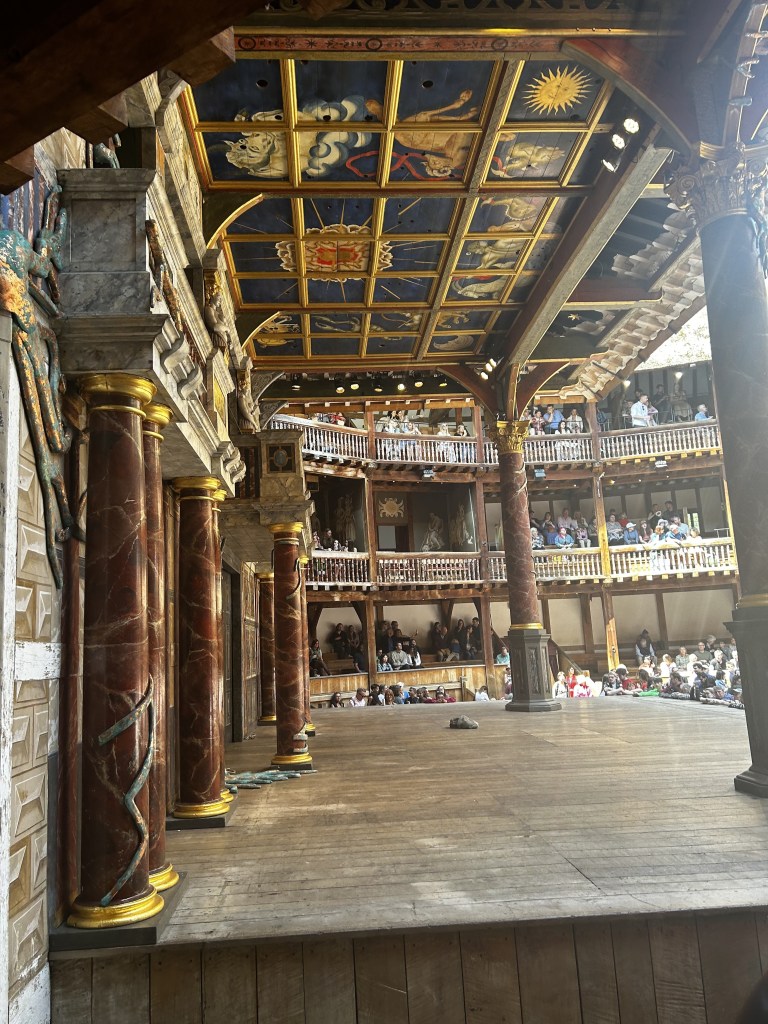
While I may not fit in with the modern world of art, I do however fit in with the historical art of appreciating Shakespeare. Two days prior to visiting the Tate Modern Museum, our group viewed the Shakespeare play, A Midsummer Night’s Dream in The Globe Theatre where William himself put on his famous plays. Walking into The Globe felt as if I were stepping inside of a time machine taking me back to the 1600s. A Midsummer Night’s Dream is about four young Athenians who run away to the forest only to have Puck the fairy make both the boys fall in love with the same girl. The four run throughout the forest pursuing each other while Puck assists his master by playing a trick on the fairy queen. In the end, Puck reverses his wrongs, and the two couples make peace and marry. By seeing A Midsummer Night’s Dream be performed rather than read, I was able to detect things in the script that I had not noticed before. I was able to see characters in ways that I didn’t really perceive as before. For example, I always perceived Puck as being comically mischievous. However, the actors and directors of this particular version really played into his mischievous side to a point that I actually found Puck to be quite creepy. I felt eerie everytime he made his way near our side of the stage. His movement felt so sly as he lurked around the stage.His costume was what also sold the creepiness. I could barely make out the face. The face was painted in camouflage and was covered in twigs and greenery that winded up to the top of his head. Twigs poked out everywhere from the top of his head. Not only was his costume creepy, but so was his high pitched voice and the way he simply delivered his lines. While I may not have enjoyed the modern museum, I really did enjoy the modern additions to this classic play. I loved the way the costumes were made to be more bright and vivid than that of the traditional wear that actors would have worn in Shakespeare’s time. I also enjoyed the modern twist of the music. Shakespeare would have had music in his performances with introductions of all the characters. He also traditionally included a jig at the end of his plays where all the characters dance together. I quite enjoyed the sound of the music. Trumpets and tubas were played loudly above the actors. I really enjoyed the jig especially because they added club background music to the trumpet sounds, making the play feel more up to date with its current audience. Speaking of the audience, my favorite part of the play was how the actors interacted with the crowd. The actors would sometimes make eye contact with the crowd. Once, the character Demetrius ordered an audience member to move out of his path as he angrily stormed off the stage. I really enjoyed how the actors did this, and it made me wonder how much or if at all this was done in Shakespeare’s time. There was one instance where one of the actors hyped the crowd up and we all started clapping and jumping as if we were in a mosh pit. Although I felt as if I might fall asleep in some parts of the first act due to the time it takes to warm up to the old Englisht, I felt more invested in the play because of how the characters included the audience. These past few days have shown me that bringing modern and traditional art together can either be a rollercoaster that only goes up or it can all go downhill. For me, Shakespeare was the rollercoaster and the Tate Modern Museum was… well it was a car with broken brakes. Despite this, both had positive aspects that I have chosen to appreciate. I don’t really understand a lot of the art in the Tate Modern Museum, but I choose to curate positivity from this rather than be the curator of my own misery.
 Theatre in London U of A