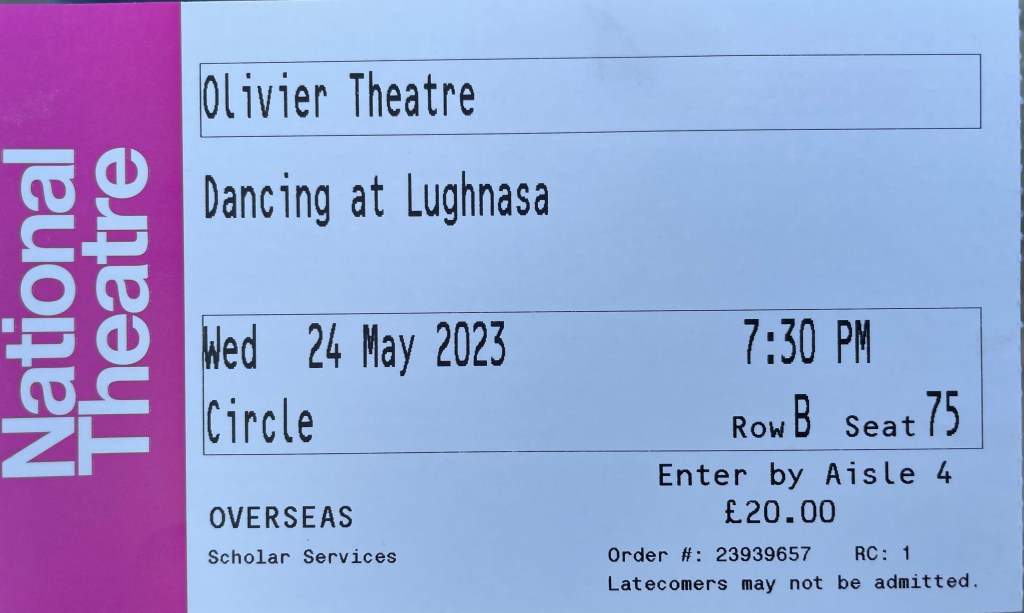
Dancing at Lughnasa is set in the summer of 1936. A memory play, an older Michael narrates the summer where his uncle, Father Jack, comes back to Balleybeg and his five sisters, Michael’s aunts and mother.
A lackluster set can be forgiven in favor of captivating actors bringing a wonderful script to light. However, while there was strong acting, my favorite part of the National Theatre’s production of Dancing at Lughnasa was the set. The Olivier Theatre presents theatre in the round. The circular stage is a wonderful treat, and the set designers used the shape to their advantage. A gorgeous grass road leads to the vocal stone-floored square where much of the play was performed. The central square created a simple kitchen where the story could unfold. Lights hung down from the celling and projected a beautiful sky on panels behind the stage.
Through no fault of the actors, I could not get invested in the play. There seems to be too much going on without any direction. Siobhan McSweeny delighted as Maggie, who is given a lot of the lighter moments throughout the play. I would have enjoyed if the play had an arc for Maggie, who in McSweeny’s performance was the most charming of the characters. Of the actual play, I most enjoyed the narration monologues. Tom Vaughan-Lawlor delivered his monologues clearly balancing a distance to what was being said and a twinge of nostalgia. The only note about the narration: early on lines were lost when Vaughan-Lawlor just continued on despite the audience’s laughter.
The first act seemed a long affair. I found myself greatly enjoying the actors on stage and wishing the script gave them something of substance to say. The most fun moment is when the sisters outrageously dance with Agnes, played by Louisa Harland, jumping up on the table. Despite both the title and Michael saying that he remembers his aunts dancing, this is truly little dancing and revelry outside of this moment. Meanwhile, the second act opens with great fanfare. The shorter of the two acts, there is more direction and coherency.
My critique lies in the script of Brian Friel. I can say with almost absolute certainty that I would love the actors in other productions, and I know I would love to see something else staged at the Olivier to see how that space could be utilized for other shows. The directing and staging were well done, and I once again must mention the enchanting set design.
Even though a play can be a peek into a life, something failed to click in Friel’s semi-biographical play. There are no discernable scenes in the play with each act dragging. There was no break during the acts with the moments getting loss in each other for the most part. When something interesting was said, it was lost in the quick sweeping to a new conversation that came out of nowhere. There is also the point of the slightly misleading beginning. There is very little actual tie in to Lughnasa aside from the opening monologue and the aforementioned dancing scene. If the play was more fully grounded in the festival, I think it would have more direction to it. It felt like if Friel had gone back and fleshed out the script it could be something really wonderful. I even felt if it was reconstructed into a one act play I would have really enjoyed the sentiment presented and would have followed it better.
All and all, I found Dancing at Lughnasa a play that could not be saved despite having the best of all other elements. Although, I did seem to be in the minority, riotous laughter echoed through the theatre throughout the play. So, while I have most gripes for the play itself and great play for the elements the National Theatre could control, audience reaction would suggest that it is a performance worth seeing.
 Theatre in London U of A