This might be a long post as this is much closer to my forte than acting…
On the day prior to our trip to Stratford, we had the chance to go to the Victoria and Albert Museum, also known as the V&A museum.
I took that as a personal opportunity to go to every museum in the vicinity. Those being, the V&A, the Natural History Museum, and the Science Museum. When the group plan was primarily to look at art and culture, I spent most of the day actually looking at dinosaurs and spaceships.
In my opinion, it was a day very very well spent.
That being said, the primary educational purpose of the trip was based on the small and out-of-the-way theatre section of the V&A.
In that section I found a few items of particular importance to the shows I saw:
Costumes from the Lion King, Sarabi and Scar, the puppet from Warhorse, and two-stage models for Sweeney Todd (one of which was a different set with buttons for lighting cues.)
These items bring to mind several shows that I saw on my trip to London, those being Lion King, Life of Pi, and The Woman in Black. While the first connection is obvious, the other two might be a bit odd for those uninformed. For the sake of brevity, I will restrict myself to discussing just the first.
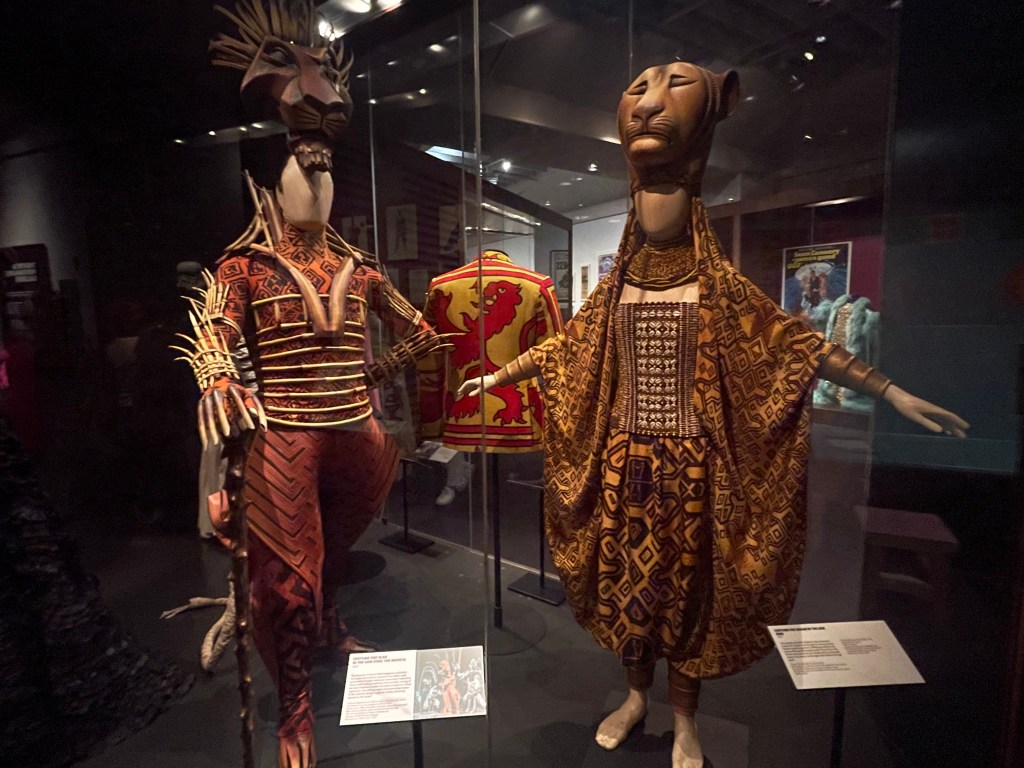
The Lion King pieces give me a chance to talk about what I consider one of the more important, but lesser discussed merits of the show. the cultural awareness and diversity. While it might be easy to just assume Lion King on stage could be as vague as the movie when it comes to culture, on the contrary, it is genuinely one of the most diversely influenced and informed shows I’ve seen thus far.
The costuming makeup, and even broader, the set, props design, lighting, and direction, take clear African inspiration and influence. It’s important to note that it does so from very specific tribes and African cultures, rather than just Africa as a whole. Furthermore, on the diversity of culture, it also has Asian, and British cultural nods, as well as the clear American touches, having come from an American blockbuster movie.
I would like to point out in particular, the design of Scar, as seen above. while the layman could potentially notice the Asian influence, one such as myself so obsessed with Japanese culture would gush at the design and recognize its roots immediately
As a whole, Scar is based upon the long-gone aristocratic samurai class, loyal to their lord, but renowned in their own right, his bone-constructed armor directly mimics some kinds of armor worn by samurai, while underscored with African patterns and color connotation. Furthermore, his mask takes the most influence from No Theatre masks, while also taking influence from broader African religious masks. If you got the chance to see it up close, one to see how the mask intentionally displays different emotions depending on the angle, much like masks in No theatre. To accentuate this, Scar’s mask is one of several in Lion king meant to articulate with a remote control hidden in the actor’s palm, allowing movement of the mask to look up and down as well as lurch forward over the actor’s face, or rest proudly back on top of the actors head. A personal favorite moment for me is scar uses this to lazily rest his (mask’s) chin upon his hands as they lean forward onto his cane, very similar to both actual lions laying about, or scar at his most sassy in the movie. It’s a particularly well-desingned piece of costuming that allows the actor to not only portray vivid emotion but heighten it to fantastically dramatic levels.
As for Sarabi, both the character and the costume are a bit simpler.
Her Shoowa-patterned garment allows billowing movement to show grace and yet strong, while also obscuring the actor’s human form in some way similar to most of the costumes in the show, allowing the suspension of disbelief and acceptance of the idea that this is a lioness. The Mask sits simply on her head very similar to the other lionesses, but hers stands slightly apart. While acting like a simple water urn balanced on their heads, hers, in particular, is shaped in a way to allow the impression of a crown or similar royal head dressing befitting the queen of pride rock. Another good detail is the expression on the mask. While the other lionesses have a separate mask/head-dress for after the death of Mufasa, complete with sorrowful look and ribbon tears flowing from the eyes, Sarabi has just one mask. it holds a calm and contemplative look, that portrays regality before Mufasa’s death, and a stoic acceptance when grieving. her tears even are able to be torn off dramatically at a later point as well, letting her return to her calm nature while yelling at Scar.
as for the War Horse puppet, it’s very interesting to see the progress made in puppets in theatre, with the titular horse almost designed in a scant and revealing way like lion king, and the contrasting recent Life of Pi taking an opposite approach of complete immersion while retaining the stylized design sensibility.
as for Sweeney Todd… I just personally love Sweeney Todd, and seeing horror theater (which was genuinely awe-inspiring as a horror fanatic) in The Woman in Black was a fantastic experience, only making me more set on seeing (and dreaming of eventually performing or producing) Sweeney Todd on stage myself.
 Theatre in London U of A