Making our way from the hotel and trekking a longer-than-average distance from London, the group found itself in front of the Kiln Theatre for Girl on an Altar. We arrived early, but time before the show was quickly whittled down by a search for quick food (that was, for me, not fruitful) and, among a smaller group of us, a discussion about what foods we were most eager to eat again once we are back in the States. I recall chips with salsa/queso coming up from Hailey, but I cannot remember any foods that I especially miss.
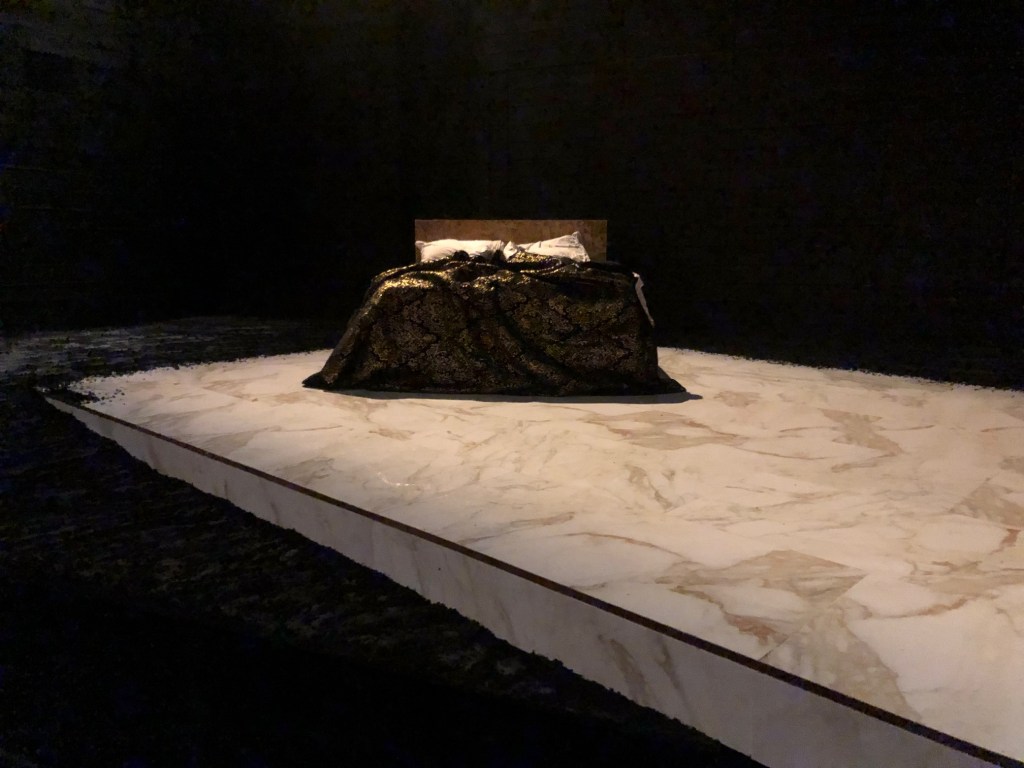
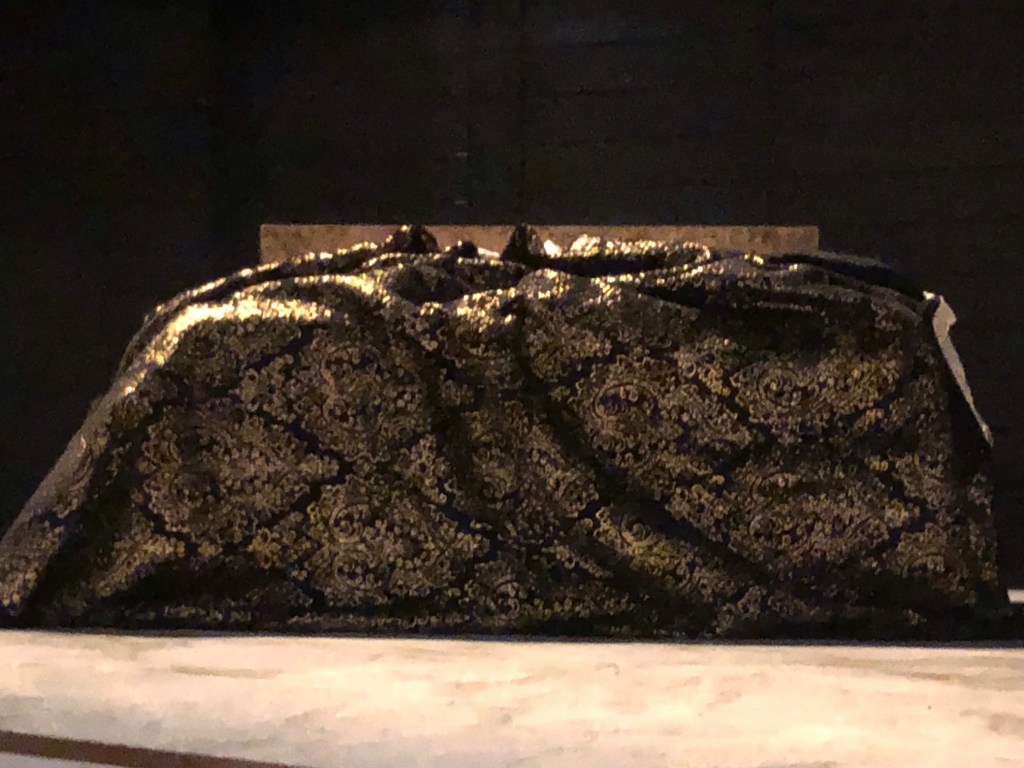
Moving on from culinary concerns, as the theater opened and we began to file in, I noticed two things. First, my ticket placed me in the second row from the stage, and I pondered how my experience would be altered by such close proximity to the actors. Second, I took in the parts of the set visible prior to the show commencing. There was a central area of the stage with a glossy, marble-like floor, on which sat a bed with an opulent duvet. Surrounding that were surfaces sloped and shape to resemble a more natural, weathered environment, covered in a material that resembled clumps of black dirt or gravel; after the end of the show, Margaret got up close to the stage and concluded that the material was a kind of soft foam, which admittedly is more sensible and comfortable than my initial guess of ground-up chunks of rubber. There were side doorways at downstage right and left, and the walls, which reached up fairly high, were composed of wooden boards painted black and laid horizontal. Later on in the show, a section of the upstage portion of that black wooden wall was pushed and pulled like a scaled up sliding door, revealing a large room with mirrored walls.

As far as the performance was concerned, all of the characters were strongly defined and each of them were relatable or understandable despite their flaws. I appreciated and was enthralled by the various points of view provided by the changes I perspective from character to character. It balanced out the prevalence of the characters, though Clyemnestra and Agamemnon definitely held the most sway, and it made the depiction of the play’s themes (loss, guilt, power, denial, etc.) more well-rounded since every character’s view was heard by the audience regardless of the character’s gender or social status.
There are several things that bothered me about the production, with most of them being either issues with the play itself (as opposed to any decision or execution of it by the actors) or annoyances that may better fit the description of nitpicks. In the second act, Clytemnestra and the audience learn that the old palace, where women who have fallen out of favor with various power figures, as well as bastard children, are relegated to, is a nightmarish place where most of the women have gone mad and the lack of food and water causes children ad women alike to perish. While I could be misremembering things, I recall Clytemnestra mentioning out of favor women an their listless, almost empty lives in the first act, and they were a far cry from what is shown in Act 2. With the concession that I am not intimately familiar with the Greek myth that this play adapts and thus this aspect may be true to the source material without my knowledge, I feel that the intense doom and gloom of the old palace in the second act was overly dramatic and interfered with my immersion; this feeling is reinforced by the fact that Antigone, a Greek tragedy that I am familiar with, demonstrates how important proper burial of the dead was in ancient Greek culture, regardless of the deceased person’s alliances or morality. Also, the old palace being such a wretched place effectively deletes all of the complexity of Agamemnon’s morality to the audience, since there is effectively no way to reconcile the possibility of him being a good or even pitiable figure with him starving numerous people for being unwilling or inconvenient to his political and personal life.
One tiny thing that hindered my suspension of disbelief was a tattoo along the left ribcage of the actor who portrayed Agamemnon. While this may be a nitpick, given the production’s modernized costumes and set dressing, Agamemnon would be shirtless and absolutely killing it in a scene, but then I would see “Human Error” printed on his side in typewriter font and my immersion would disappear for a little while. I understand that there is lots of sweat, skin-to-skin contact, and eventually having about a liter of liquid poured on you involved in this role, but I think the application of makeup to conceal that tattoo would make a world of difference.
My one outright complaint about this production, or perhaps more toward the Kiln Theatre itself, involves their terrible protocol for warning audiences. This play acts out situations of dubious sexual consent as well as general sexual content (characters embracing and kissing in a very charged manner, Clytemnestra not having any top covering as she changes from a towel to a nightgown, etc.). These subjects are sensitive and triggering to some people; a large enough percentage of people to warrant including a warning about that content. But no such warning was given! The worst part? Whoever was responsible for making the postings outside of the auditorium clearly knows that warnings are necessary for audience safety, given their posting from that night’s performance:

To include (admittedly valid) warnings about theatrical effects like haze and flashing lights, and not include warnings about common traumatic triggers present in the performance displays either a titanic lack of good judgement or a lack of respect or knowledge about emotional/mental responses.
The quality of theatre in this example of London’s fringe was certainly high, especially given the cost of admission. I only wish that the quality of the pre-show/front of house team’s awareness was on par with that of the production.
 Theatre in London U of A