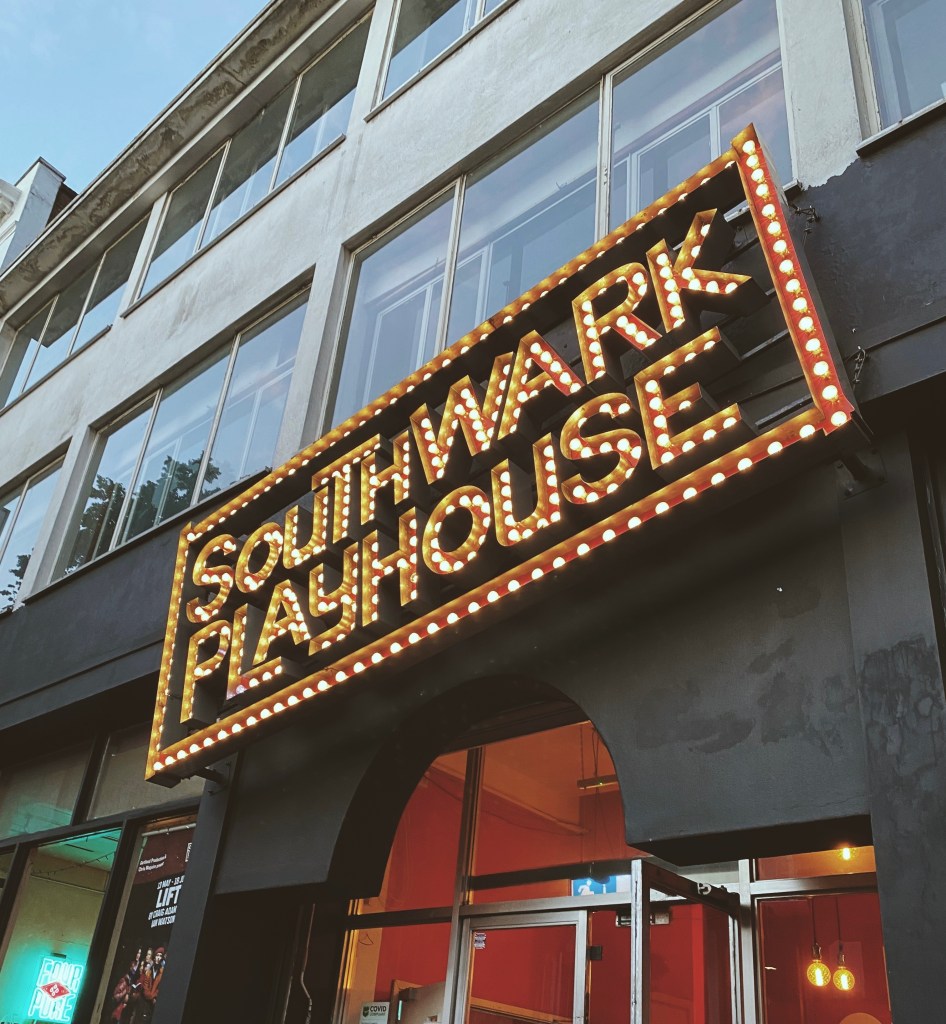
Fringe theatre is something that I have very little experience with, but seeing Lift made me curious about how other fringe shows make use of small spaces. The Southwark Playhouse had a very intimate, community-oriented atmosphere. Even the waiting area, situated in a kind of L-curve surrounding the bar, allowed for seating that encouraged conversation between strangers. It still surprises me, somehow, that theatre is as common as a source of entertainment in London as movie theatres are in America, and so much so that it can feel laidback and familiar in spaces like this. Something that I liked about Lift was the use of color. The set itself was little more than a few railings on an otherwise empty stage. However, each time the point of view between characters would shift, the lighting would switch from green to blue to yellow etc. I’m sure part of the simplicity of the set design is due to the necessity of working with a smaller budget. This use of color as a device was interesting because it would change the cast of light within the whole room and across faces in the audience.
However, without a concrete set it was difficult to distinguish between characters. The whole premise of Lift seems to be that the people we come in contact with every day are reflections of ourselves. In other words, the stranger next to you in the elevator contains multitudes of stories and thoughts just as human as your own. Consequently, many of the characters shared the same name (Sarah, Kate, Angel, Gabriel), and their stories all drifted together, which made it really difficult to figure out what was going on. For most of the show, for instance, I assumed that the Dominatrix character was who the busker was writing to, but apparently it was Kate the secretary? I think? I’m still not totally sure. One advantage of performing a show like Lift as a small, fringe production was that it allowed the vocal performances of the actors to shine. They would drift through the audience on their way to the stage, and it felt like they were gathering us together to take part in what was coming next. Around fifteen minutes before the show started, the character of the busker started playing guitar as if we were all just passersby on a street corner, and for a second, I almost thought we were. For me, this is what fringe theatre succeeds at: building a community from the audience. Even if Lift lacked clarity, it did manage to engage me as a viewer.

On the other hand, I felt that Girl on an Altar would have benefitted greatly from a larger budget/production. The play itself, a retelling of the myth of Clytemnestra, was largely told in monologues to the audience where the characters would recount events that happened off stage. The death of Clytemnestra’s daughter, for instance, happens entirely through the words of Clytemnestra. We watch as war, death, sacrifice, and the history of her life with her husband pass across her face. Yet, the stage itself contains little to involve the audience in this narrative. There is no altar in the distance as the battle rages, no army, and little representation of the prison that Clytemnestra is eventually cast into. Instead, the stage consists of a bed, a pile of ashes, and a dark room whose door opens from time to time during the play.
This isn’t to say that the space in Girl on an Altar wasn’t used in a clever way. To be able to tell a story as broad in scope as Agamemnon and Clytemnestra’s and with such a small cast was impressive in itself. However, despite my enjoyment of the ways in which the character’s monologues mimicked the oral storytelling devices of mythology, this style of narration did grow confusing after a while. I also would have preferred the literal and metaphorical distance that a bigger production would have provided. The scenes of abuse seemed even more real and raw in such a small auditorium, and I wasn’t exactly prepared for it. While I liked how fringe productions that we saw engaged with their audiences, I can understand how things like budget, the size of a cast, set design, and lighting can make or break the reality of a moment. With productions like Girl on an Altar, the actual material seems to work better on a bigger scale.
 Theatre in London U of A